Purpose. This working edition presents the current interactive Atlas in a downloadable format. It compares national tobacco and nicotine policy across product access, institutional alignment, coercion and scientific contestability. The classifications describe policy orientation rather than national virtue, and remain provisional pending continuing country-level verification.
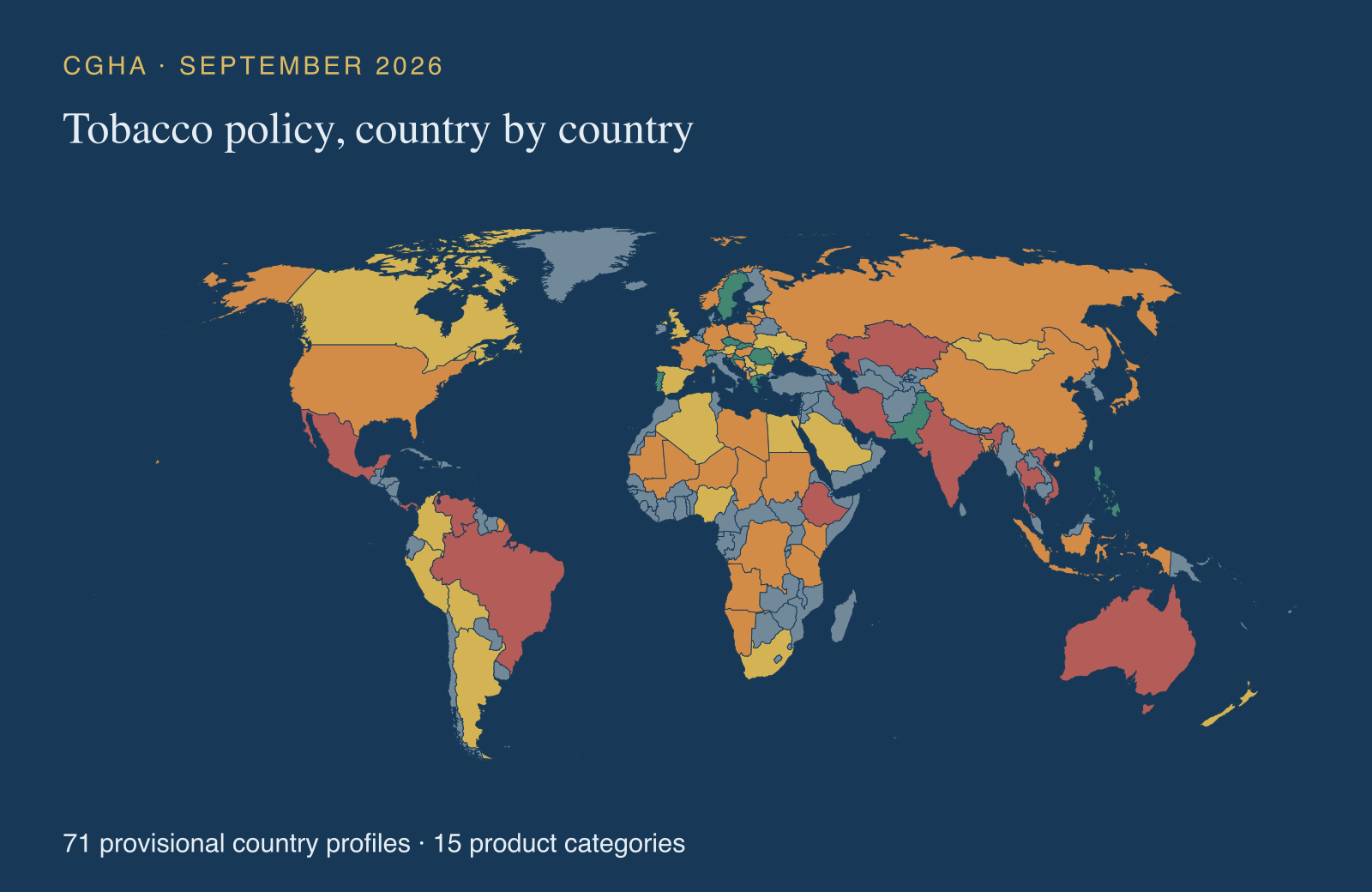
Current coverage. The Atlas contains 71 assessed country profiles: 10 green, 22 yellow, 27 orange and 12 red. Gray countries on the live map are deliberately unscored.
Evidence status. Legal status is separated from practical availability, and proposed measures are not treated as enacted law. Where a country-specific official source, exact survey year or harmonized prevalence definition has not yet been confirmed, the profile says so explicitly rather than presenting the entry as settled.
Contents
Executive summary
Classification framework
Product framework
Country classification table
Country profiles
Review points
Executive summary
The Atlas tests a simple question: where does tobacco policy respond to differences in product risk and observed outcomes, and where does it continue to treat all nicotine products as functionally equivalent? It does not assume that legal access alone produces better outcomes, nor that formal adherence to international orthodoxy proves policy success. Instead, it makes the underlying tradeoffs visible and allows readers to inspect the evidence behind each classification.
The strongest green cases combine broad adult access to non-combustible alternatives with comparatively open policy debate and lower reliance on prohibition. Yellow countries retain substantial access but introduce important compromises. Orange countries are restrictive, internally inconsistent or highly product-selective. Red countries rely heavily on prohibition, narrow legal channels or coercive enforcement. These categories are comparative judgments, not moral rankings.
The central analytical value is the common 15-product matrix. It distinguishes cigarettes, roll-your-own tobacco, cigars, waterpipe tobacco, herbal smoking products, snus, nicotine pouches, chewing tobacco and nasal snuff, several vaping formats, heated tobacco and medicinal nicotine. That prevents a country from being described as broadly supportive of harm reduction merely because one favored category remains legal.
Classification framework
| Color | Atlas label | Meaning |
|---|---|---|
| Green | Evidence responsive | Broad lower-risk access, comparatively proportionate controls and meaningful room for contestation. |
| Yellow | Favorable but compromised | Substantial lower-risk access, but with material restrictions, institutional tensions or coercive elements. |
| Orange | Restrictive or product selective | Important categories are blocked or policy treats similar-risk products inconsistently. |
| Red | Restrictive orthodoxy | Prohibition or near-prohibition dominates, with limited lower-risk access and low contestability. |
Four scored dimensions
Lower risk product access: Whether adults can lawfully obtain major non-combustible nicotine categories.
Institutional alignment: Whether domestic policy follows restrictive institutional orthodoxy or makes room for differentiated risk.
Policy coercion: The degree to which bans, criminalization, state monopoly or force substitute for regulated choice.
Scientific contestability: Whether competing interpretations and outcome evidence can enter policy debate.
The overall score is an equal-weight composite of the four dimensions. Scores are comparative indicators, not estimates of causal effect or population health benefit.
Product framework
| No | Group | Product category |
|---|---|---|
| 1 | Burned tobacco | Manufactured cigarettes |
| 2 | Burned tobacco | Roll-your-own tobacco |
| 3 | Burned tobacco | Cigars and cigarillos |
| 4 | Burned tobacco | Pipe and waterpipe tobacco |
| 5 | Burned products | Herbal smoking products |
| 6 | Oral / smokeless | Tobacco snus |
| 7 | Oral / smokeless | Nicotine pouches |
| 8 | Oral / smokeless | Chewing tobacco and nasal snuff |
| 9 | Vaping | Refillable / open-system nicotine vapes |
| 10 | Vaping | Closed nicotine pods |
| 11 | Vaping | Nicotine disposable vapes |
| 12 | Vaping | Nicotine e-liquids |
| 13 | Vaping | Nicotine-free vapes / liquids |
| 14 | Heated products | Heated tobacco products |
| 15 | Medicinal nicotine | Patches, gum, lozenges and sprays |
Country classification table
The table reports the published composite and four dimension scores. Readers should consult the country profiles for legal detail, outcome measures, caveats and sources.
| Country | Color | Overall | Access | Alignment | Coercion | Contestability |
|---|---|---|---|---|---|---|
| Albania | Orange | 56 | 50 | 50 | 50 | 75 |
| Algeria | Yellow | 63 | 75 | 50 | 75 | 50 |
| Angola | Orange | 44 | 50 | 50 | 50 | 25 |
| Argentina | Yellow | 63 | 75 | 50 | 50 | 75 |
| Australia | Red | 25 | 25 | 25 | 0 | 50 |
| Austria | Yellow | 63 | 75 | 50 | 50 | 75 |
| Bangladesh | Orange | 38 | 50 | 25 | 25 | 50 |
| Bolivia | Yellow | 63 | 75 | 50 | 50 | 75 |
| Bosnia and Herzegovina | Orange | 56 | 75 | 25 | 75 | 50 |
| Brazil | Red | 19 | 0 | 0 | 25 | 50 |
| Bulgaria | Yellow | 63 | 75 | 50 | 50 | 75 |
| Canada | Yellow | 63 | 75 | 50 | 50 | 75 |
| Chad | Orange | 44 | 50 | 50 | 50 | 25 |
| China | Orange | 44 | 50 | 50 | 50 | 25 |
| Colombia | Yellow | 63 | 75 | 50 | 50 | 75 |
| Croatia | Green | 69 | 75 | 50 | 75 | 75 |
| Czechia | Green | 69 | 75 | 75 | 50 | 75 |
| Democratic Republic of the Congo | Orange | 44 | 50 | 50 | 50 | 25 |
| Egypt | Yellow | 63 | 75 | 50 | 75 | 50 |
| Estonia | Yellow | 63 | 75 | 50 | 50 | 75 |
| Ethiopia | Red | 31 | 25 | 25 | 25 | 50 |
| France | Orange | 44 | 50 | 25 | 25 | 75 |
| Germany | Orange | 50 | 50 | 50 | 50 | 50 |
| Greece | Green | 69 | 75 | 50 | 75 | 75 |
| Hungary | Orange | 56 | 75 | 50 | 25 | 75 |
| India | Red | 19 | 25 | 25 | 0 | 25 |
| Indonesia | Orange | 50 | 75 | 50 | 50 | 25 |
| Iran | Red | 31 | 25 | 25 | 25 | 50 |
| Japan | Orange | 56 | 50 | 50 | 50 | 75 |
| Kazakhstan | Red | 31 | 25 | 25 | 25 | 50 |
| Kenya | Orange | 56 | 75 | 50 | 50 | 50 |
| Latvia | Orange | 56 | 75 | 50 | 25 | 75 |
| Libya | Orange | 44 | 50 | 50 | 50 | 25 |
| Lithuania | Orange | 56 | 75 | 50 | 25 | 75 |
| Mali | Orange | 44 | 50 | 50 | 50 | 25 |
| Mauritania | Orange | 44 | 50 | 50 | 50 | 25 |
| Mexico | Red | 13 | 25 | 0 | 0 | 25 |
| Moldova | Yellow | 63 | 75 | 50 | 50 | 75 |
| Mongolia | Yellow | 63 | 75 | 50 | 75 | 50 |
| Montenegro | Yellow | 63 | 75 | 50 | 75 | 50 |
| Namibia | Orange | 50 | 50 | 50 | 50 | 50 |
| New Zealand | Yellow | 63 | 75 | 50 | 50 | 75 |
| Niger | Orange | 44 | 50 | 50 | 50 | 25 |
| Nigeria | Yellow | 63 | 100 | 25 | 75 | 50 |
| North Macedonia | Yellow | 63 | 75 | 50 | 75 | 50 |
| Norway | Orange | 56 | 50 | 50 | 50 | 75 |
| Pakistan | Green | 69 | 100 | 50 | 75 | 50 |
| Panama | Red | 25 | 25 | 25 | 25 | 25 |
| Peru | Yellow | 63 | 75 | 50 | 50 | 75 |
| Philippines | Green | 69 | 100 | 50 | 50 | 75 |
| Poland | Orange | 56 | 75 | 50 | 25 | 75 |
| Portugal | Green | 69 | 75 | 50 | 75 | 75 |
| Romania | Green | 69 | 75 | 50 | 75 | 75 |
| Russia | Orange | 44 | 50 | 50 | 25 | 50 |
| Saudi Arabia | Yellow | 63 | 75 | 50 | 50 | 75 |
| Serbia | Yellow | 63 | 75 | 50 | 75 | 50 |
| Singapore | Red | 25 | 25 | 25 | 25 | 25 |
| Slovakia | Green | 69 | 75 | 50 | 75 | 75 |
| Slovenia | Orange | 56 | 75 | 50 | 25 | 75 |
| South Africa | Yellow | 63 | 75 | 50 | 50 | 75 |
| Spain | Yellow | 63 | 75 | 50 | 50 | 75 |
| Sudan | Orange | 56 | 75 | 50 | 75 | 25 |
| Sweden | Green | 69 | 100 | 50 | 50 | 75 |
| Switzerland | Green | 69 | 100 | 50 | 50 | 75 |
| Tanzania | Orange | 44 | 50 | 50 | 50 | 25 |
| Thailand | Red | 25 | 25 | 25 | 25 | 25 |
| Ukraine | Yellow | 63 | 75 | 50 | 50 | 75 |
| United Kingdom | Yellow | 63 | 75 | 50 | 50 | 75 |
| United States | Orange | 56 | 75 | 25 | 50 | 75 |
| Venezuela | Red | 25 | 25 | 25 | 25 | 25 |
| Vietnam | Red | 25 | 25 | 25 | 25 | 25 |
Country profiles
Review points
This draft is ready for substantive review. The most useful review questions are whether the country classifications are directionally fair, whether any material product category has been mischaracterized, whether outcome measures need greater harmonization, and whether the four dimensions capture the policy differences that matter most.
The Atlas should remain explicit about uncertainty. Legal availability is not the same as effective access; illicit availability is not legal access; enacted rules should be distinguished from proposals; and smoking measures should not be compared without attention to age ranges, daily versus current use, survey years and modeled versus observed estimates.
Interactive version: https://cgha-tobacco-alignment-atlas.rogernbate.chatgpt.site