
Executive summary
Online sportsbooks do not treat all customers alike. A casual bettor may see standardized promotions and generic reminders. A high-value customer may receive a named host, tailored deposit offers, bonus bets, event tickets, travel, merchandise, faster service and messages calibrated to the customer's recent activity. DraftKings calls its public loyalty structure Dynasty Rewards and advertises dedicated hosts, exclusive events, personalized offers and status matching. FanDuel, BetMGM and Caesars operate comparable reward or VIP systems, although the details and degree of personal contact vary.
There is nothing intrinsically improper about rewarding loyal customers. Airlines, hotels and credit-card companies do it, and a competent adult who wagers heavily is not necessarily addicted or vulnerable. A blanket prohibition would be both paternalistic and evasive. It would also encourage operators to relabel the same practices as premium support, account management or relationship marketing. The proper question is narrower: when does service become cultivation, and when does cultivation exploit evidence that the customer is losing control?
The conflict is structural. VIP hosts are commercially valuable because they know customers, respond quickly and can bring inactive bettors back. Those same functions give hosts unusually good information about escalating deposits, frantic messages, attempts to borrow, repeated reversals of limits and gambling that appears disconnected from entertainment. If host success is measured by deposits, wagering, retention, net gaming revenue or reactivation, responsible-gambling duties will predictably lose some close calls. Training alone cannot cure an incentive conflict.
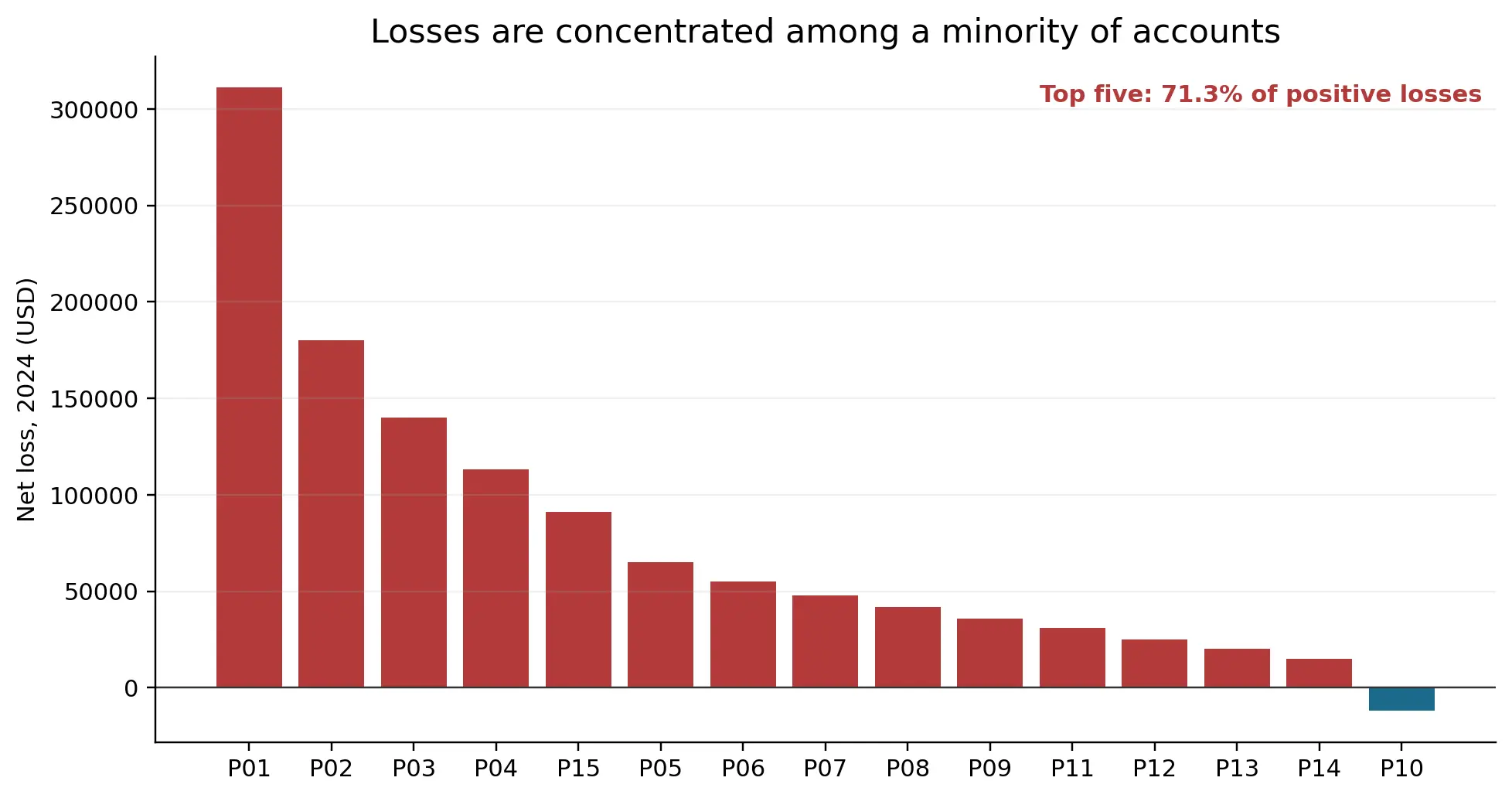
The empirical foundation is the 15-account panel assembled during research for The House Always Wins. It covers 5,490 sportsbook account-days in 2024 and supplies the fitted loss-chasing model. Across the accounts, handle was $74.50 million and net loss was $1.16 million, while the five largest losing accounts generated 71.3 percent of positive losses. A separate August 2026 field study then followed 1,654 timestamped bets in real time. That updated research recorded $569,763 in handle and a net loss of $35,297.85. More bets won than lost, but 45 bets in three short chasing episodes produced $15,444.74 of loss—43.8 percent of the month's total.
The historical model reveals a critical distinction. A same-day logistic model detects an active chase with McFadden pseudo-R² of 0.724 and participant-held-out ROC AUC of 0.986. At the selected threshold it identifies 80.7 percent of chase days with 97.6 percent specificity. Yet a model using today's behavior to predict tomorrow's big-loss window has pseudo-R² of only 0.012 and held-out AUC of 0.571. Escalation can therefore be recognized while it unfolds, but broad advance restrictions based on a customer's identity or VIP status are not supported.
The August 2026 study is best understood as an update and field application, not another component of the historical estimation sample. It shows both continuity and change. In 2022 and 2023, heavy losses were often followed by larger match offers intended to accelerate redepositing. By August 2026, host contact was more muted and automated messages sometimes suggested cooling off, pausing or checking losses. That is a genuine but slow protective shift. It is probably not enough. Deposits were still accepted immediately, no binding affordability or source-of-funds review followed the three chase episodes, and requested 20 percent loss protection returned up to $1,000 as bonus bets requiring further play. Operator practice is evolving, but largely from active encouragement toward advisory friction rather than an effective interruption.
Public allegations must be treated as allegations, not findings. Lawsuits against DraftKings and FanDuel describe customers who say hosts continued to offer credits, gifts or encouragement despite severe losses and expressions of distress. Operators contest the implication that VIP programs are designed to create addiction and emphasize training, monitoring and self-exclusion tools. Litigation selects extreme cases and does not reveal how most VIP relationships work. But the cases identify questions regulators should already be able to answer with data.
Kalshi complicates the comparison. It is a federally regulated event-contract exchange: customers generally trade against other members rather than against the platform. It does not presently advertise a sportsbook-style VIP host program. It does, however, offer volume and liquidity incentives, reduced fees for some market makers, referral benefits and rewards tied to trading activity. These can increase participation just as sportsbook rewards can increase betting. Yet transparent, market-wide formulas that reward liquidity are economically different from an individual host privately encouraging a losing customer to deposit again. Regulation should preserve that distinction while applying comparable safeguards where the underlying behavioral risk is comparable.
The United Kingdom provides a useful natural experiment. After the Gambling Commission tightened high-value-customer rules in 2020, membership reportedly fell by as much as 90 percent. A 2025 review found fewer cases in which inappropriate incentivization was a potential factor, no widespread consumer concern, and HVC schemes accounting for about 3 percent of gross gambling yield among the responding operators. The reforms did not abolish VIP service. They imposed senior accountability, financial and harm checks, regular review and separation of commercial incentives from safer-gambling decisions.
CGHA recommends a proportionate American model: disclose qualification rules and material benefits; prohibit host pay tied directly to customer losses or deposits; separate responsible-gambling authority from commercial teams; require documented review before entry and after defined risk triggers; and introduce a graduated, temporary brake when stake escalation, short-window losses, rapid redeposit and increased betting velocity converge. Promotional contact and loss-protection bonus bets should stop at the first escalation state. Deposits should pause for an hour during active chasing and for 24 hours after a repeated episode, while withdrawals remain available. Regulators should require audit trails and anonymized outcome data so these thresholds can be tested and refined rather than converted into a permanent ratchet.
1. The product is the relationship
A points program is easy to see. A customer wagers, receives credits according to a stated formula and redeems them for a benefit. The more consequential part of a VIP program is often invisible: segmentation. Operators score customers by expected value, frequency, product mix, responsiveness to promotions and likelihood of returning. The customer may experience this as exceptional service. The operator experiences it as customer-lifetime-value management.
The distinction matters because online betting removes the natural friction of a casino visit. A host no longer waits on a gaming floor. The host can text during a losing streak, offer a short-lived deposit match, arrange a credit after a disputed bet, or re-engage a customer who has stopped playing. The interaction arrives on the same device used to wager and can be acted upon immediately. Personal attention, urgency and financial inducement converge at the moment of decision.
That does not make every contact predatory. A high-volume bettor may value rapid withdrawals, accurate settlement, higher limits and a human who can resolve errors. Sophisticated customers can have legitimate reasons to use several books and may move in response to price, limits or service. Some VIP benefits reduce transaction costs rather than encourage excess. The analytical mistake is to treat all benefits as equivalent. Priority support is not the same as a time-limited deposit match after a large loss; an invitation to a sporting event is not the same as repeated reactivation messages after a request for distance.
The comparison with other loyalty programs is instructive. Airlines reward frequent travelers with upgrades, lounge access and a dedicated service line. Hotels provide free nights and late checkout. Credit-card issuers offer points, status, concierge help and increasingly valuable benefits to customers who spend more. These programs are designed to deepen loyalty and increase use, yet they are not ordinarily described as exploitative. Gambling should not be declared categorically different merely because money is at stake: financial products, credit cards and travel also create risks and encourage spending. The relevant differences must be demonstrated. A gambling operator may profit directly from a customer's losses, possess unusually detailed behavioral evidence of impaired control and deliver an inducement at the moment the customer is chasing those losses. Regulation should examine those features and the resulting conduct, rather than treating personalization, status or rewards themselves as proof of abuse.
2. DraftKings as the central case
DraftKings is the appropriate main case because it combines scale, a mature digital product, a visible loyalty architecture and an explicitly promoted VIP experience. Dynasty Rewards allows customers to earn tier credits and Crowns, move through status levels and receive tier-specific benefits. DraftKings advertises exclusive promotions, rewards for reaching new tiers, monthly earning boosts, elite gifts and experiences, status matching and, for qualified customers, a dedicated host. One DraftKings page aimed at Madison Square Garden customers lists exclusive events, a dedicated host, custom referral incentives and top-tier support.
The annual rewards can be substantial. At DraftKings, points or tier status accumulated during the year can lead to a selection of hotel stays and trips, expensive cameras and computers, spa weekends, grills and other merchandise or experiences. These are genuine prizes with real value to committed users, not simply small credits recycled into another wager. Other operators appear to use comparable tiered catalogues and hospitality benefits, but their precise earning rules and annual selections should be documented rather than assumed to be identical to DraftKings.
The public pages establish the architecture but not the operating rules that matter most. They do not provide a complete answer to how a host's portfolio is selected, how profitability and loss are weighted, whether hosts can see responsible-gambling flags, how bonuses are approved, what prompts reactivation, or how compensation is calculated. Nor do public pages reveal whether a customer's apparent wealth is verified or merely inferred from deposits and wagering.
DraftKings promotions illustrate the pressure created by time and play-through conditions. A VIP offer may require a minimum deposit, expire within days and award nonwithdrawable bonus bets whose stake is not returned with winnings. Such terms are disclosed, and many customers understand them. Still, the economic presentation can make a benefit look closer to cash than it is. A $2,500 bonus-bet award is not $2,500 available for withdrawal. Its expected value depends on the odds, the customer's choices and the stake-removed structure.
The more important issue is personalization. A standardized offer can be evaluated and regulated at scale. A host conversation is contextual and adaptive. The host learns which inducement works, which sporting event matters, whether the customer is angry, and how quickly the customer can be brought back. The same intimacy can support safer play if the host is empowered to intervene. It can magnify harm if commercial expectations dominate.
Methods and limitations
The study uses two chronologically distinct datasets. The first is the 15-account panel assembled for The House Always Wins, containing 5,490 account-days in 2024, 725 daily balance-drop windows and participant-level totals. All panel and loss-chasing models are estimated from those observations. The second is updated field research from August 2026 comprising 1,654 timestamped bets checked against transaction histories, screenshots, messages and offer terms. It is analyzed separately to assess recurrence of the historical pattern and contemporary VIP-host responses. The August observations are not pooled into the 2024 estimation sample. Bet classifications and episode boundaries were reconstructed from retained records using the definitions reported in the accompanying workbook.
The participating gamblers were experienced and had reasonable, above-average knowledge of sport and betting products. They made genuine efforts to win, consulting weather forecasts, injury reports, recent form and other available information. The experiment concerned VIP treatment and operator responses to loss-chasing in real time; it was not designed to manufacture losses through intentionally poor selections.
The evidence can show that particular safeguards and inducements operated in the documented circumstances; it cannot estimate how frequently the same pattern occurs across DraftKings customers or the wider industry. The participants were purposively selected, the operators were not randomized, and researchers could not observe internal risk scores, host instructions, compensation arrangements or the reasons for particular decisions. Historical recollections provide useful context but carry greater uncertainty than contemporaneous records. Findings about motive or revenue concentration are therefore identified as inference and should be tested against anonymized operator data.
How the accompanying dataset supports the paper
The accompanying workbook, House_Always_Wins_Real_Data_Chasing_Model.xlsx, is the quantitative appendix. Daily Panel and Loss Windows contain the supplied observations; Model Performance reports fitted coefficients and participant-held-out tests; Panel Scoring applies the fitted model to each account-day; Cross-Account Models reports ordinary R²; Bet-Level Chasing analyzes the 1,654-bet sequence; and Intervention Analysis makes its causal assumptions explicit.
| Workbook location | What it contains | Claims supported in this paper |
|---|---|---|
| Summary | Bet count, handle, winnings, net loss, stake range and margin sensitivity | Headline monthly totals and pricing counterfactuals |
| Analysis | Sport, product, jurisdiction, timing, outcomes and chasing concentration | Figures 1-10 and the 43.76% loss-concentration result |
| Bet-Level Field Data | Timestamped reconstructed wagers, stakes, results, deposits, messages and episode flags | Sequence, velocity, stake escalation and episode boundaries |
| Validation | Exact reconciliation tests against documented totals | Internal consistency and reproducibility |
| Assumptions | Definitions and evidentiary status | Limits on inference and distinction from a direct operator export |
August 2026 update: operator practice is changing, but not enough
In August 2026, researchers and participating gamblers conducted a pre-agreed, real-time field study of VIP treatment and responses to chasing losses. The experienced participants wagered with real money, made genuine efforts to win and checked such information as weather, injuries and recent form. Across 1,654 validated bets, the account won 930 and lost 724, yet finished down $35,297.85. The purpose was not to manufacture losses, but to observe whether the behavioral pattern identified in the earlier 15-account panel would recur and what the operator would do when it became visible.
There appears to have been a change since 2022. In the earlier period, heavy activity could elicit larger offers paid in DK Dollars, a more flexible form of promotional credit. In summer 2026, automated account messages - not personal interventions from the VIP host - suggested cooling off, pausing or reviewing recent losses. The increased frequency of such messages is evidence of more visible monitoring and adds some friction, even though it does not establish that a meaningful safety assessment occurred.
The VIP host's response nevertheless included an inducement. When requested, the customer was offered loss protection instead of a conventional match or play-to-earn promotion: deposit $5,000 and receive bonus bets equal to 20 percent of losses, up to $1,000. If the entire $5,000 were lost, the customer received $1,000 in bonus bets released over the following three days. This was not a $1,000 cash refund. The bonus bets had to be wagered again, could not simply be withdrawn, and ordinarily returned only any winnings rather than the promotional stake itself. Across the documented research episodes, occasional bonus bets won, but the proceeds were subsequently wagered again and, over time, the entire amount was lost. The design therefore prolonged engagement rather than restoring 20 percent of the loss as spendable cash. An automated message to pause and a host-provided reward requiring renewed play pointed in opposite directions.
The account accepted redeposits immediately. There was no source-of-funds verification, affordability inquiry, imposed deposit limit, individualized account review or mandatory interruption. Questions and generic safeguards may have appeared at other times, but none was triggered as a binding response to these episodes. The intervention was therefore a nudge rather than a constraint: it relied on a customer already chasing losses to choose restraint while the funding channel remained fully open.
The commercial response also changed as the losses accumulated. After a loss of about $6,000 followed by another roughly equivalent amount of play, the host did not offer another match. One plausible interpretation is that an additional inducement was no longer necessary: a customer who had already lost tens of thousands and continued to redeposit had demonstrated a willingness to keep playing without one. That cannot be established as the host's actual reasoning without internal messages, bonus-approval records and compensation data. But it illustrates why the absence of a fresh promotion is not necessarily evidence of effective protection. The operator may reduce inducements while leaving the customer's loss-chasing behavior entirely uninterrupted.
On some occasions, rapid chasing temporarily recovered losses, and betting then continued for days or even a week. The recovery did not last. That short-run success is crucial because it makes chasing feel rational and reinforces the belief that one more round can repair the damage. With repeated play, variance occasionally favors the customer, while the sportsbook's positive expected margin continues to operate. The house does not win every bet or every session; it wins in expectation as betting continues. A temporary recovery can therefore be more dangerous than an immediate further loss because it rewards the chasing behavior that ultimately exposes the customer to more house edge.
Documented chronology
| Event | Amount and timing | Operator response | What did not occur |
|---|---|---|---|
| Month-long field sequence | $569,763 handle; $534,465.15 winnings; $35,297.85 betting loss | Account remained active and fundable | No intervention proportionate to the cumulative loss |
| Three rapid-chasing episodes | Roughly $5,000 lost in each; redeposits and chasing within about 12 hours | Automated cooling-off or pause messages | No binding break, deposit limit or individualized safety review |
| Loss-protection offer | 20% of losses after a $5,000 deposit; up to $1,000 in bonus bets over about three days | Host supplied a continued-play incentive when requested | No cash refund; bonus bets required further wagering |
| Further heavy play | About $6,000 lost, followed by another roughly similar amount played | No additional match was offered; deposits were still accepted immediately | No source-of-funds check, affordability inquiry, account restriction or enforced pause |
Source: contemporaneous transaction records, messages, offer terms and screenshots retained by CGHA. The table reports documented events, not an estimate of industry prevalence.
A loss-chasing model: the dangerous change in stake, not merely the loss
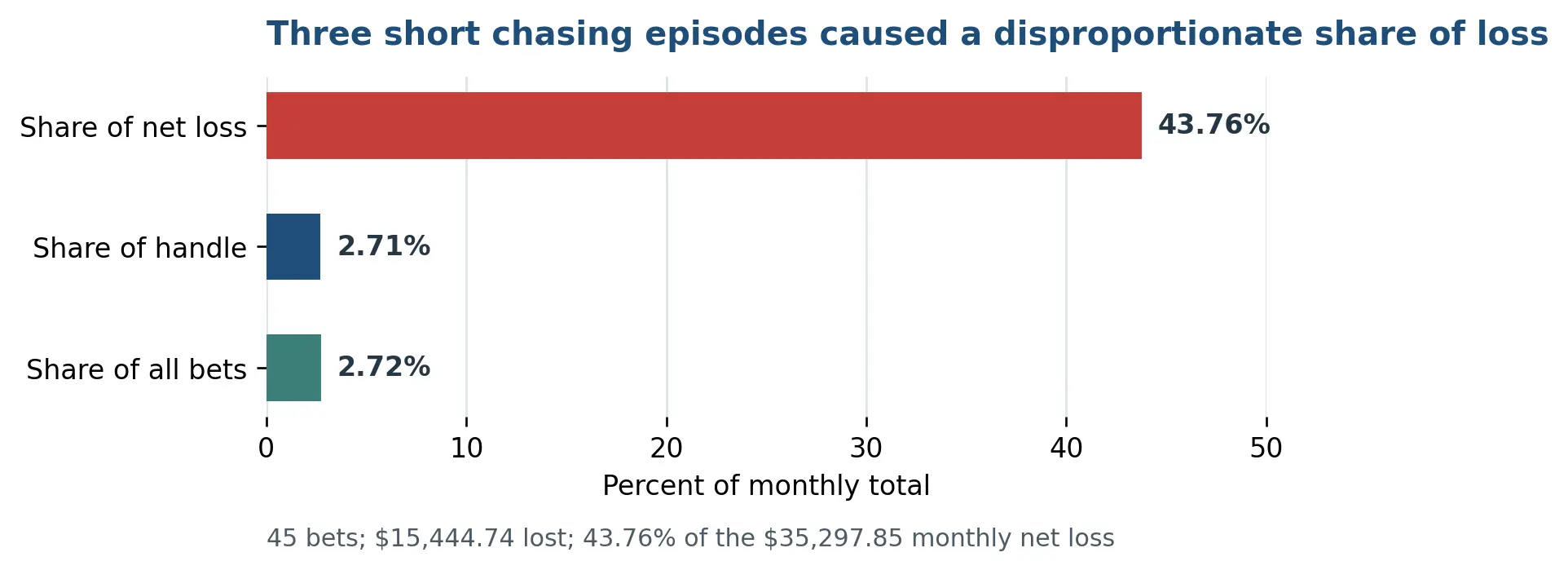
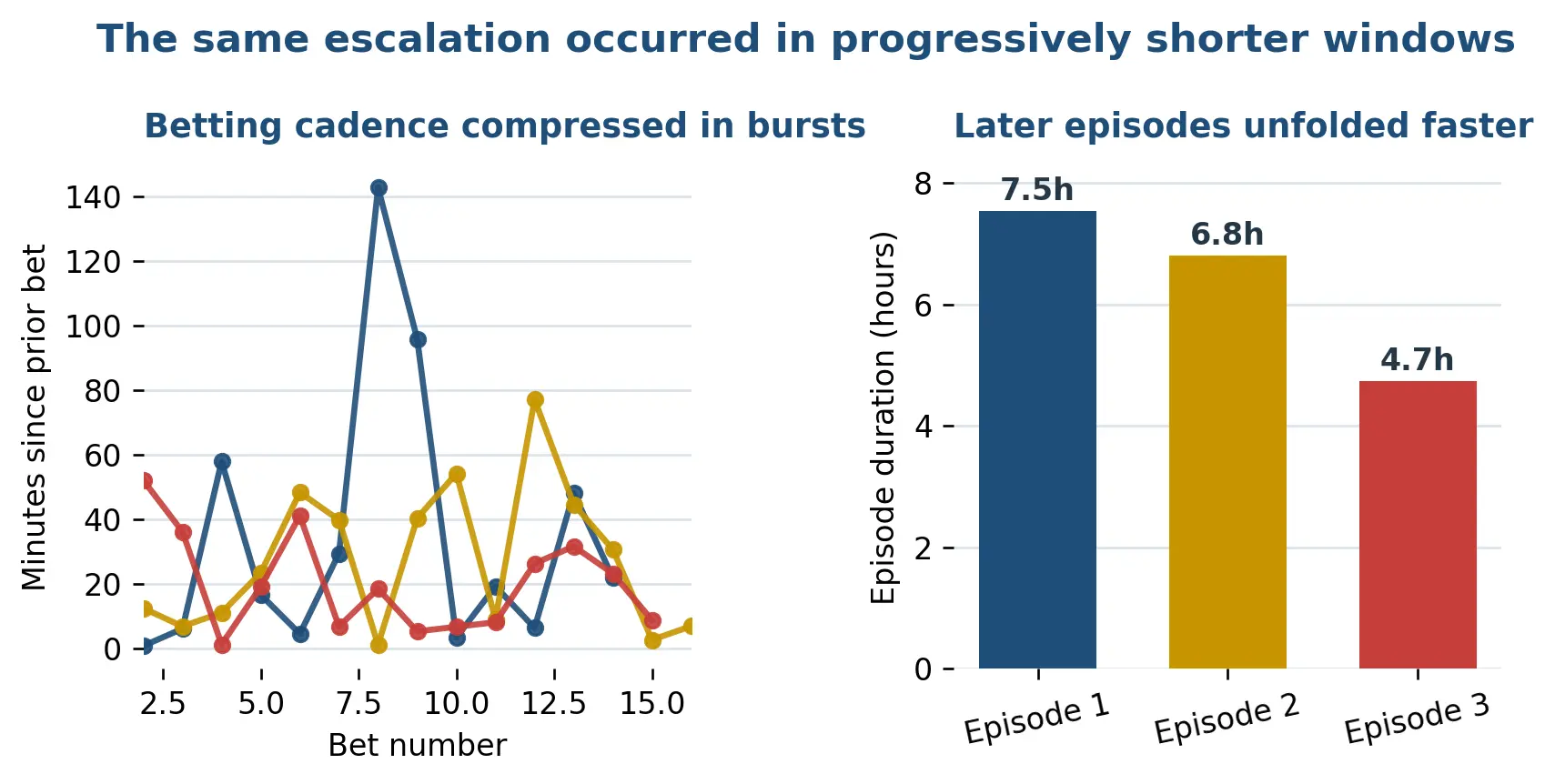
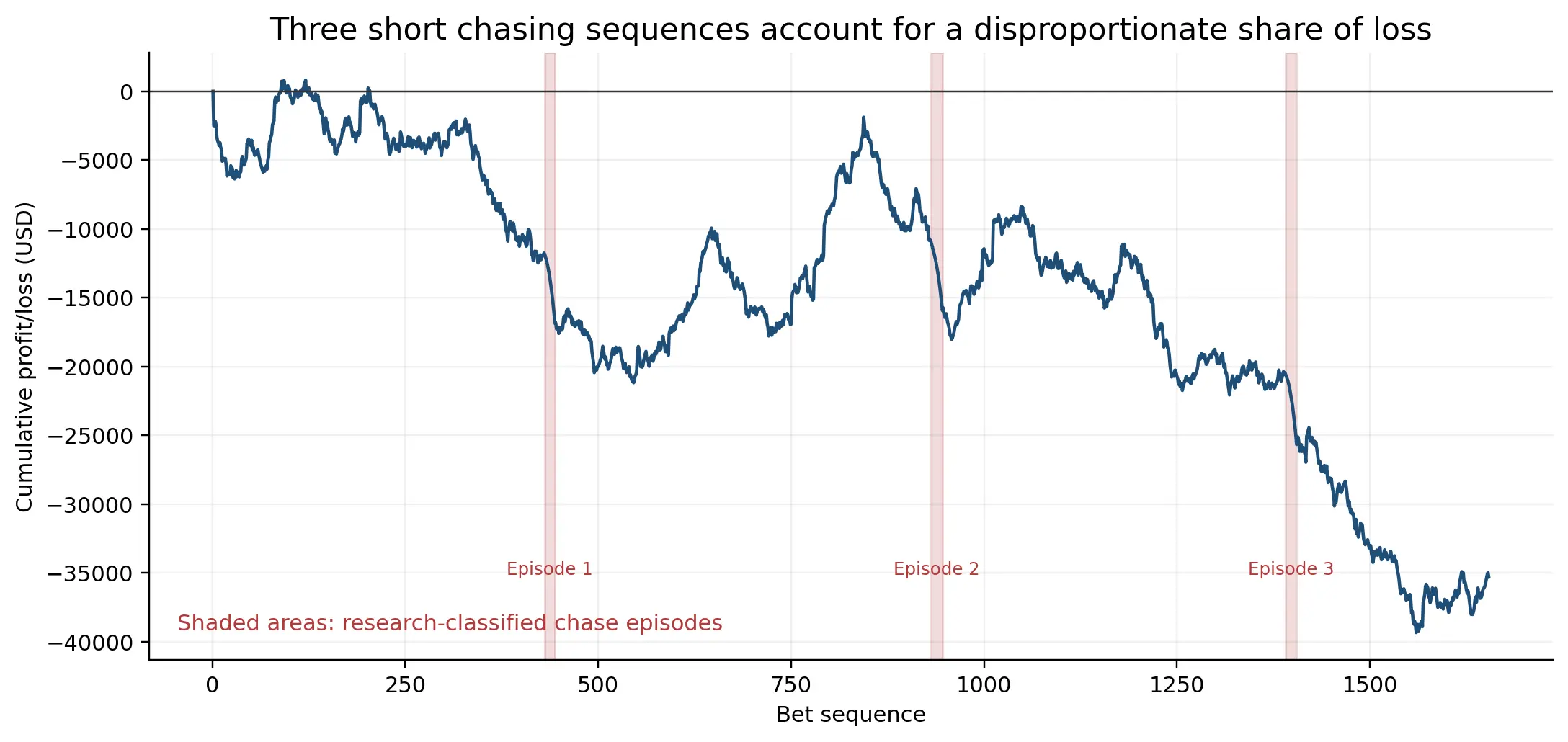
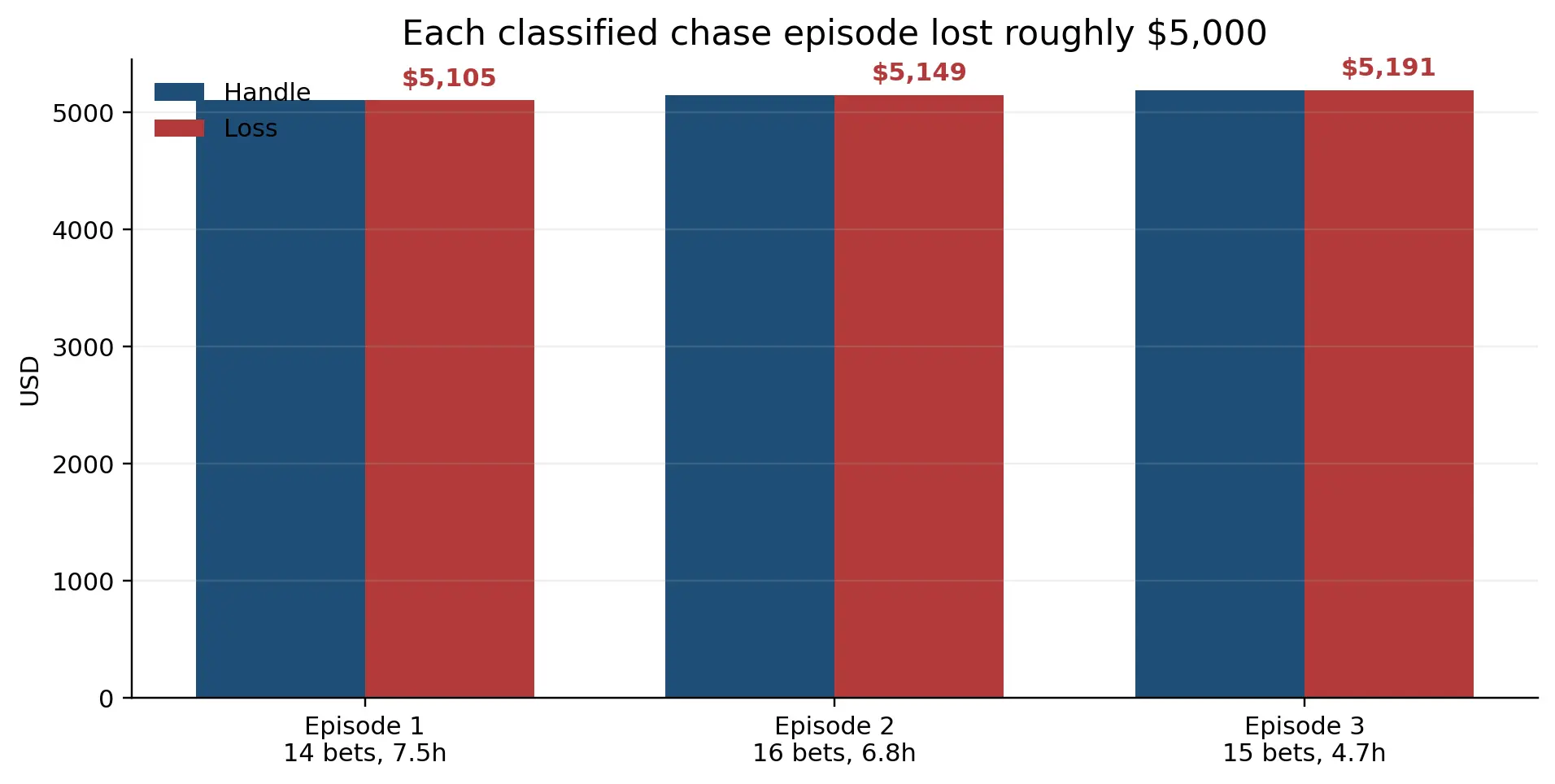
The three documented episodes isolate the mechanism. Together they contained 45 bets and $15,444.74 in stakes. Every bet in the reconstructed episode windows lost, so the same amount was lost. These bets constituted only 2.72 percent of all bets and 2.71 percent of monthly handle, yet they accounted for 43.76 percent of the $35,297.85 net loss. Their average duration was 6.4 hours. The remaining 1,609 bets collectively produced the other $19,853.11 of net loss. A few short periods therefore transformed a bad month into a severe one.
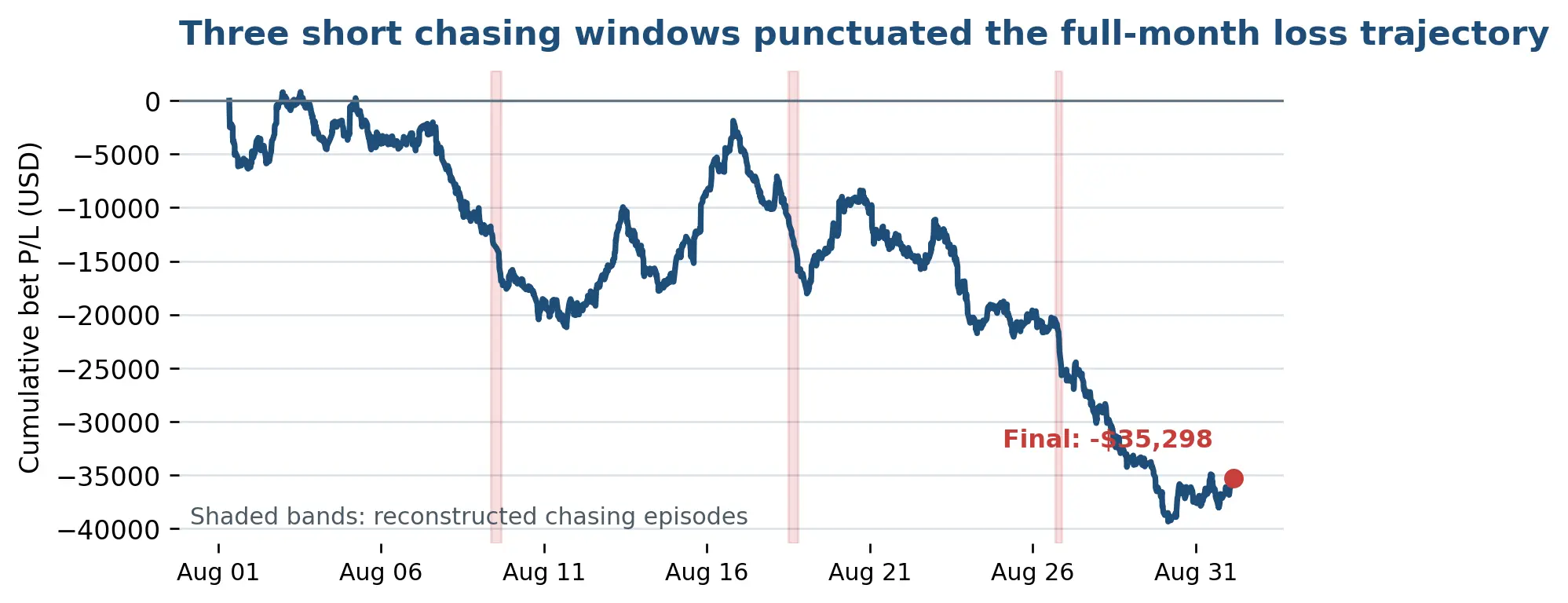
The concentration result is visible in the full sequence. Figure 2 assigns each bet's eventual result to the time the bet was placed and plots cumulative profit or loss across the documented month. The shaded chase windows are short relative to the full series but coincide with unusually steep deterioration. The line also shows temporary recoveries, reinforcing why a customer may believe that continued betting can repair prior losses.
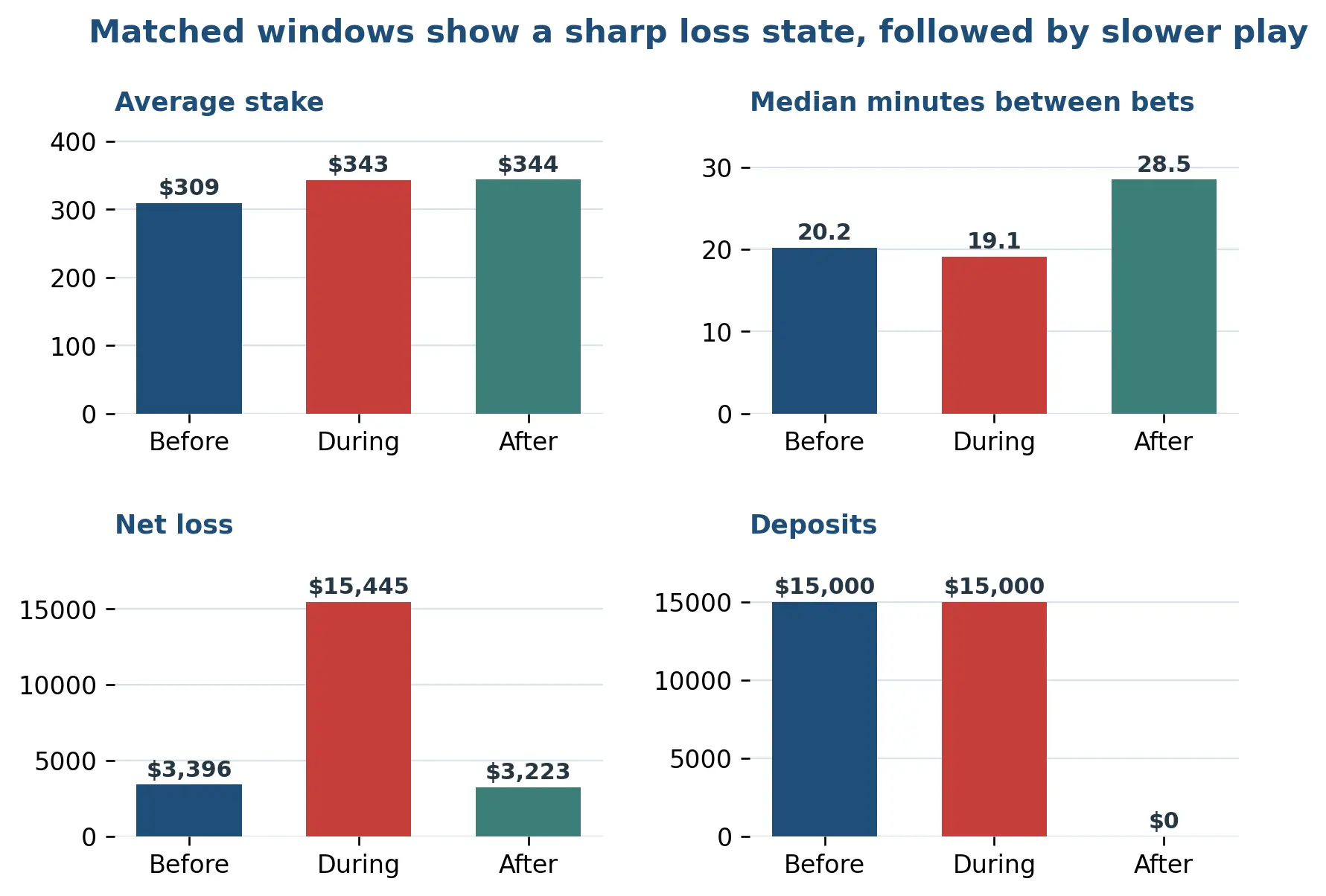
A matched-window comparison adds context. For each episode, the analysis uses a window of equal duration immediately before, during and after the chase, then aggregates the three episodes. Average stake rose from $309 before the chase to $343 during it. The median inter-bet interval shortened from 20.2 to 19.1 minutes, then lengthened to 28.5 minutes afterward. Most importantly, net loss increased from $3,396 in the three pre-chase windows to $15,445 during the chase, before falling to $3,223 afterward. Deposits totaled $15,000 both before and at the start of the chase windows, and none in the matched post-chase windows. These are descriptive comparisons, not causal estimates.
Historical panel from The House Always Wins
The 15-account panel assembled for The House Always Wins supports three distinct analyses: cross-account variation in losses, same-day detection of an active chase and prediction of a big-loss window on the following day. These outcomes are estimated separately because contemporaneous detection and forward prediction have different regulatory implications.
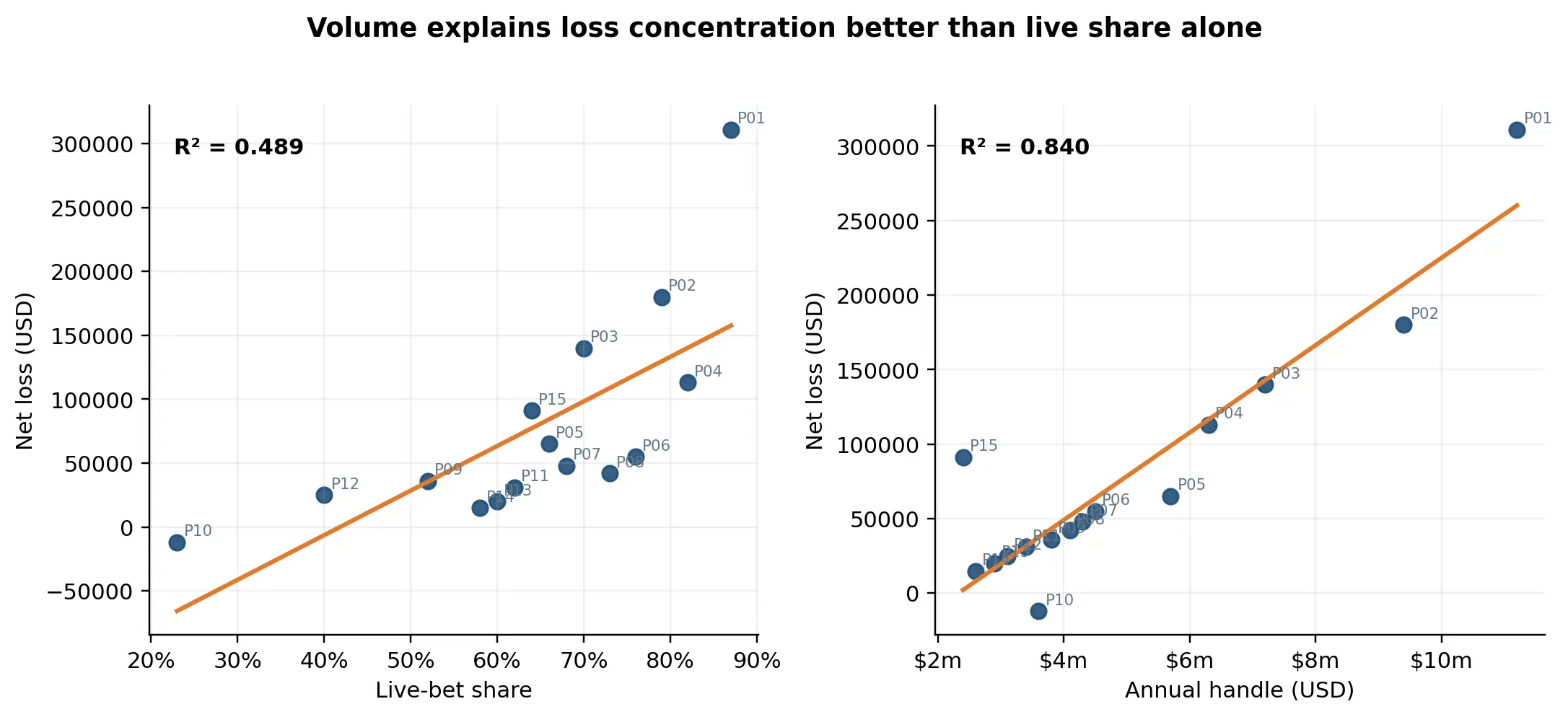
Annual handle is the dominant cross-sectional correlate. Handle alone produces R² of 0.840; adding live share raises R² to 0.865. This does not prove that live betting causes loss, nor that every high-volume customer is vulnerable. Handle, wealth, persistence, VIP selection and product choice are intertwined. The result nevertheless supports the concern that a small number of high-turnover accounts can matter disproportionately to operator profit.
Detection is not prediction
Model A is a pooled L2-regularized logistic regression using live share, stake relative to baseline, betting-rate ratio, consecutive losses, acute loss as a share of starting balance, rapid redeposit and a recent-chase indicator. The outcome is a research-classified chase on the same account-day. McFadden pseudo-R² is 0.724 and Tjur R² is 0.716. In leave-one-participant-out validation, ROC AUC is 0.986 and precision-recall AUC is 0.844. At a probability threshold of 0.501, sensitivity is 80.7 percent, specificity 97.6 percent and positive predictive value 80.1 percent.
| Model | Outcome | R² measure | Held-out AUC | Operational result |
|---|---|---|---|---|
| Active chase | Same account-day | McFadden 0.724 | 0.986 | 80.7% sensitivity; 97.6% specificity |
| Next-day big loss | Following account-day | McFadden 0.012 | 0.571 | 80% sensitivity flags 75.3% of days |
| Next-day loss severity | Log(1 + loss dollars) | OLS 0.004 | Not applicable | Held-out R² = -0.003 |
| Bet-level stake size | Log(1 + stake) | OLS 0.003 | Not applicable | Final-20% test R² = 0.005 |
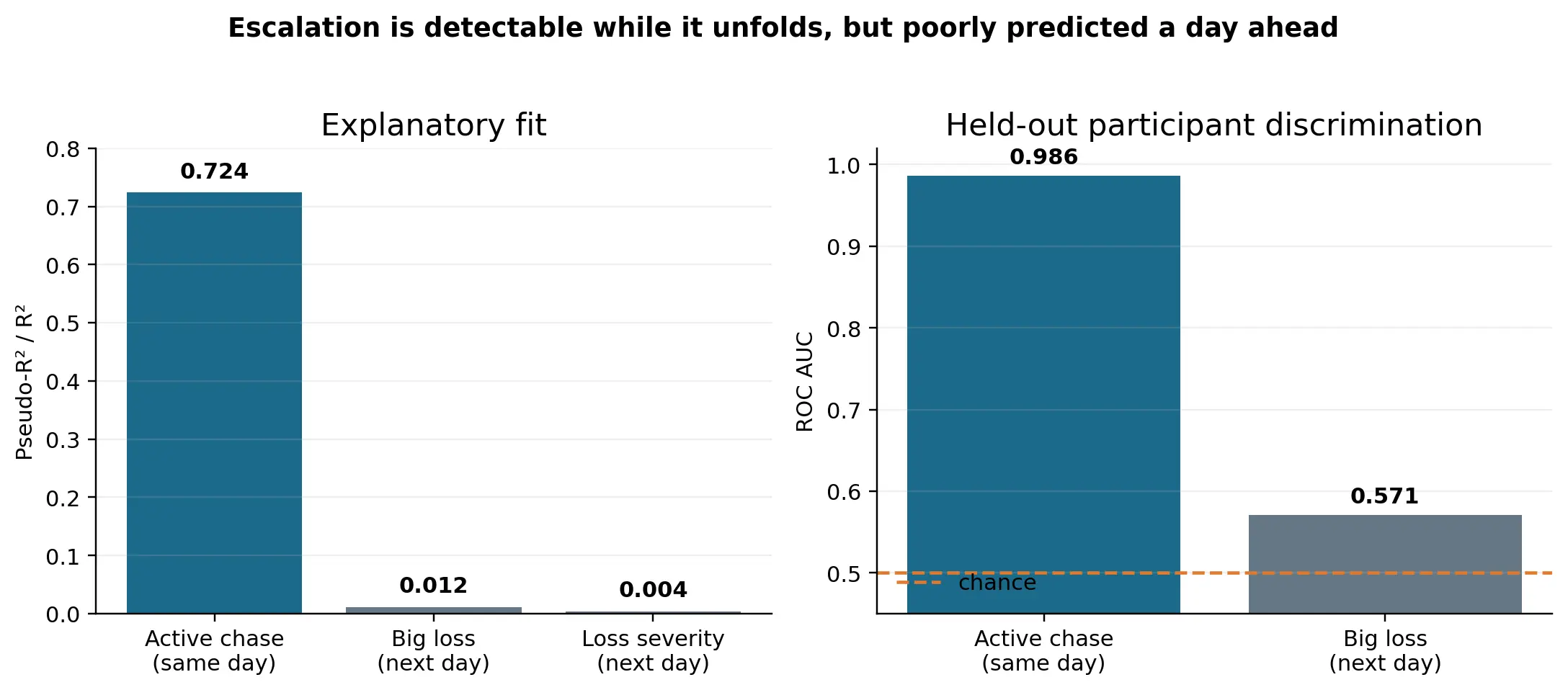
Forward prediction performed substantially worse than contemporaneous detection. The next-day big-loss model produced pseudo-R² of 0.012 and held-out AUC of 0.571. Capturing approximately 80 percent of next-day events required flagging three-quarters of all account-days, with a positive predictive value of 14.0 percent. The next-day loss-severity model produced ordinary in-sample R² of 0.004 and participant-held-out R² of -0.003.
The high same-day fit should also be interpreted carefully. Several predictors—acute loss, rapid redeposit, stake escalation and betting velocity—are close to the behavioral definition of chasing. The model is therefore best understood as a transparent detection rule, not a discovery that a hidden algorithm can identify future addiction. Its value is operational timing: it converts an observable transition into a reviewable threshold.
The bet-level result: chasing is clustered, not mechanical
The 1,654-bet sequence provides a useful check. A sequential ordinary least-squares model of log stake included the previous outcome, loss streak, prior stake, inter-bet gap, live-bet status, overround and cumulative drawdown. It explains only 0.3 percent of stake variation, with 0.5 percent R² in the final 20 percent of bets. Stakes increased after 48.3 percent of losses, compared with 53.9 percent after non-losses. A single losing bet therefore does not reliably produce a larger next bet.
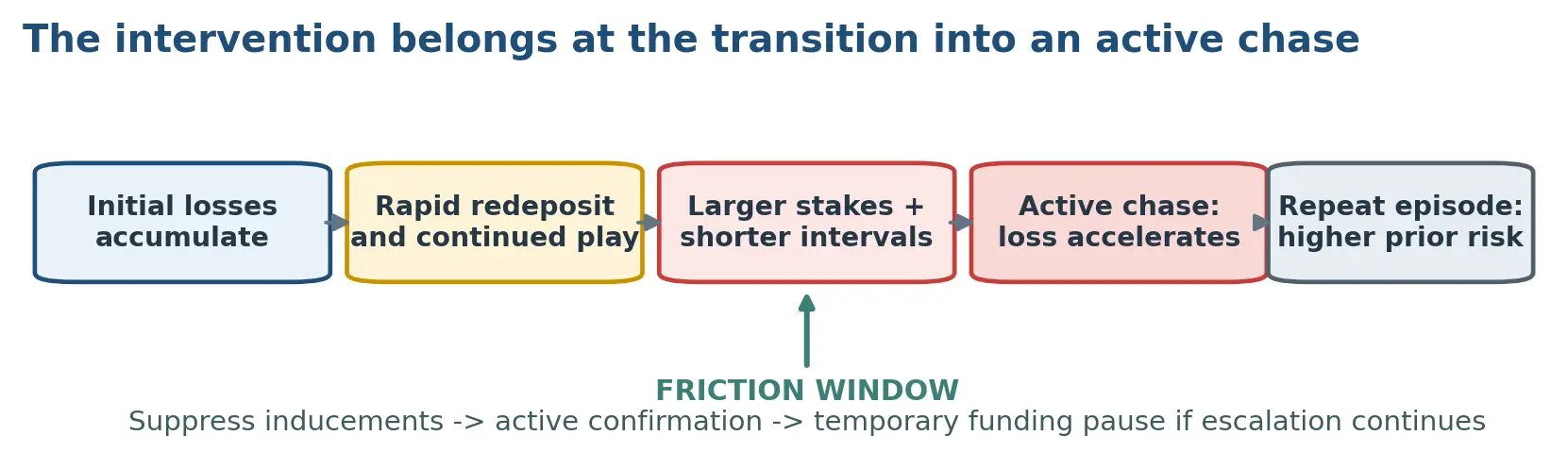
This low bet-level R² is informative. Chasing does not appear as a smooth Martingale in which every loss is mechanically followed by a larger stake. It appears as a change of state: a cluster of losses, rapid continued play, fresh funding and sustained exposure. The correct unit of intervention is therefore the episode, not the isolated wager and not the customer's permanent status.
Friction at the point of transition
The models support a graduated response. Ordinary play should remain untouched. When the same-day probability first crosses the active threshold, individualized promotions and loss-protection bonus bets should stop, the customer should see session loss and recent deposits, and continued play should require an active confirmation. If rapid redeposit or continued high-velocity loss pushes probability into a severe state, new deposits should pause for an hour. A repeated episode should trigger a 24-hour funding break and independent review. Withdrawals should remain open throughout.
The forward models impose an equally important limit. A poor next-day model should not justify permanent deposit limits, loss of VIP status or adverse account decisions merely because a customer resembles a past loser. Friction should expire when the behavioral state changes. Regulators should require false-positive rates, duration of restrictions, prevented loss per 1,000 alerts and migration to other operators to be reported before thresholds harden into a ratchet.
| POLICY RECOMMENDATIONS | PROPOSED RULE |
|---|---|
| Regulate conduct, not status | Do not restrict a customer merely for being a VIP, betting heavily or having lost previously. Intervene when observable behavior indicates that a chase is under way. |
| Stop inducements during a chase | Once the active-chase threshold is crossed, suspend deposit matches, individualized promotions and loss-protection bonus bets. Historical offers that accelerated redepositing should not recur at this point. |
| First-stage friction | Display session losses, recent deposits and cumulative exposure; require an active confirmation before further play. Cooling-off language alone is insufficient. |
| Escalate when funding continues | If rapid redepositing or continued high-velocity losses persist, pause new deposits for one hour. A repeated episode should trigger a 24-hour funding pause and independent review. |
| Protect exits | Keep withdrawals available throughout. A safety intervention should slow additional funding, not trap money on the platform. |
| Make restrictions temporary | End friction when the behavioral state ends. Weak next-day prediction does not justify permanent limits, exclusion from VIP service or other adverse labeling. |
| Require auditable outcomes | Operators should report alert volume, false positives, duration of restrictions, promotional contacts stopped, prevented loss per 1,000 alerts and migration to other operators. Thresholds should be revised or withdrawn if they do not improve outcomes. |
The cumulative effect of sportsbook pricing
The fieldwork also examined the prices offered across the reported 1,654 bets. On further review, researchers estimated an average effective pricing margin of roughly 11 percent across those wagers. Prices varied materially by market. A baseball total offered at -115 and -110 produced a 5.87 percent overround; a baseball moneyline at -160 and +110 produced 9.16 percent; a two-sided proposition at -125 and -125 produced 11.11 percent; and a less-liquid Challenger tennis match at -330 and +150 produced 16.74 percent. At the more extreme end, the fieldwork recorded an Ireland-Afghanistan cricket match priced at one point at -834 and +170. Those prices imply probabilities of approximately 89.29 and 37.04 percent, respectively, producing a combined implied probability of 126.33 percent and an overround of approximately 26.33 percent. Where the sportsbook's rules use a Super Over to determine a winner, the two teams are exhaustive outcomes, subject to the operator's separate rules for an abandoned or no-result match.
Applying one 11 percent average margin to $569,763 in handle necessarily flattens markets, stakes and outcomes that differed greatly. It nevertheless illustrates the cumulative effect of repeatedly recycling the same funds. The counterfactual holds the selections, stakes and realized outcomes constant and changes only the assumed effective pricing margin. It estimates profit or loss as the documented loss plus the reduction in pricing cost: -$35,297.85 + $569,763 x (11 percent minus the counterfactual margin). This treats the reported average as though it applied uniformly to handle; it is a rough sensitivity analysis, not a reconstruction of fair odds for every bet.
| Effective pricing margin | Estimated cumulative pricing cost | Estimated profit/loss |
|---|---|---|
| 15% | $85,464.45 | -$58,088.37 |
| 12% | $68,371.56 | -$40,995.48 |
| 11% (observed average) | $62,673.93 | -$35,297.85 |
| 9% | $51,278.67 | -$23,902.59 |
| 8% | $45,581.04 | -$18,204.96 |
| 5% | $28,488.15 | -$1,112.07 |
| 3% | $17,092.89 | +$10,283.19 |
Illustrative counterfactual using the same bets and outcomes. It is not evidence of a durable prospective betting advantage and is not a bet-level repricing of each market.
On this simplified estimate, a higher effective margin of 15 percent would have increased the loss to approximately $58,088; at 12 percent the estimated loss would have been about $40,995. Narrowing the margin to 8 percent reduces the estimated loss to approximately $18,205; at 5 percent the account is close to break-even; and at 3 percent the same selections and outcomes produce an estimated profit of approximately $10,283. The result does not show that the participant could reliably beat the market. It shows how repeated exposure to pricing margins can determine whether a month of otherwise unchanged selections ends near break-even, in modest profit or in substantial loss. Invitations, hosts and bonus bets were small beside this cumulative, less visible cost.
August 2026 results by sport and product
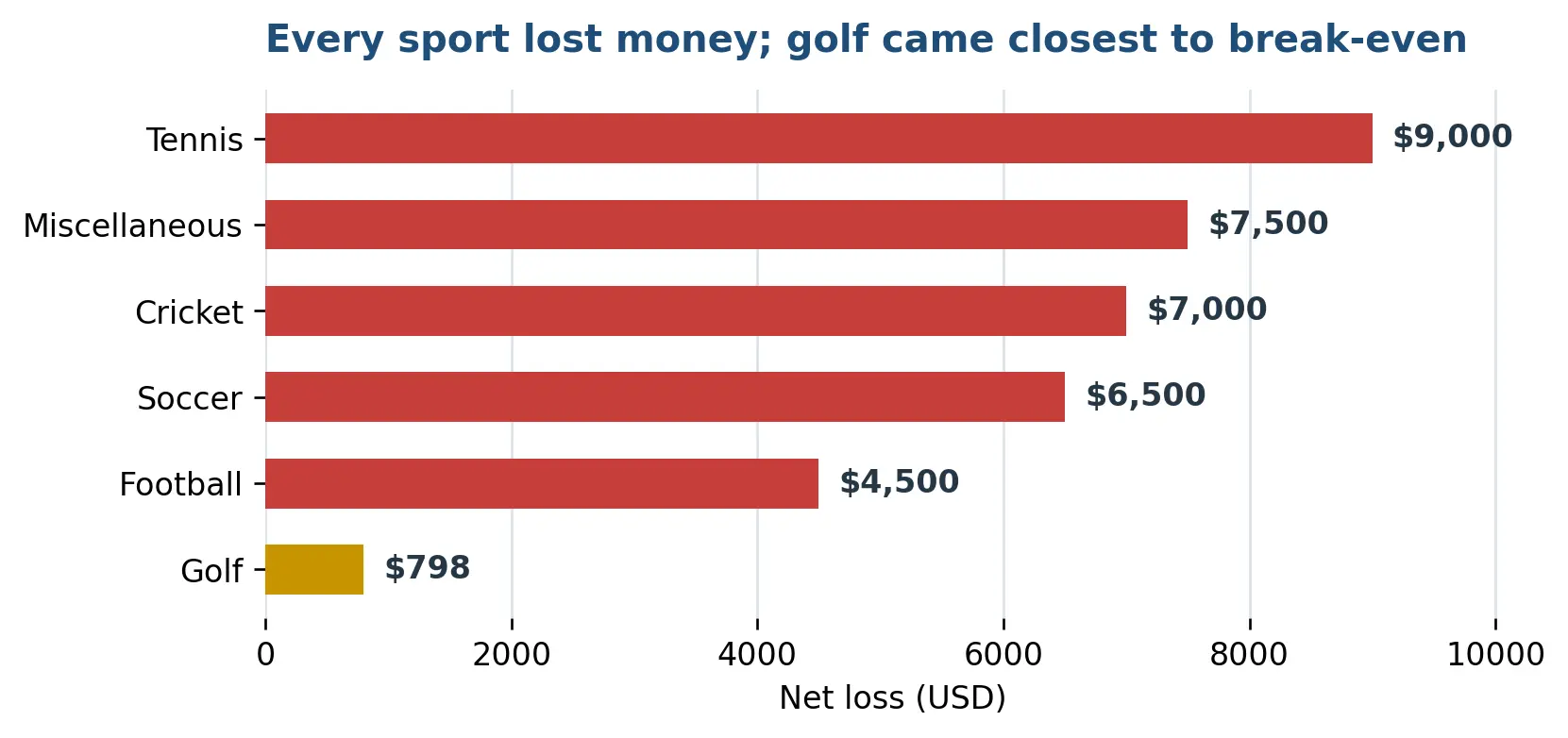
No sport provided a consistent profit during the documented month. Tennis produced the largest sport-specific loss at $9,000, followed by miscellaneous markets at $7,500, cricket at $7,000 and soccer at $6,500. Golf came closest to break-even, losing $797.85. These allocations describe this account and month; they do not establish that one sport is intrinsically easier to beat.
Product type was more revealing. Proposition bets lost $30,722.01 and moneylines lost $7,089.64, while spread and total bets gained $2,513.80. Proposition bets therefore accounted for 87 percent of the month's net loss after allowing for the offsetting gain on spreads and totals. This is consistent with the field observation that obscure props often carried much wider pricing margins, although one month cannot separate product margin, selection quality and chasing behavior conclusively.
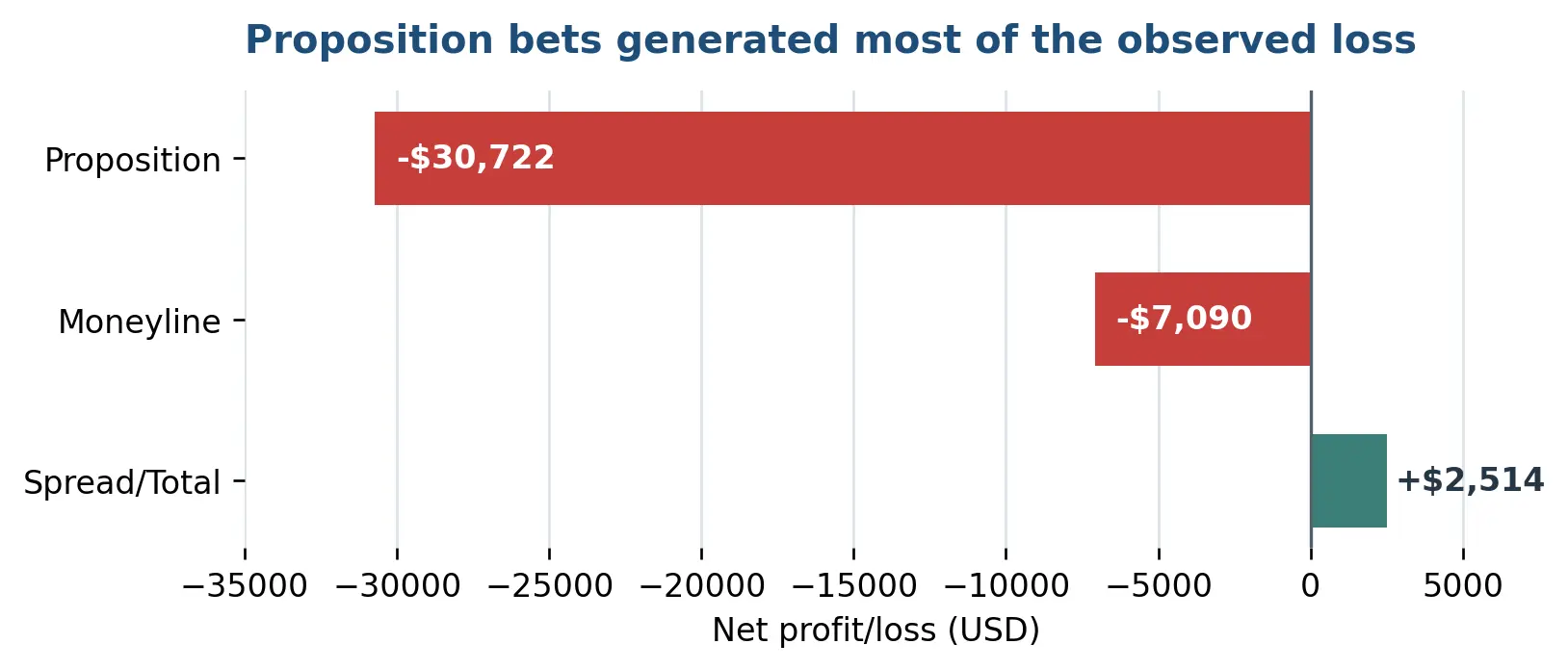
In the August 2026 sequence, proposition bets generated a net loss of $30,722, moneyline bets lost $7,090 and spread or total bets produced a net gain of $2,514. Tennis produced the largest sport-specific loss at $9,000, while golf came closest to break-even at a loss of $798. These are descriptive results for one account-month and do not establish that any sport or product is intrinsically more difficult to beat.
The litigation map: where VIP programs are being attacked
Several complaints describe disturbing conduct. One reported case involved wagering that allegedly rose from $174,000 in 2020 to more than $6 million in 2023, alongside gifts, promotions and an offer to pay for a vacation. Another plaintiff alleged that she received incentives even after asking about loans to pay her mortgage. A 2026 Pennsylvania complaint accused DraftKings and FanDuel hosts of encouraging two customers who later alleged gambling disorders and major losses. A separate FanDuel controversy involved a personalized Bryce Harper video allegedly obtained through Cameo for a VIP customer who later sued.
These facts are contested and cannot support a prevalence estimate. Plaintiffs and their lawyers have incentives to present the most damaging interpretation; confidential settlements do not establish liability; and severe cases tell us little about the denominator. Yet the allegations are valuable as stress tests. If even a small share is accurate, operators need clear rules for what happens when commercial teams encounter mortgage distress, borrowing, suicide language, repeated limit changes, self-described addiction or sudden unexplained escalation.
A serious paper should resist two symmetrical errors. It should not convert allegations into proof that the entire business model is predatory. It should not accept the industry's claim that training and responsible-gambling tools resolve the issue without examining incentives, data access and actual decisions. The necessary evidence sits inside the operators: message logs, bonus histories, host notes, risk flags, intervention records and compensation plans.
The cases aimed most directly at VIP practices
Fischer v. DraftKings, Inc. (S.D.N.Y., No. 1:25-cv-01299) alleged that DraftKings made Kavita Fischer a VIP, supplied credits and gifts, and continued inducements despite communications said to reveal serious financial distress and impaired control. The case was settled confidentially in 2025. A settlement ends the dispute but establishes neither liability nor the truth of every allegation.
D'Alessandro v. DraftKings arose from allegations that a New Jersey husband wagered about $15 million and lost roughly $942,000, including money allegedly taken from his wife and children. The complaint attacked DraftKings' VIP classification, bonuses and failure to question the source of funds despite rapid escalation. It too reportedly ended in a confidential settlement in 2025. The case is important because it frames VIP monitoring not only as protection of the gambler, but also as protection of family members and the lawful owner of deposited funds.
Youngs v. DraftKings, Inc. (D.N.J., No. 2:25-cv-00179) combines VIP and broader promotion claims. Plaintiffs challenged deposit matches, bonus terms and personalized inducements under New Jersey consumer law. In November 2025 the court allowed important fraudulent-inducement allegations to proceed while rejecting other theories. That is more legally significant than a settlement: it shows that carefully pleaded claims about what promotions actually promised may survive even when a general claim that a sportsbook should prevent addiction does not.
De Leon and Mirsberger v. DraftKings, Inc. (S.D.N.Y., No. 1:25-cv-00644) alleged misleading promotions, product-liability theories and manipulation through VIP treatment. The federal court dismissed the core addiction and product-liability claims in December 2025. This illustrates a central obstacle for plaintiffs: courts may regard gambling losses as the consequence of voluntary wagering, enforce contractual terms or reject attempts to characterize a betting platform as a defective product.
Patel v. FanDuel is the most extreme and least sympathetic test case. Amit Patel, a former Jacksonville Jaguars employee convicted of stealing more than $22 million, alleged that FanDuel exploited his disorder, gave him more than $1 million in gambling credits and used intensive host contact. FanDuel disputed the claims and emphasized Patel's fraud. In May 2026 a federal judge directed the dispute to arbitration. The allegations matter because they test what a host should do when wagering and deposits become extraordinary; Patel's criminal conduct matters because an operator is not automatically responsible for a customer's theft.
Sage and Thompson v. DraftKings, FanDuel, the NFL and Genius Sports, filed in Pennsylvania in March 2026, extends the VIP theory into product design. The plaintiffs allege that live data, microbetting and personalized hosts combined to produce or worsen gambling disorders and losses exceeding $2 million between them. One FanDuel host allegedly arranged a Bryce Harper video and other VIP benefits for Terry Thompson. DraftKings and FanDuel moved to dismiss in July 2026. No final merits ruling had been reported when this paper was prepared.
The City of Baltimore's 2025 consumer-protection action is broader still. It alleges that DraftKings and FanDuel use misleading bonus language and behavioral data to identify and intensively market to vulnerable gamblers. Because a municipality rather than an individual bettor brought the case, it attempts to recast personalized inducements as a population-level unfair practice rather than a private failure of self-control.
The wider litigation surrounding the sportsbooks
VIP litigation sits inside a much larger legal perimeter. DraftKings and FanDuel have faced class actions over the meaning of 'risk-free,' 'no sweat' and deposit-match promotions; disputes about withdrawals, account restrictions and the enforceability of arbitration clauses; privacy claims involving tracking technology and the alleged sharing of user data; athlete publicity-right suits over the use of names and images; trademark claims such as the NCAA's challenge to DraftKings' use of 'March Madness'; and earlier competition proceedings, including the Federal Trade Commission's attempt to block a DraftKings-FanDuel merger. These cases do not prove anything about VIP hosts. They matter because they determine what information, promises, data uses and private remedies surround the host relationship.
The litigation trend therefore supplies evidence but not a verdict. Repeated, independently filed allegations about bonus urgency, reactivation and host knowledge deserve investigation. Confidential settlements reveal risk but little truth. Dismissals show the weakness of some legal theories, not necessarily the absence of harmful conduct. Arbitration can remove disputes from public view. The policy response should not wait for tort law to produce a single definitive answer; regulators can require records and outcome reporting now, while preserving ordinary defenses and the presumption that adults remain responsible for voluntary wagers.
3. How the other major programs compare
| Operator | Public structure | Personal element | Principal policy question |
|---|---|---|---|
| DraftKings | Dynasty tiers, Crowns, status match, elite gifts and experiences | Dedicated host and tailored promotions for qualified members | Are hosts rewarded for deposits, loss, retention or reactivation, and how do risk flags override commercial contact? |
| FanDuel | VIP rewards and benefits; product-specific rewards structures | VIP membership and personalized customer contact | Are eligibility and exit rules consistent, documented and reviewable across sportsbook and casino products? |
| BetMGM | BetMGM Rewards integrated with MGM resort benefits | Dedicated VIP host at upper tiers | Does integration with travel, rooms and casino play obscure the customer's total exposure across products? |
| Caesars | Caesars Rewards credits earned on wagering and redeemed online or at resorts | Tier benefits and VIP experiences within a broad hospitality system | Why do parlays and same-game parlays earn credits faster than some straight bets, and does that steer users toward higher-hold products? |
| Kalshi | Volume cashback, liquidity incentives, referral credits and market-maker arrangements | No advertised sportsbook-style retail VIP host identified | Are incentives transparent and market-wide, or personalized to increase risky activity after behavioral warning signs? |
Source: operator program pages and terms reviewed August 2026. Public descriptions do not establish internal compensation or intervention practices.
FanDuel's public VIP terms confirm an age-gated program offering gifts or benefits, but public disclosure again leaves the operational core largely opaque. BetMGM more visibly connects digital wagering with resort rewards and advertises dedicated VIP hosts at higher tiers. Caesars goes further in integrating sportsbook activity into a large hospitality loyalty system. Its public materials say every qualifying bet can earn credits and that parlays and same-game parlays can earn at higher rates than straight wagers, subject to odds conditions.
That last design choice deserves scrutiny. Parlays generally produce higher margins for sportsbooks and greater variance for customers. A loyalty formula that awards more credits for a higher-hold product may be economically rational, just as an airline awards more points for a more profitable fare. But gambling is not air travel. If the reward structure deliberately shifts play toward products associated with faster losses or distorted perceptions of value, disclosure should be explicit and responsible-gambling systems should account for the induced risk.
Cross-product integration creates another blind spot. A customer can be assessed separately by sportsbook, casino and resort teams even though the relevant harm is cumulative. A complimentary room may look like hospitality expenditure, not a betting inducement; casino and sports losses may sit in different systems; and a host may see only one slice. Regulators should require a single-customer view for risk while preventing the commercial team from using sensitive affordability or health information to sharpen marketing.
4. Kalshi: similar incentive, different institution
Kalshi should not be forced into the sportsbook category merely because many event contracts concern sports. It operates a central limit order book and says users trade against other members, not against the exchange. A sportsbook ordinarily sets odds, manages exposure and earns a margin embedded in the price. An exchange matches opposing views and charges transaction fees. This changes the platform's immediate economic interest in a particular customer's loss, though it does not eliminate an interest in volume.
As of August 2026, Kalshi publicly describes a Volume Incentive Program that pays cashback according to eligible trading activity, a Liquidity Incentive Program that rewards resting orders, and market-maker arrangements involving quoting requirements, reduced fees and sometimes adjusted position limits. These programs are not merely hypothetical equivalents to loyalty rewards: they explicitly make greater activity more valuable to the user. Kalshi also offers referrals and market-specific incentives.
The institutional difference is nevertheless meaningful. A posted formula available to qualifying traders can improve liquidity, narrow spreads and make prices more informative. A designated market maker accepts obligations that benefit other users. By contrast, a sportsbook host may privately tailor inducements to a customer whose losses are revenue to the operator. The first arrangement can create a market-wide external benefit; the second is primarily bilateral customer cultivation.
But formal transparency is not a complete defense. Cashback can still encourage churn, short-term promotions can create urgency, and reduced fees can make a user trade more often than intended. An exchange can use behavioral data to target high-volume users even if it does not take the other side of a trade. If Kalshi introduces named retail account managers, private deposit inducements or reactivation campaigns, the sportsbook-style concerns would become directly relevant. Regulation should therefore follow function: standardized liquidity incentives merit disclosure and risk monitoring; individualized cultivation should trigger stronger conflict controls.
5. Regulatory objective: preventing impaired decision-making
High spending is not itself proof of harm. An affluent customer can lose large sums without compromising basic needs, while a lower-income customer can suffer serious damage at much smaller stakes. A rule based only on handle - the total amount wagered before winnings are paid - will also misclassify some customers because frequent low-margin trading can create enormous turnover with modest net loss. Net deposits, realized losses, velocity, credit use and behavioral change are often more informative than wagering alone.
The strongest triggers are combinations rather than single metrics. Rapid escalation plus repeated overnight play; larger deposits following losses; multiple failed deposits; cancellation and reversal of withdrawal requests; borrowing language; hostility when limits are suggested; requests for loans; concealment from family; use of several products; and repeated efforts to undo self-imposed controls together create a more persuasive signal. Hosts also receive qualitative information that algorithms may miss.
This is why a pure disclosure model is insufficient. Terms can explain that bonuses are nonwithdrawable and gambling involves risk, but disclosure cannot resolve an incentive conflict once the company has evidence that a customer is impaired. Conversely, an automatic affordability regime based on crude income estimates can humiliate ordinary customers, exclude legitimate high-stakes bettors and drive some activity offshore. The objective should be targeted friction: stronger checks where converging evidence indicates elevated risk, not bureaucratic interrogation of everyone.
6. The British experiment
In 2020 the British Gambling Commission responded to cases involving VIP incentives, gambling harm and possible criminal proceeds. Its approach required operators to assess affordability, safer-gambling risk and enhanced due diligence before enrolling high-value customers; assign senior executive accountability; review customers regularly; and manage the conflict between commercial incentives and protection.
The policy was consequential. The Commission later reported that HVC membership fell by as much as 90 percent from the pre-policy position. Its 2025 monitoring exercise found no subsequent growth between 2021-22 and 2023-24, a significant reduction in cases where HVC schemes or inappropriate incentives were a potential factor, and no widespread consumer concern in complaints data. Among 12 respondents providing 2024 revenue data, HVC schemes represented about 3 percent of gross gambling yield overall, with larger shares more common among non-remote casinos.
These findings should be interpreted cautiously. The sample was limited, operator data were self-reported, and Britain's market and regulatory culture differ from those of American states. A reduction in formal VIP membership may also cause activity to migrate into categories with different names. Yet the British experience rebuts two sweeping claims: that meaningful VIP safeguards inevitably destroy the regulated market, and that a ban is the only workable response. Governance rules substantially reduced exposure while leaving a functioning high-value sector.
7. A proportionate American framework
American sports betting is regulated primarily by states, creating variation that can function as policy discovery. The weakness is that operators can face inconsistent rules and regulators may lack the data to compare results. Massachusetts has begun a formal review of sports-wagering VIP programs and has considered age floors, affordability checks and restrictions on risk-promoting incentives. The best federal role is limited: common reporting definitions and research support, not a national ban that freezes one model before the evidence is mature.
CGHA proposes eight rules.
Define VIP functionally. Cover enhanced benefits or personal service based on expected customer value, regardless of labels such as premium, elite, host or account management.
Make qualification and exit rules auditable. Regulators need not publish proprietary thresholds, but they should be able to reconstruct why a customer entered, stayed in or left a program.
Prohibit direct loss-based host compensation. Host pay should not rise because an assigned customer loses more, deposits more after losses or is reactivated after risk-triggered inactivity.
Separate commercial and safety authority. A safer-gambling team independent of VIP revenue management should be able to suspend promotions, impose limits and remove a customer without host veto.
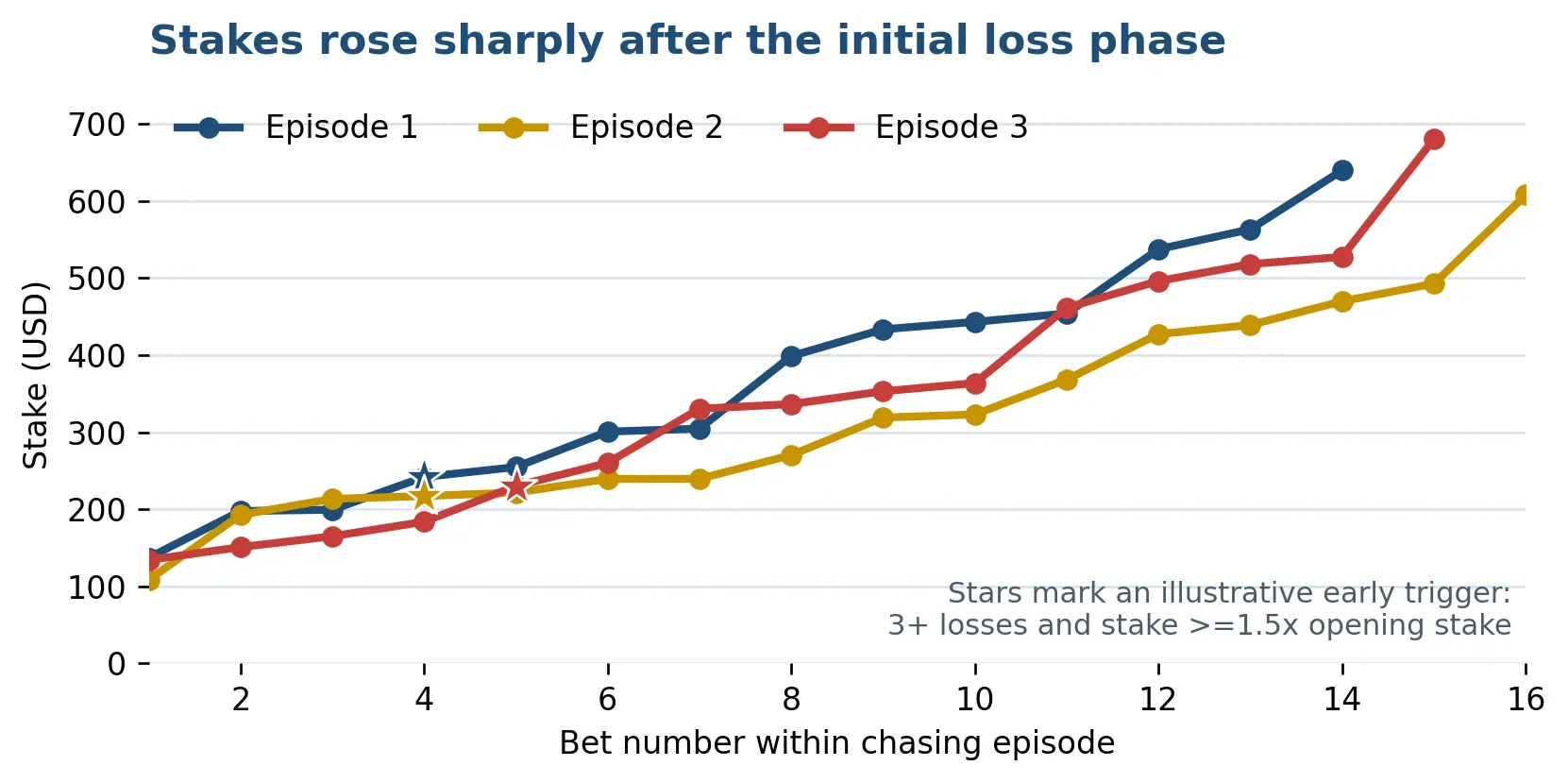
Use graduated review. Entry requires identity and risk review; stronger affordability or source-of-funds checks follow converging triggers, not high volume alone. When short-window loss, stake escalation, betting velocity and rapid redeposit indicate active chasing, suspend inducements and apply the graduated temporary pauses described in this paper.
Respect contact choices. A request for fewer inducements or no host contact should propagate across sportsbook, casino, fantasy and affiliated marketing systems without requiring full self-exclusion.
Retain messages and decisions. Operators should preserve host communications, bonus approvals, risk alerts and reasons for overrides long enough for complaint and regulatory review.
Publish outcomes. Annual anonymized reports should show VIP numbers, revenue share, bonuses, risk reviews, removals, self-exclusions and complaints using common definitions.
These rules are deliberately less dramatic than a prohibition. They preserve customer service, legitimate rewards and competition for sophisticated bettors. They focus on the asymmetry of information and incentives that makes VIP systems distinctive. They also create evidence. If harm remains high after conflict controls, stronger restrictions would be justified. If outcomes improve, regulators should resist the usual ratchet toward ever more intrusive rules merely because a politically attractive target exists.
8. Prospective validation of intervention rules
Public policy is currently being made from marketing pages, selected lawsuits, industry assurances and foreign experience. That is inadequate. CGHA's proposed fieldwork should observe the customer journey across DraftKings and comparison platforms under a pre-agreed loss ceiling and legal protocol. The purpose is not to manufacture harm or entrap employees. It is to record what ordinary customers cannot otherwise see consistently.
The protocol should measure eligibility, time to upgrade, deposits, wagering, net position, rewards, host contacts, tone, urgency, event invitations, withdrawal treatment and responsible-gambling messages. Pre-specified behavior changes should include a pause after losses, reduced stakes, a declined offer, a request for less contact, a deposit limit and account inactivity. The study should record whether the operator respects each signal, substitutes another channel or attempts reactivation.
A comparison account at Kalshi should distinguish trading incentives generated automatically by posted rules from discretionary human contact. It should track fees, volume cashback, liquidity rewards, referrals, notifications and any outreach following loss or inactivity. Because event contracts differ from fixed-odds bets, outcomes should be normalized by net deposits, realized loss, turnover, frequency and time on platform rather than treating a contract as identical to a sportsbook wager.
Interviews should include high-volume bettors, former VIPs, hosts or former hosts, compliance personnel, clinicians and regulators. The study should seek disconfirming evidence: examples in which hosts discouraged play, removed benefits, honored contact restrictions or helped customers set effective limits. A credible investigation cannot begin with the assumption that every interaction is abusive.
9. Minimum operator reporting requirements
The percentage of active customers assigned a host and their share of gross gaming revenue.
The measures used to determine VIP eligibility, including handle, deposits, losses, theoretical value, product mix and discretionary nomination.
Host access to risk flags and every override or suppression of those flags.
The portion of host compensation linked to retention, reactivation, deposits, wagering and net revenue.
The events that stop promotional contact and the time required for that stop to propagate across products.
The frequency and outcome of affordability, source-of-funds and harm-marker reviews.
The number of customers removed for safety reasons, leaving voluntarily, self-excluding or complaining about host conduct.
The expected cash value of bonuses, trips and other benefits, reported within a consistent measure of effective inducement.
Operators may reasonably protect precise commercial thresholds. They cannot plausibly claim that all aggregate answers are trade secrets. As far as can be ascertained from the fieldwork, participant reports and the economics of fixed-odds betting, a small minority of 'mini-whales' losing perhaps $10,000-$15,000 a month and still larger whales plausibly generate a majority of operator profit. In the observed DraftKings group, heavy-loss customers had VIP hosts; participating gamblers reported comparable high-value relationships at FanDuel, although this study did not verify that every such FanDuel customer receives one. These observations are consistent with concentrated profitability, but they cannot establish an industry-wide majority or its exact size. Operators should therefore disclose anonymized revenue and loss distributions by customer decile, VIP status and host assignment. Without those denominators, the public sees only extreme stories and corporate slogans, and cannot tell whether notorious cases are rare failures or symptoms of a business model concentrated on a small group of persistent losers.
Conclusion
VIP programs expose the central ambiguity of modern gambling policy. Adults are entitled to take risks, and companies are entitled to compete for valuable customers. Personalized service can be useful, enjoyable and benign. Yet the operator knows far more than the customer about behavioral patterns, product margins and the effect of specific inducements. A host relationship converts that informational advantage into human influence.
The appropriate dividing line is conduct, not status. Published points, efficient dispute resolution, hospitality and ordinary rewards can resemble airline, hotel and credit-card loyalty programs and should not be treated as evidence of exploitation. The case for intervention becomes stronger when individualized inducements follow substantial losses, rapid redepositing or other evidence of impaired control, especially when the operator's own systems have already generated a warning. A defensible regime should preserve legitimate VIP service while stopping promotional cultivation at the point where converging risk indicators require a genuine safety response.
The correct response is neither moral panic nor complacency. DraftKings and its rivals should be permitted to reward loyalty, but they should not pay or pressure hosts to intensify play when evidence of loss of control is accumulating. Safety decisions need independent authority, customer contact preferences need force, and regulators need auditable records and aggregate outcomes.
The historical panel and August 2026 update point in the same direction. Across the 15 earlier accounts, annual handle explains 84.0 percent of loss variation and the five largest losing accounts generate 71.3 percent of positive losses. In August 2026, 45 bets during three short episodes generated 43.8 percent of the month's net loss. The fitted historical model detects such states strongly while they unfold, and the later field sequence shows why that capacity matters. The operator's softer language marks progress, but immediate funding and play remained available. Regulation may therefore evolve toward a temporary operational brake at the transition—loss intensity combined with rapid redepositing, stake deviation and velocity—rather than a permanent label attached to every VIP, large bettor or losing customer.
Kalshi demonstrates why categories must remain precise. Its volume and liquidity incentives can encourage more activity and deserve scrutiny, but an exchange rewarding transparent market-making is not automatically equivalent to a sportsbook privately cultivating a losing customer. If Kalshi develops individualized high-value relationships, regulation should follow the function. Until then, it should be compared carefully rather than rhetorically assimilated.
Operators can observe an active loss-chasing state with materially greater accuracy than they can predict losses on the following day. The 2024 panel establishes this empirical distinction. The August 2026 update shows voluntary practice moving gradually from aggressive inducement toward warnings that remain easy to ignore. Proportionate regulation should therefore test time-limited funding friction during an observable episode, publish false positives and prevented loss, and withdraw thresholds that do not improve outcomes. Strong same-day detection supports precise intervention; weak forward prediction requires restraint outside the episode.
Appendix A. What is documented, reconstructed and inferred
The evidence has two periods and two functions. The 2024 15-account panel provides the model and cross-account associations. The August 2026 sequence supplies a later field test and contemporaneous evidence about VIP-host conduct. Retained messages and screenshots, public program materials, litigation allegations and foreign regulatory evidence provide additional context. Panel associations and R² values do not establish causation; research-classified chase labels are not clinical diagnoses; and the August sequence is reconstructed rather than a direct operator export.
| Evidence item | Claims supported | Status and principal limitation |
|---|---|---|
| Monthly transaction summary | Deposits, withdrawals, handle, winnings, other charges, ending balance and $35,297.85 net loss | Direct contemporaneous platform screenshot. It establishes account totals for the selected month but not the causal source of each loss. |
| Bet-level field dataset | 1,654 wager sequence; timestamps; stakes; outcomes; sport, product and jurisdiction classifications; running P/L | Researcher-validated reconstruction checked against retained records and reconciled exactly to monthly totals. It is not a direct operator export; classifications may contain research judgment. |
| Chasing-episode flags | The 45-bet episode analysis, timing plots, concentration result and matched-window comparison | Research-team classification of three documented sequences. Boundaries and proposed triggers are analytically reproducible but are not operator labels or clinically validated diagnoses. |
| Messages and offer terms | Cooling-off suggestions, immediate continued funding, and 20% loss protection up to $1,000 in bonus bets | Supported by retained contemporaneous screenshots and messages for the documented events. They do not estimate how often the same response occurs across all customers. |
| Historical VIP experience | Earlier DK Dollar offers, negotiability, hosts, trips, events and merchandise | Participant reports, including historical participation by the author, supplemented by retained records where available. Recall is less certain than contemporaneous evidence. |
| Public operator materials | Published loyalty tiers, host availability, rewards and incentive structures at DraftKings, FanDuel, BetMGM, Caesars and Kalshi | Direct descriptions of public program architecture. They do not reveal internal risk scores, host compensation or unpublished intervention rules. |
| Complaints, dockets and reporting | The litigation map and allegations concerning VIP treatment, inducements and customer distress | Primary court materials where available and reputable reporting. Allegations are not findings; settlements and arbitration do not establish liability. |
| Whale-profit concentration | The hypothesis that a small group of mini-whales and whales produces a large share of operator profit | Inference consistent with field observations and industry economics, not established by this account. Verification requires anonymized operator distributions by customer decile and VIP status. |
The accompanying workbook reports the observations, variable definitions, fitted coefficients, validation statistics and intervention assumptions. The 15 accounts are a small, non-random sample, and the modeled intervention effects are not experimentally identified.