Abstract
Governments can prohibit newer nicotine products while leaving cigarettes in legal commerce. Vietnam prohibits vaping and heated tobacco and imposes fines for vaping. India restricts supply and storage, with documented online availability years after adoption. Kenya has proposed a prison maximum for personal use of a nicotine pouch ten times the proposed maximum for supplying tobacco to a child. Indonesia imposes stringent sales controls on cigarettes and vapes while preserving channels for lawful adult access. The cases illustrate how governments choose what to restrict and whom to punish. The public record establishes several Bloomberg-linked funding and organizational relationships, with thinner evidence about who shaped specific decisions. This paper sets out how to assess adult switching, youth initiation, informal supply, and enforcement together.
1. The policy problem
Prohibition has an immediate political advantage. A government can point to the day the law passed and the date the product disappeared from licensed shops. A smoker who would have switched but carries on smoking is invisible in that account. So is the young person who would have bought a vape but takes up cigarettes, or the young person deterred from using any nicotine product. Those outcomes matter much more than the number of products or retailers brought within the prohibition.
The four countries in this paper make different choices about who should bear the cost of enforcement. Vietnam reaches the person using the product. India primarily restricts commercial activity and storage. Kenya’s bill would apply the same severe maximum penalty to personal use of an oral pouch and to conduct involving shisha. Indonesia applies significant restrictions to cigarettes as well as e-cigarettes, including common age and location rules. Comparing those choices brings proportionality back into the discussion. What additional protection can a penalty on an adult user deliver beyond age checks, product standards, and restrictions on marketing?
Cigarettes, vapes, heated tobacco and pouches differ in how they deliver nicotine and in the quality of evidence about their risks or ability to help people stop smoking. A sound analysis has to account for the product a person would otherwise use. Taking up a nicotine pouch and taking up smoking are different events. Public-health surveillance can count both, but a policy appraisal should attach weight to the harm each is likely to cause. Dependence matters, including when someone would prefer to stop. So do dose, frequency, age, and the product’s health effects. The coffee analogy makes the distinction clear. Acquiring a taste or dependence for a stimulant tells us less about its health consequences than knowing what the product is and how it is used. Wine illustrates the ordinary policy question of how adults weigh pleasure against some risk. Neither analogy supplies a numerical estimate of pouch risk. The FDA found that specific authorized pouches pose lower risks of serious disease than cigarettes, while long-term evidence on pouch use remains limited. FDA assessment · CDC overview
An adult may choose a pouch for enjoyment even if they have never smoked. Their decision can be reasonable on its own terms. The availability of a less harmful alternative for smokers is one argument for lawful access. Adult choice is another. For adolescents there is a separate case for age-of-sale safeguards and for tracking dependence and patterns of use. Counting every instance of youth or adult pouch initiation as a uniform public-health loss obscures who is using the product, why, and with what consequences.
2. Method and legal scope
The cases were selected to illuminate different instruments and are assessed as of November 24, 2026. Legislation and parliamentary records establish legal scope. Government statements establish stated rationales. Surveys establish pre-policy baselines. Retail studies establish availability in sampled channels. None can substitute for an estimate of the net change in health. Indonesia is a comparison for policy design. The countries differ too much in baseline smoking, enforcement and timing to use its national trends as a direct counterfactual for the others.
The analysis of philanthropic influence follows a similar distinction. A published award establishes a named financial relationship. An institutional admission of participation establishes a role in the activity described. A claim that a funder shaped a specific clause calls for a record linking its work to that clause. Useful records include grant deliverables, technical submissions, minutes, draft changes and contemporaneous accounts from officials. Funding totals refer to the scope stated by the reporting source.
| Country | Policy examined | Strongest finding | Main unanswered question |
|---|---|---|---|
| Vietnam | In-force prohibition on e-cigarettes and heated tobacco, with a fine for use | The state imposes a penalty on the individual whose alternative it has removed from legal sale. | How many users quit all products, continue informally, or switch to cigarettes? |
| India | 2019 prohibition centered on supply, storage and advertising | Online availability persisted after the ban. A Delhi pilot indicates the policy can still constrain some physical retail. | What happened to youth initiation, adult cessation and the balance between retail channels? |
| Kenya | 2026 proposal covering nicotine pouches and shisha | Personal use would carry a prison maximum ten times that proposed for supplying tobacco to a child. | What health benefit would user punishment add to age-of-sale and product rules? |
| Indonesia | Government Regulation No. 28 of 2024 | Sales restrictions reach both cigarettes and vapes, with legal channels left open. | Are restrictions enforced similarly for the two product categories? |
3. Vietnam — a ban with a penalty for the consumer
In November 2024, Resolution 173/2024/QH15 directed that from 2025 Vietnam prohibit production, trading, import, storage, transport and use of e-cigarettes and heated tobacco products. Under Decree 371/2025/ND-CP, Vietnam’s government says e-cigarette users face fines of VND 3–5 million from December 31, 2025. This gives the policy a second mechanism. It closes normal supply and raises the cost of continued use through direct enforcement. Cigarettes remain legally available subject to tobacco controls. The WHO country profile reports that 35% of men aged 15 and older smoked cigarettes in the 2021 STEPS survey. That is a pre-ban baseline, and it shows why even a modest effect on adult switching deserves attention. Resolution · Government statement on fines · WHO country profile
The government put adolescent use and health harms at the center of its case. Its account cites 1,224 hospitalizations in 2023 attributed by the Ministry of Health to e-cigarette harms. This deserves follow-up on diagnoses, products, ingredients and the denominator of users. An aggregate count by itself cannot tell us how much risk came from regulated nicotine products, which risks could be addressed by product standards, or how total harm compares across policy options. WHO welcomed the legislature’s decision. VINACOSH separately acknowledges Bloomberg and Campaign for Tobacco-Free Kids support on its earlier tobacco-control law. Those records show institutional support for the ban and a history of donor-backed work. They do not identify a Bloomberg grant financing this resolution. Government statement · WHO statement · VINACOSH funding disclosure
Article 6 of Vietnam’s subsequent Investment Law, No. 143/2025/QH15, separately lists trade in electronic cigarettes and heated tobacco among banned business investment activities. The combination of a commercial ban and a penalty on use deserves particular scrutiny. A seller and a consumer face different incentives. The government should show what additional health benefit it expects from fining the person who uses the product. Investment Law
The central test is what people used after the ban. A matched pre- and post-policy panel should distinguish exclusive use, dual use and abstinence. Pair that with retail cigarette volumes, tax changes, informal availability and the distribution of fines. A fall in reported vaping could reflect a genuine decline, greater reluctance to disclose use, or both. This review did not find national outcome evidence sufficient to estimate the net effect.
4. India — a supply ban with observable market leakage
India’s 2019 Act prohibits production, manufacture, import, export, transport, sale, distribution, storage and advertising of electronic cigarettes. Its definition includes specified heated and electronic devices and excludes products licensed under the drugs law. The statutory route is chiefly supply and storage, which is a material difference from Kenya’s proposed offense of personal use. In announcing the ordinance, the Indian government emphasized youth adoption and flavor appeal. Before the ban, GATS 2016–17 estimated current tobacco use at 28.6% of adults, tobacco smoking at 10.7%, and smokeless tobacco use at 21.4%. Those groups overlap. A study of substitution needs to capture bidis, cigarettes and forms of smokeless tobacco separately. Act · Cabinet explanation · India GATS
A 2024 study identified 83 online stores offering delivery to India, 49 domestic and 34 international. Many had no age check, and checks that did exist were usually self-verification. The count shows continued availability in the channels studied. It does not measure completed purchases or the national size of the market. A 2025 conference poster reports a Delhi pilot suggesting compliance above 75% among the physical vendors studied. Taken together, these records are consistent with partial retail compliance alongside continued online access. Different samples and methods prevent a direct comparison of channel shares. Online retail study · Delhi pilot
A July 2024 Indian Ministry of Health letter published by Delhi Police acknowledged that shops and vape houses were still operating illegally. This corroborates a physical enforcement problem alongside the online evidence. A high share of compliant retailers can coexist with meaningful supply if sales concentrate among the sellers who remain. Neither the official letter nor the retail pilot measures their volume. Ministry of Health letter
India is a priority country in the Bloomberg grant program. That establishes program attention, with no Act-specific grant identified in this review. The government’s contemporaneous explanation supplies direct evidence of the rationale it advanced. The critical inquiry is whether the law reduced young people’s access and total tobacco harm relative to a regulated market. Continued availability narrows what can be claimed for prohibition. It leaves the magnitude and direction of net health effects open. Bloomberg grant program
5. Kenya — the penalty exposes the policy’s priorities
Clause 51 of Kenya’s 2026 bill would prohibit manufacture, sale, use, promotion and distribution of nicotine pouches and shisha. The provision sets a maximum of ten years in prison, a fine of KSh 5 million, or both. Clause 52 sets a maximum of one year for selling or supplying a tobacco product to a child. The Hansard records the bill’s first reading and committee referral on November 5. The sponsor treated vapes and pouches as the same product in debate, although the bill defines e-cigarettes and pouches separately. Enactment was not verified as of November 24. Bill · Hansard
The obvious proportionality question is why using a pouch could attract a much greater maximum sentence than supplying tobacco to a child. Putting shisha and pouches in the same offense also leaves unexplained how the penalty reflects differences in use and exposure. The US FDA’s review of 20 specific ZYN products found substantially lower levels of harmful constituents than cigarettes and evidence of complete switching among some adults. This is relevant evidence against treating all products as interchangeable. It does not supply an estimate of switching or youth uptake in Kenya, or settle the risks of every pouch sold there. FDA product assessment
A Kenyan investigation into tobacco-industry conduct acknowledges Vital Strategies funding on Bloomberg’s behalf. That documents a local funding channel for a named report. The public bill and debate identify the domestic sponsor. A claim that the funding channel produced the ban would require a submission, workplan, correspondence or other record tied to this clause. Kenya’s policy can already be evaluated on its text. Age checks, product standards, marketing restrictions and penalties focused on suppliers are concrete alternatives to consider against the proposed punishment of users. Kenyan report and funding acknowledgment
6. Indonesia — a restrictive comparison with room for legal access
Article 434 of Government Regulation No. 28 of 2024 bars sales of tobacco products and e-cigarettes to people under 21 and pregnant women, through vending machines, and within 200 meters of schools and children’s playgrounds. It also restricts online sales, with an exception for qualifying commercial websites and apps that verify age. Its single-stick sales restriction expressly exempts e-cigarettes and cigars. These rules are restrictive, but the national regulation itself leaves a lawful adult retail market. I did not verify a later national prohibition. Restrictions can still make access difficult in practice if exclusion zones cover much of a city or age verification is unworkable. Those effects should be measured rather than inferred from the regulation alone. Government Regulation No. 28 of 2024, Article 434
GATS put adult tobacco use at 34.5% and e-cigarette use at 3.0% in 2021. Both figures predate the rule. The Centre for Indonesia’s Strategic Development Initiatives reports working with the Campaign for Tobacco-Free Kids on tobacco excise and expanding the partnership toward cessation work. This is evidence of a Bloomberg-linked policy network working on cigarettes and quitting. It does not connect that network to drafting Article 434. Indonesia is therefore a useful test of the broader claim: similar funding relationships can coexist with a different policy choice. GATS comparison · CISDI annual report
France and the cigarette that stayed respectable
For generations, French cinema could make a cigarette look like part of being Brigitte Bardot or Alain Delon. France has made real progress against the habit that image helped glamorize. Santé publique France reported that 18.2 percent of adults aged 18–75 in mainland France smoked daily in 2024, down from 25.3 percent in 2021. The decline is a public-health achievement. It makes what France did next especially hard to explain. Cigarettes remain on sale through licensed tobacconists. From April 1, 2026, France prohibited the sale, acquisition, possession and use of tobacco-free nicotine pouches. It exempted medicinal nicotine products and chewing tobacco. The government says an interim court order suspended the restrictions on production, manufacture and export, leaving the domestic prohibitions in place. Santé publique France · French government notice
The French government cites youth marketing, dependence and reports of acute nicotine poisoning. Those concerns give it reason to look closely at dose, packaging, advertising and sales to minors. The further decision to prohibit adult use needs a further argument. A pouch contains nicotine but generates no smoke. France could set a strength limit, require child-resistant packaging and restrict sales to adults. It chose instead to take the product out of lawful commerce and prohibit possession and use. That choice affects smokers who might switch and adults who have never smoked and may simply prefer a pouch. Both belong in the assessment.
The lesson of France’s smoking decline is that the health consequences of a product deserve more weight than its cultural standing. The cigarette once had the advantage of glamour. It now has the advantage of being familiar and legally available. A new product should be judged by the harm it can cause and the choices it offers consumers. France’s decree leaves a simple question unanswered. What public-health benefit requires keeping the cigarette on the shelf while making it unlawful for an adult to use a pouch?
7. What the cases establish
Vietnam has the clearest legal evidence of an adopted ban that reaches the consumer. India provides the best evidence in this set that supply can survive a ban, alongside preliminary evidence of partial physical-retail compliance. Kenya is the sharpest example of disproportionate punishment, at the proposal stage. Indonesia shows that a government can choose stringent youth and retail controls while retaining a legal adult market. None of these comparisons alone establishes the effect of a ban on smoking.
The adult health trade-off is real enough to require analysis before legislating. Cochrane finds high-certainty evidence that regulated nicotine e-cigarettes increase quit rates compared with nicotine replacement therapy in trials. That result does not transfer automatically to pouches, heated tobacco, illicit products or any national ban. It does establish a plausible benefit forgone when a policy removes regulated vaping. Governments that restrict these markets should publish the outcomes that could prove their decisions wrong: youth initiation across products, adult switching and cessation, informal supply, and the penalties actually imposed. Cochrane living review
8. The funding network and the decisions it could shape
The Bloomberg Initiative’s grants program reports more than $1.58 billion in cumulative commitments and lists WHO, the Campaign for Tobacco-Free Kids, Vital Strategies and other implementing organizations. Vital Strategies and the Campaign for Tobacco-Free Kids jointly manage the grants program. WHO acknowledges Bloomberg funding for tobacco-control capacity building. In the United States, the Campaign for Tobacco-Free Kids announced a $160 million Bloomberg initiative in 2019 that explicitly targeted flavored e-cigarettes. Those figures describe initiatives. The records reviewed do not allocate them among individual organizations or connect an amount to a particular law in this paper. International grants program · WHO capacity building · 2019 US announcement
The mechanism worth investigating is agenda-setting. Long-term grants can finance staff who produce the studies ministers read, help officials write options, and publicize the decisions that follow. Those activities can be valuable. They can also give one set of concerns, such as flavor appeal or industry conduct, more sustained attention than adult switching or the costs of informal supply. The question for each country is which specific options the institutions advanced and what happened when domestic officials considered them.
Vietnam offers the strongest policy-specific record of institutional endorsement. WHO welcomed the particular ban and identified domestic health ministry advocacy. Bloomberg’s traceable support in the records reviewed concerns earlier work. Kenya offers an identifiable local grant for a report with the legislative record separately identifying the bill’s sponsor. India is listed as a priority country. Indonesia offers a documented Bloomberg-linked partnership around tobacco excise and cessation alongside a more permissive policy choice on adult vaping access. These differences are informative. A shared funding environment can coexist with national discretion and sharply different laws.
9. What if denying the industry legitimacy is the objective?
The apparent contradiction in these policies depends on how we define success. If success means fewer people smoking and fewer people dying from tobacco-related disease, a government has to account for what happens when it removes a product smokers might otherwise switch to. If success means denying large tobacco companies a credible role in the transition away from cigarettes, the same prohibition can be rational. A product that offers smokers a way to leave cigarettes gives the company selling it a claim to have something worth offering consumers. It gives the company a commercial stake in moving people away from its most dangerous products and a public argument for being heard in the debate. For advocates who see that change in standing as the threat, stopping the product can itself count as a win. The cigarette can stay on sale while one important objective of the campaign has already been achieved.
This is a realistic hypothesis about what motivates some campaigners. It draws on an openly stated principle. The WHO Framework Convention’s Article 5.3 guidelines describe a fundamental conflict between industry interests and public health policy and call on governments to protect policymaking from industry interference. WHO's 2017 statement on the Philip Morris-funded Foundation for a Smoke-Free World illustrates the distrust behind that position. It pointed to the industry's record of misleading claims about “light” cigarettes and opposed industry funding of harm-reduction research. Past conduct gives policymakers sound reasons to scrutinize companies' evidence, lobbying and marketing. Product prohibition is a further decision. A government can keep manufacturers at arm’s length, insist on independent review, and still allow adults to buy products that meet safety and marketing standards. FCTC Article 5.3 guidelines · WHO statement on the Philip Morris-funded foundation
The distinction matters because advocates can sincerely believe that denying the industry legitimacy protects public health over the long run. Their priorities become visible when that objective conflicts with a measurable opportunity to reduce smoking. Would they support independently assessed alternatives under strict youth safeguards? Would their position change if the supplier were independent of the cigarette industry? If evaluations showed that a ban kept more adults smoking, would they revisit it? An organization that defines success by bans adopted, tobacco companies excluded and new markets foreclosed could report a successful campaign even under that last outcome. Those measures answer a question about industry power. They leave the effect on smokers unanswered.
The country cases make this explanation worth testing. Vietnam’s ban covers heated tobacco and vaping. India’s law reaches e-cigarettes regardless of who supplies them. Kenya’s proposal reaches adults who use pouches, well beyond rules governing tobacco-company access to government. If the objective were narrowly to deny cigarette manufacturers a new business line, these policies are broader than that objective alone would predict. A wider agenda of discrediting commercial harm reduction could explain the broader scope. Youth protection, concern about product quality, and domestic politics could explain it as well. Indonesia is a useful comparison because comparable tobacco-control advocacy has coexisted with legal access, demonstrating room for other policy choices.
The evidence that would make the motive claim stronger is quite specific. Compare campaign and grant documents that define success, record how advocates respond to independently produced evidence of adult switching, and trace whether proposed exemptions or risk-based controls were rejected because they could legitimize tobacco companies. Public records reviewed here establish that industry exclusion is an explicit institutional principle. They leave open whether that goal drove each of the four laws or proposals. The question for the paper is whether denying the industry a legitimate role has become an end in itself. If it has, policies that look perverse when judged by smokers' health can be entirely coherent when judged by the priorities of the people promoting them.
How the rules can strengthen the companies advocates want to weaken
A second contradiction is commercial. Modern vaping was brought to market by entrepreneurs in China, and much subsequent experimentation in devices, liquids and retail came from specialist businesses in China, the United States, Britain and elsewhere. Modern oral nicotine pouches have important roots in Sweden. The cigarette multinationals have developed products of their own, bought businesses that entered earlier, and used their distribution and regulatory capacity to scale products. Altria’s purchase of NJOY in 2023 is an example of an incumbent acquiring a business already operating in the category. The diversity of these origins matters. A campaign framed as resistance to Big Tobacco can remove independent competitors that challenged it. The records reviewed here illustrate that development. They do not establish what share of worldwide innovation came from firms of a particular size. History of early e-cigarette development · Altria annual report
The US illustrates the mechanism. FDA premarket tobacco product applications require evidence and documentation, and authorization carries continuing reporting obligations. A large firm can spread regulatory staff, laboratory capability and legal work over several products and absorb the cost of delays or unsuccessful applications. A small firm with one device or a narrow product line has fewer sales over which to spread those costs. The Campaign for Tobacco-Free Kids has urged FDA to enforce against unauthorized vapes, including products with applications pending. Its stated concern is youth access, including access to flavored disposables. Such enforcement can also give a commercial advantage to whichever firms already hold authorizations. The two effects can coexist. FDA regulatory impact analysis · Campaign for Tobacco-Free Kids enforcement position
The FDA lists illustrate both the concentration and its limits. Authorized oral pouches include Swedish Match’s ZYN, Helix’s on!, and Modoral’s VELO, associated respectively with Philip Morris International, Altria, and British American Tobacco. Authorized vapes include incumbent-owned lines such as Altria’s NJOY, alongside products listed under Glas and JUUL. The vape list therefore does not support saying that the cigarette multinationals inevitably win every authorization. Product counts also give no measure of sales, ownership-adjusted market shares, approval rates, or the effect of the regulator’s decisions on concentration. To test the barrier-to-entry claim, track parent ownership at application and authorization, firms that dropped out or were acquired, application costs, review times, and product sales. FDA authorized pouches · FDA authorized vapes
The policy can benefit incumbent cigarette companies in two ways. Where alternatives are prohibited, those companies can retain cigarette sales that would otherwise have been lost to switching. Where some alternatives are authorized, the same companies can win a larger share of the legal market if independent rivals cannot clear the regulatory barrier. A company can gain from either effect even if restrictions reduce sales of some of its own products. The size and direction of the net benefit depend on what smokers buy instead, which products win authorization and how enforcement changes informal supply. For advocates whose objective is to diminish tobacco-company power, that is a test of their own strategy. A policy can deny tobacco companies a claim to legitimacy in public debate while making it easier for them to dominate the products that remain on legal shelves.
10. What governments should be able to show
What you have to believe for a blanket ban to make sense
Imagine a young person who, with cigarettes still on sale, would otherwise use neither cigarettes nor nicotine. A vape or a pouch gives them a way to start using nicotine. In the strongest version of the argument for prohibition, dependence then makes them take up cigarettes they would otherwise never have smoked. Take away the vape or the pouch and you prevent the first step and the smoking that follows. That is the logic behind banning the products a government can still take off the market while cigarettes remain on sale.
Several things have to go right for that argument to hold. Without the alternative, enough would-be users have to remain nicotine-free. Taking up the alternative has to cause a meaningful increase in subsequent smoking. It is easy to imagine finding that people who vape are more likely to smoke later. The question is whether the same people would have taken up smoking anyway. The argument also has to work for the product being banned. Evidence about a vape cannot by itself establish what happens to someone who takes up a pouch. And the ban has to prevent enough access in practice to interrupt the sequence.
Now consider the choices that run the other way. Some people may stick with a pouch and never smoke. Some who would otherwise take up cigarettes may use a vape instead. Some adults already smoking may switch if an alternative is available, while others may continue smoking if it is removed. Some may buy the prohibited product informally. The gateway argument justifies a blanket ban on public-health grounds only if the harm prevented outweighs these costs, and if measures such as age checks, product standards and marketing restrictions would protect young people less effectively by enough to justify taking away lawful adult access.
Governments can also argue that dependence or direct product harms warrant intervention even if few users ever progress to cigarettes. That is a separate case with its own burden of proof. It has to take product-specific risks and the value of adult choice seriously. For a prohibition that leaves cigarettes on sale, the decisive question is how many people it keeps away from smoking and how many it leaves with the cigarette as the easiest option.
The case for a ban should specify which behavior it aims to change, which population it protects, and why less coercive rules would deliver insufficient protection. A proposed maximum penalty deserves its own justification. Where a country punishes a user, it should explain what the additional sanction is expected to accomplish beyond restricting supply to minors. A legislature considering Kenya’s bill can ask those questions now, before there is an outcome to defend.
Evidence must also be matched to the product. The evidence supporting nicotine e-cigarettes as a cessation tool is stronger than the evidence for oral pouches. Cochrane’s pouch review found limited evidence concerning smoking cessation and no evidence on population prevalence effects in its search. The FDA’s findings for particular pouches help establish why product differences matter. They leave the population effect in Kenya open. The comparison is therefore a reason to demand product-specific evidence and to examine substitution. Cochrane oral pouch review
| Question | Evidence to collect | Why it matters |
|---|---|---|
| What happens to youth use? | Repeated school and household surveys covering all products, initiation and regular use. | A decline in one product may coexist with a rise in another. |
| What happens to smokers? | Follow the same people through exclusive smoking, switching, dual use and quitting. | Legal availability can change a smoker’s feasible choices. |
| What happens to supply? | Repeat shop audits and online purchase verification, track prices and test products. Record enforcement effort alongside seizures. | The legal market may contract while supply persists elsewhere. |
| Who bears the enforcement burden? | Publish warnings, fines, arrests and prosecutions by offense and role. | Enforcement against commercial suppliers and individual users imposes different costs. |
| Who advanced the policy? | Match dated grants and deliverables to submissions, draft language and the legislative record. | The evidence can show whether a financial relationship translated into policy involvement. |
Vietnam should distinguish the commercial prohibition from the later introduction of user fines when examining outcomes. India should replicate comparable retail protocols across physical and online channels and track the volumes they serve. Kenya has a chance to collect baseline evidence before any prohibition takes effect. Indonesia can test whether authorities enforce comparable rules against cigarette and vape sellers in the same areas. In every case, empirical work should account for preexisting trends, excise changes and other concurrent policies.
11. Conclusion
The clearest finding is an asymmetry in legal access. Familiar combustible products stay available while newer products may be removed entirely and their consumers penalized. Kenya makes the problem especially visible because the bill sets out the penalties side by side. Vietnam shows how a prohibition can reach the individual consumer. India shows the difference between banning supply and ending it. Indonesia shows that youth protection and strict retail controls can be pursued within a legal adult market.
A campaign can succeed at denying cigarette manufacturers a new market or a more legitimate standing and still leave smokers worse off. Whether that happened is a question for evaluation. Whether campaigners would count it as success is a question about their objectives. The competition test is whether the same policy protects incumbent cigarette sales or gives incumbent firms a larger share of the authorized alternatives.
The evidence supports judging these policies by their effect on smoking, substitution, youth initiation and enforcement, with results published alongside adoption and seizure tallies. It also supports tracing Bloomberg’s institutional role with more precision than a donor map alone can supply. A public-health policy should be judged by what people do after it takes effect and whether those changes justify the costs it imposes.
Appendix Global inventory of restrictions on alternatives to cigarettes
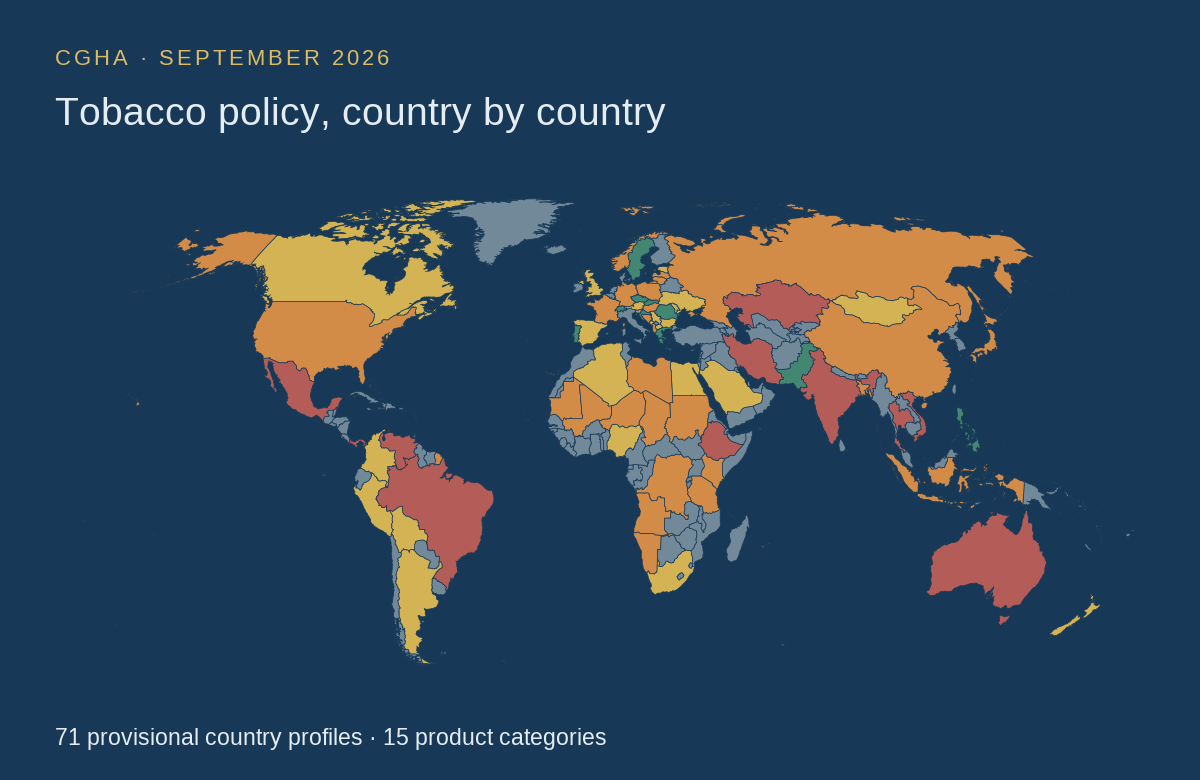
Research snapshot, November 25, 2026. This inventory covers 68 countries and jurisdictions, including comparators and open cases. It asks a narrower question than whether a country has strict tobacco regulation. Can adults lawfully buy the relevant product through an ordinary retail channel? The table shows reported category-wide sales prohibitions separately from import-only or disposable-only restrictions, pharmaceutical routes, bills and repealed laws. Tobacco-free nicotine pouches are distinct from tobacco snus. The count of rows is a count of places investigated, not a count of confirmed current bans.
Reading the table. Yes means a ban supported by a country-specific source or case study. WHO† is WHO’s reported nicotine-vape sales-ban classification for 2024. Scan† is a sales prohibition reported by the heated-tobacco or pouch scan and still awaiting a fresh country-level check. Medicinal† means the pouch scan reported a medicines route with no approved pouch products as of August 2025. — means the table makes no finding about that product. Sales coding alone says nothing about possession or use. WHO treats the Cook Islands and occupied Palestinian territory as separate entries, and Hong Kong and Taiwan are separately listed for their distinct regulatory regimes.
| Country or jurisdiction | Nicotine vapes | Heated tobacco | Tobacco-free pouches | Scope or verification note |
|---|---|---|---|---|
| Afghanistan | — | Scan† | — | See baseline sources below. |
| Argentina | Repealed | Repealed | Registration framework | ANMAT and the health ministry announced replacement of blanket bans with a regulatory framework in May 2026. |
| Australia | Pharmacy only | Scan† | Medicinal† | The vape route is through pharmacies. The 2025 pouch scan reports medicines classification and no approved pouch products. |
| Azerbaijan | Yes | — | — | 2026 law prohibits vape sales, import, storage and use. |
| Bangladesh | Import ban | Scan† | — | WHO reports an import ban. The April 2026 Act repealed the 2025 ordinance. The current general sales position needs further reconciliation. |
| Belgium | Disposable only | — | Scan† | Category-wide pouch sales ban. The vape measure concerns disposables. |
| Brazil | WHO† | Scan† | — | See baseline sources below. |
| Brunei Darussalam | WHO† | — | — | See baseline sources below. |
| Cabo Verde | WHO† | — | — | See baseline sources below. |
| Cambodia | WHO† | Scan† | — | See baseline sources below. |
| China | — | Scan† | — | See baseline sources below. |
| Cook Islands | WHO† | — | — | See baseline sources below. |
| Cuba | WHO† | — | — | See baseline sources below. |
| Cyprus | — | — | Medicinal† | See baseline sources below. |
| Ethiopia | WHO† | Scan† | — | See baseline sources below. |
| France | Disposable only | — | Yes | French government reports that the April 2026 restriction reaches sale, import, possession and use. The interim suspension covered manufacture, production and export. |
| Gambia | WHO† | — | — | See baseline sources below. |
| Germany | — | — | Scan† | Effective sales exclusion via food-law classification in the pouch scan. Distinguish this mechanism from a specific possession or use ban. |
| Ghana | WHO† | — | — | See baseline sources below. |
| Hong Kong | Yes | Yes | Medicinal† | Separate jurisdiction. Health Department confirms the sales and import bans and a public-place possession rule for specified products from April 2026. |
| India | WHO† | Yes | Medicinal† | The 2019 Act covers specified heated devices and chiefly targets supply and storage. |
| Indonesia | Regulated | — | — | Case-study comparator. National restrictions preserve adult vape sales channels. |
| Iran | WHO† | Scan† | — | See baseline sources below. |
| Iraq | WHO† | — | — | See baseline sources below. |
| Japan | — | — | Medicinal† | See baseline sources below. |
| Jordan | WHO† | — | — | WHO country-profile coding is retained as a dated finding. Current licensing practice warrants verification. |
| Kazakhstan | WHO† | — | — | See baseline sources below. |
| Kenya | — | — | Proposed | Clause 51 would reach personal use. The paper verified introduction only. |
| Kyrgyzstan | WHO† | — | Scan† | WHO codes nicotine-vape sales as banned. A 2026 resolution also imposes a six-month import restriction on specified products. |
| Laos | WHO† | Scan† | — | See baseline sources below. |
| Lithuania | — | — | Scan† | See baseline sources below. |
| Luxembourg | — | Scan† | — | See baseline sources below. |
| Malaysia | Unresolved | — | — | Some states restrict sales, and federal policy has been contested. A nationwide blanket ban could not be verified. |
| Maldives | WHO† | Scan† | — | See baseline sources below. |
| Malta | — | Scan† | — | See baseline sources below. |
| Marshall Islands | WHO† | — | — | See baseline sources below. |
| Mauritius | WHO† | Scan† | Scan† | See baseline sources below. |
| Mexico | WHO† | Scan† | — | See baseline sources below. |
| Nauru | WHO† | — | — | See baseline sources below. |
| Netherlands | — | — | Scan† | See baseline sources below. |
| New Zealand | Disposable only | — | Medicinal† | Disposable-vape restriction. Medicinal coding for pouches is from the 2025 scan. |
| North Korea | WHO† | — | — | See baseline sources below. |
| Norway | WHO† | Scan† | Unresolved | WHO baseline concerns nicotine-containing vapes. The pouch scan describes overlapping medicinal and tobacco rules. Confirm availability and classification by product before treating it as a blanket ban. |
| Oman | WHO† | Scan† | — | See baseline sources below. |
| Palau | WHO† | — | — | Domestic vape ban reaches use. The international nicotine review request concerns a separate process. |
| Palestinian territory | WHO† | — | — | See baseline sources below. |
| Panama | Unresolved | Unresolved | — | The Supreme Court struck down Law 315. A 2025 resolution addresses sales to minors and promotion. Older measures and their remaining scope need reconciliation. |
| Papua New Guinea | Unresolved | — | — | May 2025 GGTC list conflicts with WHO’s 2024 country profile. Later national ban instrument was not verified. |
| Qatar | WHO† | Scan† | — | See baseline sources below. |
| Russia | — | — | Scan† | See baseline sources below. |
| Seychelles | — | Scan† | — | See baseline sources below. |
| Singapore | WHO† | Scan† | Scan† | See baseline sources below. |
| Sri Lanka | WHO† | Scan† | — | See baseline sources below. |
| Suriname | WHO† | — | — | See baseline sources below. |
| Syria | WHO† | — | — | See baseline sources below. |
| Taiwan | Yes | Regulated | — | Health Promotion Administration confirms the vape ban and an authorization route for heated tobacco, with products approved. |
| Tajikistan | — | — | Scan† | See baseline sources below. |
| Thailand | WHO† | Scan† | — | See baseline sources below. |
| Timor-Leste | WHO† | — | — | See baseline sources below. |
| Turkmenistan | WHO† | Scan† | — | See baseline sources below. |
| Türkiye | WHO† | Scan† | — | WHO country profile treats import and production restrictions together as a vape sales ban. It records a personal-import exception. |
| Uganda | WHO† | Scan† | — | See baseline sources below. |
| United Kingdom | Disposable only | — | — | The disposable-vape restriction leaves compliant reusable products on sale. |
| Uruguay | Yes | Yes | — | Decree 125/025 extended the commercial restrictions and reversed the previous heated-tobacco opening. |
| Uzbekistan | Yes | — | Scan† | Law LRU-1098 also reaches acquisition and storage. |
| Vanuatu | WHO† | Scan† | — | See baseline sources below. |
| Venezuela | WHO† | Scan† | — | See baseline sources below. |
| Vietnam | WHO† | Yes | Unresolved | Vape and heated-tobacco prohibition verified in the case study. The pouch scan recorded a ban pending further action, so pouch status remains provisional. |
Sources and disagreements
- WHO global tobacco epidemic report 2025, Figure 48 provides the dated nicotine-vape baseline. WHO European Region factsheet distinguishes nicotine-vape bans from disposable restrictions and records Uzbekistan’s subsequent adoption.
- GGTC May 2025 vape inventory is a cross-check. Its list includes Bahrain, Chile, Colombia, Egypt, Kuwait and Lebanon with qualifications, while WHO codes these markets as regulated. These were left outside the table’s prohibition entries absent a verified category-wide change.
- Global State of Tobacco Harm Reduction heated-tobacco inventory is the broad screening list. The Johns Hopkins heated-tobacco scan has different coverage and sometimes different coding. Brunei and Palau should not be treated as heated-tobacco bans merely because they prohibit vapes. The table supersedes the heated-tobacco scan’s Argentina and Panama entries where newer legal records warrant it.
- Johns Hopkins global nicotine-pouch policy scan, Table 1 gives the August 2025 pouch baseline, including the differences between direct bans and medicinal pathways. France is updated from its 2026 government notice.
What the global comparison adds
France and Azerbaijan broaden the case studies in useful ways. France reaches the adult who acquires or uses a pouch. Azerbaijan shows that a vape prohibition can reach private behavior as well as commercial conduct. Taiwan offers a comparison in which regulators prohibit vapes but authorize specific heated-tobacco products. Argentina shows that governments can reverse earlier prohibitions and move to registration. The variation matters. A law that eliminates all ordinary sales channels raises a different question from one that excludes disposables, imposes product standards, or restricts where the product can be used.
The proportionality critique is sharpest where a government permits ordinary cigarette sales and bars adult access to an entire noncombustible category. The legal inventory identifies where to ask that question. It does not establish the extent to which each ban changed smoking, youth use, industry concentration or informal supply. Those outcomes remain separate questions for empirical work.