Illustrative image generated with AI.
The United Kingdom and United States in a global context
Disease prevention injury and the limits of compulsion
Center for Global Health Accountability | 27 October 2026
Research on what vaccination has achieved, whom it benefits, what it costs, and when public policy goes too far. The principal histories are British and American, placed alongside evidence from poorer countries and selected OECD policy comparisons.
The evidence examined here supports vaccination as an important means of preventing disease. It also supports a more discriminating judgment than either blanket reassurance or blanket rejection. Benefits and injuries belong to particular products, recipients and circumstances. This report asks how far those conclusions survive uncertainty in the evidence, and what they can legitimately justify in public policy.
Contents
- Introduction
- 1 What counts as a benefit
- 2 Why deaths fell before vaccination
- 3 What evidence can establish
- 4 Smallpox and the changing case for vaccination
- 5 Polio and affluent societies
- 6 Measles before and after vaccination
- 7 Mumps rubella and the limits of combined categories
- 8 Diphtheria tetanus and pertussis
- 9 Meningitis pneumonia and invasive bacterial disease
- 10 Hepatitis HPV and cancer
- 11 Rotavirus varicella and the value of avoiding hospitalization
- 12 Influenza and modest absolute benefits
- 13 COVID and the need for separate judgments
- 14 How vaccine injuries are found or missed
- 15 Who produces the evidence
- 16 Where vaccination saves most lives
- 17 Hesitancy trust and polarization
- 18 Consent recommendations and accountability
- 19 When vaccination is worth taking
- 20 COVID mandates and the burden of justification
- 21 Different countries different vaccination policies
- 22 A qualified success and the limits of compulsion
- Additional vaccines and adult outcomes
- Data definitions and verification
- Glossary of key terms
- References and evidence notes
Introduction
CGHA considers the science underpinning vaccination sound and vaccination one of the great contributions to public health. Its achievements include preventing deaths, serious illness and lasting disability. Those achievements do not make all vaccines equal, or establish that every dose, recommendation or mandate is justified. Each should be assessed by its performance in the circumstances in which it is used.
This report examines that performance: which disease is prevented, which product is used, who receives it, how long protection lasts, what harms occur, and how reliable the evidence is. Age, health, prior infection, previous vaccination and local disease burden can change the balance. CGHA’s approach is to judge benefits, harms and uncertainty openly, and to revise conclusions when better evidence becomes available.
The central question is what each vaccination changes for particular people. That question has a historical form: how much did vaccination contribute after better living conditions and medical care had already reduced deaths? It has a contemporary form: what does another dose offer someone of a given age and health status, with a given exposure and immune history? It also has a public-policy form: when does the evidence support paying for, recommending, or requiring an intervention? Those questions cannot be answered by the same percentage.
The United Kingdom and United States provide the main evidence base. Where a series covers England and Wales, we name that geography. Evidence from poorer countries tests the generality of the findings and shows the potentially larger survival gains where infection is more dangerous and treatment less accessible.
For established childhood programs, the largest absolute survival gains occur where preventable infection and fatality remain high, conditions concentrated in poorer countries. This does not establish that every vaccine is more valuable in every poor country or that the formal UN group of least developed countries receives most benefits. Chapter 16 examines the distinction.
The chapters begin with disease and its consequences, then examine vaccination. This order prevents a marketing claim or a recent controversy from becoming the organizing principle. The later chapters connect disease-specific evidence with the Cambridge and Montgomery County comparison, distinguishing questions about individual vaccines from confidence in the institutions recommending them.
1 What counts as a benefit
An infection can matter without killing. A child with meningitis may survive with impaired hearing. A person with paralytic polio may survive for many decades with a permanent disability. Rubella can be relatively mild for the person transmitting it and devastating to a fetus. A study confined to deaths would miss much of the reason these diseases attracted preventive attention. The corresponding harms of vaccination deserve the same breadth of measurement.
Benefit should therefore be stated as a set of outcomes: infection, symptomatic illness, medical attendance, hospitalization, lasting impairment, and death. These outcomes are related, but they are not interchangeable. A product may reduce severe illness more reliably than it prevents every infection. Another may reduce transmission as well as protect the recipient. An antibody measurement can support a biological explanation without supplying a direct count of admissions or deaths prevented.
The denominator determines how a percentage should be understood. Relative efficacy compares risks in vaccinated and comparison groups. Absolute benefit describes the difference between them over a specified period. In the healthy-adult influenza trials assembled by Cochrane, confirmed influenza affected approximately 2.3% of unvaccinated participants and 0.9% of vaccinated participants. A sizable relative reduction thus accompanied a small absolute reduction. Neither measure invalidates the other.
Duration also belongs in the sentence. Preventing an illness during one season is different from preventing it for decades. Dose number, time since vaccination, prior infection, and exposure cannot be relegated to technical appendices if they change the clinical balance. A finding in vulnerable older people does not automatically justify the same expectation in healthy young adults.
There are benefits to other people, but these require evidence too. A recipient may be less likely to transmit an organism, or community transmission may fall as susceptible people become less numerous. Such effects cannot be assumed for every vaccine. Tetanus, which is not transmitted between people, makes the distinction particularly clear: its preventive rationale is individual protection against environmental exposure.
The appropriate account begins with health outcomes in natural units. It then asks how patients value them and what resources prevention consumes. A recommendation should remain understandable even to a reader who disagrees with the monetary value assigned to a year of life.
A practical comparison needs a credible alternative. For a child in Britain today, the alternative to vaccination includes modern medical care and the protection supplied by other people's vaccination. It does not include the mortality conditions of Victorian Britain. For a national program, however, holding everyone else's protection constant while removing the program is incoherent. Individual decisions at high coverage and the consequences of abandoning a program are different counterfactuals. The difference explains why a very low observed disease rate cannot, on its own, establish that continuing prevention has no value.
The arithmetic should remain visible. Suppose the risk of a specified illness over a season is 2 in 100 without vaccination and 1 in 100 with it. The relative reduction is half, the absolute reduction is one percentage point, and 100 vaccinations would prevent one illness on average under those conditions. If the background risk falls tenfold while the relative effect stays the same, the absolute reduction also falls tenfold. These are illustrative numbers, not estimates for a vaccine. They explain why a headline percentage cannot establish the clinical or economic case.
Severity cannot be handled by counting every event as equivalent. One temporary fever, one hospital admission, and one permanent neurological injury are not interchangeable units. Nor can a composite outcome be understood without its components. A fair assessment first reports outcomes separately and then makes any weighting explicit. The public can reasonably disagree over how to value a small chance of severe harm while agreeing on the underlying probabilities.
This is especially relevant to repeated recommendations. Evidence that an initial course benefited a susceptible population does not establish the additional benefit of another dose after infection, previous vaccination, or a change in circulating pathogen. Each extension needs an estimate of what it adds. The same standard applies when a new formulation is substituted for an older one.
We count serious illness and lasting disability alongside death, but we insist that each be measured separately. This is the standard we use to judge vaccination throughout the report. An impressive relative percentage is insufficient; the practical question is what happens to people who receive the intervention compared with those who do not.
2 Why deaths fell before vaccination
The twentieth-century decline in infectious mortality is broader than the history of vaccines. McKinlay and McKinlay challenged the share attributed to medical intervention in the earlier US mortality decline. We take that challenge seriously: a vaccine cannot cause an improvement that preceded its arrival. But explaining a century's mortality decline and estimating what a vaccine added when introduced are different tasks.
Deaths reflect both the frequency of infection and the probability of dying once infected. Better living conditions and treatment can affect either, with different mechanisms for different diseases. Clean water interrupts some transmission routes; antibiotics can treat secondary bacterial infection. Prosperity is therefore part of the explanation, but it is not a mechanism that explains every disease trajectory.
Measles supplies a particularly useful test. Calculations from the England-and-Wales historical table show average annual notifications of about 342,669 in 1940–49 and 412,094 in 1958–67. Average annual deaths over those windows fell from 568.7 to 86.3. This descriptive comparison is consistent with much improved survival while infection continued to circulate. It does not identify the respective contributions of nutrition, housing, antibiotics, or other changes.
The fact that deaths had fallen should limit claims about vaccination's share of the entire historical mortality improvement. It does not remove the remaining deaths or the nonfatal burden. It also does not establish that infections would have disappeared without vaccination. Those are separate propositions requiring different evidence.
Raw counts need further work before becoming mortality rates. Populations grew and aged. Birth cohorts changed. Registration and diagnostic rules changed. The early historical series must be assessed for geographical completeness and the way deaths were classified. ONS provides guidance on the changing measles codes and the earlier mortality files; those pre-1940 annual files were not retrieved for this review.
Our graphics therefore identify what they actually contain. Annual counts are labeled counts. Population rates are used where matching denominators have been extracted. Selected period averages are not drawn as an invented continuous line. Historical comparisons are presented as evidence about trajectories, with causal interpretation reserved for a combination of designs.
The timing objection is strongest when a historical narrative credits vaccination with the whole fall from an early mortality peak. For measles in Britain, much improved survival was already apparent while large epidemics continued. A graph beginning shortly before vaccine introduction can obscure this achievement of earlier social and medical change. A graph ending at introduction can obscure what happened to infections afterward. Both truncations can mislead even when every plotted observation is accurate.
The useful counterfactual allows continued progress in survival. If modern care would have reduced deaths per infection even without vaccination, that reduction belongs to care. The vaccine's mortality contribution depends on the infections it prevents multiplied by the fatality risk under that improved care. This formulation will usually yield a smaller mortality benefit than freezing an early historical fatality rate. It can still yield a substantial benefit when a very common infection is prevented. The nonfatal effects need their own calculation.
Historical data also impose a restraint on apparent precision. Reported cases are often a fraction of infections, while fatal cases may be more likely to attract investigation. Dividing registered deaths by notifications therefore does not automatically yield an infection-fatality risk. Matching numerator and denominator matters as much in a historical table as in a modern trial. A ratio can change because reporting changed, because survival changed, or because both changed.
The most informative historical account asks several questions in sequence. Was the disease becoming less lethal? Was its circulation changing? What treatment became available? Did the age distribution shift? Was the vaccine introduced gradually or widely? The answer may differ between diseases, which is precisely why one general story about sanitation or one general story about vaccines is inadequate.
Figure 1 US measles mortality before vaccine introduction
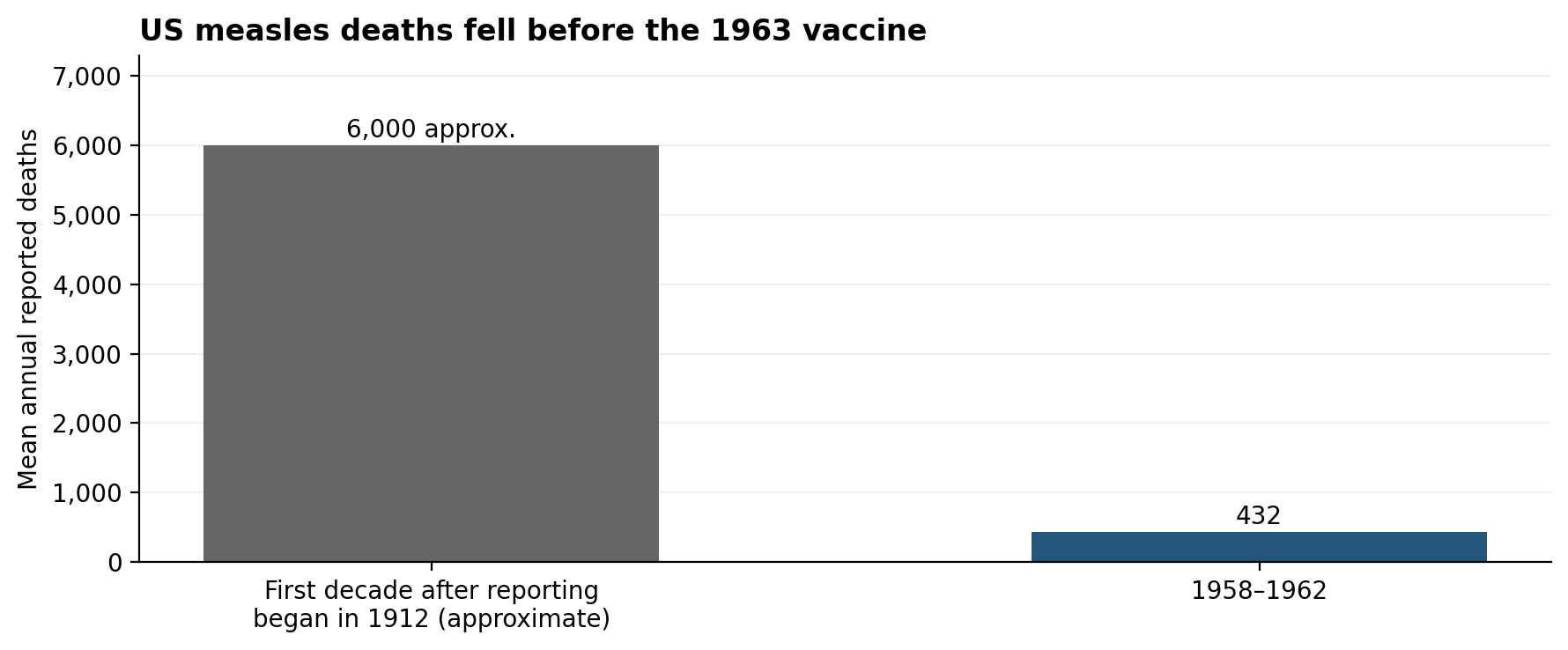
Two published period averages, not an annual series and not age-adjusted rates. The early value is approximate and reporting coverage changed. Do not infer a precisely measured causal percentage decline from these two bars.
Our conclusion is that the mortality decline before vaccination changes the size and attribution of the benefit; it does not abolish the later benefit. We reject both an account that credits vaccines with earlier improvements and an account that treats the surviving disease burden as irrelevant because fewer people died.
3 What evidence can establish
Random allocation helps prevent differences between people from becoming confused with an effect of treatment. A trial can nevertheless answer a narrow question well while leaving broader questions unanswered. Its participants, comparator, outcome, follow-up, and exclusions define its reach. An early trial of symptomatic illness does not automatically measure later mortality or the effects of repeated doses.
Observational research is indispensable for uncommon injuries and real-world severe outcomes. It also faces selection. People who accept vaccination can differ from those who decline in frailty, health behavior, medical access, and willingness to seek testing. Jackson and colleagues' US influenza research found mortality differences before influenza season, exposing bias that could otherwise be mistaken for vaccine protection.
National histories offer another form of evidence. A change near program introduction is suggestive, especially if it recurs across places at different dates and appears in relevant age groups. Interrupted trends, comparison groups, and biological specificity strengthen interpretation. Epidemic cycles, treatment changes, and altered surveillance can weaken a simple comparison. The value of the historical tables lies partly in making these alternative explanations visible.
Models answer a different question: what might have occurred under an unobserved alternative? Historical reconstructions and global deaths-averted estimates require assumptions about exposure, coverage, protection, and fatality. Their outputs can inform decisions, but they should retain their identity as estimates. The historical data projects and global immunization studies cited here are useful starting points for examining those assumptions.
The same discipline applies to harm. Insufficient evidence to establish a relationship is different from persuasive evidence against one. The Institute of Medicine's causality framework explicitly distinguishes these positions. A conclusion should state which is justified for the particular vaccine and outcome.
This is a narrative evidence review with original descriptive calculations from identified historical records. It is not a systematic review or a new meta-analysis. We draw stronger conclusions where trials, surveillance and clinical evidence converge, and narrower ones where they do not. The reference register identifies the material inspected, including records or abstracts where full study files have not been reviewed. That distinction limits particular judgments; it does not require suspending all judgment.
Comparator choice requires an explicit account of the question. A saline-controlled trial can estimate the effect of a whole formulation relative to an injection without its active ingredients. A comparison against an existing vaccine can estimate the additional effects of a replacement product. An adjuvant-containing comparator may help isolate one ingredient but cannot establish the whole formulation's effects relative to no exposure. None of these comparisons answers every question. The evidence review should name the comparator rather than describe all trials simply as placebo-controlled.
Rare-event evidence benefits from designs that compare different risk windows within the same person. Such approaches reduce confounding by stable personal characteristics, but depend on assumptions about event timing, vaccination after illness, and changing infection pressure. Large linked-record studies also require attention to people whose previous infections were never recorded. A very large dataset narrows random uncertainty; it does not automatically remove systematic error.
Independent replication must mean more than a second institution repeating the same estimate. Studies can share data, case definitions, models, and assumptions. Confidence rises more when a result survives genuinely different sources of information: a randomized trial, a national disease series, and an outbreak with documented vaccination status. Conversely, disagreement between these sources is a reason to investigate, not to select whichever estimate supports a preferred policy.
The review therefore gives each major claim two assessments. One concerns the size and certainty of the health effect. The other concerns access to the material needed to audit it. An effect can be well supported despite imperfect access, and a beautifully documented dataset can still answer the wrong question. Keeping these judgments separate avoids both automatic deference and automatic rejection.
What the evidence review establishes
We distinguish checking a paper from reproducing its analysis. Reading methods, tables, a protocol or a supplement can identify an unsupported interpretation; it does not demonstrate that every record was coded correctly. Reproduction additionally requires the underlying data, code and assumptions. The reference notes distinguish complete main-paper inspection, targeted review of accessible sections, and abstract-only access. A large reference list should never conceal those differences.
The evidence reviewed here supports our broad conclusions while imposing several limits. Illness prevention is better established than mortality reduction in some trials. A nonsignificant difference in serious adverse events is not a demonstration of equivalence. Self-controlled safety studies reduce some confounding while retaining other biases. Model intervals can omit substantial uncertainty. These distinctions determine how confidently we state a result rather than whether we am permitted to state one at all.
The Amish: a comparison that must be tested
Living in Pennsylvania makes the Amish an obvious comparison to consider. If a population with much less vaccination experienced no greater burden of the diseases vaccines target, that would be important evidence. But both the exposure and the outcome must be measured. Amish affiliation cannot stand in for an individual vaccination record, and an impression of good health cannot stand in for comparable disease surveillance.
Vaccination is not uniformly absent. In a Holmes County, Ohio, survey mailed in 2007, 359 parents responded; 68% said all their children had received at least one immunization, 17% said some had, and 14% said none had. The reported response rate was 37%. These family-level answers do not establish completed schedules or coverage in Pennsylvania; nonresponse also limits representativeness. They do show why it would be a mistake to label every Amish child unvaccinated.
The directly relevant Pennsylvania outcome study does not support an absence of excess vaccine-preventable disease. Williamson and colleagues reviewed Penn State Children’s Hospital records for 2005–2015. Using estimated child populations in the primary service area, they reported a relative risk of hospitalization for vaccine-preventable disease of 2.67 in Amish children compared with non-Plain children (95% confidence interval 1.87–3.82). This concerns a defined set of illnesses and admissions, not all disease, mortality or overall health. The accessible abstract, rather than a complete full-paper audit, is the basis for this estimate here.
We would not treat that association as the isolated effect of refusing vaccination. A single referral hospital can capture groups differently; population denominators, age distribution, exposure and decisions to seek care need examination. The finding nevertheless challenges the proposed factual premise. We should apply the same scrutiny to favorable Amish comparisons as to favorable pharmaceutical studies, rather than dismiss either because it conflicts with an initial expectation.
The 2014 Ohio measles outbreak supplies a different kind of evidence. Investigators reported 383 outbreak-related cases, 380 among Amish people, after importation associated with two unvaccinated travelers. This establishes that substantial measles transmission can occur in an underimmunized Amish setting. A case count without comparable exposure denominators does not independently measure vaccine effectiveness, and the outbreak response included interventions beyond vaccination.
Invasive Hib also occurred in unvaccinated Amish children in Missouri in 2014. The published three-child report included one death. A case series has no population denominator and cannot estimate comparative incidence, but it is sufficient to reject a claim that serious vaccine-preventable illness never occurs in these communities. The investigation also records subsequent vaccine uptake, another reason not to treat affiliation as a permanent exposure category.
A credible comparison would follow vaccinated and unvaccinated children within specified Amish settlements and in nearby communities, using product and dose records, age-specific person-time, comparable diagnostic criteria and active outcome ascertainment. Family size, household mixing, travel, occupation, healthcare use and prior infection would require attention. For communicable infections, surrounding vaccination can alter exposure; a low observed burden during a quiet period does not show what would happen after an introduction. Tetanus, which does not spread between people, asks a different question.
The same design would need to investigate proposed long-term harms rather than rely on different rates of recorded diagnoses. An apparent difference in a chronic condition may reflect real biology, different exposures or different access to assessment. The infectious-disease findings cannot settle every proposed chronic outcome, and a favorable chronic-outcome comparison would not erase an infectious-disease risk. Each claim needs its own denominator and ascertainment.
This comparison helps distinguish decisions rather than supplying a verdict on vaccines as a class. A vaccine with a strongly favorable balance can still injure a small number of recipients; those injuries remain part of informed consent. Conversely, the additional benefit of a later dose in a low-risk person may be modest without the dose being proved harmful. The Amish studies examined here do not establish an advantage from declining COVID vaccination. That proposition requires COVID-specific outcomes, prior-immunity information, product and dose histories, and comparable follow-up. Early protection of vulnerable adults and later doses in healthy previously infected people remain separate questions.
Our conclusion is that Amish communities are valuable populations for careful comparative research, but are not a ready-made untreated control group. The Pennsylvania hospitalization finding and documented outbreaks weigh against the claim that undervaccination carries no additional disease burden. They do not justify attributing every health difference to vaccination or concluding that every vaccine recommendation is warranted. This is a useful test precisely because the answer must be allowed to challenge either side.
Figure 2 UK program milestones
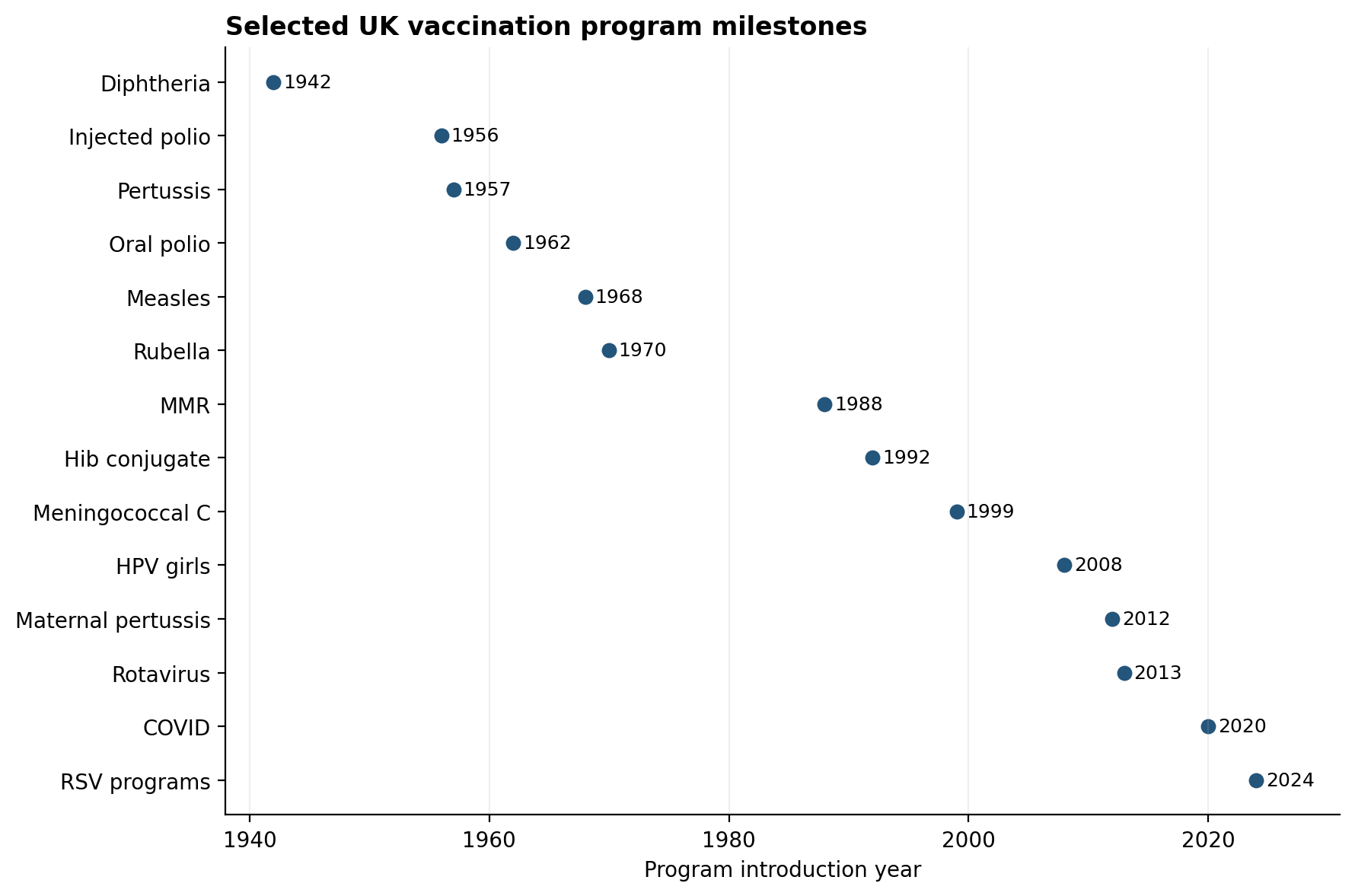
Selected dates from UKHSA timeline. Dates identify national program milestones, not invention, first experimental use, full coverage, or identical implementation across all UK nations. US milestones are marked on US disease figures.
We do not require one impossible experiment to resolve every historical question. We give most weight to agreement between designs with different weaknesses. Where the evidence remains narrow, our conclusion remains narrow. Neither skepticism nor institutional confidence can substitute for that discipline.
4 Smallpox and the changing case for vaccination
Smallpox is a test of whether success can change the justification for continuing an intervention. Vaccination formed part of the strategy that eliminated the disease, alongside surveillance, isolation, contact investigation, and containment. Treating eradication as the work of a vial alone understates the program. Treating containment as evidence that vaccination was dispensable would understate it in a different way.
For Britain and the United States, the relevant history includes repeated importation threats, unequal access to protection, the distinction between more and less severe forms of smallpox, and the costs imposed by vaccination itself. We should not estimate benefit by assuming one unchanging fatality rate across all outbreaks. Nor should the decline in notifications automatically be credited to one legal requirement without examining implementation and uptake.
The CDC historical summary records the last US case in 1949. Its annual tables document the final reported cases and subsequent absence. This part of the record is a late-stage account, long after vaccination began; it cannot by itself estimate the original effect of vaccine introduction. An eighteenth-century milestone and a twentieth-century annual series do not form a clean experimental comparison.
Older replicating vaccinia products could cause severe complications, including progressive vaccinia and post-vaccinial encephalitis. Contact transmission could injure people who had not themselves chosen vaccination. Historical US safety reviews and clinical reports provide the appropriate evidence base; their rates must be tied to product, primary vaccination versus revaccination, age, and underlying conditions. They cannot be transferred to every modern smallpox or mpox product.
Once routine exposure disappeared, the expected benefit for the ordinary recipient fell sharply. Continuing an intervention with a nonzero injury risk then required a different justification. Eradication is therefore also a story about stopping routine vaccination. That decision can be compatible with the judgment that earlier vaccination delivered enormous benefit.
The global account adds a durable benefit: people born after eradication avoid the disease without needing routine vaccination. An evaluation confined to immediate recipients would miss this inheritance. Its valuation requires an explicit time horizon, however, and should not be used as a template for diseases whose biology makes eradication much harder.
The chapter's present conclusion is limited but substantial. The smallpox record supports the joint effectiveness of vaccination and organized containment, and it establishes serious product-specific harms. A fuller British and American mortality reconstruction before eradication is still needed before assigning a precise fraction of historical deaths prevented.
Smallpox also exposes the difference between a historical achievement and a standing authorization. The enormous value of eliminating the disease does not make every campaign, product, or enforcement practice beyond criticism. A policy could contribute to disease control while imposing avoidable injuries or inequitable penalties. Evaluating those penalties requires evidence about their additional effect beyond voluntary vaccination and organized outbreak response.
The endpoint after eradication is unusual. Continuing protection depends partly on avoiding reintroduction and retaining response capacity, while ordinary people no longer face naturally circulating smallpox. The collective success reduces the individual reason to accept a product carrying appreciable risk. This is not a contradiction. It is the expected result of a successful intervention changing the environment in which its future use is judged.
We regard smallpox vaccination as a decisive contribution to eradication, alongside surveillance and containment. The history does not establish that one legal regime was indispensable everywhere. The clinical achievement is extraordinary; the necessity of a particular form of compulsion remains a separate historical claim.
An assessment that changes after eradication
The appropriate counterfactual changes across the history of smallpox. During endemic circulation, avoiding a frequently fatal infection was the central benefit. During the final eradication campaigns, stopping a chain of transmission also protected people who would never themselves receive vaccine. After eradication, ordinary exposure largely disappeared. Continuing routine vaccination would then preserve a real adverse-event burden against a very different probability of natural infection. The same product could therefore justify a vigorous campaign in one period and cessation of routine use in another.
This is an unusually strong demonstration of the value of collective prevention, but also of the need for a stopping rule. Eradication produced benefits after vaccination ceased. Those continuing gains should be counted when assessing the campaign, while the hypothetical cost of vaccinating everyone forever should not be charged to the policy actually adopted. Conversely, a contemporary emergency stockpile or occupational offer requires its own exposure-based justification. Our conclusion is that eradication was an enormous achievement and that ending routine use was part of its success, rather than an admission that vaccination had failed.
5 Polio and affluent societies
Polio is difficult to fit into an account in which rising prosperity simply made vaccination unnecessary. Large epidemics affected industrialized countries. The burden included paralysis and prolonged dependence on care, not merely deaths. The United States reported more than 21,000 paralytic cases in 1952. A successful preventive intervention could therefore remain valuable even when most infections were mild or clinically silent.
The US historical tables show both total reported polio and a separately reported paralytic category for later years. The decline across the vaccine era is clear, but the categories should not be merged. A reader concerned about changing diagnosis is entitled to see the subtype series, its missing early values, and the definitions used. A claim that all apparent improvement arose from relabeling would itself require evidence that the clinical burden persisted elsewhere.
Polio challenges the suggestion that vaccination's important gains belong only to poor countries. Paralysis was a substantial burden in wealthy societies, and survival could mean a lifetime of restricted mobility, respiratory support, or later functional problems. Counting deaths alone makes this burden nearly disappear statistically while leaving it fully present in people's lives. The distinction is a reason to broaden the outcome measure, not a reason to inflate mortality claims.
The American and British histories also help prevent an epidemic peak from doing too much work. Polio fluctuated before vaccination; comparing the largest epidemic with a quiet later year overstates what a two-point calculation can establish. The longer series shows the subsequent sustained suppression more clearly. Trial evidence and the timing of programs then add information that a before-and-after chart cannot supply by itself.
Product choice altered the harm profile. Inactivated and oral vaccines should not be pooled into a single safety estimate. Oral vaccine's capacity to cause vaccine-associated paralysis and contribute to vaccine-derived circulation under some conditions belongs in the same account as its practical advantages for transmission control. Moving to an inactivated schedule in an appropriate setting is an example of adjusting policy as risks change.
The affluent-country conclusion is consequently strong but specific: preventing paralytic disease was a major achievement. It does not follow that every historical dose, formulation, or legal requirement was optimal. Nor does the present rarity of wild-virus disease show that the original burden was imaginary. The remaining policy question concerns which product and coverage strategy best preserve protection with the fewest injuries.
The Salk field trial supplies evidence beyond an aggregate national curve. Its design included placebo-controlled and observed-control areas. Those components deserve separate treatment, including enrollment and allocation procedures. The original statistical report remains the necessary basis for a precise reconstruction of trial efficacy rather than a celebratory retelling of its announcement.
Britain's program developed on a different timetable. The official timeline places injected polio vaccination in 1956 and oral vaccination in 1962. The archival British table reproduced here records notifications and distinguishes deaths including late effects from deaths excluding them. A death decades after infection should not be interpreted as failure to prevent a new infection in the year of death.
The distinction between products is fundamental. Oral vaccine can produce vaccine-associated paralysis and, under particular conditions, vaccine-derived circulation. Inactivated injected vaccine does not contain replicating poliovirus and cannot cause that mechanism of injury. CDC's record of US vaccine-associated cases and the later move to an injected-only program show that the preferred balance changes as wild-virus exposure falls.
The Cutter manufacturing failure belongs alongside efficacy in the history of polio vaccination. It demonstrates that an effective preventive technology can injure through failures of production and oversight. Correct manufacture is part of the intervention, not an administrative afterthought. We do not use that episode to estimate the risk of properly manufactured doses, or attach disputed casualty totals without the underlying investigations.
Our British transcription also illustrates the importance of checking sources: the printed subtype counts for 1951 sum to 100 more than the printed total. The chart preserves the source total and flags the discrepancy. This does not explain the later decline, but it prevents an archival inconsistency from being silently converted into a supposedly exact dataset.
Which polio vaccine and which risk?
For polio, the decisive clinical outcome is paralysis, including respiratory impairment and long-term disability. Falling deaths alone can obscure these outcomes as respiratory support improves. A reasonable assessment therefore reads the paralytic series alongside mortality, while retaining the distinction between a reported case and an infection. This prevents better treatment from being mistaken for elimination of the disease.
Product choice belongs inside the judgment. Inactivated vaccine cannot reproduce the live-vaccine mechanism of vaccine-associated paralysis. Oral vaccine has practical and transmission-control advantages in some campaigns, but its rare recipient or contact injuries and the possibility of circulating vaccine-derived virus matter. These are not interchangeable products with one fixed global balance. The attractive strategy changes with local circulation, population immunity and the feasibility of delivery.
We favor maintaining appropriate protection in affluent countries despite very low contemporary incidence. That incidence is partly an outcome of control, not necessarily the risk that would persist after sustained withdrawal. Nevertheless, maintaining inactivated-vaccine protection and giving repeated live-vaccine campaigns require different arguments. The burden of proof belongs to the actual product and setting.
Figure 3 US total and paralytic polio reports
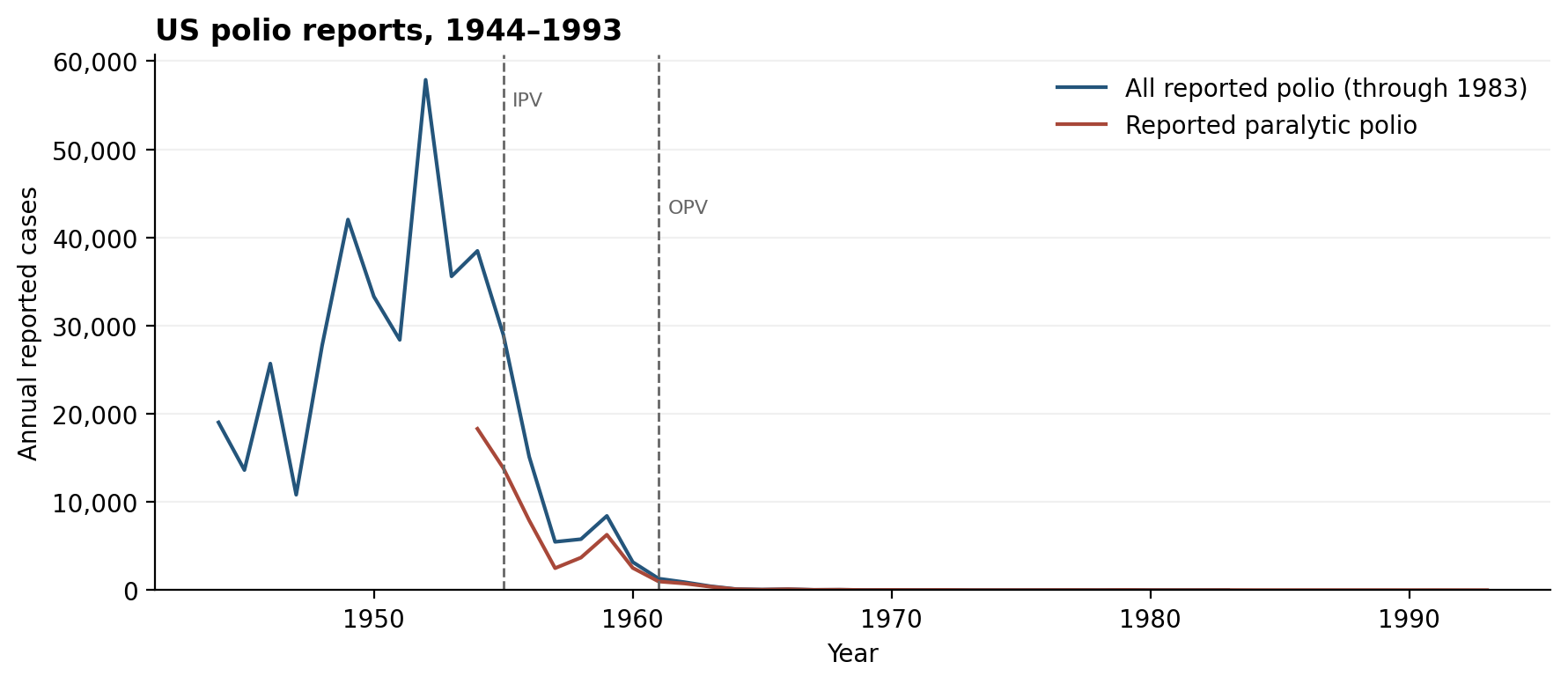
CDC historical tables; paralytic subtype data are not printed for the earliest years and remain missing. Cases include different etiologies in later years. The curves must not be read as a fully harmonized clinical definition.
Figure 4 Polio notifications and deaths with product introduction dates
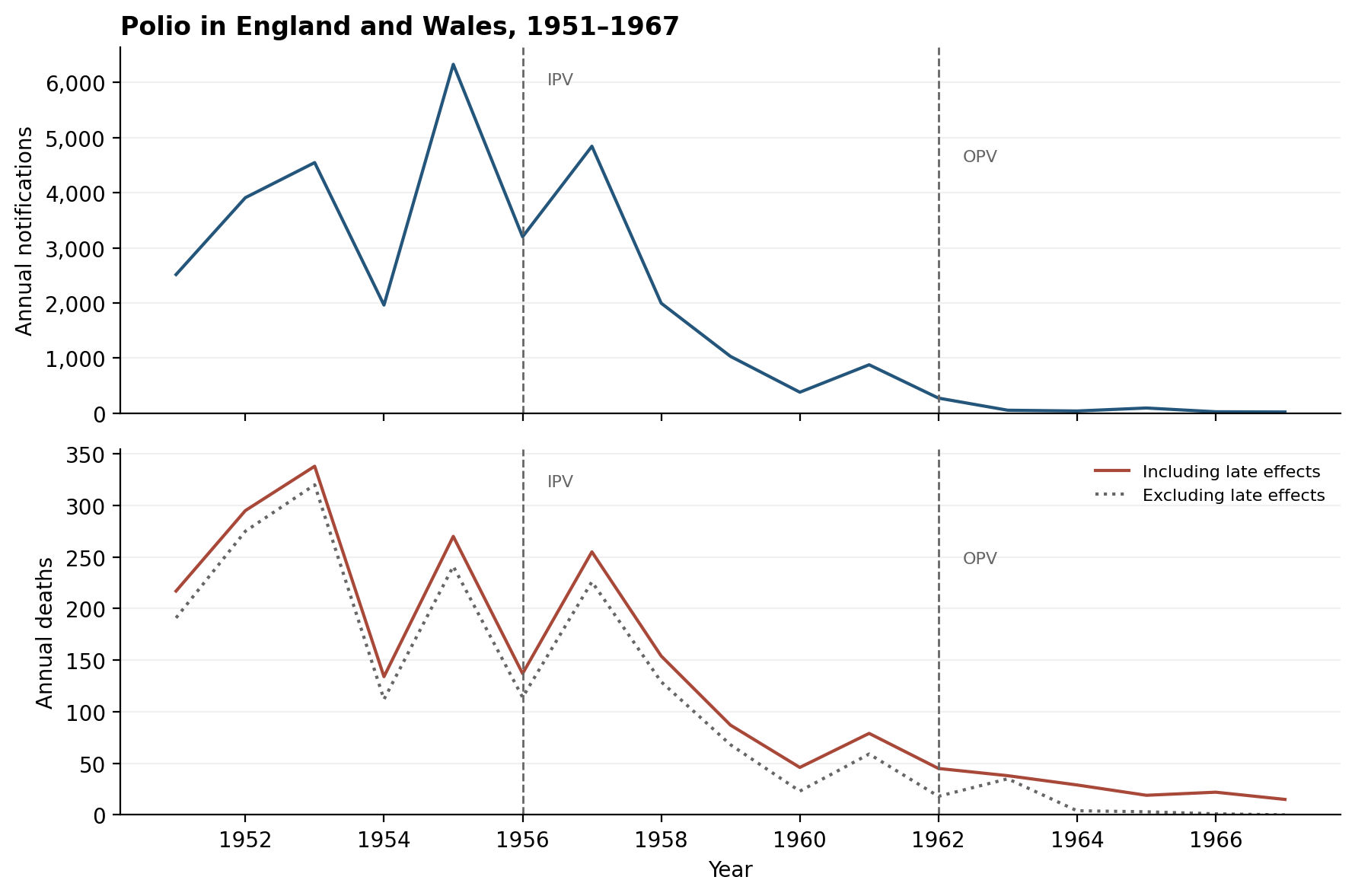
Manual transcription of an archival reproduction, p2; original-volume reconciliation pending. The printed 1951 subtype sum differs from its total by 100; the figure preserves the printed total. Death series distinguish late effects.
Our verdict is that polio vaccination brought enormous benefit to affluent societies as well as poorer ones. The prevention of paralysis is central to that judgment. The injuries associated with particular products and production failures are reasons for product selection and accountability, not reasons to erase the achievement.
6 Measles before and after vaccination
Measles brings our central historical question into sharp focus: what did vaccination add after the disease had become much less lethal? The earlier decline is real. An account that begins its graph immediately before vaccine introduction hides a large part of the history.
England and Wales provide an annual series from 1940 in the retrieved official table. The selected ten-year windows show much lower deaths before 1968 without a parallel disappearance of notifications. The subsequent vaccine era brought further reductions in both. Comparing 1958–67 with 1968–77, mean notifications fell from about 412,094 to 160,098, and mean deaths from 86.3 to 29.2. Those are descriptive changes across selected windows, not an estimate that vaccination alone caused every difference.
The England-and-Wales record supports two distinct findings: deaths fell markedly before 1968, and notifications subsequently fell to a much lower level. Trial and review evidence supports a causal role for vaccination in preventing illness. Our judgment is that measles vaccination was a major additional success, even in a prosperous country. The historical curves do not, by themselves, count the deaths a present-day programme prevents against an alternative with equally good treatment.
Maintaining that distinction makes the defense of vaccination more credible. The claim need not be that measles remained as lethal in 1968 as it had been a century earlier. The relevant claim is that many infections persisted, some caused severe complications, and prevention reduced that burden. A reader who accepts the earlier mortality improvement has no reason to deny the additional value of preventing illness. A reader persuaded of the vaccine's value has no reason to assign it credit for changes that preceded it.
The risk communication should also distinguish rare injury from background illness. A febrile seizure after MMR is a recognized outcome with a defined risk window; it is not interchangeable with permanent neurological damage. An autism claim requires its own evidence and cannot be established by placing two developmental events close together in time. The large Danish cohort is useful corroboration outside the principal study countries, while the review and safety evidence identify recognized outcomes that should be disclosed.
A fair modern assessment would report age-specific admissions, encephalitis, long-term complications, deaths, vaccine-attributable events, and the costs of outbreak control. It would distinguish a child already protected by prior immunity from one who is susceptible. Until those elements are assembled consistently, the strongest conclusion concerns major prevention of infection and its consequences, with the exact modern mortality increment less securely quantified. That is a substantial finding, even without a grand historical death total.
Several interpretations should be resisted. A death curve cannot show that the earlier improvement was caused by a later vaccine. A surviving high case burden cannot be treated as unimportant simply because most children recovered. Nor can the number of deaths that occurred before vaccination be assumed to be the number a modern program prevents each year. Modern care and contemporary exposure belong in the alternative scenario.
The United States licensed measles vaccine in 1963, earlier than Britain. CDC's historical series shows recurring large case totals before that date and a pronounced later decline. The population-rate panel prevents population growth from obscuring the comparison. It also shows why the fall in reported infections deserves an explanation distinct from the earlier improvement in survival.
Evidence on recipients adds to the national histories. The Cochrane review supports substantial protection against measles, with moderate certainty for effectiveness. Its findings on mumps are less impressive, and its direct rubella efficacy evidence includes a strain used in China rather than the standard British or American product. These qualifications matter when a review of a combined vaccine is summarized as one universal efficacy number.
Britain also has the MRC trial and long follow-up. Ramsay and colleagues describe a trial begun in 1964 involving more than 36,000 children. Later follow-up was available for markedly fewer participants, especially controls. That evidence supports investigation of duration but requires attention to attrition and later vaccination rather than treating a decades-long follow-up label as proof of complete ascertainment.
The harm side includes febrile seizures and immune thrombocytopenia after measles-containing vaccination. The particular combined product matters; MMR and MMRV should not be pooled indiscriminately. Those outcomes should be reported as excess risks over a defined window where credible estimates exist.
CDC's safety summary describes approximately one additional febrile seizure per 3,000–4,000 children vaccinated with MMR and cites an estimated thrombocytopenia risk of one per 40,000 vaccinated children. Transient joint symptoms are much more common in a particular group: up to one in four females past puberty who were not previously immune to rubella. These are different outcomes and populations; the frequency of a brief joint reaction must not be equated with permanent disability.
The evidence against an autism association is substantial. Hviid and colleagues' large Danish cohort is corroborative evidence, while remaining outside our principal country comparison. Evidence against that proposed injury does not cancel the recognized injuries.
An intellectually useful conclusion can hold several findings together. Measles became less deadly in affluent societies before vaccination. Vaccination subsequently prevented infections and their consequences. The size of the mortality gain in present-day Britain or America depends on exposure, care, age, immunity, and complications. Precisely quantifying that gain requires more than subtracting today's deaths from a historical peak.
The measles judgment in an affluent society
Our conclusion begins with a concession that should never have been controversial: much of the historical reduction in measles mortality preceded routine vaccination. The English and Welsh records show that notifications remained substantial while deaths fell. That is evidence of changing consequences per reported case, consistent with improvements outside vaccination. It is not evidence that infection itself had already disappeared.
The additional case for vaccination rests on the subsequent reduction in disease, the clinical complications prevented, and the risk of renewed circulation among susceptible people. A modern hospital does not make an avoidable admission inconsequential, and a low fatality rate does not make encephalitis acceptable. Equally, a graph beginning at the nineteenth-century mortality peak exaggerates the proportion of the entire historical mortality decline attributable to a vaccine introduced much later. The appropriate account credits both improvements in living conditions and clinical care, and the additional prevention achieved by immunization.
The harm assessment should name febrile seizures, rare thrombocytopenia and severe allergic reactions where supported, using the correct formulation and denominator. MMR and MMRV cannot silently share every safety number. A short febrile seizure, a permanent neurological injury and a death must not be assigned identical weight merely because all can appear in a list of events. Our judgment remains strongly favorable to appropriate measles protection in Britain and America; its justification survives an honest account of the earlier mortality decline.
How much confidence does the review earn?
The 2021 Cochrane review’s measles estimates rely on cohort studies: approximately 95% effectiveness after one dose and 96% after two, rated moderate certainty. Those figures come from different study sets; their one-point difference is not a randomized estimate of the benefit of a second dose. Across the review, 36% of studies were classified at low risk of bias, 42% unclear and 22% high. Reliability therefore belongs to each outcome, not to the Cochrane name alone. The favorable measles judgment survives this qualification; it is not proof of every claimed benefit or absence of every harm.
Figure 5 Measles cases and deaths before and after UK vaccination
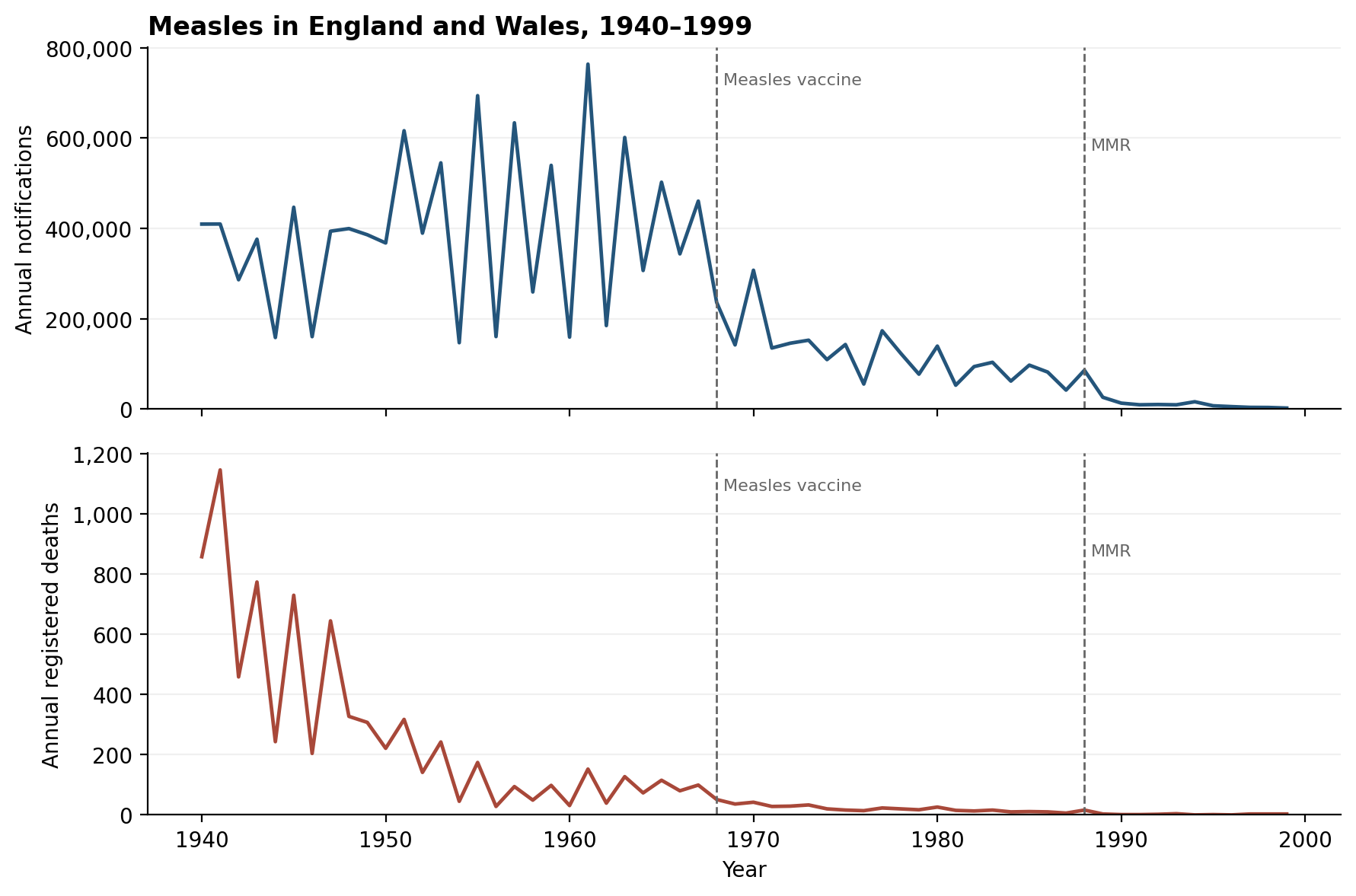
Separate panels show counts on different scales. Mortality had already fallen before 1968. Notifications remained high before introduction. Dates show program timing, not a causal estimate. Source total deaths may include late effects.
Figure 6 The decline in deaths preceded the decline in measles reports
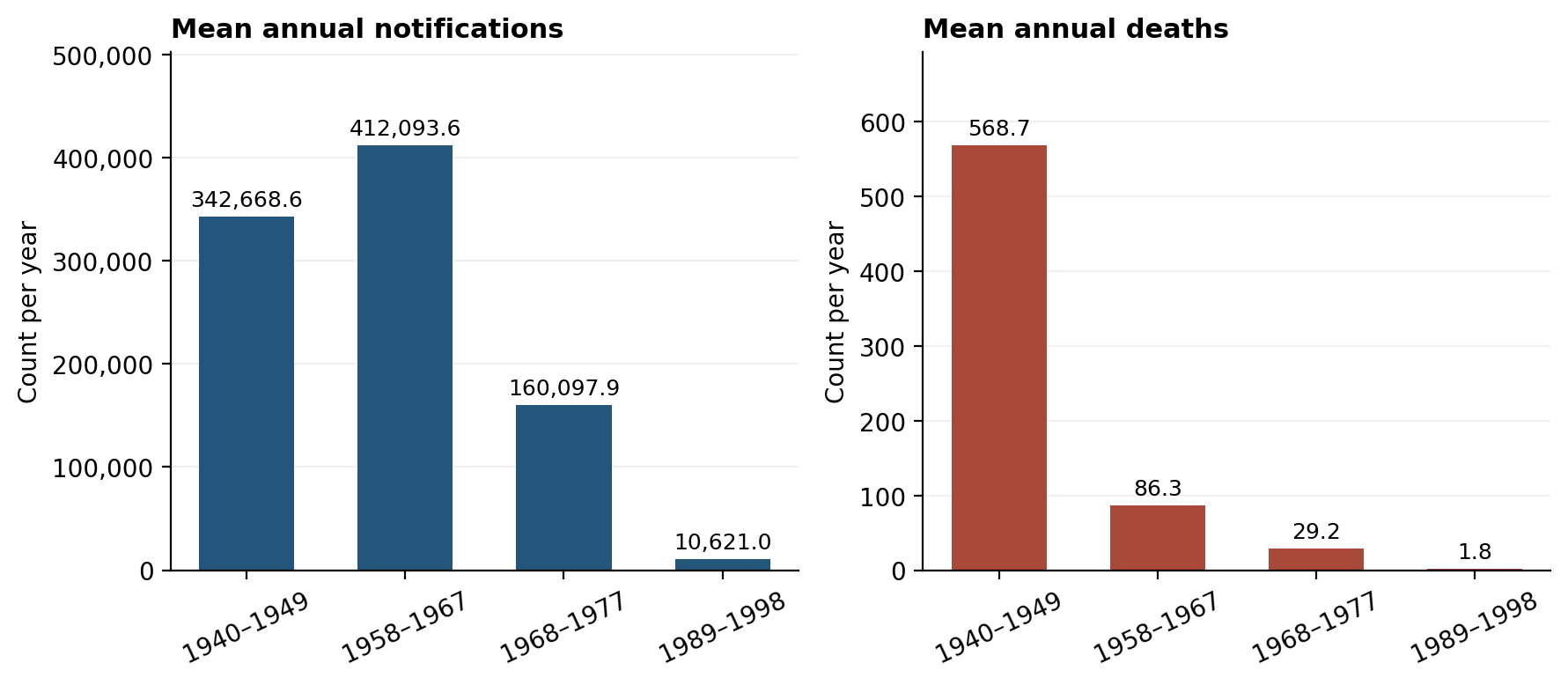
Equal ten-year windows, with gaps between selected periods. Values are arithmetic means of annual counts, not population rates or estimates of deaths prevented. Calculated from the UKHSA measles series.
Figure 7 US measles reports and population rates
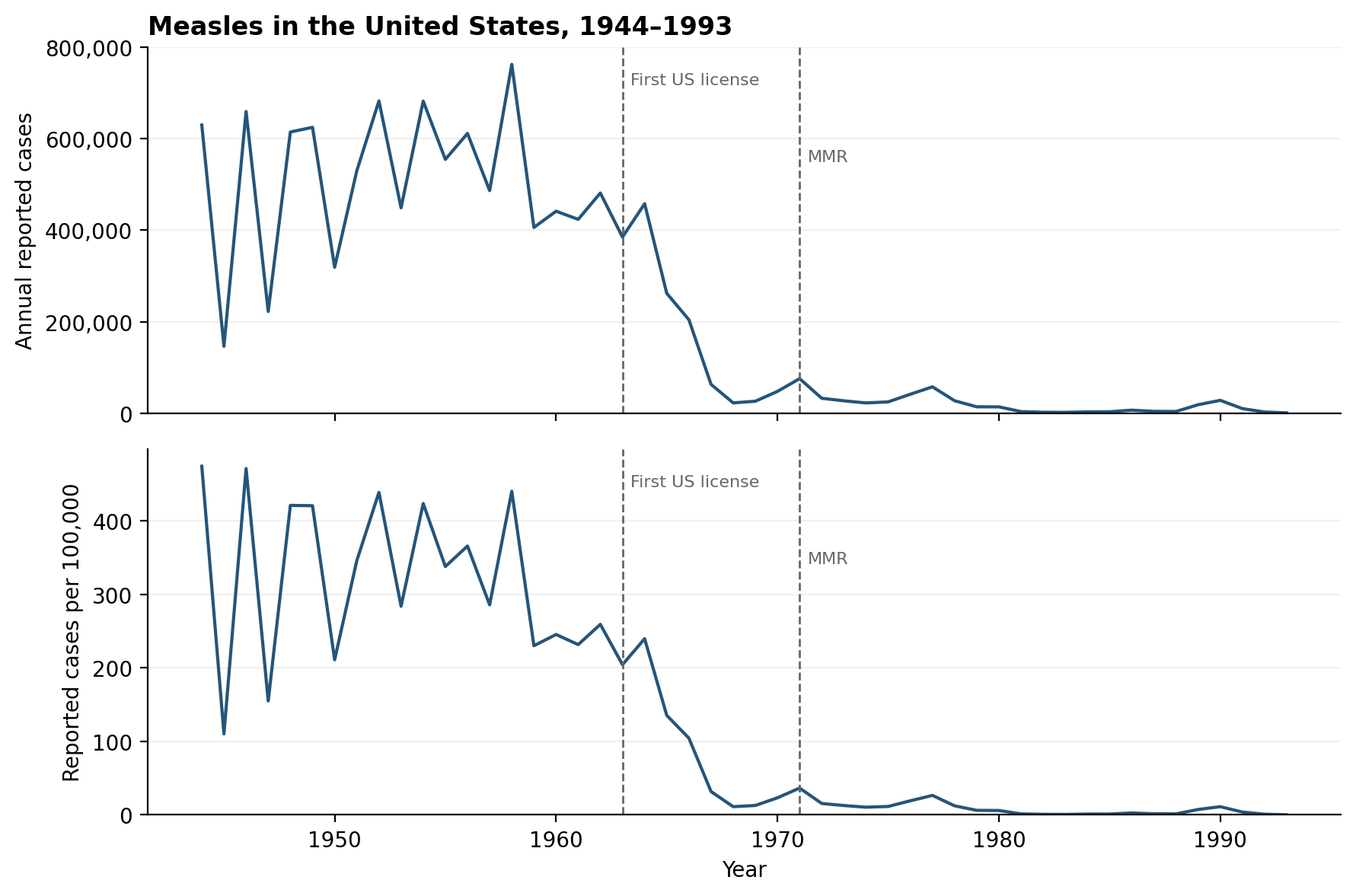
CDC historical Tables 1 and 3–6; rates calculated using the population printed for each year. Reported cases undercount infections. This chart is about morbidity, not deaths. First licensing is not immediate universal uptake.
Figure 8 Disease reports, deaths and the reporting ratio
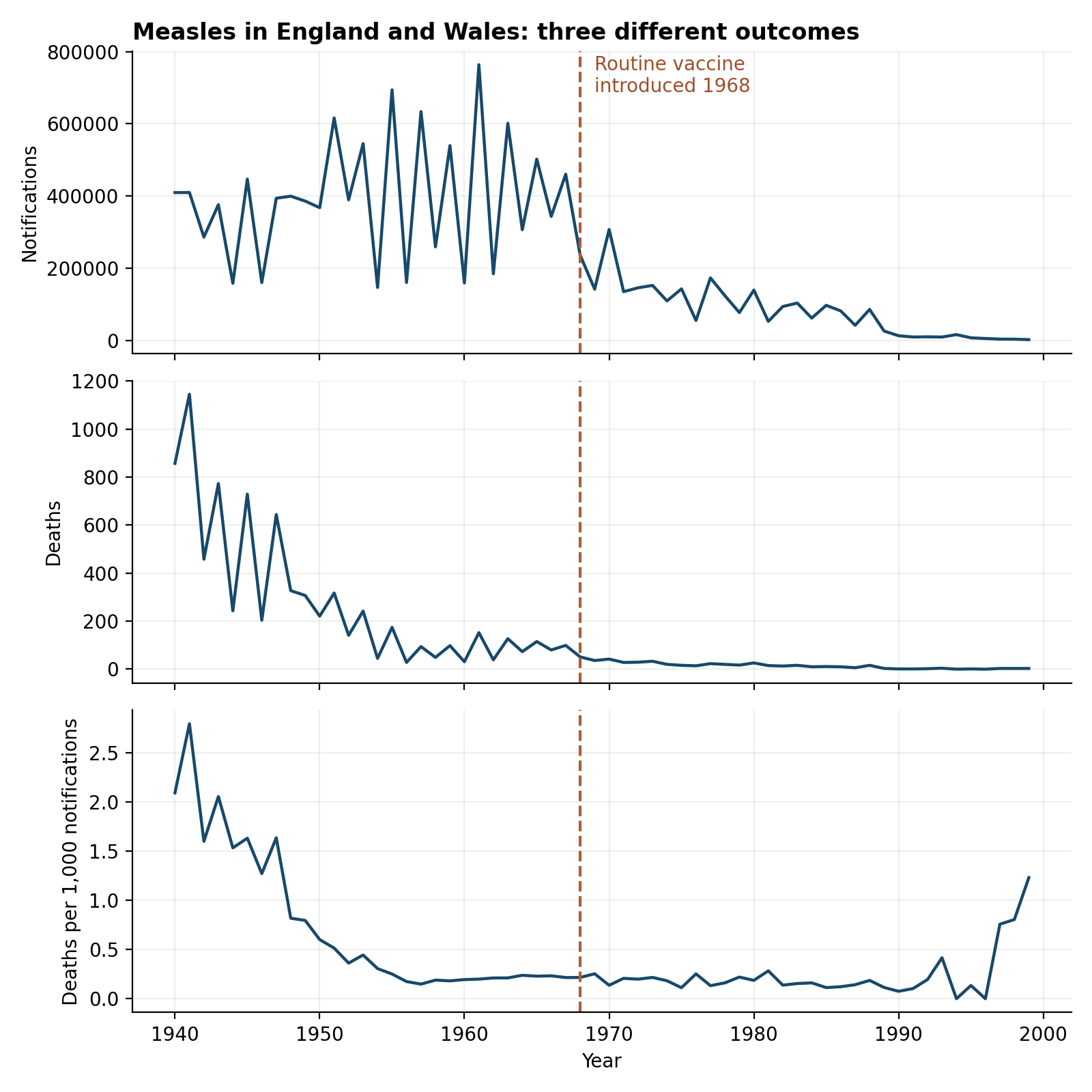
UKHSA historical records, 1940–1999. Deaths per notification is a reporting ratio, not a true case-fatality rate: infections are incompletely reported, surveillance can change, and deaths may include late effects. Each panel has its own vertical scale. The marker identifies routine introduction, not immediate complete coverage. Earlier declines in mortality coexist with persistent reported disease.
7 Mumps rubella and the limits of combined categories
The three components of MMR prevent different burdens. Mumps often resolves, but orchitis, meningitis, hearing loss, and other complications can make it consequential. Rubella's distinctive burden is infection during pregnancy and congenital injury. Grouping the diseases because they share an injection should not obscure differences in the reason for prevention.
The US mumps series in the retrieved tables starts in 1968, after licensure of the live vaccine in 1967. It shows a substantial later decline, but it cannot supply an observed prevaccine baseline. That limitation is stated on the figure. Rubella has a short reporting period before its 1969 license. A longer baseline would improve interpretation, but it would not make the routinely notified cases equivalent to all infections.
Rubella demonstrates why the person receiving protection and the person receiving a dose need not be the same person. Childhood infection may be mild, but transmission into pregnancy can have serious consequences. A mortality-only assessment focused on vaccinated children would miss the main clinical rationale. The relevant outcomes include fetal loss and congenital injury as well as illness in the transmitting population. Those outcomes also require sensitive ascertainment and cannot be inferred from rash notifications alone.
Mumps raises a different question. Outbreaks in highly vaccinated groups show that protection can be incomplete or wane; they do not show that vaccinated and unvaccinated people have identical risks under comparable exposure. Conversely, a reduction in national reports is not enough to promise lifelong protection to an individual. Timing since dose, crowding, and exposure belong in any account of breakthrough outbreaks. The Cochrane review supplies a more relevant starting point for dose-specific effectiveness than the first year in a series that began after licensure.
The combined MMR product offers practical advantages, but those advantages should not dissolve the components into a single claim. Measles, mumps, and rubella differ in their disease burden, duration of protection, and importance of indirect effects. A combined schedule can be reasonable while the evidence for its three components varies. Explaining this variation is more informative than demanding that readers hold precisely the same opinion about each disease.
For mumps, the Cochrane review estimates better protection after two doses than one, but protection is less complete than against measles. Breakthrough outbreaks must therefore be examined in relation to time since vaccination and exposure. An outbreak in vaccinated people does not alone establish absence of benefit: the question is the risk under comparable exposure and immune histories.
Complication studies can add information. The Netherlands outbreak study in Emerging Infectious Diseases found lower orchitis risk among vaccinated male cases. Such analyses are relevant but conditional on becoming a detected case. They may not capture the full effect on preventing illness, and the case groups can differ in ways that matter. The limited numbers also constrain inference about uncommon outcomes.
Rubella makes mortality-only accounting particularly misleading. Official reconstruction of the US 1964–65 epidemic includes about 20,000 infants born with congenital rubella syndrome and 2,100 neonatal deaths. Pregnancy-loss estimates also include categories requiring explicit separation, including spontaneous and therapeutic abortions. The much smaller congenital-rubella notification totals in later surveillance are not a directly comparable measure of that epidemic reconstruction.
British and American policy should therefore be evaluated through protection of pregnancies and newborns as well as infection in children. One person's mild illness can impose severe consequences on another. The converse obligation is to assess injuries from vaccination with equal seriousness, including recipient-specific contraindications and product differences.
We support the combined MMR offer on the evidence for its components and its practical advantages. The reasons differ: measles prevention removes a very common illness and its complications; rubella prevention protects pregnancies; mumps prevention has a more qualified history because protection wanes. Convenience and fewer appointments add value, but cannot substitute for the clinical case for each component.
Three diseases do not supply one benefit estimate
Mumps prevention is principally an argument about illness and complications, not a large contemporary mortality burden. Durability and outbreak performance deserve greater weight than an impressive early antibody response. Rubella requires an entirely different perspective: an often mild infection can cause devastating consequences when it occurs in pregnancy. Counting deaths among infected children misses much of the purpose of prevention.
A combined injection can be sensible without making the three components equivalent. The assessment should preserve congenital outcomes for rubella, complications and waning for mumps, and the distinct transmission and complication profile of measles. The benefits of convenient combined delivery belong in programme costs and completion; they should not be presented as three identical clinical returns. We support the combined strategy while allowing the evidence and confidence for each component to differ.
Figure 9 US mumps and rubella notifications
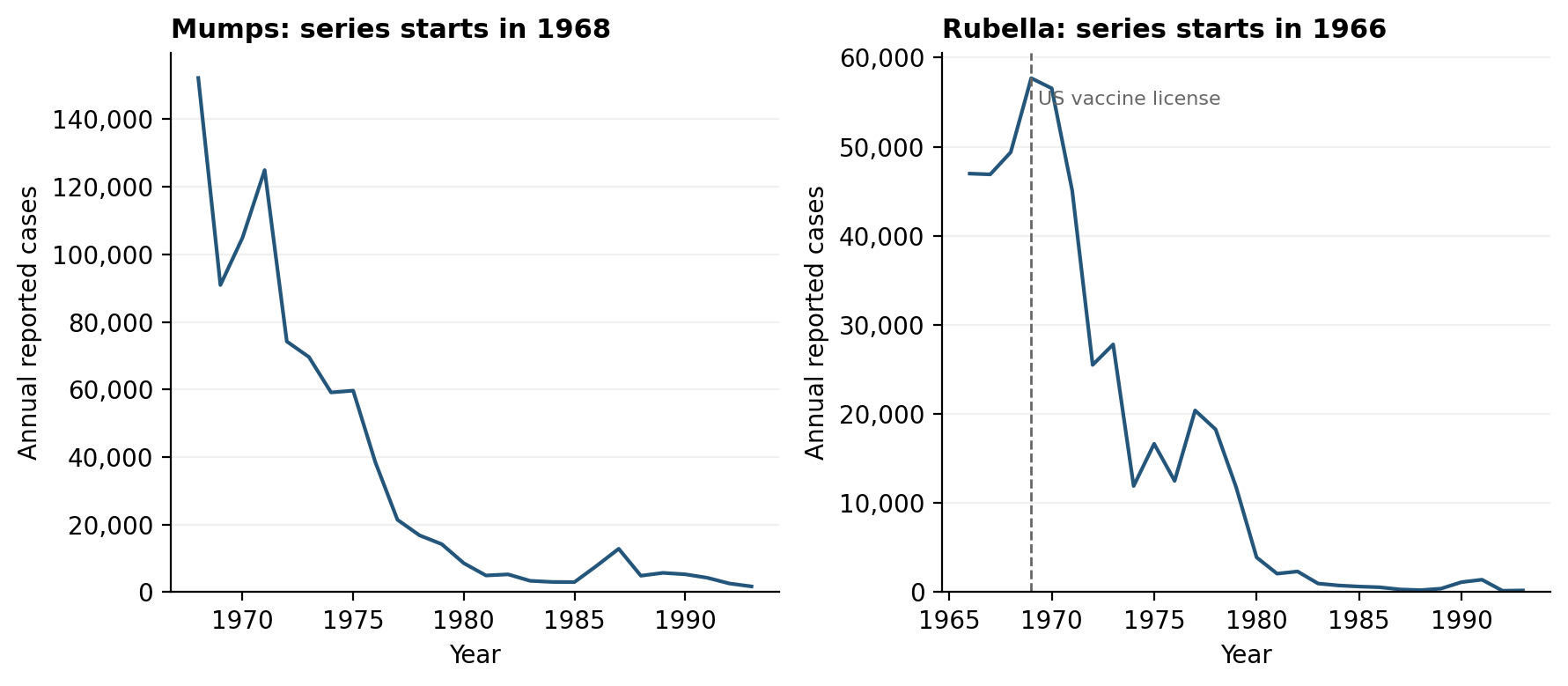
CDC historical series. The mumps series begins AFTER 1967 vaccine licensure and does not provide a prevaccine baseline. Rubella reporting is short before licensure. Congenital injury is a separate outcome.
8 Diphtheria tetanus and pertussis
These three bacterial diseases are often delivered through combined products, yet they present different policy questions. Diphtheria and tetanus are principally diseases of toxin-mediated injury. Pertussis involves respiratory infection with a particularly serious burden in young infants. An evaluation of the combination must preserve those distinctions.
British diphtheria records document a large burden around the introduction of mass immunization and a subsequent collapse in disease. The Green Book gives more than 61,000 UK cases and 3,283 deaths in 1940, contrasted with 38 cases and six deaths in 1957. These endpoints are useful historical anchors, but geographical consistency and the contributions of antitoxin, treatment, and uptake must be checked before treating them as an isolated causal experiment.
The US annual rate series begins after diphtheria vaccination and other control measures were already being used. It shows a continuing decline rather than a clean unexposed baseline. Tetanus has no person-to-person transmission, so its protection is not explained by neighbors' immunity. CDC's recent surveillance documents continuing cases and deaths despite rarity; exposure and inadequate individual protection remain relevant.
Tetanus makes a particularly useful check on public-health language. Someone else's vaccination does not remove environmental spores from a wound. The argument for vaccination therefore rests principally on the recipient's protection, together with programmatic advantages of reliable access. Appeals to protecting neighbors should not be borrowed from diseases with person-to-person transmission. Clean delivery practices, wound care, immunization, and post-exposure management can each contribute without being competing explanations for every avoided case.
Pertussis shows why a recommendation can remain useful even when a product needs improvement. Waning protection changes the expected timing of disease and the additional value of boosters. It also makes an undifferentiated historical success claim inadequate. Maternal vaccination addresses an especially vulnerable interval before an infant can complete vaccination; evidence for that strategy should be evaluated on infant outcomes rather than adult antibody levels alone.
The British mortality series warrants the same honesty as measles: deaths declined before the routine program marker, while later epidemics still occurred. Those patterns should lead to a more careful decomposition, not a decision to ignore either period. Notifications and deaths also respond differently to surveillance changes and clinical care. The graph is an invitation to examine those mechanisms, not a complete answer.
The policy lesson across the three diseases is that the intended beneficiary and endpoint should be named. A rationale based on individual antitoxin protection, one based on protecting a newborn, and one based partly on reducing circulation do not support identical arguments about mandates. Clinical recommendations may be delivered together for practical reasons while retaining separate evidentiary foundations.
Pertussis provides a valuable contrast. In Britain, deaths fell substantially before the 1957 routine-program milestone. Later notifications also fell, but large epidemic cycles persisted. A history that chooses one high year and one low year risks making the program look either stronger or weaker than the longer series warrants. The figure displays every retrieved year through 2000.
The whole-cell to acellular transition raises a real tradeoff between reactogenicity and durability. Klein and colleagues' US research documents waning after the fifth acellular dose. That finding should inform expectations about long-term control rather than be reduced to a verdict that the vaccine either works or fails. The effects on clinical severity, infection, and transmission need separate assessment.
Maternal vaccination addresses an unusually clear vulnerability: infants too young to have completed their own primary doses. Amirthalingam and colleagues estimated high effectiveness against confirmed pertussis in young infants following the English maternal program. This observational evidence is relevant to targeted protection; it is not a randomized estimate of every pregnancy or infant outcome.
The chapter's policy lesson is specificity. A rational schedule can combine population protection, individual protection, and protection of newborns. It also requires ongoing surveillance of injury and duration. There is no need to pretend all three diseases have the same transmission dynamics or that one historical delivery decision settles every later dose.
Routine protection and the vulnerable newborn
Our assessment gives strong weight to diphtheria and tetanus protection because the consequences can be grave even where care is available. For pertussis, we distinguish incomplete or waning control of circulation from protection against severe infant disease. An adult booster that offers temporary protection and maternal vaccination intended to protect a newborn answer different clinical questions.
The English maternal programme provides a useful measured result: the original observational evaluation estimated 91% effectiveness against laboratory-confirmed pertussis in infants younger than three months, with a 95% confidence interval of 84–95%. That is a specific early-infant disease endpoint. It should not be relabeled a 91% reduction in every infant death or every possible pregnancy complication. Nevertheless, it supports a targeted benefit that the slogan vaccines do not stop transmission would miss.
Figure 10 US diphtheria and tetanus reports
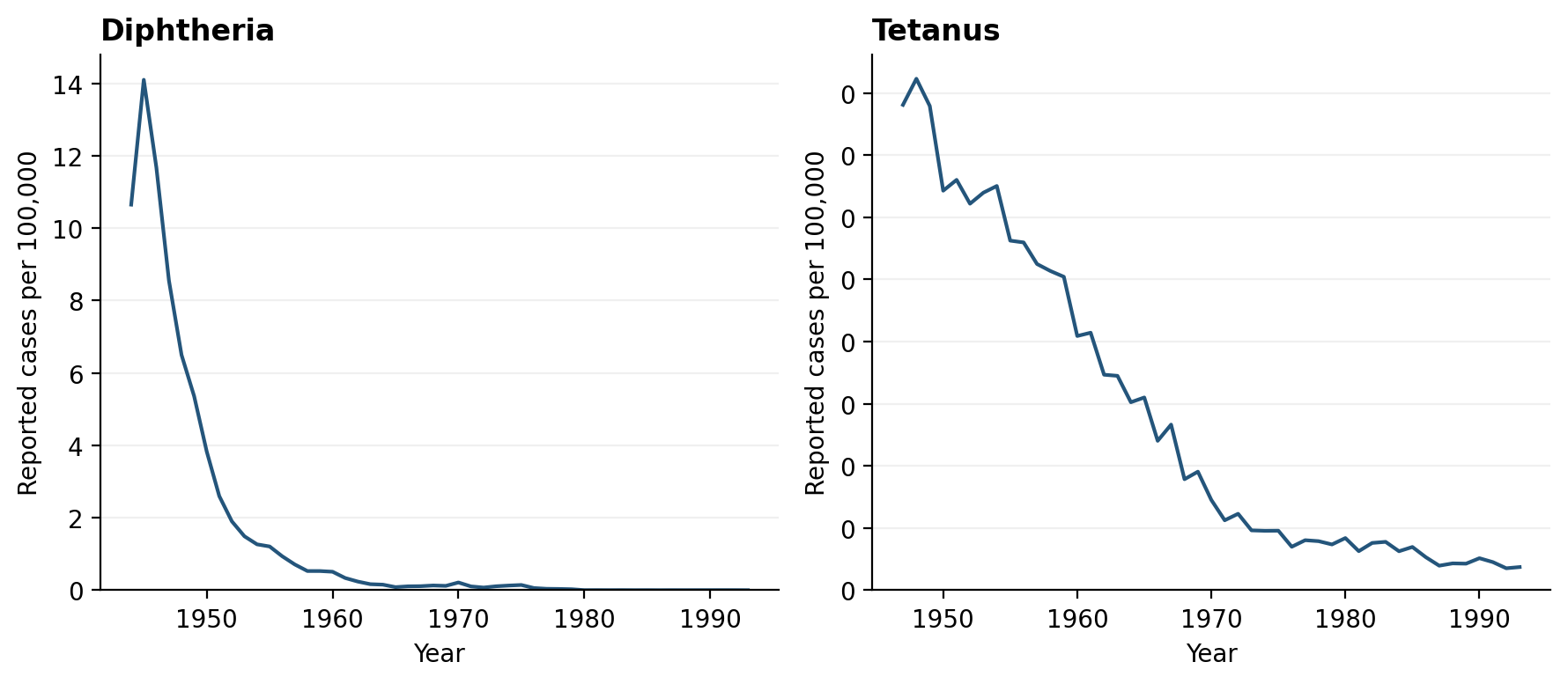
Rates calculated from CDC cases and population. Vaccination and other interventions predate parts of the series; there is no single clean introduction point here. Tetanus reporting starts in 1947.
Figure 11 Whooping cough before and after routine vaccination
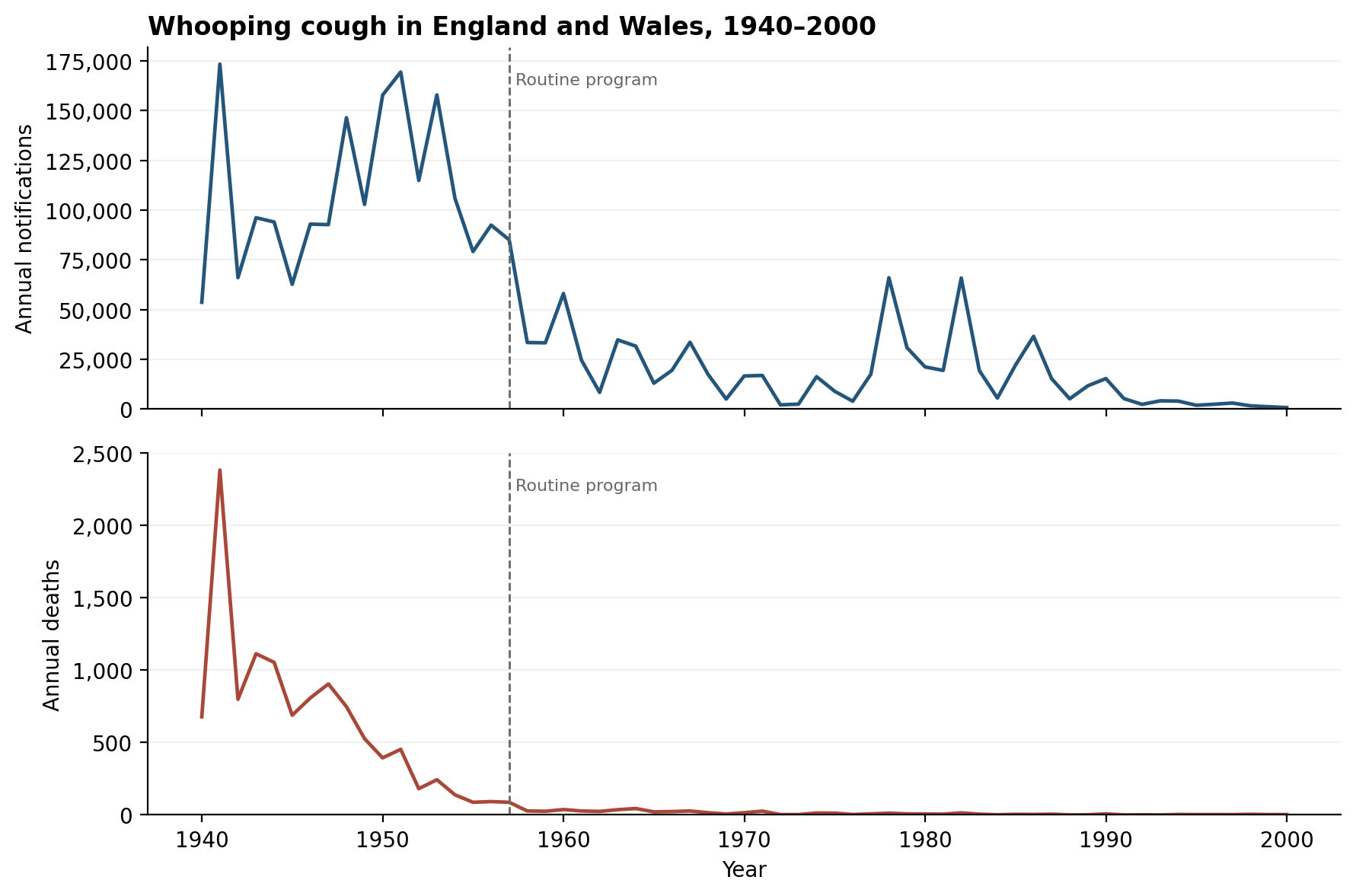
UKHSA Table 6 historical notification and death counts. The 1957 marker follows the official UK program timeline; earlier trials and use existed. Epidemic cycles, coverage and product changes require separate analysis.
Our verdict is favorable to prevention of diphtheria and tetanus, and favorable but more qualified for pertussis. Waning protection makes claims of durable control less persuasive; it does not erase the value of protecting vulnerable infants. We attach particular importance to matching the programme to the intended beneficiary.
9 Meningitis pneumonia and invasive bacterial disease
Invasive bacterial disease is an important test of the claim that vaccines matter only where sanitation and treatment are poor. Modern hospitals can treat meningitis and bloodstream infection, yet treatment can arrive after neurological injury has occurred. The relevant comparison is therefore not vaccination versus the absence of antibiotics. It is vaccination plus available care versus the same care without vaccination.
Hib provides evidence from a prospective Finnish field trial as external corroboration. Eskola and colleagues allocated infants through a birth-date scheme, with early vaccination in one group and later vaccination in controls. The design and the clinical invasive-disease endpoint are important. Its allocation method, lack of conventional individual blinding, and population context deserve scrutiny alongside the findings. Britain introduced Hib conjugate vaccination in 1992.
The American pneumococcal conjugate trial offers a strong clinical anchor: nearly 38,000 children in a randomized comparison, with protection against invasive disease caused by covered serotypes. That supports a favorable judgment about the studied intervention. It does not remove questions about comparator composition, sponsor control, replacement disease or the value of each subsequent formulation.
Population surveillance then asks whether laboratory and trial findings translate into fewer serious infections. Whitney and colleagues described declining invasive pneumococcal disease in the United States following conjugate-vaccine introduction. English and Welsh surveillance examined both indirect protection and serotype replacement. These studies supply a more nuanced account than a covered-serotype chart alone.
Replacement matters because reducing one group of organisms may create ecological room for others. The net outcome depends on the severity and frequency of the replacing disease as well as the disease removed. It would be misleading to report only the disappearing serotypes. It would also be misleading to treat any replacement as proof that the total benefit vanished.
Meningococcal vaccines require separate judgments by serogroup and local burden. The British chronology records MenC and subsequent programmes, but the evidence assembled here is not sufficient for a numerical comparison of the net benefits of MenC, MenB and MenACWY. We therefore do not borrow a verdict from Hib or pneumococcus to fill that gap.
For affluent countries, this evidence makes a blanket claim of negligible vaccine benefit difficult to sustain. It does not establish that every newer, broader-valency product or every age expansion is equally valuable. The next decision should be evaluated against the disease remaining under the existing program.
Invasive bacterial disease supplies a demanding test of the rich-country skepticism. These illnesses occur in settings with functioning hospitals, and survival may depend on treatment arriving before rapid deterioration. Prevention can therefore add value after sanitation and antibiotics have already delivered their gains. A claim of no meaningful benefit in wealthy settings must confront evidence on invasive disease and its sequelae, not only the earlier fall in general infectious mortality.
The strongest assessment distinguishes vaccine-type disease from disease due to other strains. If a product suppresses the types it targets but other types increase, both observations belong in the result. The net change in severe disease is the central clinical outcome. The English and Welsh pneumococcal analysis is valuable precisely because it examines replacement rather than assuming that laboratory protection against selected types proves the entire population result.
Indirect effects create additional analytical obligations. Adults may benefit when infant vaccination reduces circulation, but attribution requires information about the types, ages, and timing of decline. Changes in antibiotic use, case ascertainment, or blood-culture practice can also affect invasive-disease records. These alternatives should be considered alongside the trial and surveillance evidence, with confidence based on their convergence.
The resulting judgment need not authorize every expansion of a conjugate schedule. A successful original program can leave a smaller residual burden for a new product to address. Its incremental benefit, price, dosing demands, and safety evidence then require a fresh appraisal. Demonstrated value of the underlying technology and value for a particular next purchase are related but separate conclusions.
We conclude that prevention of invasive bacterial disease is a substantial rich-country benefit. Trial and surveillance evidence support that judgment for studied Hib and pneumococcal programmes. It does not give every expanded formulation or every meningococcal product an automatic favorable verdict.
What remains valuable after antibiotics
For Hib and pneumococcal vaccination, the strongest affluent-country argument concerns invasive disease and its consequences. Antibiotics can save a child after infection without restoring hearing or neurological function already lost. The primary trials and subsequent surveillance therefore deserve more weight than a general observation that twentieth-century sanitation improved.
Serotype-specific protection also sets the limit of the claim. A decline in covered-serotype disease is not automatically an equal decline in all bacterial pneumonia, all meningitis or all respiratory admissions. Replacement and changing formulations require continuing total-disease surveillance. Our judgment is favorable for routine childhood conjugate protection, with renewed appraisal of the incremental benefit and price of each expanded product. A favorable verdict on an earlier formulation does not establish the value of every additional antigen at every price.
10 Hepatitis HPV and cancer
Vaccination can prevent a chronic infection whose most serious consequence emerges decades later. That changes both the evidence and the economics. A short trial may establish an effect on infection or precancer while being unable to observe enough invasive cancers. Long follow-up and registry research become necessary, bringing their own problems of selection and changing diagnostic practice.
England's HPV program offers a principal rich-country case. Falcaro and colleagues studied cervical cancer and high-grade precancer after the program began. Their later work examines socioeconomic deprivation. These are clinically meaningful outcomes and a useful test of whether benefits reach disadvantaged groups. Program eligibility, uptake, screening policy, and birth-cohort differences remain part of the interpretation.
The Swedish registry study by Lei and colleagues supplies corroboration outside the principal UK/US frame. Its association with lower invasive cervical cancer is stronger evidence of a patient benefit than an antibody result, but it remains observational. The appropriate question is how robust the association is to confounding and how its magnitude varies with age at vaccination.
Screening and vaccination should not be placed in an artificial either-or contest. Screening can identify established disease or precancer; vaccination acts earlier in the causal chain. A country with poor access to screening may obtain a different absolute benefit from prevention. In Britain and America, evaluation should use the screening services actually available rather than an idealized system everyone uses perfectly.
Hepatitis B adds another cancer pathway. Chang and colleagues examined childhood liver cancer after Taiwan's universal vaccination program. Its high-endemicity setting and maternal transmission pattern are central to the result. It demonstrates a mechanism with major potential global importance, without supplying a ready-made absolute benefit for every British or American newborn.
The comparison must distinguish a low average prevalence from no exposure risk. Maternal testing, infection acquired later, household exposure, missed follow-up, and the consequences of infection at different ages belong in an analysis of universal versus targeted delivery. The cost of reliably identifying everyone at risk is part of the alternative strategy.
Hepatitis A warrants a separate assessment. It differs in natural history, routes of exposure, and consequences from hepatitis B. The historical CDC tables contain changing hepatitis categories, some of which combine infections that were later separated. Those cells cannot be used as an uninterrupted hepatitis-A or hepatitis-B series without reconstruction.
We give substantial weight to the observed cancer outcomes. They make the case for prevention stronger than an antibody result or a promotional promise. They do not settle every question about delivery, safety or additional claimed benefits.
Cancer prevention changes the time horizon of the argument. A trial may be able to measure persistent infection or precancer sooner than it can measure invasive cancer. Those earlier endpoints are valuable when the causal pathway is strong, but an eventual cancer outcome remains more directly meaningful to patients. England's program provides particularly relevant evidence as cohorts mature. The observational design still requires attention to screening, deprivation, birth cohort, and the age at which vaccination was offered.
Relative reductions should be accompanied by the underlying incidence and follow-up period. Younger women have a different short-term cancer risk from older women, even when lifetime prevention may be substantial. A strong effect after vaccination before exposure should not be transferred unchanged to an older, previously exposed population. Nor should vaccination be presented as a substitute for all cervical screening. The Swedish study strengthens the overall causal account, but does not remove these distinctions.
Hepatitis B illustrates another limitation of using one national average. Background infection and transmission routes differ, so the value of early vaccination can differ between populations within the same affluent country. The Taiwan cancer evidence is a powerful external example; it is not a ready-made estimate of the absolute benefit for every British or American child. Exposure patterns and prevention alternatives need to be carried into the comparison.
Our judgment is favorable for preventing oncogenic infection before exposure, with the most persuasive argument grounded in disease outcomes rather than a promotional promise. Safety assessment remains product-specific. Questions about comparator choice, follow-up, and institutional conduct should be examined directly; they should neither disappear because cancer prevention is important nor erase a cancer-prevention finding supported by independent records.
Cancer prevention needs a longer clock
Hepatitis B and HPV expose a weakness in short follow-up: prevention today may avert cancer many years later. An accounting restricted to childhood deaths would undervalue this benefit, while an accounting that treats every modeled future cancer as already observed would overstate certainty. The chain from infection prevention through precancerous disease to cancer should remain visible.
For HPV, national registry follow-up supplies a clinical cancer endpoint beyond the original trial endpoints. Lei and colleagues reported invasive cervical cancer in 19 vaccinated and 538 unvaccinated women in Sweden. Those raw counts are not an absolute risk comparison: the groups differed in size, age and follow-up. Adjusted analyses found a substantially lower incidence, particularly with earlier vaccination. Screening and sexual-health differences remain potential sources of residual confounding in this observational design.
We favor timely HPV protection before likely exposure and appropriate hepatitis B protection. These are preventive interventions with delayed returns, not treatments for an established infection. Screening remains relevant after HPV vaccination. A present-day national funding decision should state which long-term outcomes are observed and which remain modeled rather than pretending the distinction invalidates either kind of evidence.
11 Rotavirus varicella and the value of avoiding hospitalization
An intervention can be worthwhile in a wealthy country even if its principal gain is preventing hospital admissions. It can nevertheless have a different value where the same illness often kills. Rotavirus and varicella help separate these propositions without pretending that every nonfatal infection is trivial or that every avoided illness justifies any price.
Large randomized rotavirus trials were designed to measure severe gastroenteritis and safety. Vesikari and colleagues' trial is a major starting point. The Cochrane review finds prevention of severe rotavirus disease across settings, with lower relative efficacy in high-mortality countries but potentially larger absolute effects because baseline disease burden is greater. This distinction directly supports the need for a separate global assessment.
Intussusception is a recognized serious harm. Current US safety summaries describe an additional risk on the order of one case per 20,000–100,000 vaccinated infants. The fact that a trial or pooled trial analysis does not detect a significant increase is compatible with a small increase emerging in much larger postmarketing populations. Trial size and precision, not an assumption of bad faith or perfect detection, explain why both observations can coexist.
The appropriate balance in Britain or America includes dehydration, emergency care, hospital days, bowel injury, family disruption, and costs. The same clinical product in a setting with limited rehydration and hospital access can prevent more deaths. Neither calculation should borrow its answer from the other without adjusting baseline risks and delivery conditions.
Varicella provides US evidence across a long program period. Marin and colleagues studied hospitalizations and deaths through 2019 and reported large declines in severe disease among people under 50. This is a population time-series result, rather than a randomized estimate of the entire reduction. Changes in ascertainment and care still require attention, but the endpoints extend beyond the count of a familiar childhood rash.
Live products require recipient-specific precautions. Safety cannot be inferred for an immunocompromised person merely from tolerability in healthy children. The general safety literature and causality reviews should be used to identify the particular product–outcome relationships and susceptible groups.
These examples also guard against moving the goalposts. If the proposed benefit is fewer admissions, the evaluation should measure admissions. A critic is entitled to ask whether that benefit justifies cost and injury risk. The proponent is entitled to count it even when death was uncommon before vaccination.
The objection that a disease is usually survivable is incomplete in a wealthy health system. Hospital care uses resources, exposes families to disruption, and may be frightening or painful. Preventing a common illness can be worthwhile even when deaths are rare. The monetary value of a parent's missed work is different from the child's health gain, however, and these components should be reported separately rather than bundled into a single impressive figure.
Rotavirus also shows why national context changes the principal benefit. Where rehydration and hospital care are accessible, the account may be dominated by avoided emergency attendance and admissions. Where they are not, prevented dehydration can save many more lives. The Cochrane review's variation by mortality setting makes direct transfer of one efficacy estimate inappropriate. The same disease can support a different balance of outcomes across settings.
Rare intussusception risk belongs in that account in absolute terms and within the relevant post-dose interval. A trial with no statistically clear signal does not prove zero risk; a later safety signal does not imply that the trial necessarily concealed a detectable effect. Size, timing, and case ascertainment determine what each study could have seen. The safety summary provides a starting range, but a complete comparison should use the product, schedule, and population being considered.
Britain introduced routine childhood MMRV vaccination in January 2026, adding varicella to its offer for eligible cohorts. This recent adoption should not be confused with absence of earlier authorization or with a completed British long-term outcome evaluation.
For varicella, broad changes over a long program are informative but do not isolate every causal pathway. Age shifts, admission thresholds, and changes in diagnosis need consideration. The American program evaluation supports reductions in severe outcomes, while further analysis should distinguish direct recipient benefits from population effects. The clinical conclusion can be favorable without claiming that every downstream change has already been resolved.
We judge rotavirus vaccination valuable where it prevents severe dehydration and hospital care, with the survival case strongest where treatment is least accessible. We also judge the American varicella experience a meaningful prevention success. For a newly implemented British programme, the US evidence is informative but cannot be presented as British long-term follow-up.
A modest mortality burden can conceal a useful intervention
Rotavirus and varicella challenge a death-only account of value in affluent countries. Preventing dehydration admissions, complications and substantial family disruption can be worthwhile even when treatment keeps mortality low. Those benefits should be stated plainly rather than inflated into a large domestic mortality claim.
Rotavirus provides an explicit tradeoff: currently used infant products carry a small excess intussusception risk, while preventing severe gastroenteritis. The CDC estimates about one additional intussusception case per 20,000–100,000 vaccinated US infants, concentrated after early doses. This range is not the historical RotaShield risk, a death rate or an estimate transferable unchanged to every country. The relevant comparison includes severity and treatment of both diseases.
Britain’s routine MMRV introduction from January 2026 makes a historical US–UK disagreement less suitable as a permanent verdict about either country. We regard prevention of severe rotavirus disease as well supported; the value of varicella programmes additionally depends on programme costs, uptake and the outcomes included. We should judge the updated British offer on its actual eligible cohorts and combined formulation.
12 Influenza and modest absolute benefits
Influenza vaccination occupies a different evidential position from the classic childhood elimination programs. The virus changes, vaccine composition changes, and protection is assessed over seasons. A percentage from one year cannot be presented as a permanent property of an intervention called the flu shot.
The Cochrane healthy-adult review provides an unusually clear absolute-risk illustration. Its pooled trial results suggest roughly 14 fewer confirmed influenza cases per 1,000 vaccinated over a season under those study conditions. The effect on influenza-like illness is smaller in relative terms because other viruses produce similar symptoms. Evidence for hospitalization or time away from work is less decisive in healthy adults.
Influenza is a case where public communication should be comfortable with modest benefits. Reducing the chance of an unpleasant illness can be worthwhile at low cost and low risk without supporting a claim of large mortality protection for every healthy adult. The Cochrane absolute estimates are a useful discipline: readers can see both the relative effect and the small difference in seasonal risk. A recommendation becomes more intelligible when the outcome is named.
The evidence for older people needs a different interpretation. Their baseline risk of severe disease is greater, but frailty and differences in healthcare-seeking make observational comparisons difficult. Pre-season mortality differences provide a concrete warning about confounding. A very large apparent mortality benefit is not automatically more persuasive than a smaller estimate of confirmed illness or admission. The outcome, comparator, and bias assessment determine its value.
Program evaluations should also include the costs of annual delivery. A small benefit per season accumulates over repeated seasons, but so do appointments, reactions, and expenditure. It is misleading to multiply benefits across years while treating costs as a one-time event. The appropriate comparison uses the same time horizon for each, with uncertainty about strain match and circulation retained rather than averaged out of sight.
Our conclusion is that influenza vaccination offers useful but variable protection against illness. For healthy adults, the evidence supports a voluntary offer described in modest absolute terms, rather than sweeping mortality claims. A requirement imposed on workers needs additional evidence of benefit to others and proportionality; individual benefit alone cannot establish it.
Older people face greater consequences from influenza but do not necessarily generate stronger immune responses. The companion Cochrane review describes limited randomized evidence for severe outcomes. This does not demonstrate absence of benefit; it limits how confidently one can attach an exact mortality percentage to the recommendation. The risk of bias in observational comparisons then becomes particularly important.
The US evidence about pre-season mortality differences is a warning against accepting very large all-cause protection estimates uncritically. A study can adjust for recorded diagnoses without fully capturing frailty, care-seeking, or the decision not to vaccinate someone near death. The remaining association may not equal the effect of vaccination.
Recent US test-negative estimates nonetheless support protection against influenza-associated hospitalization. The interim 2025–26 report estimated about 30% effectiveness in adults and 41% in children and adolescents. These are relative observational estimates from one season, not a forecast for 2026–27 or an estimate of all-cause mortality benefit.
The harm account also needs specificity. Pandemrix-associated narcolepsy concerns a particular pandemic product and population. It must be examined seriously without converting its incidence into the risk of every seasonal influenza vaccine. Similarly, formulation, dose, age, and coadministration matter when studying fever or neurological events.
For British and American policy, the useful questions concern absolute effects by risk group, alternatives among available formulations, and what patients wish to avoid. An elderly person with substantial cardiopulmonary illness and a healthy younger adult should not receive identical numerical explanations. The evidence can justify offering vaccination while remaining more uncertain about a broad institutional requirement.
We regard influenza vaccination as a useful option whose importance increases with the consequences of infection, rather than a test of a person's allegiance to science. Imperfect protection does not make it worthless. Equally, a favorable average estimate does not make every annual dose equally important to every recipient.
A favorable option can remain a modest priority
Influenza vaccination should be assessed against a specified season and recipient, with laboratory-confirmed influenza separated from all influenza-like illness. The older healthy-adult randomized evidence supports a modest absolute reduction in confirmed illness. It does not establish a large mortality benefit in healthy twenty-year-olds. Older people and those with conditions that increase the consequences of infection face a different decision.
Our conclusion is therefore favorable but graduated. A healthy adult can reasonably value avoiding several days of illness enough to accept vaccination, including its inconvenience and transient reactions. The public case for protecting vulnerable recipients is stronger. Neither conclusion implies that declining an annual dose is evidence of ignorance. A mandate requires an additional demonstration of benefit to others and proportionality; the existence of some personal benefit does not supply it.
What the healthy-adult evidence cannot establish
Healthy-adult trials in the 2018 review span 1969–2009; searches ended in 2016–2017. They establish a historical illness benefit, not a forecast for today’s formulation and season. Confirmed-influenza evidence was moderate certainty; hospitalization and work-absence evidence was weaker. Fever increased from about 1.5% to 2.3%. Observational safety searches were no longer updated, limiting rare-harm assessment. A healthy young adult’s mortality benefit requires separate evidence.
Figure 12 Flu vaccine benefits in absolute terms
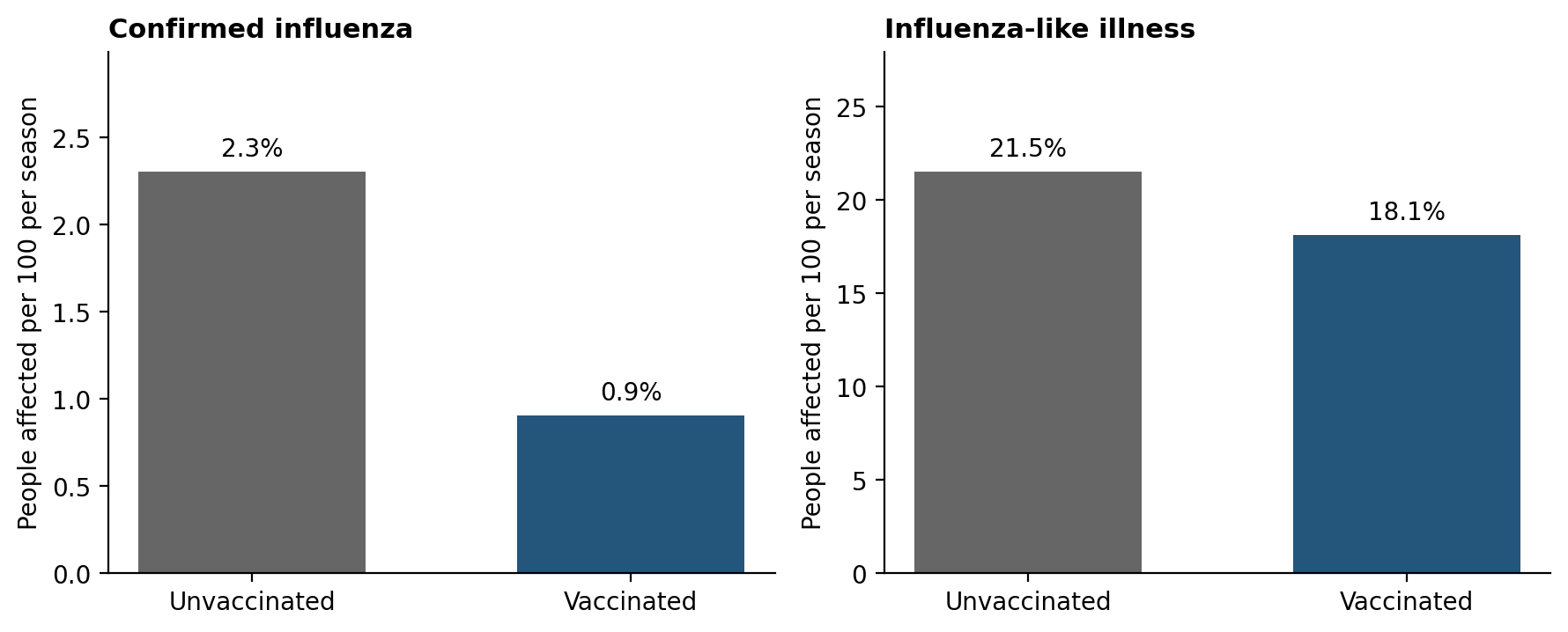
Historical pooled randomized-trial risks in healthy adults, Cochrane 2018. Panels have different scales. The evidence is international and does not predict a particular UK or US season.
13 COVID and the need for separate judgments
COVID brought together rapid product development, large clinical trials, emergency policy, and unusually consequential public communication. These should be disentangled. Whether a vaccine reduced severe disease is different from whether a spokesperson accurately described transmission protection, whether a mandate was proportionate, or whether institutions disclosed information promptly.
Polack and colleagues' original Pfizer trial reported strong short-term protection against symptomatic COVID in its study context. At the initial publication, median safety follow-up was about two months. The trial was multinational and manufacturer-sponsored. Its measured endpoint and timeframe matter: it did not establish durable protection against every later variant or settle the balance of repeated doses after prior infection.
Early Israeli rollout evidence supplied observational corroboration of protection against severe outcomes. For the core British analysis, Andrews and colleagues' work is more directly relevant to variants and waning. The English test-negative studies show why time since dose and the outcome being prevented belong in any account of effectiveness. Their design also requires examination of who sought testing and how comparison patients were selected.
The recognized injuries include myocarditis after mRNA products and thrombotic thrombocytopenia associated with particular adenoviral-vector vaccines. Greinacher and colleagues' clinical and laboratory evidence helped characterize the latter syndrome. A case series can establish a compelling safety signal and a plausible mechanism without independently estimating population incidence.
Patone and colleagues provide an English example of the importance of subgroup reporting. In men under 40, their estimated excess myocarditis after a second Moderna dose was higher than after a recorded positive SARS-CoV-2 test. The positive-test comparator does not capture every infection, and this is not a complete net-benefit comparison. It nevertheless makes a population-average reassurance inadequate for the subgroup question.
The early COVID decision involved a new infection, limited prior immunity, and urgent concern about severe disease. Later decisions involved accumulated infection, previous doses, different variants, and different baseline risks. Treating both as one timeless intervention prevents a fair evaluation. The original Pfizer trial is important evidence of short-term protection against its symptomatic endpoint. It is not a randomized test of universal mandates, an annual booster schedule, or durable population transmission control.
Transmission evidence must be assessed in its actual period. Eyre and colleagues' English contact study found vaccination-associated reductions for Alpha and Delta, with smaller and waning effects for Delta. This means that a claim of no transmission benefit at any point is too strong. It also means that an enduring rule could not rely on an unchanged effect as variants and time since dose changed. The study is observational and concerns identified contacts, so its estimates should not be treated as a universal parameter.
Prior infection changes the relevant alternative. Comparing a previously infected young adult receiving another dose with a completely susceptible older adult conflates both baseline risk and immune history. Recorded infection is an imperfect measure because many infections were never tested. This can distort observational comparisons and benefit-risk models. An honest account should distinguish documented prior infection, probable unrecorded infection, and genuinely uncertain history rather than assume that every person without a positive record was naive.
Safety also requires clinical specificity. Myocarditis risk after a particular dose in young men cannot be averaged away using a predominantly older population. Nor can one unfavorable subgroup estimate establish net harm for all recipients or all formulations. The Patone graphic illustrates the importance of subgroup reporting; it does not contain all COVID outcomes or quantify a lifetime balance. Serious disease prevented and vaccine-attributable injuries need comparable populations, time horizons, and severity measures.
The institutional audit should separate unsupported claims from demonstrated deception. To establish concealment requires records showing what was known, by whom, when, and what was withheld. Failure to update advice can be serious without being the same finding as falsifying data. This distinction strengthens accountability because a specific documented failure is harder to dismiss than an accusation that treats every mistake as proof of one comprehensive conspiracy.
A documented example is the Prescription Medicines Code of Practice Authority’s case AUTH/3888/4/24, completed in April 2025. The UK industry code authority found Pfizer’s November 2020 promotion misleading because it presented relative efficacy without the corresponding absolute risk. It also found promotion before marketing authorization and failures of standards. These are findings about communication and conduct, not a finding that the trial’s efficacy result was fabricated. The panel separately rejected allegations that the linked material lacked relevant adverse-reaction information or that its statement about no serious safety concerns necessarily claimed an absence of side effects. An accurate accountability assessment must preserve both the upheld and rejected findings in the ruling.
Our assessment of the clinical evidence is that the early protection of vulnerable adults was an important achievement. Our policy judgment is that this did not establish a case for compelling later doses in low-risk, previously infected people. These conclusions coexist. People protected, people injured and people excluded by policy all belong in the accounting.
Critical reanalyses deserve examination. Fraiman and colleagues' post hoc analysis of the original mRNA trial reports found an increase in a selected serious-adverse-event grouping. They estimated 12.5 additional serious events of special interest per 10,000 participants across the trials. Event counts are not automatically counts of distinct people injured; the selected grouping, coding decisions, and the absence of individual-level data limit interpretation. The result warrants a full audit, not conversion into a settled one-in-800 causal injury rate.
Black and Evans published a methodological response to that reanalysis. We have checked its publication and declared interests, but have not adjudicated the full exchange against participant-level data. We therefore do not treat the reanalysis as a settled causal injury rate. The argument is a reason for access and scrutiny, not an adequate basis for a precise verdict about all recipients.
A communication audit needs a dated record. Each disputed statement should be placed beside the evidence available then, the actual wording, and any later correction. An overconfident forecast, a mistake, failure to update, withholding of evidence, and demonstrated intentional deception are different findings. Documentary support should determine the label.
For present decisions, age, comorbidity, prior infection, product, dose, and circulating variant should be specified. The first doses in a largely susceptible population and later boosters in an immune young population are different interventions. Reliable evidence of early benefit cannot settle every later recommendation, while later failure to prevent infection does not erase earlier protection against severe disease.
A decision that changes with immunity and alternatives
Our COVID judgment has three separate parts. First, the original vaccines provided important protection in the early pandemic, especially for people at high risk. Second, specific product-related injuries are real and must change advice for affected groups. Third, the marginal value of an additional dose in a healthy previously infected young adult cannot be borrowed from a first-course estimate in an older susceptible population. Each proposition requires its own evidence.
An alternative vaccine can alter the answer even when no vaccination would be worse than vaccination. The proper comparison for a young recipient may be a different product, a longer interval or a later decision, rather than a forced choice between the originally supplied product and no protection ever. Public communication that suppresses feasible alternatives makes consent less informative. We favor a targeted and revisable approach, and reject the inference that the achievements of early vaccination justified uniform and enduring compulsion.
Reading the original trial beyond the headline
The original Pfizer trial’s saline comparator and randomized allocation provide strong evidence for its short-term symptomatic endpoint. Table 2 reports 8 cases among 18,198 evaluable vaccine recipients and 162 among 18,325 placebo recipients without prior infection. Crude proportions imply a reduction of about 0.84 percentage points over the observed follow-up, or roughly 119 courses per symptomatic case prevented. This is an illustrative count-based calculation; the published 95% efficacy used surveillance time. It is not an annual estimate or a number needed to prevent death.
The supplementary safety table reports participants with at least one serious adverse event: 126 of 21,621 vaccine recipients and 111 of 21,631 placebo recipients. Those counts neither demonstrate equivalence nor establish that the numerical difference was caused by vaccination. Follow-up was short, the analysis was descriptive, and rare injuries remained difficult to detect. Pfizer controlled major trial functions; the published data-sharing statement made access request-based and subject to review. We therefore retain the efficacy finding while rejecting a universal safety guarantee. The protocol and selected supplementary tables have been checked; participant-level data have not been independently reanalyzed.
Patone’s English study answers a narrower safety question. Each myocarditis case contributes exposed and baseline time, which controls fixed personal characteristics; calendar-time adjustment addresses some changing conditions. It still relies on hospital and death coding, recorded tests and selected risk windows. Only people eventually vaccinated were included, so infection deaths before a possible vaccination could be missed. First myocarditis events were studied; recurrent events and long-term severity require other evidence. Its young-male product difference is important, but is not a complete benefit–risk comparison for a contemporary booster.
Figure 13 Myocarditis risk depends on recipient and dose
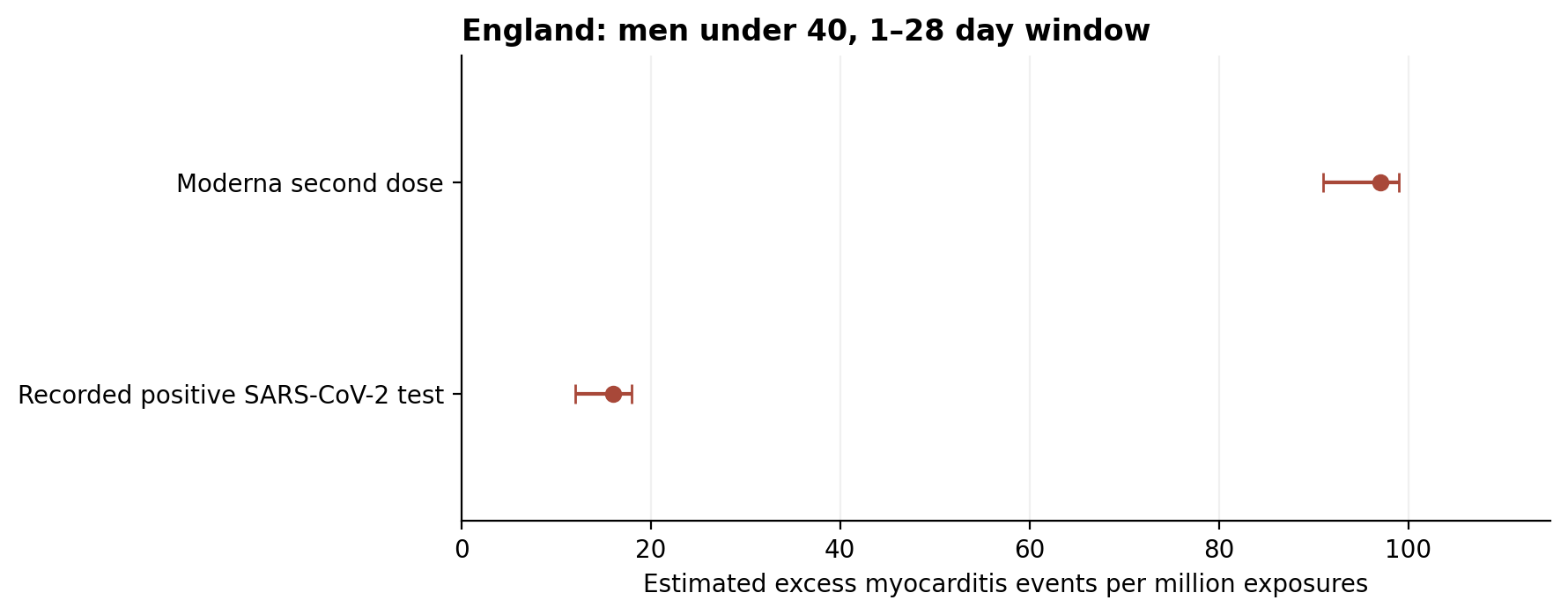
Patone et al 2022, subgroup estimates and 95% CIs. A recorded positive test is not every infection. These are historical observational excess risks, not total event rates, current formulation risks, or a complete net-benefit calculation.
14 How vaccine injuries are found or missed
Safety is a question about a particular exposure and outcome. It needs the same attention to measurement as benefit. Common short-lived reactions, rare life-changing injuries, and suspected delayed effects should be described separately. A pooled statement that serious events were similar can obscure a specific excess, while a list of every event after vaccination can create a false causal impression.
Randomized trials are valuable for safety but have practical limits. If an injury occurs once in 100,000 recipients, a vaccinated trial group of 10,000 would expect only 0.1 such cases. Most trials of that size would see none even if the risk were real. This elementary arithmetic explains why absence of an event in an initial trial cannot exclude a sufficiently rare harm.
Passive systems such as VAERS depend on reports. They can miss events, contain incomplete information, and include illnesses that would have happened anyway. Publicity can change reporting rates. Their proper role includes identifying signals for investigation; neither raw counts nor the absence of reports independently supplies a causal rate. There is no universal underreporting multiplier suitable for every vaccine and every outcome.
Linked medical-record systems such as the Vaccine Safety Datalink can search for diagnosed outcomes without waiting for a voluntary report. They improve the ability to study rare events, but still depend on coding, access to care, time windows, and comparison methods. Their findings should be evaluated outcome by outcome.
Pandemrix and narcolepsy provide a concrete example. The Finnish study by Nohynek and colleagues estimated approximately one attributable narcolepsy case per 16,000 vaccinated children and adolescents aged 4–19. It concerns a particular product and period. The British account requires UK-specific incidence and case ascertainment before transferring that number, but the finding establishes the seriousness of examining rare injury after rollout.
The broader US safety review by Gidengil and colleagues is useful as a map. Its overall conclusion is not a substitute for extracting each vaccine–outcome pair, its confidence interval, and evidence quality. The Institute of Medicine framework supplies an equally useful distinction between established harm, evidence against a proposed relationship, and unresolved uncertainty.
The evidential standard should not depend on whether an injury is politically convenient. Mechanistic evidence, clinical records, replication, and epidemiology each contribute. A patient deserves investigation and care even when causation remains unresolved. A policy estimate deserves a population denominator and a comparison group before it becomes an attributed injury count.
Safety review should begin before a signal becomes politically contested. A surveillance plan needs prespecified outcomes, meaningful follow-up, accessible case definitions, and a method for comparing observed events with background incidence. Investigators should explain how diagnoses were verified and whether independent adjudicators knew exposure status. Published reassurance without these details is difficult to audit.
One recurring error is to treat a nonsignificant result as proof of no important harm. If the confidence interval includes both a small reduction and a clinically meaningful increase, uncertainty remains. The opposite error is to search many outcomes and report only a few elevated associations without accounting for the search. A credible review asks how many comparisons were made and whether the finding replicated in a separate population.
Delayed outcomes present additional problems. A plausible biological concern is a reason to investigate, but does not establish its frequency or causal importance. Long follow-up is valuable, yet participants may change exposures, receive additional doses, become infected, or leave observation. The review should identify which risks were actually studied and which remain poorly bounded. It should avoid both a universal no-harm claim and an unlimited catalogue of untested possibilities.
The obligation to patients is broader than the statistical question. People with persistent symptoms need clinical assessment and care while causation is investigated. That obligation does not require accepting every proposed mechanism. Equally, a population-level net benefit is no reason to minimize a verified injury. A system asking people to accept a preventive intervention should retain responsibility for investigating and supporting those who may be harmed.
Our conclusion is that vaccine injury is established for specific product–outcome relationships, and inadequately bounded for some others. Neither raw adverse-event reports nor broad assurances supply a complete risk estimate. A credible programme must investigate suspected injury, disclose what it finds and provide care and fair redress.
Five safety episodes and five different lessons
The history is more informative when failures are identified precisely. In 1955, inadequately inactivated Cutter polio batches caused disease despite passing the required tests. This was a manufacturing and release-control failure, rather than proof that the intended inactivated product necessarily causes polio. The distinction matters for remedies: lot testing, manufacturing oversight and traceability cannot be replaced by a larger efficacy trial.
The 1976 US swine influenza campaign raised a different problem: an uncertain epidemic threat and a neurological injury. The subsequent assessment associated vaccination with approximately one additional Guillain–Barré case per 100,000 recipients, and the programme was stopped. Its lesson is to revisit the expected disease burden during a campaign; a preventive decision can become less attractive when the anticipated exposure does not materialize.
RotaShield supplied a third lesson. After US introduction in 1998, investigations established an intussusception risk; the recommendation was withdrawn and the manufacturer withdrew the product in October 1999. Current infant rotavirus vaccines need their own estimates. Retaining the old risk to describe newer products is as misleading as citing the newer, smaller risk to minimize injuries from the withdrawn product.
Pandemrix deserves particular attention in a British account. The 2020 English reassessment by Stowe and colleagues included children whose diagnoses were delayed. It estimated one attributable narcolepsy case per 34,500 doses, compared with approximately one per 55,000 in the earlier English assessment. Elevated onset risk was confined to the first year; late diagnosis was not the same as late onset. The study used three sleep centres, with uncertainty about catchment populations and possible recall bias. One author disclosed medico-legal expert work; the authors reported no specific funding.
That reassessment illustrates why follow-up must examine diagnostic delay as well as the time between exposure and symptoms. Its higher attributable estimate despite lower odds ratios is a warning against comparing relative measures without their underlying populations. It does not justify transferring an English childhood estimate to every influenza vaccine, every age or every country.
Finally, the adenoviral COVID clotting syndrome and mRNA-associated myocarditis show why platform and subgroup distinctions matter. On 7 April 2021 EMA said unusual clots with low platelets should be listed as a very rare Vaxzevria adverse effect. It also retained a favorable overall assessment and recognized that national decisions would depend on epidemic conditions and alternatives. A favorable overall balance and a reason to select another product for particular people can coexist.
These episodes establish that serious injury can escape initial trials and become clearer after wider use. They also establish that surveillance and published investigations sometimes identify those injuries and change policy. Neither a claim of perfect institutional performance nor a claim that every signal is suppressed fits this record. To judge whether a response was unacceptably slow, we want the first credible signal, the information available at each decision date, the action taken and the feasible alternative placed side by side.
15 Who produces the evidence
Commercial incentives can influence research without requiring a conspiracy. A manufacturer can choose a favorable question, comparator, endpoint, or analysis. A well-conducted study can still leave an inconvenient question unanswered. Journals and media then determine which results become prominent, and public agencies decide how strongly to translate those results into advice.
Jefferson and colleagues' review of influenza studies found an association between industry funding and publication in more prestigious journals and higher citation. Study size and assessed quality did not explain that association. This is evidence about dissemination. It does not independently prove that editors were paid to suppress harms or that a particular reporter acted dishonestly.
Lundh and colleagues' broader review found that manufacturer-sponsored drug and device studies more often reported favorable efficacy findings and conclusions. Standard risk-of-bias items did not fully explain the pattern. Funding and control therefore belong in an evidence assessment even when randomization and blinding appear sound. The result is broader than vaccines and cannot be used to assign an automatic numerical discount to every vaccine estimate.
Public institutions have incentives too. An agency invested in uptake may fear that admitting uncertainty will discourage protection. A critic may have reputational or commercial reasons to emphasize injury. These possibilities are reasons to examine procedures and evidence, not reasons to presume equivalent wrongdoing or dismiss all expertise.
Every pivotal study should be assessed for data ownership, sponsor involvement, protocol registration, changes in analysis, outcome switching, exclusions, missing follow-up, and access to regulatory material. Disclosed funding is the beginning of that inquiry. A short disclosure at the end of a paper cannot show whether independent investigators could reproduce the analysis.
We do not claim to have demonstrated systematic media suppression of vaccine injury. This review contains no representative content analysis of reporting. Selective headlines can illustrate a failure, but cannot establish its prevalence. Our criticism rests instead on identifiable omissions, differences between relative and absolute risk, and the documented sponsorship patterns discussed here.
An effective accountability standard is reproducibility and access. Criticism should become more specific as the evidence grows: identify the omitted outcome, inaccessible data, altered protocol, unsupported claim, or delayed correction. That is a firmer foundation for reform than either institutional reassurance or a general declaration that all journals are captured.
The original concern about industry influence is best translated into questions that evidence can answer. Who controlled the dataset? Could academic authors publish without sponsor permission? Were all prespecified outcomes reported? Did regulators receive analyses absent from the journal paper? Did a journal publish a response or correction, and did prominent reporting reflect it? These are investigable features of a particular record rather than a general verdict about an entire industry.
Funding associations should be interpreted with the same care as clinical associations. The sponsorship reviews show patterns deserving scrutiny, but do not establish that every sponsored estimate is false or every independent estimate is sound. A critic's financial, professional, or organizational interests also deserve disclosure. Applying that rule symmetrically does not imply that every interest has equal scale or influence. It establishes a consistent basis for examining control and incentives.
The same standard applies to CGHA’s work. Organizational involvement, funding and analytic choices need disclosure, and readers need enough information to inspect the conclusions. Independence is a claim to be demonstrated through access and conduct, rather than a credential we can award ourselves.
Our conclusion is that neither commercial sponsorship nor public-agency endorsement is a sufficient guarantee of reliability. Sponsor influence deserves scrutiny because systematic evidence documents an association with favorable findings and dissemination. A general assertion that all journals or all unfavorable results are controlled goes beyond that evidence.
An accountability test: dates, decisions and consequences
We want to judge institutions by what they said and did when evidence was available. A harmful outcome, an inaccurate assurance, a slow response and deliberate concealment are different findings. The first three can be documented without proving the fourth. Conversely, the absence of proof of concealment does not excuse an inaccurate claim or an unfair claims process. These three cases put that distinction to work. Dates below identify public actions and publications; they do not establish when every official first knew something privately.
Case 1: myocarditis and the duty to update consent
Table 15.1. Myocarditis: recognition, advice and revision
Date | Public record | What it establishes |
|---|---|---|
23 June 2021 | ACIP publicly reviewed myocarditis after mRNA vaccination; its assessment appeared online on 6 July. | A recognized safety signal and an explicit contemporary benefit–risk judgment. |
25 June 2021 | FDA revised Pfizer and Moderna fact sheets; IHS documented the revisions on 28 June. | Warnings were public in 2021; their existence does not establish the quality of every consent discussion. |
3 September 2021 | JCVI declined to recommend a universal programme for healthy 12–15-year-olds on direct health grounds. | It judged the positive margin too small and uncertain to support that programme; it did not conclude that vaccination caused net harm. |
13 September 2021 | UK chief medical officers recommended offering one Pfizer dose to healthy 12–15-year-olds, adding educational considerations. | A broader policy judgment following, rather than overturning, the narrow clinical assessment. |
February 2022 | CDC guidance allowed an eight-week primary-series interval for some adolescents and adults; the March MMWR explained it. | Advice incorporated a practical way to reduce myocarditis risk, especially for younger males. |
25 June 2025 | FDA required an updated myocarditis warning with newer incidence and follow-up information. | An update to an existing warning, not the first official recognition of injury. |
The June 2021 ACIP analysis belongs in its own historical setting. It compared a two-dose course with no vaccination over 120 days, using contemporary disease rates and assumed high effectiveness. It was not a calculation for a previously infected young man deciding on a later dose during Omicron. Nor were the VAERS reporting rates used in that discussion automatically causal excess rates. An institution should explain which assumptions still apply before reusing an old reassurance.
The British adolescent decision is especially revealing. The clinical advisers judged the individual health balance marginally positive but insufficient to justify a universal programme. The chief medical officers then included expected effects on education and recommended an offer. Their remit concerned benefits and disadvantages for those young people, including indirect effects. This was not a recommendation to vaccinate children primarily for the benefit of older adults. Readers can disagree with the weighting of educational disruption without pretending the clinical committee had found a large direct benefit, or had found net harm.
Our judgment is that informed consent should have made the narrowness of that balance plain. When benefit is small, product, dose spacing, prior immunity, sex and age become more consequential. The decision to offer vaccination can be defensible while pressure to accept it is excessive. A public warning is necessary, but it is not evidence that every recipient was told the relevant risk in an understandable form. We would need consent materials, their revision dates and evidence of their use to answer that question.
The record also places limits on criticism. It does not support saying that regulators kept myocarditis secret until 2025. They publicly acknowledged it in 2021. It does support asking whether their communication and recommendations adjusted adequately as subgroup evidence and alternatives improved. The later FDA label contains follow-up information whose long-term prognostic significance remains uncertain; neither a generally mild acute course nor an abnormal follow-up test settles the lifetime outcome for every affected patient.
Case 2: transmission claims and the justification for mandates
Table 15.2. Transmission, reassurance and changing policy
Date | Public record | What it establishes |
|---|---|---|
December 2020 | The pivotal Pfizer trial established substantial protection against symptomatic COVID over its observed follow-up. | It did not establish permanent prevention of infection or onward transmission. |
May 2021 | CDC published breakthrough infections and narrowed national passive reporting from 1 May to hospitalized or fatal cases. | Reduced breadth of that surveillance stream; other effectiveness and infection studies continued. |
21 July 2021 | President Biden gave a categorical assurance against getting COVID, while elsewhere in the same town hall acknowledging breakthrough infection. | Public messaging was internally inconsistent and overstated protection already known to be incomplete. |
27–30 July 2021 | CDC changed masking advice on 27 July; the Barnstable outbreak report followed on 30 July. | Breakthrough infection mattered to policy; the outbreak did not establish zero vaccine effectiveness. |
January–March 2022 | England announced intended revocation on 31 January, published its response on 1 March and revoked requirements from 15 March. | Changing Omicron-era evidence and workforce considerations altered the proportionality assessment. |
The most troubling assurance here does not depend on hindsight. At the July 2021 town hall, Biden said that vaccinated people were “not going to get COVID”. Breakthrough infection was already public knowledge. The same transcript contains his acknowledgment that vaccinated people could catch the virus, so it would be unfair to portray the whole appearance as a consistent denial. The accurate finding is that a consequential public assurance was categorical, wrong and inconsistent with both the existing record and his own qualification. The transcript cannot establish his private intention.
There is an equally important restraint on the opposite argument. The high proportion of vaccinated people among Barnstable cases cannot by itself estimate vaccine effectiveness: the relevant denominators, exposures and selection of cases matter. Similar PCR cycle thresholds are not a complete measurement of infectiousness. Studies of contacts in England did find reductions in transmission associated with vaccination, with smaller and waning effects for Delta. The reasonable conclusion is that transmission protection was incomplete and changed over time, not that it never existed.
CDC’s surveillance choice deserves scrutiny without a conspiracy being assumed. Narrowing one national passive reporting system made its count less useful for tracking all breakthrough infections. It did not mean CDC stopped studying infection: the report explicitly described continuing work through other systems. An accountability inquiry should ask what information was lost, why the change was made and how that limitation was explained when infection prevention remained central to public arguments. A reporting change alone is not proof that harms or failures were deliberately hidden.
England’s reversal supplies a concrete example of the obligation to revisit compulsion. Care-home requirements had already operated, whereas the wider health and social-care requirement planned for April 2022 was revoked before implementation. The government’s consultation response discussed Omicron, reduced protection against infection and staffing considerations. Revocation was a policy reassessment; it was not a finding that vaccination had ceased to benefit vulnerable patients. Nor does that document quantify every job loss, infection or death attributable to the earlier requirement.
Our conclusion is that an enduring, broad requirement could not fairly rely on an early, categorical promise about transmission. The case for coercion had to be renewed for the particular setting, circulating variant, immunity level and available alternatives. This is a stronger criticism than merely observing that guidance changed. It asks whether the burden imposed remained proportionate to the additional benefit. The nursing-home evidence discussed elsewhere in this report provides counterevidence to a claim that every mandate was necessarily a mistake: targeted requirements in a highly vulnerable setting may have produced substantial benefits. That does not establish the wisdom of applying the same rule to every healthy young adult.
Case 3: Pandemrix, narcolepsy and the limits of redress
Table 15.3. Pandemrix: signal, restriction and recognition
Date | Public record | What it establishes |
|---|---|---|
27 August–23 September 2010 | EMA opened a review following Nordic narcolepsy reports, then publicly described uncertainty in September. | A signal was under investigation; uncertainty was not evidence that no risk existed. |
21 July 2011 | EMA recommended restricting Pandemrix use below age 20 to specified circumstances. | A meaningful change in response to evidence, not a universal ban on influenza vaccination. |
2012–2020 | Nordic studies and subsequent English follow-up documented the association and refined attributable-risk estimates. | Estimates differ with population and ascertainment; later diagnosis does not mean newly arising late-onset injury. |
9 February 2017 | The Court of Appeal decision summarized by HMCTS addressed prognosis in assessing disablement. | The consequences of a lifelong condition matter to a severity assessment. This is not a population risk estimate. |
Current rules, October 2026 | The UK scheme requires at least 60% disablement and provides a one-off £120,000 payment. | Payment eligibility, proof of causation and full compensation are different questions. |
Pandemrix is an example in which a real vaccine injury should be acknowledged without qualification by reassurance about vaccines in general. A favorable aggregate benefit–risk assessment cannot cancel an individual’s narcolepsy. Equally, the finding concerns a particular pandemic influenza product and circumstances; it cannot establish that every influenza vaccine has the same risk. The Finnish and English studies discussed in the safety chapter provide the relevant product-specific evidence.
EMA’s September 2010 notice described an investigation opened in August. It discussed alternative explanations and insufficient evidence then to confirm a link. By July 2011 it recommended restrictions for those below 20, while retaining an overall favorable assessment in specified circumstances. These documents show recognition and subsequent action. They do not alone establish whether every part of the intervening period was justified, or whether an earlier restriction would have prevented a particular number of cases. That requires the evidence available at each stage and actual product use during the interval.
The English follow-up is also a lesson about follow-up itself. Narcolepsy may be diagnosed long after symptoms start. The later study’s higher attributable-risk estimate reflected more complete ascertainment; it should not be presented as evidence that the vaccine routinely produced new narcolepsy many years after exposure. A short observation period can underestimate a difficult-to-diagnose injury even when its onset is relatively early.
Redress adds a separate institutional test. The official summary of the 2017 appeal records that prognosis can matter when assessing disablement from a lifelong condition. We have checked that official summary, not the complete appellate judgment, and do not infer broader legal findings from it. Under current UK rules, a person can have a meaningful injury yet fail the scheme’s 60% disablement threshold. The NHS scheme describes its £120,000 award as a one-off payment rather than compensation; court damages remain a separate route. A rejected application therefore cannot automatically be counted as proof that no vaccine injury occurred.
Our view is that a programme which asks people to accept a small risk for public benefit owes those who are seriously harmed a credible route to recognition and support. The severity threshold makes this scheme narrower than a promise to compensate every causally injured recipient. That is a policy choice open to criticism. These sources do not, however, supply a complete claims cohort from which to calculate rejection errors, delays or lifetime unmet costs. We would not turn individual examples into such a rate.
What these cases establish
We conclude that public-health success and institutional failure can coexist. The evidence supports substantial vaccine benefits, recognized product-specific injuries, public overstatement about protection, revisions in policy and restrictive conditions for redress. These findings warrant better consent, more precise claims, publication of subgroup assumptions and a stronger duty to reassess coercive policies. They do not establish a single explanation in which all journals, manufacturers, media outlets and regulators coordinated to suppress the truth.
For the Cambridge and Montgomery County research, that distinction matters. A person who encounters an inaccurate assurance or a family struggling for recognition may reasonably lose trust, even if the next vaccine offered has a strongly favorable balance. Our author-supplied data and qualitative observations can illuminate that loss of confidence. Without the missing sampling details, exact questions and linked exposure histories, they cannot establish that one political group knew more, that media exposure caused hesitancy, or that hesitant respondents made better clinical decisions. The research belongs alongside these documented institutional cases, with its own evidentiary limits visible.
The outstanding full-text gaps remain explicit: the Cochrane influenza and MMR reviews have not both received a complete full-text audit here, and the Pennsylvania Amish hospitalization study remains assessed from its primary abstract. Unsuccessful downloads returned web challenge pages rather than papers; they are not archived as full articles. These gaps limit the depth of verification, not the obligation to state what the accessible evidence does and does not show.
16 Where vaccination saves most lives
We conclude that the greatest absolute survival gains from established childhood vaccination occur in places with high preventable infectious mortality, disproportionately in poorer countries. This is more than a plausible mechanism: the regional analysis in Shattock and colleagues finds larger absolute gains where initial mortality was high. It does not mean that every additional vaccine dose is most valuable in the poorest country. The disease, recipient, existing coverage and feasible delivery determine that marginal decision.
What the geographical claim means
We use poorer countries as a description, not as a substitute for a defined statistical group. Low- and middle-income countries are a broad income category. The UN designation least developed countries is narrower and includes criteria beyond income. The rest of the world includes affluent countries too. A result for 98 low- and middle-income countries cannot be relabeled a result for the formal LDC group. Our conclusion concerns high-burden settings; this evidence does not allocate a precise global share to that UN group. The UN classification uses income, human assets and economic and environmental vulnerability.
Greatest benefit also needs a unit. Total deaths prevented depends on population size and historical coverage. Benefit per vaccinated child depends on that child's risk. Benefit per dollar depends on full delivery costs and alternatives. Financial savings can be large in rich countries precisely because treatment is expensive. These measures can rank the same programme differently. We give priority here to avoided premature death and serious illness, while keeping the economic question separate.
What the global estimates establish
Shattock and colleagues estimate 154 million deaths averted by vaccination against 14 pathogens from 1974 to 2024. Their regional comparison finds that higher initial mortality translated into larger absolute survival gains. These are modeled counterfactuals, not observed death certificates for people who otherwise would have died. The geographical pattern supports our conclusion more directly than the worldwide headline total.
Li and colleagues estimate 37 million deaths averted in 98 low- and middle-income countries during 2000–2019, with a 95% credible interval of 30–48 million. Their estimate of 69 million for 2000–2030 includes projections and must not be described as an already observed achievement. The studies overlap in scope and modeling inputs; we do not add their totals or treat them as wholly independent confirmations.
Those models were funded by institutions committed to immunization: WHO for Shattock, and Gavi and the Gates Foundation for Li. Sponsorship matters, and the assumed no-vaccination world, historical coverage, fatality and extrapolation deserve scrutiny. It does not follow that the regional gradient is an invention. The trial evidence and the British and American disease histories provide checks on the underlying premise that preventing infection prevents consequential illness. We are more confident in the direction of the geographical conclusion than in any headline count to the nearest million.
Where the modeled mortality gains occurred
The geographical conclusion is directly visible in the supplementary income analysis, not merely inferred from a worldwide total. Figure S2 places the largest cumulative mortality gain in lower-middle-income countries, with the three lower-income strata together substantially exceeding the high-income stratum. That is a conclusion about totals across populations, not a rate per dose. It uses countries’ 2024 income classification throughout the historical comparison. We do not assign an exact percentage to the unlabelled bar heights.
The regional table supplies numerical estimates. Africa accounts for 52.84 million modeled deaths averted and South-East Asia for 38.03 million. Together these are 90.87 million, or 59.1% of the published global point estimate of 153.858 million. These regions include populations with different incomes; the 59.1% is a regional share, not an LDC or low-income-country share. Europe accounts for 7.28 million and the Americas for 16.12 million, but neither WHO region is synonymous with rich countries.
Table 16.1 Regional impact of the 14-pathogen programme, 1974–2024
WHO region | Deaths averted, millions | Reported model interval* | Global share |
|---|---|---|---|
African region | 52.84 | 51.08–54.42 | 34.3% |
Eastern Mediterranean | 25.07 | 24.30–25.79 | 16.3% |
European region | 7.28 | 6.94–7.59 | 4.7% |
Americas | 16.12 | 15.36–16.85 | 10.5% |
South-East Asia | 38.03 | 37.05–38.98 | 24.7% |
Western Pacific | 14.51 | 13.95–14.99 | 9.4% |
Global | 153.858 | 148.673–158.621 | 100% |
Source: Shattock et al, supplementary Table S1. All ages; estimates rounded in the source. Regional totals sum to 153.858 million. Shares are author calculations from point estimates; uncertainty ranges are not added or converted into share intervals. These are gross disease-impact estimates against no historical vaccination, not a comprehensive net benefit after every vaccine injury. *Intervals omit substantial input and structural uncertainty; see supplementary pp 42–43.
Which diseases drive the result
Measles accounts for 93.712 million of the estimated deaths prevented: 60.9% of the total. Measles, tetanus, pertussis and tuberculosis together account for 94.7%. This concentration matters. The headline is principally a history of preventing severe childhood infections, including maternal protection against neonatal tetanus. It cannot validate COVID mandates, a seasonal adult recommendation or a new product that was not studied.
Table 16.2 Disease-specific modeled deaths averted globally
Pathogen | Deaths averted, millions | Reported model interval* |
|---|---|---|
Measles | 93.712 | 90.477–96.901 |
Tetanus | 27.955 | 26.991–28.745 |
Pertussis | 13.155 | 12.587–13.586 |
Tuberculosis | 10.902 | 10.658–11.126 |
Hib | 2.858 | 2.811–2.892 |
Pneumococcal disease | 1.623 | 1.600–1.638 |
Polio | 1.570 | 1.570–1.570 |
Yellow fever | 0.557 | 0.534–0.568 |
Hepatitis B | 0.461 | 0.444–0.479 |
Rotavirus | 0.395 | 0.388–0.402 |
Diphtheria | 0.353 | 0.325–0.375 |
Rubella | 0.285 | 0.258–0.307 |
Japanese encephalitis | 0.030 | 0.029–0.031 |
Meningitis A | 0.002 | 0.002–0.003 |
Source: Shattock et al, supplementary Table S1, p 2. Calendar-period deaths averted, 1974–2024, not lifetime benefits of everyone vaccinated during that period. Delayed hepatitis-B benefits therefore remain partly outside the window. Fixed polio model outputs do not express genuine absence of uncertainty. Global and regional estimates are model-dependent. *Intervals omit substantial input and structural uncertainty; see supplementary pp 42–43.
Why we qualify the numbers
The appendix makes a stronger qualification than a generic warning about modeling. Its uncertainty section says the reported bounds do not include all uncertainty and do not carry their usual interpretation. Coverage and population inputs are treated as given; uncertainty is not propagated through every underlying model, and allowable posterior widths are predefined. The table intervals below are therefore reported partial model intervals, not comprehensive 95% limits on the true historical total. This reduces confidence in numerical precision without, by itself, overturning the broad geographical pattern. We retain the point estimates as model results and avoid presenting their narrow ranges as proof of exactness.
A clinical test of the argument
A randomized rotavirus trial in Malawi and South Africa provides a concrete example. Efficacy against severe rotavirus gastroenteritis was lower in Malawi: 49.4%, compared with 76.9% in South Africa. Yet vaccination prevented more severe episodes there: 6.7 rather than 4.2 per 100 infant-years. Higher background risk outweighed lower relative efficacy. These are severe-illness outcomes during trial follow-up, not deaths prevented or a direct UK–Malawi comparison. The trial was supported by GlaxoSmithKline and PATH, so its sponsorship belongs alongside its design and findings.
This is the practical reason an identical efficacy percentage cannot settle two national decisions. If infection is common and treatment delayed, prevention can remove a larger burden. The Cochrane rotavirus review also distinguishes mortality settings. Together, these findings justify treating the larger absolute gains in high-burden settings as an evidence-based conclusion, while retaining product-specific injury risks and avoiding a universal rule about every country.
Why affluent-country benefits remain substantial
The UK and US histories establish important gains after prosperity had already reduced mortality. Polio paralysis, congenital rubella injury and invasive bacterial disease were not made inconsequential by functioning hospitals. Measles mortality fell before vaccination, but large recurring case burdens persisted. Prevention added a different kind of improvement: fewer infections and their complications. We regard that distinction as decisive against the claim that vaccines matter only in poor countries.
A 2024 CDC model estimates 1,129,000 premature deaths and 32 million hospitalizations prevented over the lifetimes of approximately 117 million Americans born in 1994–2023, with $540 billion in net direct savings. Influenza and COVID vaccines were excluded. This is a lifetime cohort model, not deaths observed during those 30 years. Its use of prevaccine disease incidence and mortality makes the counterfactual particularly consequential; roughly two-thirds of its estimated deaths prevented concern diphtheria. We treat it as evidence of potential scale, not a precise modern-care-only comparison or a figure directly comparable with the global studies.
Is vaccination the best purchase?
Our economic conclusion is narrower than our mortality conclusion. Established childhood vaccination is often an excellent use of scarce resources, but a cheap vial is not a cheap programme. Transport, refrigeration, staff, administration, wastage, surveillance and reaching remote families all count. The relevant choice is the next feasible intervention in that setting, not an average procurement price. Ozawa and colleagues' return estimates illustrate substantial potential value, but the answer changes with the valuation method; the value assigned to longer life is not cash released in a ministry budget.
Water, sanitation, nutrition and primary care also produce benefits across diseases. A fair comparison counts those broader gains, just as it counts vaccination's protection against disability and financial loss. The studies assembled here do not establish that vaccination universally dominates these alternatives. We would fund high-value childhood immunization as part of basic care, and compare marginal expansions against the best available competing use of money. This is a policy judgment about the evidence, rather than a claim that one intervention wins every local comparison.
Gavi: evidence from the institution built for this purpose
Gavi is directly relevant to our argument because its purpose is to expand equitable vaccine use, particularly in lower-income countries. Its own reports offer evidence about reach and modeled outcomes. Those records deserve attention, followed by a separate question: how much improvement did Gavi itself add beyond what governments and other donors would otherwise have achieved?
Table 16.3 Gavi’s reported programme indicators
Indicator | Reported result |
|---|---|
Routine recipients, 2000–2025 | More than 1.3 billion unique children |
Future deaths prevented, vaccinations 2000–2025 | More than 23 million, modeled |
Future DALYs prevented, 2021–2025 | More than 352 million, modeled |
Economic benefits, 2000–2025 | More than US$308 billion, modeled |
Under-five mortality in Gavi57, 2019 to 2024 | 59.0 to 52.6 per 1,000 live births |
Zero-dose children in Gavi57, 2025 | 9.5 million; 4% above 2019 |
Source: Gavi 2025 Annual Progress Report, mission indicators, accessed 25 October 2026. Recipient means completion of at least one supported routine vaccine, not every vaccine. Future deaths and disability-adjusted life years (DALYs) use Vaccine Impact Modelling Consortium models; economic benefits use the DOVE-ROI economic model. Under-five mortality is an all-cause country trend, not wholly attributable to vaccination. These totals overlap other impact estimates and must not be added to them.
This is substantial supporting evidence, but its categories matter. Delivery is an achievement; deaths prevented require a counterfactual. A fall in all-cause mortality can reflect nutrition, sanitation and treatment as well as vaccination. The estimated value of supported vaccination is also different from the additional value created by the funding institution: some recipients might have been vaccinated without Gavi. We therefore use its report as a transparent programme account, rather than as self-validating proof of the institution’s entire causal contribution.
Testing whether Gavi added benefit
Jaupart, Dipple and Dercon used a different method: comparing changes in eligible countries with changes in lower-middle-income countries outside eligibility, using 1995–2016 data. Their difference-in-differences study estimated the following improvements. This is useful corroboration because it evaluates programme eligibility rather than simply applying clinical efficacy to doses delivered. It remains observational and was funded by the Gates Foundation; methodological distance from the impact models is not financial independence.
Table 16.4 Quasi-experimental estimates of Gavi eligibility effects
Outcome | Estimated change | 95% confidence interval |
|---|---|---|
DPT coverage | +12.02 percentage points | +6.56 to +17.49 |
Measles coverage | +8.81 percentage points | +3.58 to +14.04 |
Infant mortality | −6.22 per 1,000 live births | −10.47 to −1.97 |
Under-five mortality | −12.23 per 1,000 live births | −19.66 to −4.79 |
Source: Jaupart et al (2019). Country-level eligibility comparison, not randomization. Infant deaths are included within under-five deaths; the two effects must not be added. Identification depends on credible comparison trends and absence of differential contemporaneous influences.
That finding strengthens our judgment that vaccination assistance can produce important gains beyond the background improvement in living conditions. It is not the final word on Gavi. Dykstra and colleagues’ regression-discontinuity study found small or statistically unclear coverage gains from aid for cheap established vaccines near the income-eligibility threshold. That local result concerns less-poor countries near the boundary and does not exclude larger gains in the poorest settings. The two studies ask different questions. Their combination favors targeting unmet need and checking additional impact, rather than assuming every dollar or donated dose has the same effect.
Our institutional conclusion is favorable but discriminating. Gavi’s programme records and the eligibility-based mortality study strengthen the case for reaching children with established vaccines in poorer settings. The weaker evidence near the funding threshold also favors concentrating support where unmet need and additional benefit are greatest. This is a case for a well-targeted programme, not a presumption that every expenditure is equally valuable.
An explicit test of the economic claim
Lai and colleagues’ 2026 economic evaluation provides the income comparison missing from a simple appeal to cheap doses. It reports benefit-cost ratios of 23.63 in low-income countries, 16.58 in lower-middle-income countries, 14.87 in upper-middle-income countries and 14.80 in high-income countries. These are historical averages for 14 pathogens across 1974–2024, using 2023 US dollars and a 3% discount rate. Countries are reclassified annually, unlike the fixed-2024 strata in Shattock’s supplementary figure. (pp 3–5)
Table 16.5 Economic returns across income groups
World Bank group | Benefit-cost ratio | Reported 95% interval |
|---|---|---|
Low income | 23.63 | 16.87–34.32 |
Lower-middle income | 16.58 | 11.50–25.02 |
Upper-middle income | 14.87 | 9.76–23.99 |
High income | 14.80 | 9.38–23.86 |
Source: Lai et al (2026), published article p 5. Benefit numerator is principally modeled lifetime productivity losses avoided through averted mortality; denominator includes procurement, administration and family time costs. These are modeled societal returns, not treasury cash savings. Intervals overlap and do not establish a statistically precise ordering between every pair of income groups.
The low-income point estimate is about 1.60 times the high-income estimate. That supports the argument for particularly good value in poor settings, but the intervals overlap substantially. The analysis also estimates favorable aggregate returns in all 194 countries, and the USA has the largest absolute monetized net benefit. Higher wages and the valuation of future productivity make the dollar ranking different from the health ranking. We therefore reject the claim that the economic benefits reside only, or necessarily mainly in dollar terms, in poor countries.
The economic paper inherits the Shattock health-impact estimates; it is not independent replication of lives saved. It omits important nonfatal disease and care-cost benefits, but it also does not provide a comprehensive deduction for vaccine-attributable injuries. A favorable aggregate calculation cannot supply a product-specific net balance. The study’s funding includes Chinese research agencies, the Vaccine Impact Modelling Consortium and Japan’s research agency; several authors disclose wider vaccine-industry or global-health funding. We retain those disclosures while assessing the methods rather than presuming their result false.
Nor is the past average the value of the next purchase. The study’s global ratio falls from 16.06 for the full 50 years to 7.53 for 2000–2024 and 4.89 for 2024. Changes in disease, health, costs and the valuation framework all affect that trend. It supports reassessing marginal additions, rather than assuming the returns from early measles control apply unchanged to every current expansion.
The conclusion we draw
Our conclusion is that established childhood vaccination has delivered most of its modeled survival gains outside high-income countries, with lower-middle-income countries contributing the largest total in the published income analysis. High-burden poorer settings also offer especially strong absolute gains and high estimated economic returns. Africa and South-East Asia together account for 59.1% of the modeled historical deaths prevented, while the low-income economic return estimate is 23.63 against 14.80 in high-income settings. These results support the central argument, with substantial gains in wealthy countries retained. They do not prove a formal LDC majority, a universal ranking per dose or per dollar, or superiority over every investment in basic care.
Three questions hidden inside the phrase most beneficial
The geographical conclusion needs three denominators. Total historical survival gain asks where the greatest number of deaths was prevented. Benefit per recipient asks what one course achieved for a person facing a specified exposure. Benefit per additional dollar asks what a present programme can achieve at the margin. The first can be large because a population is large; the second depends heavily on disease risk; the third also depends on delivery costs and what competing services already exist.
The global historical model supports concentration of survival gains outside high-income settings, and its income-group figure places lower-middle-income countries first in total modeled deaths averted. The economic model gives the highest benefit–cost ratio to low-income settings. These are distinct findings with different income-classification methods. Their agreement in broad direction is useful, but the economic evaluation inherits the health model rather than independently validating the underlying deaths.
We therefore conclude that the principal historical childhood survival gains occurred outside rich countries, and that high-burden poorer settings often offer exceptionally large absolute returns. We cannot convert this into a universal ranking of every current vaccine purchase. A costly final-mile campaign in a low-burden district can have a lower marginal return than protecting a high-risk person in a rich country. Nor does the formal UN least-developed-country category identify the same set of people as every low- or middle-income analysis.
The comparison with nutrition, safe water and treatment should use the next feasible investment in the same place, rather than contrast vaccination with the entire historical contribution of sanitation. Complementarity matters: better nutrition can reduce disease fatality, treatment can rescue remaining cases, and vaccination can prevent illness that neither measure fully removes. Our favorable judgment on vaccination is strongest when the programme is integrated with those services rather than used to excuse neglect of them.
Figure 14 Income and the distribution of survival gains
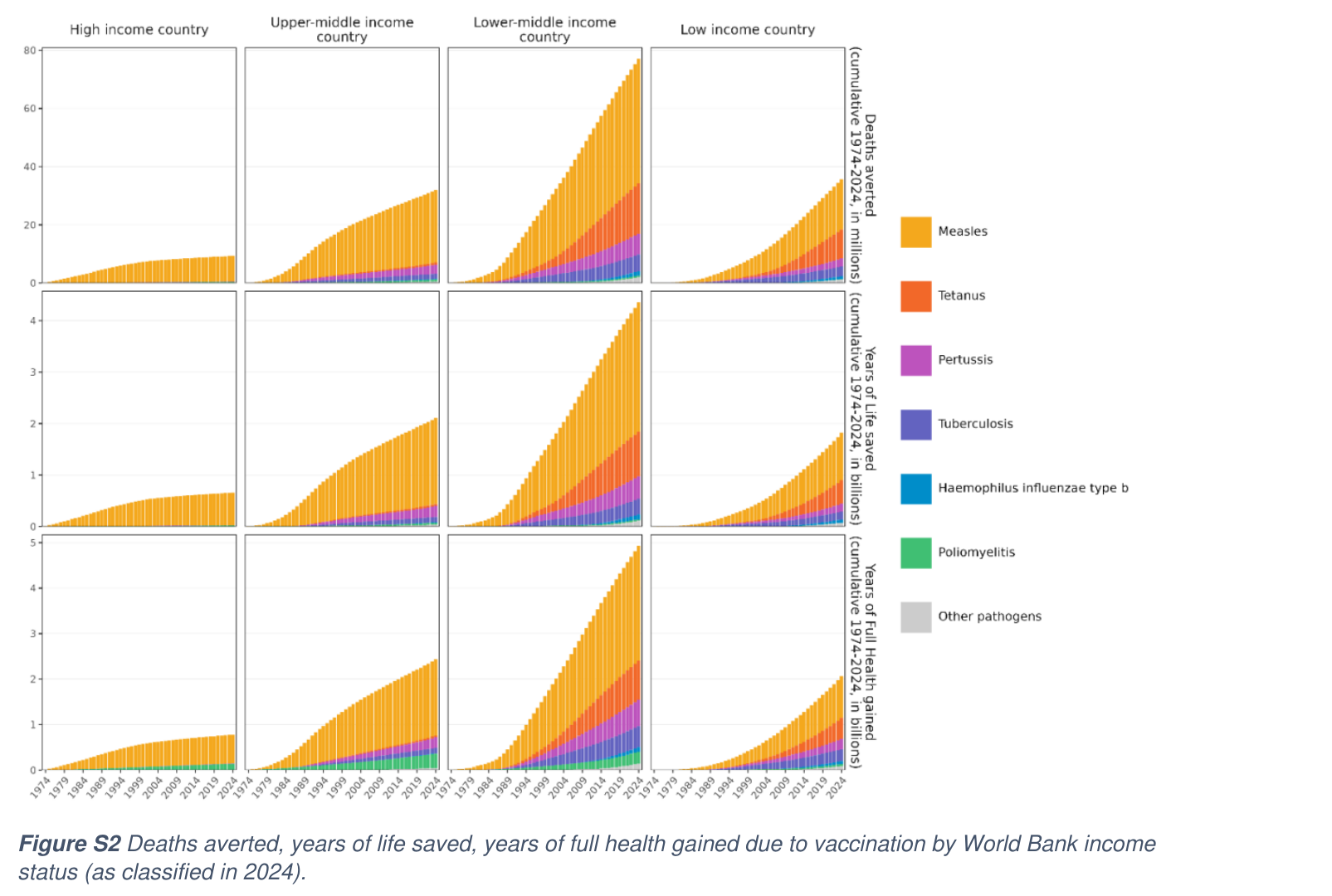
Reproduced from Shattock et al (2024), supplementary Figure S2, p 7, under CC BY. Top panels: cumulative deaths averted; middle: life-years; bottom: years of full health. Income is classified as of 2024. This published graphic demonstrates the income pattern; its bar heights are not transcribed into invented exact totals.
Figure 15 Regional deaths prevented, with uncertainty
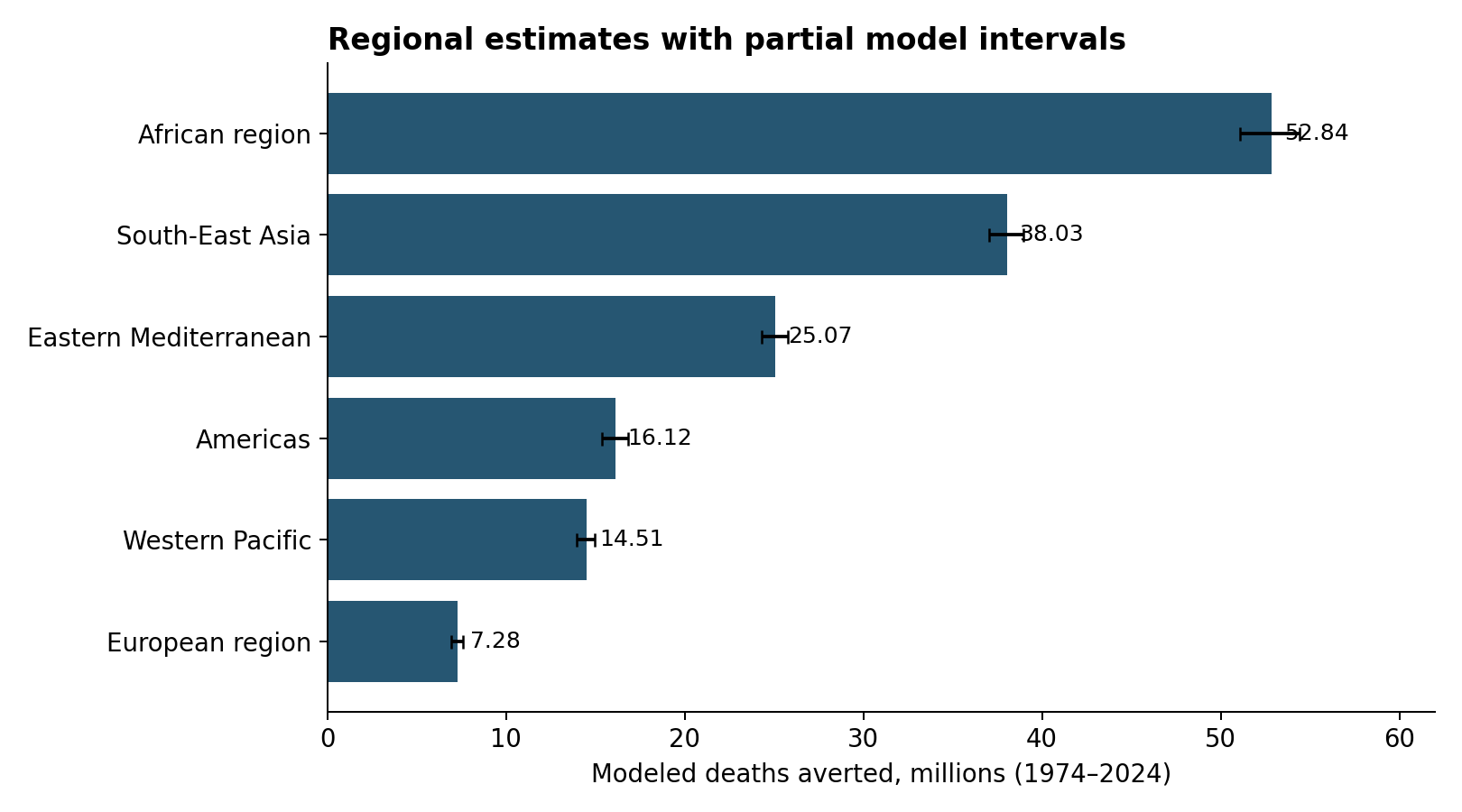
Author graphic from Shattock et al, supplementary Table S1, pp 2–6. Error bars reproduce partial model intervals; they do not capture all uncertainty. WHO regions contain mixed income levels. The combined African and South-East Asian regional point estimates equal 59.1% of the global total; this is not a formal LDC share.
Figure 16 Economic returns differ by income
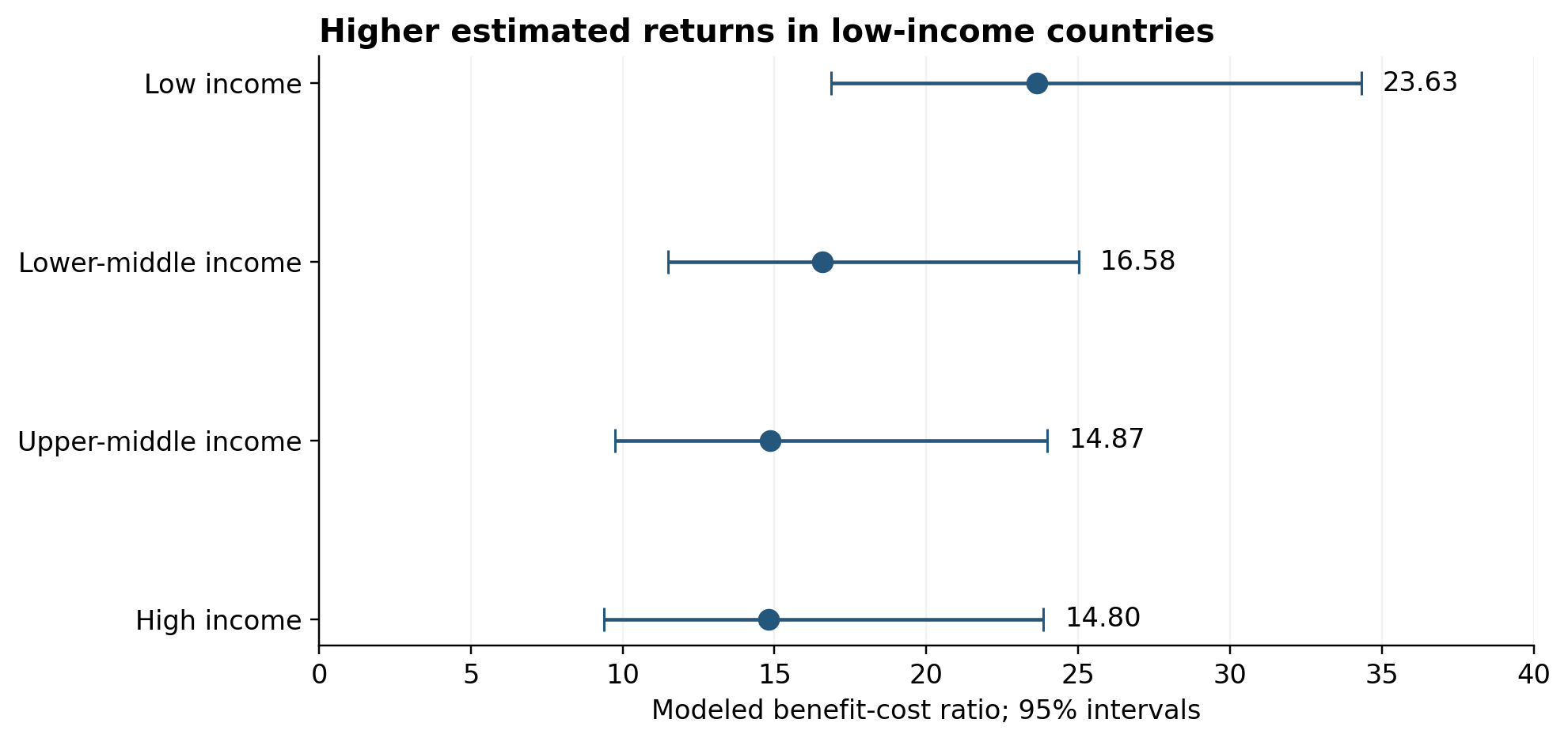
Author graphic from Lai et al (2026), p 5. Historical aggregate ratios for 14 pathogens, 1974–2024. Points and reported 95% intervals; overlap limits claims about a strict ranking. Principally mortality-related productivity valuation, not budget cash savings or an independent replication of the underlying mortality estimates.
Figure 17 Lower efficacy can coexist with greater absolute benefit
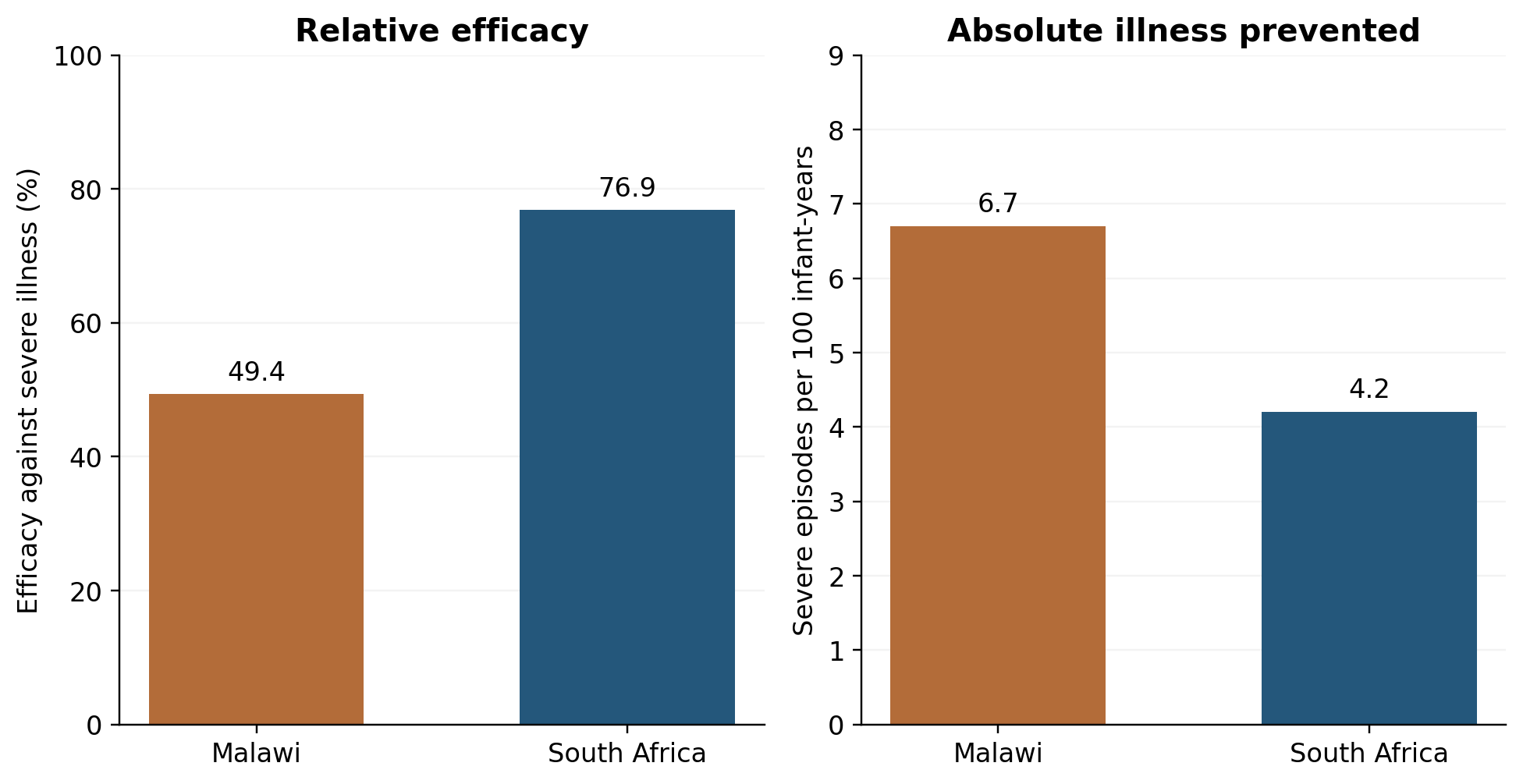
Author graphic from Madhi et al (2010), Table 2. Randomized infant rotavirus trial: country-specific point estimates over follow-up. Malawi efficacy 49.4% (95% CI 19.2–68.3); South Africa 76.9% (56.0–88.4). Absolute rates are severe episodes prevented per 100 infant-years, not deaths. Separate scales; no inferred comparison of all-cause mortality.
17 Hesitancy trust and polarization
Respondents in Cambridge and Montgomery County reported greater vaccine hesitancy at the time of the survey than they recalled before COVID. Cambridge began from a lower recalled level and remained lower. This is a retrospective comparison of reported attitudes, not a longitudinal measurement of change. Its meaning depends on distinguishing reservations about particular recommendations from a general rejection of vaccination.
The comparison comprises 616 respondents aged 18 or older in Cambridge and surrounding villages, and 654 adult residents of Montgomery County, surveyed during summer 2026. Recruitment used lists and convenience approaches in public places, including outside shopping malls. Collection was mixed mode, with more responses obtained in person than online; the locations used a similar approach. Percentages are unweighted. The author reports complete answers to applicable questions, with deliberate filtering for questions restricted to particular groups. These nonprobability samples describe participants and should not be treated as representative estimates for either locality or country. Exact field dates, the division between collection modes, recruitment-list coverage, response rates and the full questionnaire remain to be documented.
Different starting levels and a shared direction
Reported hesitancy about at least one recommended vaccine was recalled as 12% before COVID and reported as 29% at the survey in Cambridge, an increase of 17 percentage points. In Montgomery County the corresponding percentages were 22% and 46%, an increase of 24 points. The gap between locations is 10 points for recalled pre-COVID attitudes and 17 points for current attitudes. The difference between the retrospectively reported increases is seven points. These calculations describe the supplied percentages; they are not adjusted effects or tests of statistical significance.
Table 17.1 Recalled pre-COVID and current vaccine hesitancy
Hesitancy measure | Cambridge | Montco |
|---|---|---|
Recalled pre-COVID | 12% | 22% |
Current | 29% | 46% |
Increase in percentage points | 17 | 24 |
Author-supplied aggregate comparison. Cambridge n = 616; Montgomery County n = 654. Summer 2026 convenience recruitment through lists and public approaches, mainly in person with some online collection. Pre-COVID attitudes were recalled during the survey.
No pre-COVID survey was conducted for this comparison. Respondents recalled their earlier attitudes when completing the summer 2026 survey. Present beliefs may influence those recollections. The percentages therefore describe a reported retrospective change, not a measured change between survey waves. Exact question wording and the pre-COVID reference period should accompany the final tables. Neither locality supplies a national prevalence estimate.
Selective hesitation and the importance of the vaccine
The supplied willingness figures preserve a clear ordering. Willingness to receive established childhood vaccines such as MMR is 88% in Cambridge and 82% in Montgomery County. Willingness to receive influenza vaccination if recommended for the respondent is 61% and 43%; willingness to receive a further COVID vaccine is 44% and 27%. These are answers about willingness, not verified vaccination histories. The eligible populations and precise wording need to accompany any final comparison.
Table 17.2 Willingness to receive selected vaccines
Reported willingness | Cambridge | Montco |
|---|---|---|
Established childhood vaccines such as MMR | 88% | 82% |
Influenza vaccine if recommended | 61% | 43% |
Further COVID vaccine if recommended | 44% | 27% |
Supplied willingness percentages. These measures do not estimate clinical benefit or establish that respondents made informed choices.
The differences make a single label such as anti-vaccine an inadequate account of this material. They also do not show that every selective refusal is justified. The clinical case still depends on the particular product, disease, recipient, and period. The research contribution is to identify the choices people distinguish, so that a response addresses the recommendation they are questioning.
Personal doctors and institutional confidence
Trust in the respondent’s own doctor’s vaccine advice is reported at 75% in Cambridge and 62% in Montgomery County. Trust in national public-health vaccine advice is lower, at 53% and 34%. The resulting gaps are 22 and 28 percentage points. Concern that vaccine risks are understated is reported by 48% and 65%. These aggregate differences suggest a useful distinction between personal medical relationships and institutional confidence, although they cannot show whether the same individuals trust one source while rejecting another.
The national institution actually named must be retained in the research record. Trust in the NHS, a regulator, a government and a public-health agency are different questions. The Montgomery County sample size of 654 matches the earlier CGHA report, which describes 201 Republicans, 139 Independents and 314 Democrats. The earlier public figures and the revised workbook remain distinct reporting versions; their questions, denominators and final values need reconciliation against the underlying records before they are combined.
Reasons for hesitation and the experience of pressure
Among hesitant respondents, concern about adverse effects is reported by 66% in Cambridge and 73% in Montgomery County. Insufficient information about absolute risks is cited by 58% and 63%, and conflicting or changing advice by 61% and 67%. Distrust of pharmaceutical companies is 54% and 59%; distrust of government or public-health agencies is 43% and 68%. Respondents could cite several reasons, so these percentages are not intended to sum to 100%.
The largest supplied difference among the listed reasons concerns resentment about pressure or mandates: 36% in Cambridge and 77% in Montgomery County, a gap of 41 percentage points. That is a prominent difference to investigate, but the denominator is hesitant respondents, not everyone surveyed. The combined wording also does not distinguish a legal obligation from workplace pressure, family pressure, or persuasive messaging. It cannot establish that a particular mandate caused the wider rise in hesitancy. This is particularly important when interpreting social pressure within families: the supplied item does not identify family pressure separately or measure damage to relationships.
Unpleasant experiences following vaccination are reported by 25% and 32% of hesitant respondents. These accounts warrant careful recording and, where appropriate, clinical investigation. An event following vaccination is not automatically an event caused by vaccination. The distinction should be preserved without dismissing the person reporting it. Recoverable interview accounts can add detail, but no quotations or individual experiences are inferred from these aggregate percentages.
Decisions and the possibility of reconsideration
Safety-related delay or refusal since COVID is reported by 23% of all respondents in Cambridge and 39% in Montgomery County. This is a more specific behavior than broad concern, but still a self-report. Missing a dose for cost, inconvenience, illness, or eligibility reasons should be recorded separately. Additional information-seeking is reported by 57% and 65%, while 39% and 44% report asking a clinician about safety.
Among respondents who delayed or declined, 59% in Cambridge and 46% in Montgomery County say they would reconsider after discussion with a trusted clinician. A clear personal benefit–risk comparison attracts reported willingness to reconsider of 64% and 66%. These answers identify potential openings for discussion. They are not evidence that such an intervention has already changed behavior, and the two responses can overlap.
What the comparison means for recommendations
The gap between willingness to receive established childhood vaccination and another COVID dose is 44 percentage points in Cambridge and 55 in Montgomery County. These differences between aggregate responses are consistent with selective judgment rather than uniform rejection. They do not reveal how each individual answered both questions. The appropriate response is to explain the particular recommendation, including its expected absolute benefit, known harms, and relevance after previous infection or vaccination, rather than treat every reservation as opposition to the whole programme.
The responses about reconsideration also warrant a modest interpretation. Personal benefit-risk information attracts similar stated interest in the two locations, while the clinician-discussion item differs more. This suggests questions for a communication study; it does not establish that either approach will change uptake. An evaluation could compare actual decisions after a neutral, product-specific discussion with decisions under existing practice, while retaining refusal as a legitimate outcome of informed consent.
Knowledge allegiance and family relationships
The original comparison also reveals common ground that a team-based debate can obscure. Among hesitant respondents, concern about adverse effects is reported by 66% in Cambridge and 73% in Montgomery County; insufficient absolute-risk information by 58% and 63%; and conflicting or changing advice by 61% and 67%. These are broadly shared concerns across the two locations. They sit alongside substantial differences in confidence and pressure-related resentment. Cambridge and Montgomery County are geographical samples, not opposing vaccination teams, but the common concerns deserve as much attention as the differences.
We do not interpret those similarities as proof that the groups possess the same factual knowledge. The workbook contains no objective knowledge test and no respondent-level link between knowledge, identity and vaccine choice. Information-seeking is not a knowledge score, and willingness to vaccinate is not a test of competence. Someone can answer a biological question correctly and still make a poor risk calculation; someone can know little about immunology and make a sensible decision with a trusted clinician. These distinctions prevent us from treating agreement with a recommendation as the measure of being informed.
The question we want to ask is whether people with comparable factual understanding are nevertheless pulled apart by allegiance, trust and social pressure. That comparison would require knowledge measures independent of approval or refusal, linked to individual responses. It has not been performed in these aggregates. The existing finding is narrower and still consequential: both places contain substantial willingness to accept established childhood protection alongside much lower willingness to receive another COVID dose. A single label cannot adequately describe that pattern.
Alongside the aggregate results, we encountered frustration that vaccination had become a loyalty test. People wanted to ask about a particular risk or recommendation and felt that their question was being interpreted as a declaration of political allegiance. That frustration is part of what we found in the field, not simply an explanation imposed afterward on the percentages.
The information people described encountering also differed across political circles. In conservative conversations, accounts of vaccine injury were prominent; people in Democratic circles often appeared less exposed to those accounts. We are describing the pattern we encountered, not claiming that every conservative heard the same stories or that Democrats never heard them. It concerns exposure and attention as well as belief. Whether an injury story establishes causation remains a separate clinical question.
The people caught between these camps were particularly important to our interpretation. Some belonged broadly to one political side but were unsure about a medical recommendation. They did not necessarily want to join an opposing movement. They wanted a serious answer and described feeling let down by media they had trusted, and sometimes by their own medical professionals. What they experienced as betrayal was the sense that doubt had become unacceptable before their particular question had been answered.
These observations help explain why simply supplying another official recommendation may fail to resolve the disagreement. When someone thinks that information has been filtered through allegiance, the source and manner of the answer become part of the problem. The aggregate trust figures still show substantial confidence in personal doctors overall. They do not rule out important experiences of disappointment among some respondents, and they do not identify which individuals felt betrayed. The qualitative account adds context without changing those numerical findings.
The cost of ignoring those distinctions extends into family life. A discussion about a particular injection can become a judgment about whether a parent is responsible, a sibling is selfish or a relative can be trusted. The medical question then carries the weight of an entire relationship. We find that infuriating. People who care about one another can end up defending a side when they need to discuss a specific benefit, injury, uncertainty or obligation. Disagreement should not require a declaration that one belongs with us or against us.
Our pressure item cannot tell us how often this happened. It combines pressure and mandates and does not identify its source. The 36% in Cambridge and 77% in Montgomery County are percentages among hesitant respondents, not estimates of family conflict. The figures cannot establish the prevalence or causes of damaged relationships. Our concern is with the social cost of moralizing a medical choice, rather than a claim to have measured that cost.
The practical implication is to separate the particular decision from the demand for loyalty. A relative can reasonably ask what an additional dose changes for someone of their age and health without thereby rejecting childhood vaccination. Another can decide the additional protection is worthwhile without endorsing every mandate or dismissing everyone reporting injury. These are possibilities for discussion, not claims that every choice is equally well supported. Respect for a relationship does not require agreement on the facts; it requires room to examine the facts without making affection or belonging conditional on the answer.
This is why the original research matters to the report. Its contribution is to show distinctions that the public labels flatten: between products, between a personal doctor and a national institution, and between asking for information and rejecting prevention. We want a recommendation to answer those distinctions. Winning a family argument is not a health outcome, and dividing people into camps is not evidence that the underlying medical question has been resolved.
What the supplied records can establish
The author confirmed the corrected Montgomery County attitude distribution on 27 October 2026: 32% accepting without substantial reservations, 20% concerned but generally accepting, 37% selectively delaying or declining, and 11% generally reluctant. The four mutually exclusive categories total 100%, as do Cambridge’s. The earlier 103% total was corrected rather than attributed to ordinary rounding. The spillover categories total 101% in Cambridge and 100% in Montgomery County; the one-point excess may reflect rounding.
Headline hesitancy and the attitude distribution came from separate questions. The headline was a direct yes/no answer about hesitation concerning at least one recommended vaccine. The attitude question placed respondents in one of four categories. Selective delay or refusal plus general reluctance totals 30% in Cambridge and 48% in Montgomery County, compared with headline hesitancy of 29% and 46%. These differences therefore do not represent failed arithmetic within one measure. The measures should be reported separately rather than forced into agreement. All respondents answered applicable questions, according to the author, and percentages are unweighted. Overall sample sizes are 616 and 654; filtered questions require their own subgroup counts. No probability-sampling margin of error or adjusted individual association is reported.
The substantive conclusion is that confidence should be examined vaccine by vaccine and institution by institution. The supplied figures describe retrospectively reported increases in hesitation in both locations, alongside substantial willingness to accept established childhood vaccination and continuing trust in personal physicians. They give reasons to examine the lasting effects of pressure and the demand for clearer personal benefit–risk information. Establishing how much any particular policy caused the change requires evidence beyond these aggregates.
When vaccination becomes an identity
The most frustrating feature of this debate is its demand for a declaration of allegiance before the evidence is considered. A question about adverse effects can be heard as hostility to vaccination. Acknowledging protection against severe disease can be heard as loyalty to a government or pharmaceutical company. Under those conditions, a change of mind becomes a defection rather than a response to new information. We regard that as a serious obstacle to useful medical discussion.
The word vaccines hides too much. It covers different diseases, formulations, delivery technologies, recipients and time horizons. Someone who asks about the balance of another COVID dose has not thereby supplied an opinion about measles, tetanus or HPV. Equally, an injury associated with one product cannot establish the balance of every other product. The appropriate unit of judgment is the intervention offered to a particular group under particular conditions.
There is empirical evidence that vaccination status became a social identity during COVID. Henkel and colleagues followed respondents in Germany and Austria, beginning with samples of 3,267 vaccinated and 2,038 unvaccinated people. Stronger identification with vaccination status was associated with polarizing attitudes and behavior, and with reactance toward mandates among unvaccinated respondents. These are associations in those settings; they do not establish that receiving a vaccine caused polarization, or that the pattern is identical in Britain and America.
Bor, Jørgensen and Petersen studied discriminatory attitudes through experiments that included a 21-country comparison. They found negative stereotyping and exclusionary attitudes toward unvaccinated people among vaccinated respondents. The findings were not a simple picture of equivalent hostility in each direction. Manipulating information about a hypothetical person can identify its effect on respondents’ judgments; it does not randomize people into actual vaccination status or measure every real-world act of exclusion.
A preregistered US study of 832 unvaccinated adults by Rosenfeld and Tomiyama found that perceived moral reproach was associated with stronger refusal, after accounting for other measured variables. That is a reason to take the tone of public discussion seriously, not proof that a particular campaign or mandate caused an individual to refuse. Nor does it prove that more courteous messaging would necessarily change uptake.
Our conclusion is that polarization is a substantive part of the vaccination story, not merely an unpleasant background to it. It can affect which questions people ask and which answers they are willing to hear. But we do not infer that one side is always honest, that responsibility is evenly distributed, or that a hostile audience makes a claim scientifically correct. Each proposition still requires its own evidence.
There is now a large movement against vaccines. Some participants embrace conspiracy theories, but many do not. Many of the people we have spoken with are physicians. That observation describes our conversations, not a representative survey of critics or an estimate of the movement’s size. Professional standing does not validate every claim, but dismissing all these people as cranks avoids questions that deserve an evidence-based answer. Their concerns should be judged proposition by proposition, just as official assurances should be.
Political alignment and the selection of evidence
We take political alignment seriously as a source of interest. Much of the established American news media occupies a political and cultural environment closer to the left than to the Republican right, while contemporary vaccine skepticism is more prominent on the right. That creates an intelligible incentive to scrutinize claims differently according to who advances them. No agreement between editors and manufacturers is necessary for a newsroom to regard one story as responsible public education and another as assistance to its political opponents. This is our interpretation of a documented alignment, not a finding that every journalist shares an ideology or every injury story is suppressed.
The evidence is more precise than the shorthand. The 2022 American Journalist survey of 1,600 journalists found about 36% identified as Democrats, 3.4% as Republicans and 51.7% as independents. Party identification does not measure every respondent’s ideology, but the imbalance is substantial. The survey does not test vaccine coverage. Pew’s 2025 audience research independently found that Democrats and Republicans used and trusted different news sources; it measured audiences, not the ideological content of their reporting. These distinctions define the evidence rather than remove the concern.
Pew’s November 2025 vaccine survey found that 78% of Republicans and 92% of Democrats thought MMR benefits outweighed its risks. Republicans were more likely to perceive high side-effect risks. The political difference is real, but most Republicans in that survey still favored MMR’s benefit–risk balance. Opposition to a mandate is also not equivalent to opposition to vaccination. We therefore describe a stronger contemporary concentration of skepticism on the right rather than assign one position to every conservative.
Our concern is selective attention. Where a doubtful vaccine claim is associated with political opponents, a journalist or editor may be especially alert to its weaknesses and less alert to weaknesses in the official response. Where institutional distrust is part of an outlet’s appeal, the selection pressure may instead favor injury and betrayal. These are mechanisms to investigate, not measured estimates of how frequently either occurs. Their scale need not be equal. Established institutions have greater resources and, in some cases, power over clinical recommendations and employment conditions.
Scientific journals require their own examination. A survey of journalists cannot establish the politics or conduct of journal editors. The sponsorship and dissemination studies in Chapter 15 provide a different basis for concern about the production and promotion of evidence. Professional commitment to a successful intervention can also make unwelcome results harder to accept. We regard financial interests, reputational interests and political alignment as legitimate questions even where deliberate concealment has not been proved. None supplies a substitute for checking a particular analysis.
The Cambridge and Montgomery County material helps explain why this matters to people. The supplied aggregates distinguish confidence in established childhood vaccination from willingness to receive another COVID dose; our qualitative observations describe frustration at having doubt treated as disloyalty. They do not measure newsroom ideology or prove that media exposure caused hesitancy. A respondent may distrust an institution for a sound reason and still misjudge a particular vaccine; another may reach a sound clinical decision while knowing little about institutional failures. The book should make room for those combinations.
A contributor to this research has held a Brownstone fellowship. That connection belongs in the disclosure: independence requires scrutiny of contributors’ affiliations as well as those of the institutions examined. We value the willingness to publish criticism and accounts of injury. We will examine Brownstone’s arguments on their evidence, including where they challenge our conclusions, and will not treat their publication there as either a guarantee of truth or a reason for dismissal. The aim is to escape the loyalty test rather than reverse it.
A technology is not a verdict
The argument about mRNA often reproduces the same division. In one version it is a brilliant technology whose novelty supposedly settles the case for its products. In another it is intrinsically sinister and responsible for almost any subsequent illness. Neither description supplies the clinical comparison we need. A platform can be a major technical achievement while a particular formulation, dose or indication has a less favorable balance. Its assessment must include efficacy, duration, delivery, adverse effects and the recipient’s baseline risk.
The biological account also needs precision. Vaccine mRNA supplies instructions that cells use to produce an antigen; rewriting the recipient’s DNA is not its mode of action. The National Library of Medicine explains that vaccine mRNA does not alter DNA. Claims that authorized mRNA vaccines rewrite or destroy recipients’ DNA are not established by the evidence reviewed here. Rejecting that claim does not establish that every product or dose is harmless.
Myocarditis is an example of a real product-related concern that does not depend on the DNA claim being true. The FDA labeling and the English safety studies discussed earlier warrant careful reporting by age, sex, product and dose. They do not become less important because some critics make unsupported allegations. Conversely, documented myocarditis cannot be used to validate every proposed mechanism of injury. A clinical event, its attributable frequency and its mechanism are related questions, not interchangeable answers.
We would apply the same discipline to a future mRNA product with a different target. Experience with a platform is relevant evidence; it is not perpetual authorization for everything built on it. The same principle applies to traditional platforms. The respectable age of a technology cannot substitute for examining the actual product, and novelty cannot by itself establish danger.
Why more data are necessary and insufficient
We want data because slogans conceal differences that matter. Relative efficacy without baseline risk conceals absolute benefit. A list of events after vaccination without a comparison conceals attributable harm. A mortality curve beginning just before vaccine introduction can conceal earlier improvements. A fall in deaths before vaccination can conceal the nonfatal disease burden that remained. The previous chapters examine these errors because they can turn a defensible argument into an exaggerated one.
Data do not remove every disagreement. People can accept the same estimate of illness prevented and place different values on avoiding that illness, tolerating short-lived reactions or accepting uncertainty. A public funding decision must compare competing uses of resources. Compulsion adds judgments about rights, obligations and proportionality. Our aim is to expose those value choices after the empirical questions have been made clear, rather than present a contested political judgment as the only possible scientific conclusion.
The Cambridge and Montgomery County comparison is relevant because willingness differs substantially across vaccines. In the supplied aggregates, willingness to receive established childhood vaccination is 88% and 82%, compared with 44% and 27% for a further COVID dose. That is consistent with selective judgments rather than a single undifferentiated attitude. It does not show which people endorsed both items, measure vaccination identity, or prove that polarization caused the difference. The records cannot do work that their questions and design do not support.
Institutions have a particular responsibility because their advice can become a condition of employment, education or access to care. They need to publish the supporting evidence, state absolute benefits, investigate injury and correct overstatement. Critics have a responsibility to distinguish an unanswered question from an established harm, and a suspected mechanism from a demonstrated cause. The scale and power of those responsibilities differ; the need for evidence applies to both.
What would change our conclusion
A useful disagreement identifies what evidence would change the answer. Higher current severe-disease risk would strengthen a preventive recommendation if protection remained effective. A credible excess of serious injury would weaken it. Better evidence of waning could change timing or remove a transmission-based rationale for a requirement. A correction to a model’s assumptions should change the estimate rather than provoke a defense of the institution that issued it.
This applies to our own conclusions. The history of smallpox or measles cannot make us accept an unsupported claim about a later product. Institutional failure during COVID cannot make us dismiss a well-supported result about childhood prevention. We want confidence that is specific enough to be revised: confidence in this intervention for these people under these conditions, with its uncertainties and injuries stated.
We do not want the report to recruit readers into another vaccination identity. We want them to be able to ask which vaccine, against which outcome, for which recipient, over what period, compared with what alternative, and with what harms. Those questions are more demanding than declaring belief or disbelief. They are also the questions that allow a good idea to remain useful without placing every implementation beyond criticism.
What the contrast tells us about a loyalty test
The supplied aggregates contain a revealing juxtaposition. Willingness to accept established childhood or MMR protection is 88% in Cambridge and 82% in Montgomery County, while willingness to accept a further COVID dose is 44% and 27%. These differences are consistent with discrimination between interventions rather than one universal attitude to vaccination. They do not reveal whether the same individuals gave each answer, because the supplied tables are aggregate summaries.
Pressure also differs sharply: among hesitant respondents, resentment of pressure or mandates is reported by 36% in Cambridge and 77% in Montco. This is a selected subgroup with multiple responses permitted, not a percentage of every resident or proof that mandates caused the increase in hesitancy. Nevertheless, alongside our qualitative observations it gives a concrete reason to examine the experience of coercion rather than interpret all refusal as deficient knowledge.
The frustration we encountered was often about the terms of the conversation. People wanted an account of uncertainty that did not require them to adopt the politics of whoever happened to share one concern. Our observations suggest that politically different information environments exposed people to different accounts of injury, institutional failure and benefit. The survey tables cannot establish the frequency or accuracy of that exposure. A media audit would have to examine actual stories and audiences rather than substitute our impressions for measured coverage.
The question of knowledge must remain open. Similar scores on a sound factual assessment could show that disagreement persists despite comparable knowledge; they would not by themselves show equal understanding of every vaccine or prove that every policy preference is equally supported. Conversely, a lower score would not invalidate a verified personal injury or an objection to compulsion. Knowledge, confidence, experience and political permission to express doubt need separate measurement.
For CGHA the family consequences make the issue more than a messaging problem. A relative may interpret a question about one dose as rejection of everything they believe about science or social responsibility. Our qualitative account records this experience; the workbook contains no measured family-conflict outcome. The practical conclusion is to make the unit of disagreement smaller: name the product, recipient, dose and outcome before asking anyone to defend a political identity.
Figure 18 Published Montgomery County distrust summaries
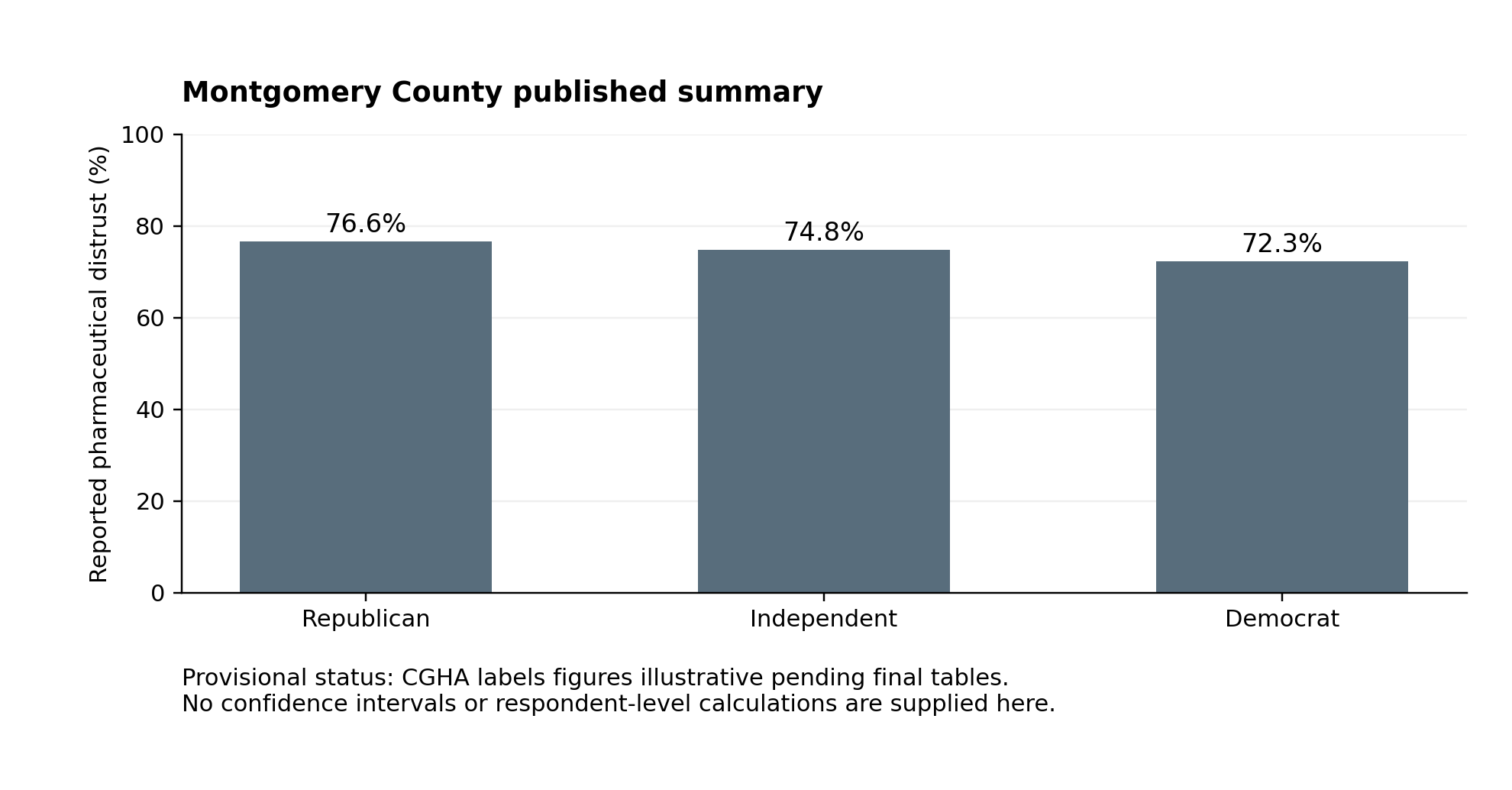
CGHA public summaries accessed 25 October 2026. The associated data page labels figures illustrative pending final tables. Group sample sizes are Republican 201, Independent 139 and Democrat 314. Chart reproduces published percentages; it does not validate final field data, estimate uncertainty, or establish causality.
Figure 19 Recalled pre-COVID and current hesitancy
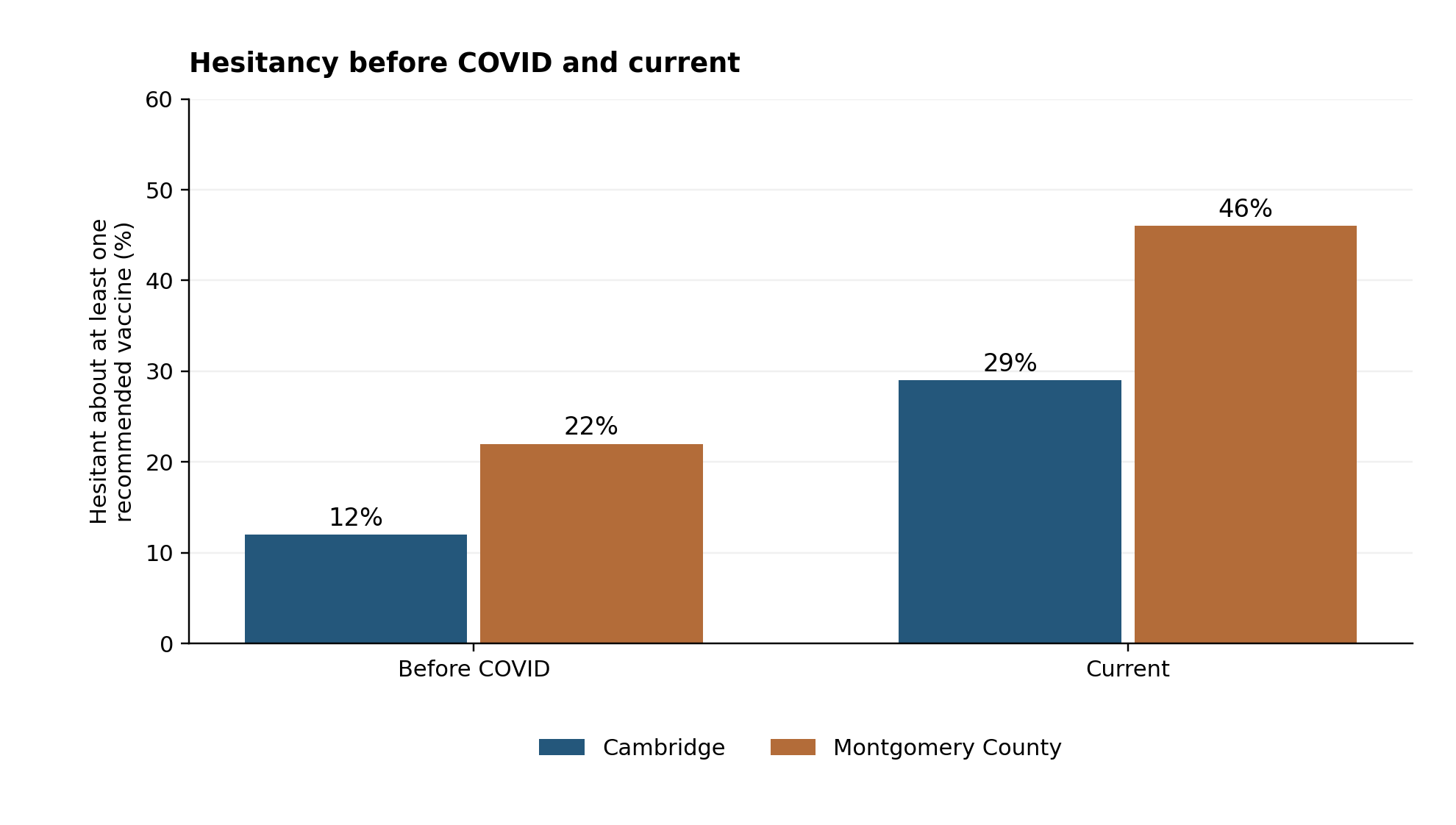
Author-supplied aggregate workbook, revised 25 October 2026; methods clarified by the author on 27 October. Cambridge n = 616; Montgomery County n = 654. Summer 2026 mixed-mode convenience sample; pre-COVID attitudes recalled retrospectively. Increases of 17 and 24 percentage points describe reported change, not longitudinal or causal effects.
Figure 20 Willingness differs by vaccine
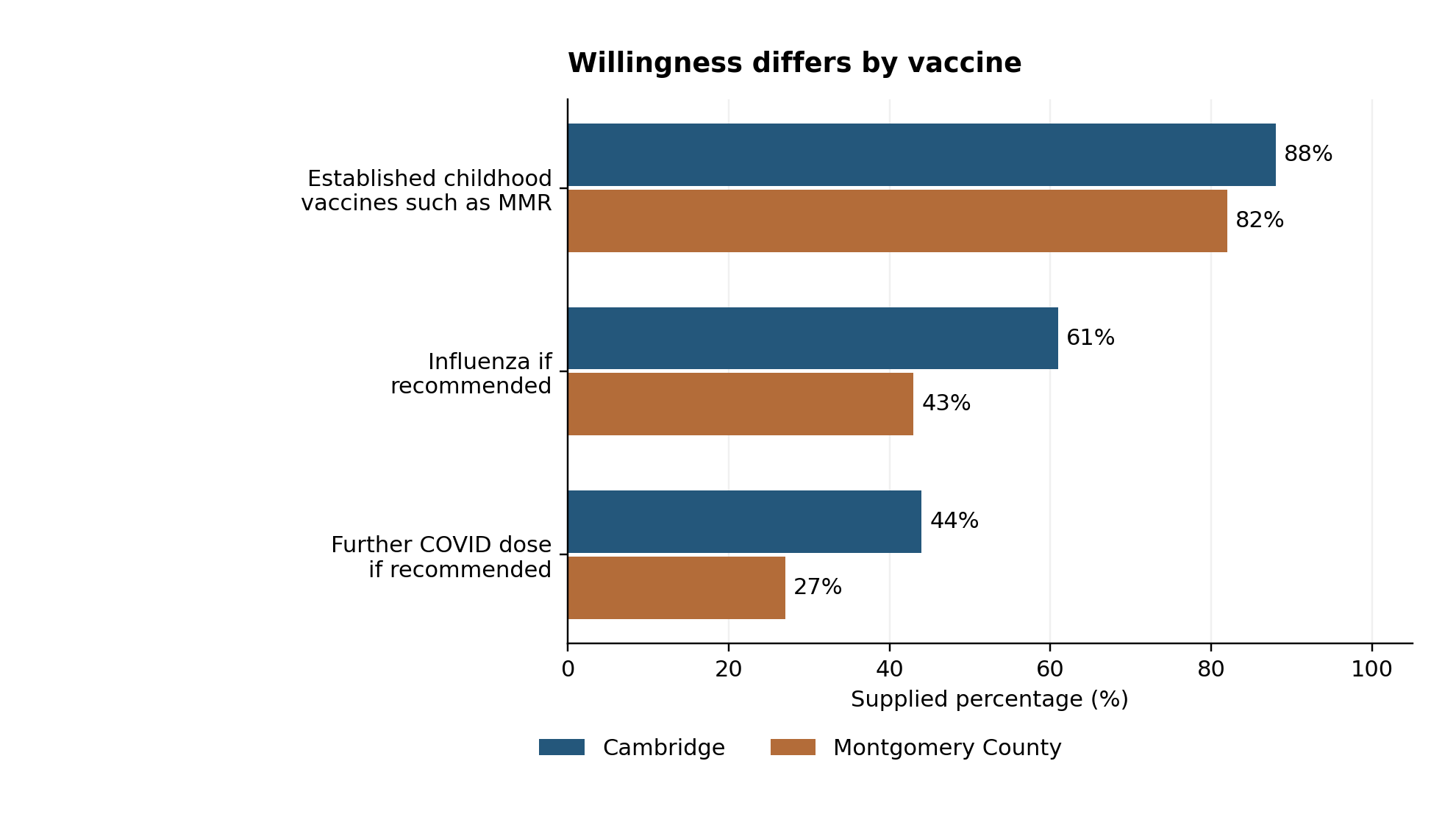
Supplied percentages among eligible respondents, with exact eligibility and wording to be confirmed. Willingness is not verified uptake. Measures can overlap and are not a partition.
Figure 21 Personal doctors and national advice
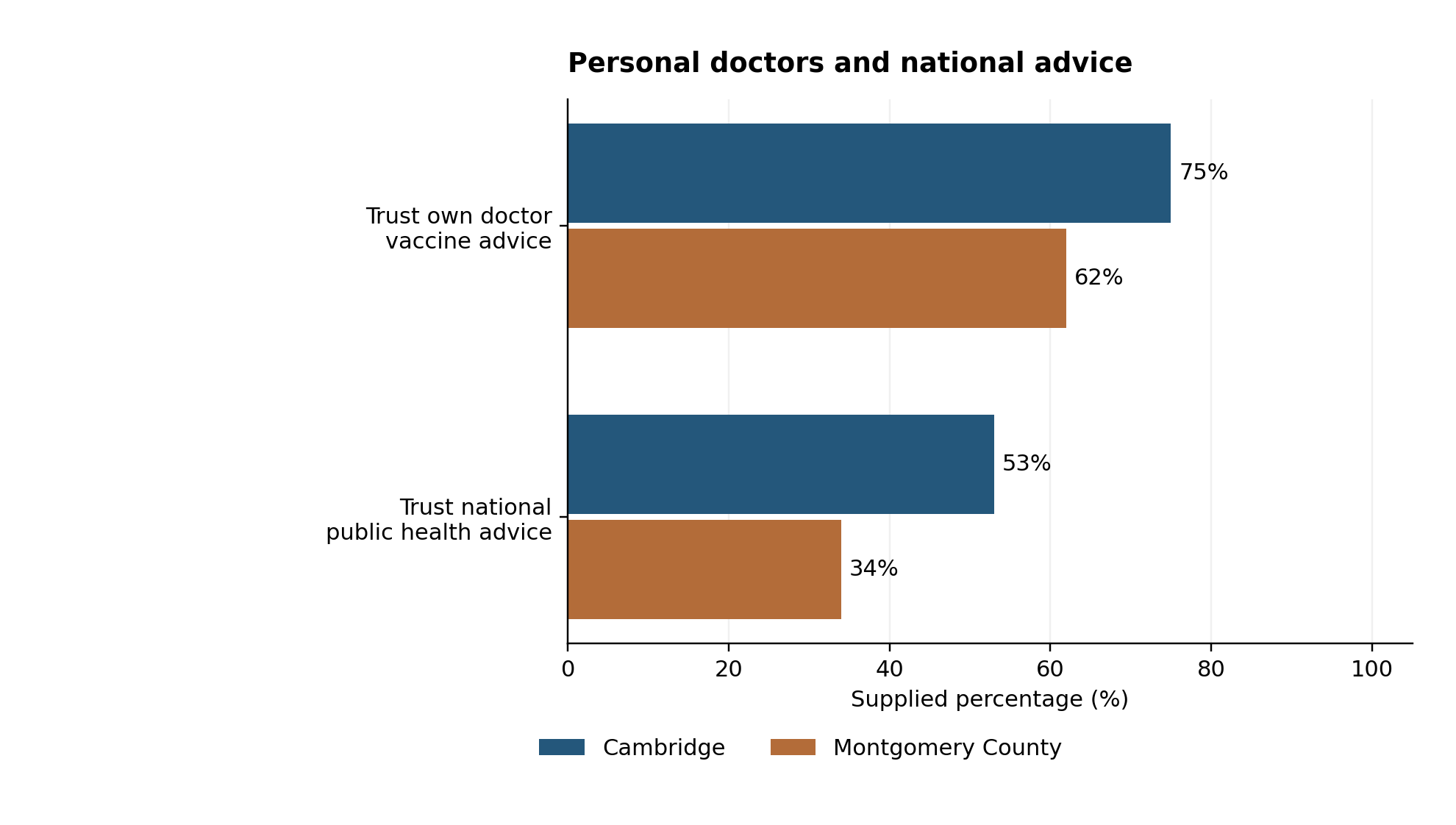
Unweighted author-supplied percentages, with complete applicable responses reported. Cambridge and surrounding villages n = 616; Montgomery County n = 654; residents aged 18 or older. Exact institutional wording remains to be documented. Aggregate differences do not establish individual-level relationships.
Figure 22 Selected reasons among hesitant respondents
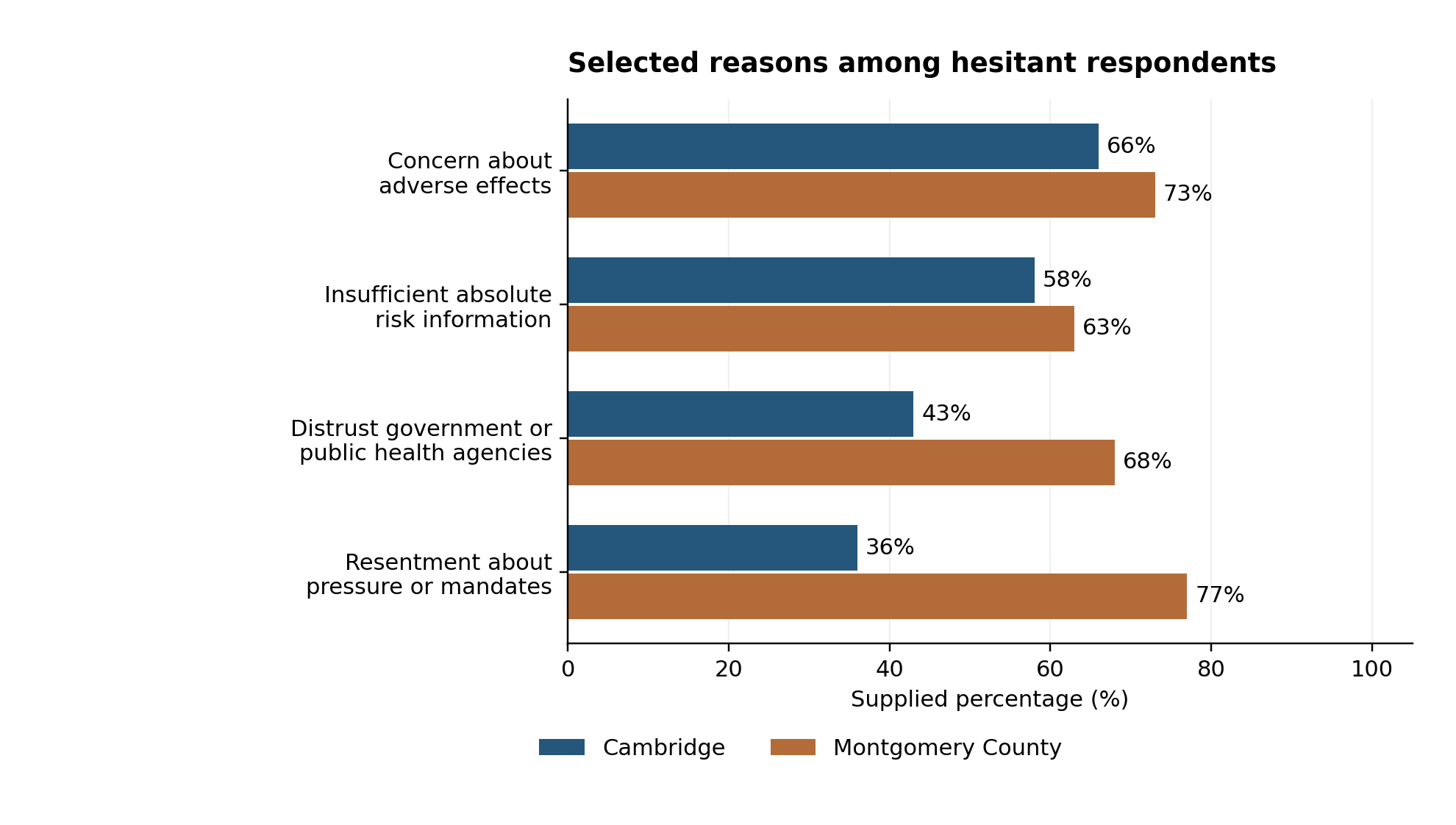
Denominator is hesitant respondents; multiple answers permitted. Pressure and mandates share one supplied item. The answers do not isolate legal requirements or establish that mandates caused changes in hesitancy.
18 Consent recommendations and accountability
A product can have positive average net benefit without being appropriate for every recipient. It can be worth offering without requiring it. It can be valuable historically while the additional value of another dose becomes small. Policy needs to explain which of these judgments it is making.
An individual recommendation should specify the expected outcomes over a defined period, the recipient's baseline risk, recognized injuries, important uncertainties, and alternatives. Where numbers are unreliable, uncertainty should be explicit rather than hidden behind precision. Where the clinical balance is clear, honesty about limitations need not prevent a recommendation.
The argument for requiring vaccination adds questions about benefits to others, feasible less-restrictive alternatives, fairness, exemptions, enforcement, and the distribution of injury. These questions cannot be settled by efficacy alone. The same logic applies to institutions setting employment or access conditions: the proposed rule needs its own justification.
An accountable system would make protocols and analysis plans accessible, preserve a dated record of advice, publish meaningful safety follow-up, and explain changes in recommendation. Access to individual data requires privacy protection, but privacy should not become a blanket reason to prevent qualified independent scrutiny.
Compensation deserves an assessment independent of whether an overall program was worthwhile. A small number of serious injuries may be compatible with a large population benefit; the people injured still bear a real loss. Counting a compensated case does not automatically establish a general incidence rate, and failure to compensate does not prove an injury did not occur. Legal and clinical standards must be distinguished in the later institutional review.
The American arrangements need to be distinguished. The National Vaccine Injury Compensation Program is a no-fault route for injuries associated with specified covered vaccines, established partly to protect supply. COVID vaccine claims instead fall under the Countermeasures Injury Compensation Program. For covered activities meeting the relevant declaration’s conditions, the PREP Act provides broad immunity, subject to an exception for willful misconduct. These protections do not mean there is no compensation route, nor are the two schemes interchangeable. HRSA describes their scope and requirements.
The procedural differences matter. The countermeasure scheme does not pay legal fees and permits administrative reconsideration but no judicial appeal of its injury determinations. The ordinary vaccine scheme allows judicial appeals and may pay legal fees when its requirements are met. A supply rationale for liability protection does not settle whether redress is accessible or adequate. A government recommending an intervention, especially one it requires, should explain how injured people can obtain investigation and fair treatment under the applicable system.
In our view, apparent imbalance between protection for manufacturers and redress for patients can deepen distrust, including on the political right. This is an institutional interpretation, not a causal result established by the local survey. Wholesale distrust creates its own risk when people dismiss an effective intervention because of its manufacturer rather than assess the evidence for its use.
Our conclusions are organized vaccine by vaccine and decision by decision. For several childhood diseases, the evidence supports substantial prevention in affluent countries. For seasonal products and later doses, the absolute effects may be more variable and the appropriate target population narrower. In settings with high untreated burdens, prevention can have extraordinary value. These are compatible judgments, subject to the evidence for each intervention.
The Cambridge and Montgomery County figures help identify the questions such an explanation must address: personal benefit, adverse effects, pressure, and the reliability of changing advice. They do not establish which communication strategy will improve confidence. Trust cannot be measured only by compliance. A system worthy of confidence should state its evidence, acknowledge its limits, correct mistakes, and care for people harmed by interventions it recommends.
A defensible rule should name its objective before choosing its instrument. Preventing a recipient's hospitalization, reducing infection of vulnerable patients, protecting workforce capacity, and achieving a coverage target are different objectives. More uptake is an intermediate result, not a complete welfare assessment. A policy could raise uptake while imposing costs greater than its additional health gain, or deliver worthwhile health gains without achieving every announced target.
Exemptions and alternatives belong in the design. A rule that ignores contraindications, prior immunity, or differences in exposure can impose burdens unrelated to its purpose. Testing, safer working arrangements, paid leave when ill, and improved access may provide parts of the intended benefit. Their effectiveness and costs need evidence too. Calling an alternative less coercive is not proof that it works, but declining to examine alternatives is not proof that compulsion was necessary.
Accountability should extend to withdrawal. An emergency measure needs an expiry point or a scheduled review against explicit evidence. Continuing a requirement after its original rationale weakens should require a renewed justification, with the new evidence made public. The English reversal of vaccination as a condition of deployment illustrates that a government can continue to recommend vaccination while changing its judgment about statutory requirements.
Trust is an outcome of institutional conduct as well as communication. Better explanation cannot substitute for accessible evidence, fair injury assessment, or correction of an unsupported claim. Equally, rebuilding trust does not require public institutions to endorse every allegation. It requires showing how a claim was evaluated and allowing independent challenge. The appropriate ambition is warranted confidence, including confidence that recommendations can change.
19 When vaccination is worth taking
We favor completing established childhood vaccination, but we do not believe that this judgment settles every later injection. A three-year-old who lacks protection against measles or polio and a healthy 20-year-old considering another COVID dose face different decisions. Their disease risks, previous immunity, products and potential injuries differ. The comparison becomes useful only when those differences enter the calculation. Our conclusion is that the case for established childhood protection is generally strong; the case for each seasonal adult dose is more dependent on risk and preferences. We would not combine influenza and COVID into one verdict about young adults.
Start with the decision that actually exists
At age three, the first question is which doses have already been received and which are due. Most routine protection begins earlier. A fully vaccinated child does not need a fresh course of every childhood vaccine simply because they turn three. Conversely, missing early doses is not a reason to give up on protection. Catch-up schedules account for age, earlier doses, products, intervals and conditions that make a live vaccine unsuitable. The UK guidance explicitly provides catch-up pathways for children and older people with incomplete records.
At age 20, being young is not a general reason to avoid vaccination. Missing measles protection, susceptibility to tetanus, an indicated HPV course, travel or residence in a setting with particular exposure can make prevention valuable. The English HPV cancer evidence in Chapter 10 also shows why the relevant benefit may lie many years ahead. The decision we scrutinize more closely is an additional seasonal dose in a healthy person who already has substantial immunity, rather than every vaccine received after childhood.
A healthy 20-year-old is itself an incomplete description. Sex matters for myocarditis; pregnancy, immunosuppression and underlying disease can change severe-infection risk; recent infection and earlier doses change the comparator. Contact with vulnerable people may add a benefit to others, provided the product reduces transmission enough in the relevant period. We do not presume that a population-average result supplies each of these answers.
The model in natural units
For a specified outcome and time period, the core calculation is simple: absolute risk reduction equals the risk without the proposed dose multiplied by the relative reduction produced by that dose. The comparison is vaccination now versus no additional dose now, with the same existing immunity, care and exposure conditions. It is not necessarily vaccination versus an immunologically naive person in 2020.
Let r be the baseline probability of the outcome during the stated period, e the vaccine’s incremental effectiveness against that outcome, and N the number of comparable people. Expected outcomes prevented are N × r × e. If r × e is positive, the number needed to vaccinate is 1 ÷ (r × e). When an appropriate study directly reports both risks, their difference is preferable to reconstructing the result from incompatible inputs. The following sensitivity table illustrates the arithmetic; none of its rows is asserted to describe a particular age group or current vaccine.
Table 19.1 Why baseline risk changes the same efficacy claim
Baseline hospitalizations per 100,000 | Assumed effectiveness | Prevented per million | Number needed to vaccinate |
|---|---|---|---|
1 | 50% | 5 | 200,000 |
10 | 50% | 50 | 20,000 |
100 | 50% | 500 | 2,000 |
1000 | 50% | 5,000 | 200 |
Illustrative six-month scenario with a hypothetical 50% incremental reduction in hospitalization. Baseline risks span scenarios, not empirical estimates for three- or 20-year-olds. All denominators refer to comparable people over the same period. This table estimates gross admissions prevented, not injury-adjusted net benefit.
A baseline hospitalization risk of one per 100,000 gives five admissions prevented per million at 50% effectiveness. A baseline risk of 100 per 100,000 gives 500 prevented. Identical relative effectiveness produces a hundredfold difference. The decisive empirical work is therefore estimating the baseline risk and the additional effect of the proposed dose for the person being considered, rather than selecting an impressive efficacy percentage.
Do not count the same benefit twice
If a study estimates effectiveness against hospitalization directly, we do not multiply it again by an infection-prevention estimate. Its hospitalization endpoint already includes the relevant routes to preventing admission. A model built from separate infection and severity probabilities instead needs a coherent joint structure. Treating every reduced infection as an additional prevented hospitalization counts overlapping pathways twice.
Death, admission and prolonged symptoms also overlap. A defensible model can use mutually exclusive outcome states, or a single health-loss measure that accounts for their sequence and duration. It cannot simply sum all cases, admissions and deaths as independent events. Long COVID belongs in the analysis where suitable evidence exists, but uncertain incremental protection in previously infected young adults must not be replaced by an arbitrary benefit. Nor should it be silently assigned zero.
Time matters. A vaccine can reduce risk strongly for several weeks and less later. A seasonal estimate needs to integrate changing infection pressure, immunity and effectiveness. A 28-day injury window and a six-month benefit window can be reasonable if both are specified and all relevant injuries are considered. Hiding the windows, or extending short-term effectiveness unchanged across a lifetime, is not reasonable. Repeated-dose decisions require repeated costs and updated risks, rather than multiplying the benefit of a first dose indefinitely.
Harms need causal excess and clinical severity
For injury type j, expected additional cases equal N multiplied by the excess probability attributable to the dose. That excess is the difference from an appropriate background comparison, not every diagnosis recorded after vaccination. Injury risks must match the product, dose, age, sex and interval as closely as the benefit estimate does. Common reactions, lost days, serious acute events and lasting disability are different burdens.
The FDA’s June 2025 labeling update provides a useful warning against careless inputs. It reports approximately 27 myocarditis or pericarditis diagnoses per million 2023–2024 mRNA doses in males aged 12–24 within days 1–7, compared with eight per million across ages six months to 64. These are unadjusted observed incidences, not attributable excess risks, and not estimates for a 2026 formulation or an individual 20-year-old. We do not insert 27 as a causal harm rate and subtract it from admissions prevented.
The English Patone estimates discussed earlier answer a different historical question: product- and dose-specific excess myocarditis during a defined period. They show why young men cannot be represented by an older population average, but cannot be transferred unchanged to every later booster. The FDA update and Patone analysis therefore belong in the evidence ledger as distinct measures, not pooled into a single current injury rate.
Nor is a hospitalization for COVID automatically equivalent in severity to a myocarditis diagnosis. Some admissions are brief; some injuries or infections have lasting consequences. Both distributions need examination. A count comparison can identify where an assumption matters, but cannot alone establish a complete clinical balance.
The threshold at which a decision changes
Let Ld represent the expected health loss from the disease outcome, Lv the health loss from an attributable vaccine injury, a its excess probability, and b the expected burden of common reactions. In a simplified one-outcome model, additional vaccination has positive expected personal health value when r × e × Ld exceeds a × Lv + b. The baseline-risk threshold is therefore (a × Lv + b) ÷ (e × Ld). This is a decision rule, not a claim that all its inputs are known precisely.
For example, suppose an attributable serious injury risk were ten per million, effectiveness against a disease admission 50%, and both events carried the same average health loss, with other outcomes temporarily omitted. Count parity would occur at 20 disease admissions per million without vaccination, or two per 100,000. If injury were on average five times as burdensome, the baseline threshold would rise to ten per 100,000. If it were one-fifth as burdensome, it would fall to 0.4 per 100,000. All these numbers are hypothetical. The example demonstrates why counts without severity weights cannot settle the question.
A robust decision remains favorable across credible adverse assumptions. A preference-sensitive decision changes sign within a credible range, or offers a small gain whose value depends on how the recipient values illness, reactions and inconvenience. An unresolved decision lacks reliable inputs. We would label these situations openly. An evidence gap does not establish zero benefit, but it also does not authorize an unconditional claim that an additional dose is necessary.
Influenza in the healthy 20-year-old
Here the evidence prevents us from endorsing a general instruction not to vaccinate. The Cochrane healthy-adult trials estimate confirmed influenza falling from about 2.3% to 0.9% over a studied season: roughly 14 cases prevented per 1,000 vaccinated, or 1,400 per 100,000. Using the rounded risks gives about 71 vaccinations per confirmed case prevented. This is evidence about illness in healthy adults across historical study settings, not a current age-20 mortality estimate. Severe-outcome evidence in that population is less decisive.
CDC’s safety summary reports no detected increase in Guillain–Barré syndrome in most seasons; where an increase has been found, it has been approximately one or two additional cases per million vaccinated. That is a rare-harm estimate, not an inventory of every possible adverse effect. It cannot be compared one-for-one with prevented influenza episodes, which are much more numerous but usually less consequential. Personal contraindications and earlier serious reactions remain relevant.
Our judgment is that seasonal flu vaccination is a reasonable voluntary option for a healthy 20-year-old, often offering modest personal benefit. Avoiding an unpleasant illness, disrupted work or study, and exposure to others can matter even when death is unlikely. Someone who places a low value on that reduction and a high value on inconvenience or reactions may make a different choice. The claim that a young adult generally should not receive flu vaccine would need stronger evidence of an unfavorable balance than this review supplies.
The policy comparison is informative without resolving the individual decision. The US generally recommends annual influenza vaccination from six months of age. England’s 2026–2027 publicly funded programme covers specified age and risk groups, including two- and three-year-olds, while an otherwise healthy 20-year-old is not included simply by age. A narrower funded offer does not establish that buying a vaccine privately has negative clinical value. Programme cost-effectiveness, individual benefit and compulsion are three different judgments.
An additional COVID dose in the healthy 20-year-old
This is the more demanding case for a risk-based recommendation. We would ask for the current chance of serious COVID without another dose in people with similar health, sex, prior infection and vaccination history. We would then ask how much the specific additional dose lowers that risk, for how long, and with what attributable injury risk. A figure combining all adults aged 18–49, or a first-dose result from a largely susceptible population, does not directly answer the question for a healthy previously infected 20-year-old.
We do not give a universal current numerical net-benefit estimate because the assembled evidence does not supply all those matched inputs. Filling the gaps with an older adult hospitalization rate and a historical young-male myocarditis rate would create precision without validity. The sensitivity model shows what risk levels would change the decision, and identifies the evidence needed to locate a particular subgroup within it. It does not identify the subgroup by assumption.
Our policy judgment is that an additional COVID dose should not be presumed necessary for every healthy previously infected 20-year-old, and that this group does not warrant a broad mandate on the evidence reviewed here. That is narrower than concluding that every such dose is harmful or that no young adult benefits. Pregnancy, immunosuppression, important comorbidity, exposure and the timing of recent infection can materially change the assessment. The product-specific balance also differs between young men and women.
JCVI’s autumn 2026 and spring 2027 advice illustrates a targeted public programme: adults aged at least 75, older care-home residents and immunosuppressed people from six months. Its analysis uses an example combined vaccine-and-delivery price of £25. This provides a documented policy and economic rationale for focusing resources, not proof that a healthy younger individual has no possible personal benefit.
A historical test of the young-adult argument
CDC’s June 2021 assessment modeled a favorable balance even in young adults. Table 19.2 reports the age 18–24 estimates per million second doses, comparing a two-dose course with no vaccination. It assumed 95% effectiveness against cases and hospitalization over 120 days using then-current disease rates. The comparison did not isolate healthy previously infected 20-year-olds.
Table 19.2 The historical 2021 young adult assessment
Age 18–24 | Admissions prevented | ICU admissions prevented | Deaths prevented | Expected myocarditis |
|---|---|---|---|---|
Male | 530 | 127 | 3 | 45–56 |
Female | 1,127 | 93 | 13 | 4–5 |
ICU means intensive care unit. Source: Gargano et al 2021, Table 2. Modeled benefits over 120 days, per million second doses; myocarditis ranges are ±10% of crude VAERS reporting rates, not confidence intervals or independently established excess risks. Hospital, ICU and death outcomes overlap and must not be added.
The historical model provides evidence against a timeless claim that young adults cannot benefit. Its assumptions require scrutiny, and its pooled products, exposure conditions and immunity cannot determine the current booster balance. Our conclusion concerns matching the decision to its period and recipient, not choosing whichever historical model favors a preferred answer.
The three-year-old needs a different comparison
For an unprotected child, preventing measles, polio, invasive Hib disease, tetanus and other established vaccine-preventable outcomes can protect against serious illness and lasting disability, not merely immediate death. The disease-specific evidence in the earlier chapters supports a generally favorable judgment about completing the relevant routine courses. The remaining susceptible years and the possibility of outbreaks matter. Today’s low incidence partly reflects other people’s vaccination; it cannot automatically be treated as the exposure a child would face if coverage fell.
That population feedback needs two separate scenarios. The individual question holds existing coverage approximately fixed and estimates the child’s risk within it. The programme question models how infections change if many families stop vaccinating. The second can produce larger collective benefits, but it cannot be substituted silently for the first. Neither scenario establishes a mandate without the additional policy assessment developed in the next chapter.
There are important limits to the favorable childhood judgment. A missed-dose decision differs from repeating a completed course. Live vaccines need recipient-specific screening. Age limits can make some infant products inappropriate for catch-up at three. Combined products can alter the harm profile: the safety evidence for MMR is not identical to MMRV. We therefore favor schedule completion with appropriate product choice, rather than as many injections as possible.
Table 19.3 Judgments across different recipients
Recipient and decision | Our judgment | What changes the assessment |
|---|---|---|
Three-year-old missing established routine doses | Generally strong case for appropriate catch-up | Review records, age limits, contraindications and product; prevent serious disease and disability. |
Three-year-old with completed age-appropriate courses | Follow the next due doses | No blanket repetition; seasonal products need their own assessment. |
Healthy 20-year-old missing MMR or other indicated protection | Age alone is no reason to decline | Susceptibility and exposure can preserve substantial benefit. |
Healthy 20-year-old considering influenza vaccine | Reasonable voluntary option; modest illness benefit | Benefit varies by season, exposure and preferences; not a demonstrated unfavorable balance. |
Healthy previously infected 20-year-old considering another COVID dose | Assess individually; no automatic necessity or broad mandate | Require matched current baseline risk, incremental effectiveness and product-specific attributable harms. |
Young adult with immunosuppression, pregnancy or important disease | Reassess; healthy-peer assumptions do not apply | Higher disease consequences can strengthen the clinical case; product and contraindications still matter. |
Older or frail adult considering seasonal protection | Often substantially stronger severe-disease rationale | Use age- and condition-specific evidence; effectiveness and competing risks still change. |
Author synthesis of the evidence reviewed in this report. This is a framework for clinical discussion, not a personalized dosing schedule. Pregnancy and immunosuppression do not have identical effects for every vaccine.
Costs and the choice to wait
For the recipient, costs include any payment, travel, time, expected reactions and injury risk. For the health service they include procurement, delivery, surveillance and the opportunity cost of other care. Avoided treatment, illness and disability belong on the benefit side. A societal analysis may also include credible effects on other people. We keep those perspectives distinct, so that a public funding decision is not confused with the private value of an offer.
Using the historical flu absolute reduction of 0.014, an illustrative all-in delivery cost of $25 implies about $1,786 spent per confirmed episode prevented before subtracting avoided treatment or work losses and before valuing health or harms. At $5 it is about $357; at $100 about $7,143. These are arithmetic examples, not observed programme prices or cost-per-death estimates. They show why a modest clinical benefit can become more or less attractive depending on delivery and what the recipient wishes to avoid.
Waiting is a real alternative, but its value depends on what happens during the delay. Later seasonal vaccination may align protection with circulation; waiting during an outbreak may forgo a useful protective interval. A recent infection may change the additional value of vaccination now. A missed childhood course and an optional seasonal booster therefore require different timing judgments. Neither immediate vaccination nor indefinite delay is the universal default.
What a defensible recommendation must show
We want the recommendation to identify the recipient, product, dose and comparator; quantify relevant baseline risks; estimate additional outcomes prevented over an explicit period; disclose attributable injuries and uncertainty; and explain whose costs and benefits have been counted. Where reliable subgroup numbers are missing, the recommendation must say so. A range or a preference-sensitive conclusion is more informative than a fabricated point estimate.
The final distinction is between beneficial, worth offering, worth funding and worth requiring. A small positive expected benefit can justify a voluntary offer. It may not justify an expensive universal programme, and it does not by itself justify coercion. A strongly favorable routine childhood programme and a cautious approach to repeated doses in low-risk young adults are compatible. Our conclusions follow the particular intervention and recipient; influenza evidence does not support the same blanket rejection that some critics apply to later COVID requirements.
Two further worked decisions: pregnancy and older age
Consider a pregnant woman deciding about pertussis vaccination. The beneficiary includes an infant too young to have completed primary vaccination. The English effectiveness estimate is approximately 91% against confirmed pertussis before three months of age. If the unvaccinated infant disease risk were hypothetically 100 per 100,000 over that period, this estimate would imply approximately 91 cases prevented per 100,000 maternal vaccinations, or about 1,099 vaccinations per infant case prevented. At a hypothetical risk of 10 per 100,000, it becomes 9.1 prevented and about 10,989 vaccinations. These are illustrations, not measured current local rates; they omit uncertainty and do not count cases as deaths.
This example makes the clinical logic visible. The mother’s own probability of severe pertussis is not the only relevant endpoint. At the same time, the analysis must include maternal reactions, contraindications, timing and the actual infant exposure. Treating pregnancy as a single indication for every vaccine would be an error; live and nonlive products, and their evidence bases, differ. The appropriate offer is product-specific, supported by a discussion that makes the infant endpoint explicit.
Now consider an older adult choosing recombinant shingles vaccination. In the manufacturer-funded randomized ZOE-70 trial, shingles occurred in 23 vaccine and 223 placebo recipients over a mean 3.7 years, with rates of 0.9 and 9.2 per 1,000 person-years. Reported efficacy was 89.8%. This supports prevention of a defined illness in older adults, not a claim of demonstrated mortality reduction.
The rate difference is 8.3 per 1,000 person-years: approximately 83 cases avoided per 10,000 person-years under those trial conditions. It should not be called a one-year cumulative risk difference or multiplied indefinitely without accounting for waning and changing risk. Transient reactions were more frequent with vaccine; serious outcomes require separate review. The favorable assessment rests on avoiding shingles and its complications, including pain, rather than on mortality rhetoric.
The serious-harm discussion must also include the postmarketing Guillain–Barré signal. The FDA-hosted Shingrix label revised in February 2026 describes two observational Medicare analyses in adults aged 65 and above: approximately 3 and 7 excess GBS cases per million doses during days 1–42, respectively. In the later analysis, the estimate after the first dose was 12 per million, with no increased risk detected after the second. The later study used claims diagnoses without medical-record review. These are study-specific excess estimates, not a pooled range or a risk established for every age.
For an older adult, these findings belong beside the trial evidence of shingles prevention and the burden of transient reactions. They cannot be subtracted directly from 83 shingles cases prevented per 10,000 person-years: one measure concerns a severe neurological outcome per administered dose and the other disease incidence over follow-up. A net health calculation needs comparable recipients, completed courses, time horizons and severity weights. The evidence still supports a favorable offer for many older adults, but the decision must disclose the neurological signal rather than rely on the original trial alone.
Together these cases show why age alone cannot supply a universal rule. Maternal vaccination can protect someone else at a particularly vulnerable moment. An older recipient may value prevention of prolonged pain even without a proven survival gain. A young adult may reasonably attach less value to preventing a short illness. The model clarifies those judgments by making baseline risks and outcomes explicit, rather than supplying one answer for every person.
Figure 23 Baseline risk determines the absolute gain
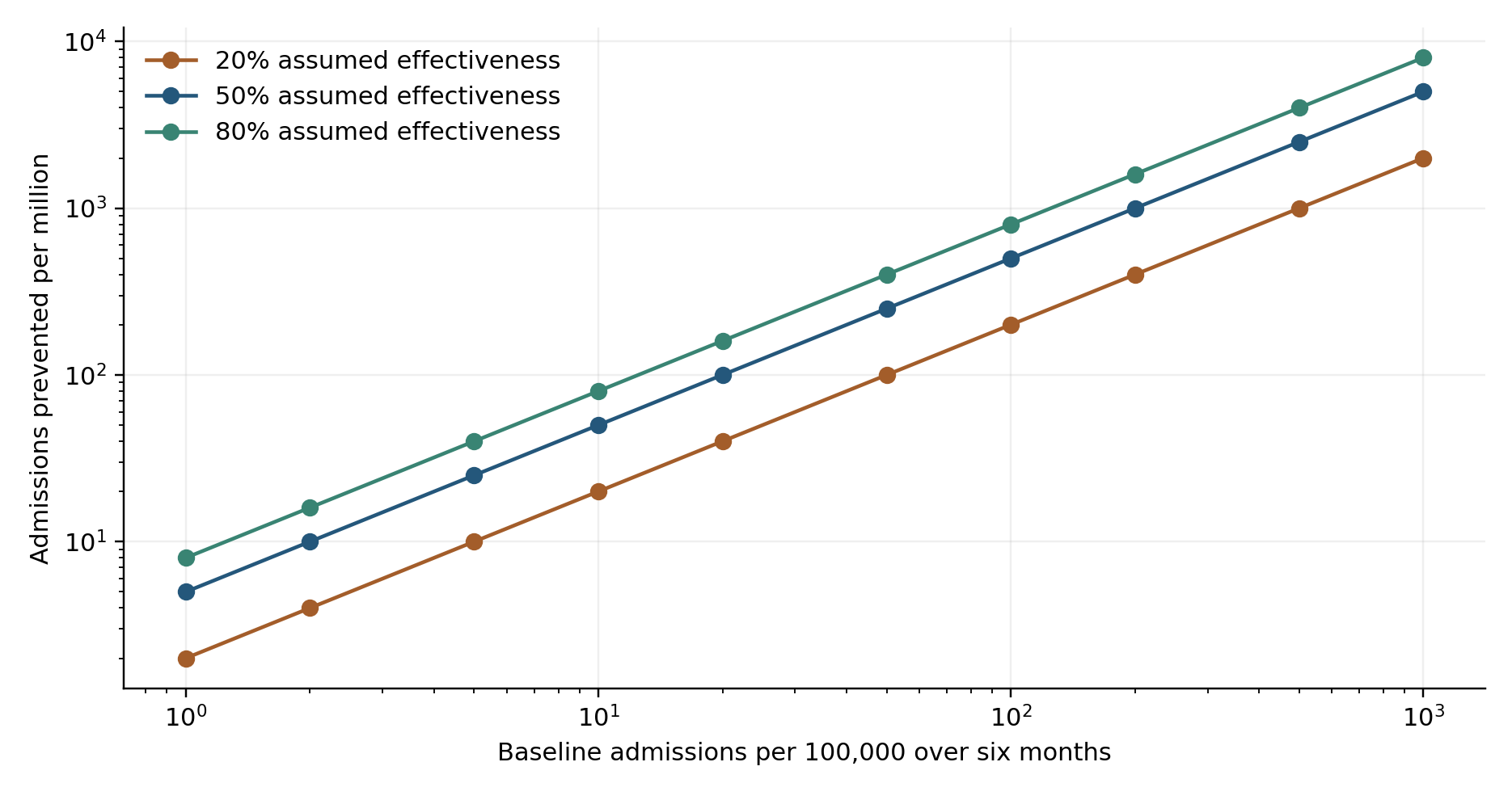
Illustrative sensitivity analysis, not age-specific clinical estimates. Logarithmic axes. Outcomes prevented equal baseline risk multiplied by assumed incremental effectiveness and cohort size. This figure excludes harms; it cannot determine whether a current dose is worthwhile for an individual.
Comparing decisions rather than declaring allegiance
Figure 24 brings the judgments together. It is based on published studies, safety-surveillance findings and reported incidents, with different weight given to each. A controlled estimate of attributable injury and an account of illness after vaccination do not answer the same question. Reports can identify signals deserving investigation; clinical comparisons help establish causation, frequency and severity. The tiers are our synthesis of that evidence, not scores calculated from a common mortality dataset.
Figure 24 Benefits and safety depend on the vaccination decision
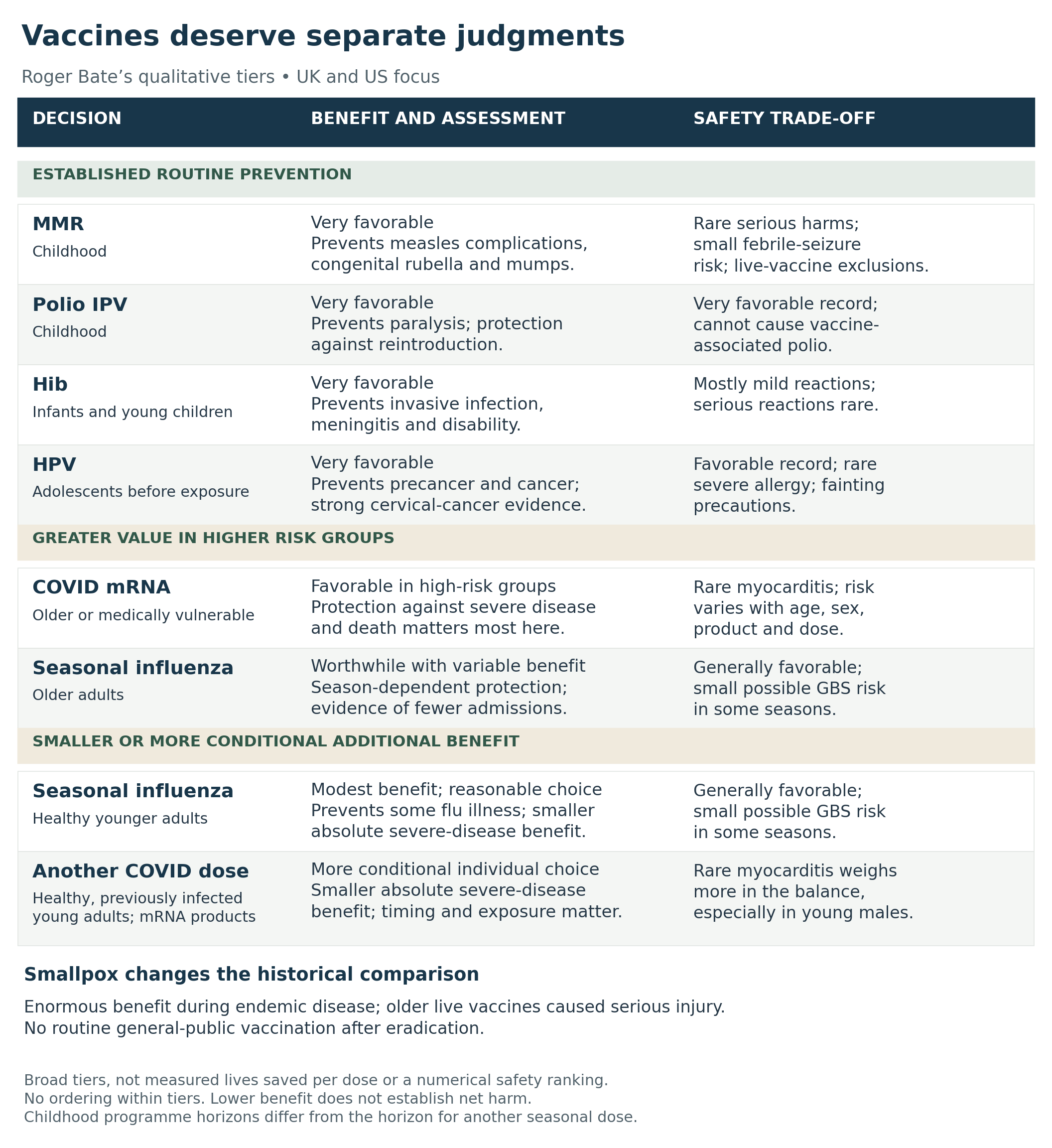
Author’s synthesis. MMR; IPV; Hib; HPV; COVID; influenza; smallpox. Safety notes are selective and contraindications apply.
How to read the assessment
The available evidence supports substantial benefits from many vaccines, with a more conditional balance for others. It remains possible that some harms are more frequent or consequential than the published record captures, that benefits are overstated, or that the data and their presentation are biased. The figure should be read as an accountable judgment under those uncertainties. It is not a declaration that the evidence base is complete or that every favorable label is secure against revision.
The greatest confidence belongs to conclusions supported by different kinds of evidence: prevention of a specified disease, changes after introduction, trial results where available, and comparisons across settings. Agreement among studies is more persuasive when their errors are genuinely different. Ten papers using the same biased source do not provide ten independent confirmations. Conversely, a vivid account of an injury deserves attention without being converted into a population incidence estimate.
The tier differences also reflect different decisions. MMR, IPV and Hib concern programmes that protect children and maintain population protection. HPV is assessed before exposure, with benefits extending into later life. The seasonal rows concern another dose in people with differing baseline risk and immunity. Low disease incidence produced by successful vaccination is not a fair substitute for the risk that would arise if population protection were abandoned. Smallpox belongs in a historical panel because eradication changed the case for routine use. These distinctions prevent the chart from becoming the blanket verdict it is intended to challenge.
Listening to the strongest contrary case
React19’s Cries for Help, published by Brownstone, selects V-safe narratives about serious suffering, requests for assistance and deaths. Its introduction and methods describe 3,329 participants meeting its search criteria among approximately 3.49 million participants in the released free-text data. That is a count of selected reports, not an estimate that one in roughly a thousand vaccine recipients suffered a causally established serious injury. The book explicitly does not determine causation or what CDC did with each report. We have examined its methods rather than clinically adjudicated every entry. (printed pp. 6–8)
The accounts remain important. Some participants described repeated requests for contact without the response they expected. Those claims warrant an audit of follow-up records. Accepting that suffering occurred does not require first proving its cause; assigning that suffering to a vaccine does require a clinical and epidemiological assessment. Tucker’s accompanying essay advances much broader conclusions about effectiveness, mass injury and deception than the collection’s design can establish. A testimony archive can expose a neglected question without settling the aggregate benefit–risk balance.
Persistent illness could materially change that balance. Yale’s preliminary comparison of 42 people reporting post-vaccination syndrome with 22 controls identified biological differences requiring validation. It did not determine population incidence or establish that a particular measured abnormality caused symptoms. The research supplies a reason for investigation, not a number to insert as attributable risk. A confirmed syndrome with years of disability could matter much more than a transient reaction, especially for a low-risk recipient contemplating another dose.
The cancer argument has equally consequential implications if substantiated. The Kuperwasser and El-Deiry review collects reports and possible mechanisms, but does not estimate attributable cancer risk or establish causation. If a product caused a meaningful excess of cancer or accelerated existing disease, the expected health loss would require a substantial revision. Until its frequency, latency and causal basis are established, assigning an arbitrary cancer penalty would replace one unsupported certainty with another. The appropriate response is linked follow-up and independent analysis, with infection, screening, pre-existing disease and diagnostic changes considered.
The childhood chronic-disease claim would reach beyond COVID. The Henry Ford draft placed in the Senate record reports an association between any vaccination and chronic conditions. It includes sensitivity analyses, which deserve examination rather than being omitted from criticism. But its groups differed in clinical characteristics, observation and healthcare use; it does not identify causal effects of individual products, number of doses or timing. Its conclusion acknowledges that causality is unproved. Henry Ford disputes the methodology and allegation of suppression. Neither the institution’s denial nor the allegation settles the analytic question. If a substantial causal burden were independently replicated, we would reopen the childhood rankings. The draft does not currently establish that burden.
What would make us change our mind
The following table treats adverse propositions as counterfactual assumptions. It states their consequences if established and the evidence that could establish them. It does not present every proposition as equally likely. The burden is to update the affected product and subgroup, not to protect a favored category or condemn unrelated vaccines.
Table 19.4 Evidence that would change the assessment
If established | Change in judgment | Evidence needed |
|---|---|---|
Persistent serious injury is substantially undercounted. | Increase attributable harm, duration and care costs. Small additional benefits become less attractive first. | Validated case definitions; linked records; comparable unexposed or appropriately timed groups; independent replication. |
Effectiveness is materially overstated by selection or confounding. | Reduce benefit estimates. Recalculate by age, immunity, dose and period rather than apply one discount to every product. | Trials where feasible, credible natural experiments and analyses that address healthcare-seeking, frailty and time-varying exposure. |
An excess cancer or other delayed serious-disease risk is causal. | Potentially a major downgrade for the implicated product. Magnitude and latency determine whether net benefit reverses. | Longitudinal linked cohorts and registries with appropriate comparators, diagnostic controls and converging evidence. |
Childhood vaccination causes a substantial additional chronic-disease burden. | Reopen the childhood assessment, including highly rated entries. Identify which products or schedules contribute. | Replicated designs with comparable diagnostic opportunities, complete follow-up and product-specific temporal analysis. |
Credible reports were not adequately investigated or patients were denied assistance. | Strengthen the institutional-failure conclusion; widen uncertainty where detection suffered; improve care and redress. | Follow-up logs, clinical records, response standards and an independent audit. Administrative failure alone does not quantify causal incidence. |
A mandate adds little protection and causes substantial social or health losses. | Withdraw or narrow that requirement even if voluntary vaccination retains a favorable clinical balance. | Setting-specific estimates of additional uptake, transmission or severe outcomes, staffing effects and other burdens. |
These revisions must enter the same calculation as the benefits. Expected disease burden avoided is reduced by attributable vaccine injury, with severity and duration on both sides. An admission, a mild infection and a lifelong disability are not equivalent units. A harm that would not overturn a large benefit in a highly vulnerable adult could overturn a small additional benefit in someone already well protected. An uncertainty about an event’s frequency belongs in sensitivity analysis, rather than being silently set to zero or inflated to a chosen worst case.
Our judgment is that established childhood prevention remains strongly supported by the evidence examined here, while the incremental case for seasonal vaccination is more dependent on recipient and circumstances. That judgment has to remain revisable. COVID-specific findings do not establish injury from MMR or IPV. Equally, a causal finding against an established childhood product would not become acceptable merely because the programme has a distinguished history. What matters is the burden actually prevented and caused under the conditions of use.
Testing how much error would change a decision
For this purpose, let B be expected disease-related health loss avoided and H the expected health loss caused by vaccination, both in the same units for the same population and decision period. Common reactions should be included where they matter. The reported net gain is B minus H. Let q represent the fraction of the estimated benefit that survives correction, and m the factor by which attributable harm has been underestimated. The revised gain is q × B minus m × H. The values of q and m below are assumptions for testing sensitivity, not estimates derived from Brownstone, V-safe or any clinical study.
Consider a hypothetical decision with B equal to 100 units of health loss avoided and H equal to one unit caused. If benefit has been overstated twofold and harm understated fivefold, the revised balance is 50 minus 5, leaving 45 units of net gain. Now consider a marginal decision with B equal to two and H equal to one. The same correction produces one minus five, or four units of net loss. These examples use invented health-loss units solely to explain arithmetic. They do not represent specific vaccines, ages or measured probabilities.
The implication is that a criticism can be important without reversing every conclusion. A modest correction might change the recommendation for an additional dose in a low-risk group while leaving an established program favorable. Conversely, a verified severe injury associated with a particular product could require restriction even if other products remain useful. The conclusion must follow the scale and scope of the new evidence.
A new category of injury needs more than a multiplier on an old one. If H excluded a distinct condition, multiplying H may fail to represent it. The model should instead add that condition’s attributable frequency and expected severity, with uncertainty stated. Nor should an underreporting factor for a passive system be applied to a risk already estimated through linked medical records. That would confuse reports with diagnosed events and could count a correction twice.
Corrections to benefit also need an identified mechanism. Healthy-vaccinee bias can inflate an observational mortality estimate; changing exposure can reduce the absolute value of another dose; selective publication can make favorable studies unusually visible. Each points to a different repair. Applying a universal discount to every vaccine because one observational estimate was confounded would ignore the distinction between randomized prevention of illness, measured disease incidence and historical mortality models.
An honest assessment should report whether a conclusion changes across plausible assumptions. Where the evidence constrains the uncertainty well enough, the analysis can identify a threshold at which an injury estimate or lower effectiveness would reverse the balance. Where the necessary inputs are unavailable, we cannot say that a favorable judgment has survived a quantified stress test. The graphic is therefore a reasoned synthesis, with the worked examples explaining how to challenge it rather than pretending to validate every row numerically.
Policy can change before the expected clinical balance becomes negative. Greater uncertainty may justify a narrower recommendation, a different product, longer intervals or a stronger emphasis on individual choice. Compulsion requires additional evidence of benefit to others and proportionality. A small personal gain does not settle that question, and incomplete transmission protection cannot be replaced by moral certainty.
20 COVID mandates and the burden of justification
A vaccine can be clinically useful while a requirement to receive it is poorly justified. A mandate changes the decision from an offer of protection to a condition attached to work, education, travel, or participation. The additional claim is that imposing that condition produces benefits sufficient to justify its burdens. Clinical efficacy establishes only part of that argument.
The phrase mandates for all needs historical precision. Neither Britain nor the United States imposed one uniform vaccination rule on every resident. Requirements varied across employers, healthcare settings, universities, jurisdictions, and periods, sometimes with testing or recovery alternatives. The book's criticism concerns broad requirements that treated unlike risks alike or persisted without a convincing updated rationale. It should identify actual rules rather than argue against a policy no government implemented in exactly that form.
The strongest case for a requirement involves a substantial risk imposed on vulnerable others, a meaningful reduction in that risk, and inadequate less restrictive alternatives. The argument becomes weaker when protection against infection is transient, most people have prior immunity, or the recipient's incremental health benefit is small. Preventing one's own hospitalization can create wider benefits, but this does not automatically justify compelling every low-risk person. The size and distribution of those wider benefits must be demonstrated.
English transmission research illustrates the changing factual basis. Evidence of some Alpha and Delta transmission reduction should be acknowledged, while its waning and variant dependence limit any permanent inference. Protection against severe disease and protection of contacts are different endpoints. A rule justified in part by the second cannot be defended exclusively by evidence for the first after its practical effect changes.
England's reversal is especially informative. The government announced revocation of vaccination as a condition of deployment in health and social care, effective 15 March 2022, before the wider healthcare extension was due to commence. Its explanation included changing evidence on Omicron, the limits of longer-term protection against spread from a primary course, and workforce considerations. It continued to recommend vaccination. This is evidence of an official reassessment, not proof that every earlier restriction was irrational.
Evidence favorable to targeted requirements must also be considered. Gandhi and colleagues' NBER working paper examines employer mandates at 581 US nursing homes using difference-in-differences methods and estimates fewer resident deaths. Its reported average is approximately one life saved per two adopting facilities. The study is observational; selection, comparison trends, and the period studied matter. Its result should neither be ignored nor extrapolated to all workplaces, universities, later variants, or a universal population policy. The present review has checked the study record and reported findings, not completed an independent replication.
Certificate studies provide another type of evidence. Mills and Rüttenauer's synthetic-control analysis reports uptake changes in selected countries. Certification can therefore influence behavior, but increased vaccination is not the same endpoint as net health benefit, and a certificate allowing tests or evidence of recovery is not identical to an unconditional vaccine requirement. These international results are supplementary to the report's UK and US focus. Their applicability depends on baseline uptake, policy design, eligibility, and epidemic timing.
Bardosh and colleagues' BMJ Global Health analysis maps possible harms through reactance, polarization, exclusion, and loss of institutional confidence. Those are relevant policy outcomes, including when difficult to monetize. The paper is a critical framework and synthesis rather than a direct measurement of total net harm from every mandate. A published response argues that harms and benefits need more explicit comparison across settings and policy designs. Including both arguments keeps a plausible mechanism from becoming an assumed effect size.
The costs deserve the same discipline as the benefits. Employment exclusion can impose serious losses on individuals, but the aggregate staffing effect depends on how many leave, where they go, and whether care deteriorates. Distrust can affect future health decisions, but it cannot be assigned an arbitrary monetary value or attributed entirely to mandates from a cross-sectional survey. We count these consequences as real policy concerns, while declining to invent their aggregate magnitude.
We conclude that broad COVID vaccination requirements were a serious policy mistake where they treated markedly different risks alike or continued after the transmission rationale weakened without a convincing reassessment. Compulsion carries a burden of justification beyond showing some recipient benefit. Failure to establish that additional case is consequential even when the total net harm cannot be measured precisely.
That judgment is narrower than saying every COVID mandate everywhere caused more harm than good. Early requirements in high-risk care settings may have a different balance, and the nursing-home evidence is a substantive challenge to an absolute rejection. The defensible criticism is that governments and institutions too often allowed the clinical case for protecting vulnerable adults to stand in for the distinct case for compelling low-risk people. Each policy should be judged against the evidence available when adopted and the evidence that should have triggered revision.
21 Different countries different vaccination policies
Affluent countries disagree about which vaccines to offer routinely, who should receive them, how much the public should pay, and when refusal should have legal or financial consequences. That variation is a legitimate subject for scrutiny. A recommendation cannot be treated as self-validating simply because one national authority issued it. Equally, another country's different policy does not by itself prove the first one wrong. The question is whether differences can be explained by disease burden, delivery costs, evidence, and stated public values.
The Organisation for Economic Co-operation and Development (OECD) provides a useful comparison group, but it is not a set of identical health systems or populations. Its 38 members include countries with substantially different incomes, demography, geography, and infectious exposures. The book retains Britain and the United States as its principal histories while using other members to test the consistency of their policy reasoning. The associated register names all 38 members and distinguishes assessed cases from countries awaiting review. It does not count unassessed countries as having no requirements.
Approval recommendation funding and obligation
Four decisions need separate records. Authorization permits a named product for specified uses, subject to its legal label and conditions. Recommendation expresses a clinical or public-health judgment about use. Funding identifies who pays and which recipients qualify. A requirement attaches a consequence to noncompliance in a particular setting. Clinical advice may also explicitly discuss off-label use, so these decisions cannot always be drawn as neatly nested circles.
The same vaccine may be authorized for a broad age range, routinely recommended to a narrower group, available to others after an individual discussion, and publicly funded under another eligibility rule. Conversely, guidance may recommend a use outside the product's approved indication and identify it as such. None of these facts establishes that a school, employer, or government can require it. Each step raises an additional question rather than automatically inheriting the answer to the previous one.
A comparison of total vaccines approved is especially vulnerable to ambiguity. One product may have several brands, formulations, pack presentations, indications, or variant updates. A central European authorization is different from national procurement and actual availability. The review should count unique products and disease indications under a defined rule, retain the label version, and distinguish a withdrawn authorization from a product that was never submitted. An absent product may reflect a commercial decision rather than rejection of its evidence.
The FDA's current Comirnaty page specifies use at age 65 and above, or ages 5–64 with a high-risk underlying condition. The EMA therapeutic-indication field for Comirnaty XFG specifies age six months and above with use according to official recommendations. This is a concrete regulatory difference, not merely a different schedule. It does not establish which regulator has the better benefit-risk judgment; that requires the underlying reasoning and evidence.
The CDC's September 2026 seasonal COVID guidance makes a further distinction: it recommends vaccination for all adults and uses shared clinical decision making for children without moderate or severe immunocompromise. It explicitly identifies uses outside FDA indications as off-label. A comparative table that silently substitutes the FDA label for CDC advice, or CDC advice for a legal mandate, would misstate US policy.
What selected official country records show
The initial cases establish several different policy mechanisms rather than a single international division. NHS guidance describes childhood vaccination as nonmandatory and dependent on consent. Denmark, the Netherlands, Norway, and Sweden also describe their relevant childhood or national programmes as voluntary, with free programme offers. These examples show that an organized public offer and strong recommendation can exist without an ordinary childhood vaccination obligation. They do not establish the absence of every occupational or outbreak restriction.
Belgium's federal medicines agency identifies polio as mandatory and other basic-schedule vaccines as strongly recommended. France's infant requirements encompass several diseases, with meningococcal ACWY and B added to obligations from January 2025. AIFA describes ten obligatory disease vaccinations under Italy's 2017 law, alongside freely offered vaccines without that obligation. These are different scopes of compulsion; the Italian explanatory page also requires reconciliation with consolidated current law before a definitive 2026 legal census.
Germany is particularly useful because a single word can obscure the actual rule. Its measles legislation requires proof in specified community and employment settings, with provisions for immunity and medical contraindications. Daycare exclusion and compulsory schooling are not equivalent: Hamburg explains that children subject to compulsory schooling may attend without proof while the matter must be reported to the health authority. The rule should therefore be coded as an evidence-of-protection requirement with setting-specific consequences, not a universal forced-injection law.
The United States and Canada need subnational records. Pennsylvania requires specified immunizations for school attendance with medical, religious, and defined moral or ethical exemptions. Ontario has its own school-pupil legislation and exemption process. Neither case can be relabeled as the rule for an entire federation. Comparing one national British schedule with one American state's admission requirements would otherwise confuse two different decision levels.
Australia adds a different pressure mechanism. Services Australia ties specified family assistance to immunization requirements. State childcare-entry rules require separate treatment. Financial eligibility conditions may affect families differently according to income and dependence on assistance, even without a general legal order to vaccinate. Japan presents another category: its statutory duty to endeavor for defined vaccination categories, alongside guidance requiring informed consent, should not be equated without further analysis with fines or school exclusion.
The accompanying table summarizes thirteen selected country cases, including Pennsylvania and Ontario within their federations. It is a starting set of official-source comparisons, not a completed legal inventory of all OECD members. The unfilled country register and the explicit qualifications protect the eventual analysis from treating a research gap as a policy finding.
Table 21.1 Selected vaccination policies
Official pages checked 25 October 2026. Scope and source dates differ. These cases do not constitute a completed 38-country legal census. The United States and Canada rows describe Pennsylvania and Ontario.
Country | Scope | Policy and qualification | Sources |
|---|---|---|---|
United Kingdom | Routine childhood programme | NHS describes childhood vaccination as nonmandatory and requiring consent. Historical COVID employment rules are separate; nation-specific implementation must be retained. | |
United States | Pennsylvania school attendance | School-entry immunization requirements; medical, religious and specified moral or ethical exemptions. Pennsylvania is a case study, not a national rule. Federal recommendation and state admission conditions are distinct. | |
Canada | Ontario school attendance | Immunization of School Pupils Act requires specified vaccinations or valid exemption; nonmedical exemption education process. Ontario is not all Canada; no nationwide mandate inferred. | |
Australia | Specified federal family assistance | Immunization status affects Family Tax Benefit Part A and childcare fee assistance eligibility. State childcare-entry rules, exemptions and payment-specific consequences require separate records. | |
Belgium | National basic schedule | Polio vaccination is mandatory; other basic-schedule vaccines strongly recommended. Federal summary does not adjudicate every community childcare rule. | |
Denmark | Routine childhood programme | Childhood vaccination is voluntary and free. The Danish-language 2026 page is used; an English SSI summary is dated 2019. | |
France | Infant vaccination | Infant obligations include meningococcal ACWY and B from January 2025, alongside established requirements. Birth cohorts and age-specific provisions matter; no timeless count of injections. | |
Germany | Specified childcare school and employment settings | Age-appropriate measles protection evidence required; immunity and contraindication provisions apply. Compulsory school attendance and daycare exclusion differ. The 2019 adoption announcement is historical. | |
Italy | Law 119 of 2017 childhood framework | AIFA lists ten obligatory disease vaccinations and separate freely offered nonobligatory vaccines. Official explanatory page refers to the 2017 framework; full 2026 consolidated-law audit outstanding. | |
Netherlands | National childhood programme | RIVM describes participation as voluntary and free, with consent. Does not classify every occupational, travel or outbreak rule. | |
Norway | Childhood and adult programmes | Vaccination is voluntary; childhood programme vaccines offered free through age 19. Adult availability, recommendations and municipal patient charges differ. | |
Sweden | National vaccination programmes | National programme vaccinations are voluntary and free; all regions additionally offer infant hepatitis B. Formal national-programme membership and regional universal offers are different categories. | |
Japan | Routine vaccination statutory framework | Vaccination Act article 9 specifies a duty to endeavor for defined categories; informed consent required by implementation guidance. Not coded as a fine-backed mandate; current sanctions and exceptions require separate legal review. |
Different offers can exist within the same country
The distinction is sometimes visible without crossing a border. Norway's adult programme page separates an offer of COVID vaccination from age 65 from a recommendation beginning at 75, with access for risk groups and municipal patient charges. That page includes autumn 2025 reminder examples, so its age thresholds must be reconfirmed for any new seasonal comparison. It nonetheless illustrates why offered, recommended, and free are separate fields.
Sweden supplies another classification lesson. Its formal national childhood programme lists eleven diseases, while all regions additionally offer hepatitis B vaccination to infants. Counting only formal national-programme membership would miss a universal regional offer. A comparison claiming that one country does not vaccinate against a disease simply because it is absent from one national list can therefore be wrong even when that list was copied correctly.
Britain's varicella decision also demonstrates the importance of time. The updated schedule introduced routine MMRV from January 2026. A table describing Britain as not offering routine childhood chickenpox protection may have described an earlier period but is no longer an adequate account of the new cohorts. The comparison should preserve the date of the decision, eligibility by birth cohort, and implementation rather than overwrite history with one present-day category.
Why different policies need not imply contradictory science
Two authorities can accept the same estimate of clinical efficacy and reach different program decisions. If disease is less frequent in one setting, the absolute benefit may be smaller. A vaccine added to an existing visit may cost less than one needing a separate appointment. Prior infection, maternal screening, access to treatment, and the ability to identify high-risk people can alter the relative attraction of universal and targeted offers. These explanations should be demonstrated where invoked rather than treated as an all-purpose defense of any discrepancy.
Thresholds also reflect judgments beyond scientific measurement. Public authorities may assign different importance to avoiding hospital admissions, preserving individual choice, preventing rare catastrophic outcomes, or reducing inequalities. They may use different discount rates for delayed benefits or different budget constraints. Science can estimate consequences without supplying one compulsory weighting of those consequences. The proper response is to expose the assumptions so the public can evaluate them.
That qualification does not excuse inconsistency. If otherwise comparable countries use the same product for the same risk group yet describe opposite conclusions as beyond dispute, the underlying appraisals deserve direct comparison. We should ask whether one included newer safety evidence, used a different clinical endpoint, assigned greater weight to opportunity cost, or retained a policy whose original rationale had changed. Where no convincing explanation is documented, institutional inertia becomes a hypothesis worth investigating, not an established finding about motives.
The policy threshold for compulsion remains higher than the threshold for an offer. A country can reasonably recommend a vaccine while deciding that consent, reminders, and easy access are sufficient. Another country may favor a requirement because of a local outbreak or a specific care setting. Whether the additional restriction is proportionate depends on its marginal effect and burdens, not on whether the vaccine has some average benefit. International variation therefore challenges blanket rhetoric about necessity more directly than it challenges the biology of protection.
Do mandates improve outcomes
Observational comparisons provide relevant but limited evidence. Vaz and colleagues examined 29 European countries and reported associations between mandates and higher measles and pertussis coverage; lower measles incidence was associated with mandates without nonmedical exemptions, while a significant pertussis-incidence association was not found. Published comments questioned country classification and surveillance comparability. The authors emphasized that their regression did not establish causality. This exchange belongs in the review because it identifies substantive limitations without making the favorable associations disappear.
The reverse inference also needs restraint. A country with high uptake and no mandate shows that a mandate is not universally necessary for high uptake. It does not prove that removing a particular existing mandate elsewhere would have no effect. Likewise, a country with a mandate and outbreaks does not show that the rule had zero benefit. The relevant alternative is what would have happened in the same setting under a feasible different policy.
Policy adoption is rarely random. A government may impose a requirement because uptake is already falling or an outbreak is occurring. A crude cross-country comparison can then make mandates look ineffective because difficult conditions caused their adoption. The opposite bias occurs when countries with stronger delivery systems also maintain stricter laws. Measuring the statute while ignoring nurse visits, reminder systems, or access attributes the entire package to compulsion.
The most useful studies follow policy changes over time, examine pre-existing trends, compare plausible unaffected groups, and separate uptake from clinical outcomes. They should record enforcement rather than assume that a law on paper was implemented uniformly. School exclusion, fines, benefit loss, and workplace dismissal have different consequences. Distributional effects, access, and trust should be included alongside illness and admissions, with uncertainty retained where their magnitudes cannot be measured reliably.
What the OECD comparison can establish
A defensible comparison uses country-disease-age-period records rather than a ranking by the number of injections. It counts diseases, antigen components, administrations, injections, visits, and seasonal repetitions separately. Combination vaccines reduce injections without necessarily reducing the number of diseases covered. Catch-up doses and risk-group provisions cannot be summed as though every child receives them. Passive RSV antibodies should not be counted as vaccines merely because they share a schedule table.
ECDC's scheduler is a useful starting point for EU and EEA members, but it is not a complete OECD source or a substitute for checking national legislation and funding rules. Current pages also need version control: some English summaries remain older than local-language pages, and a retrieved page may mix current headings with historical examples. The complete comparison therefore requires an explicit evidence date and identification of unverified fields.
The selected OECD cases establish that vaccination has no single necessary legal form. Recommendations, benefit conditions, proof requirements and statutory obligations vary substantially. We conclude that approval cannot settle the separate political questions of funding and compulsion. The variation does not establish that every wider schedule is excessive or every narrower schedule inadequate.
Our preference is a strong voluntary offer backed by intelligible evidence, practical access and credible injury investigation. A government seeking to add compulsion must demonstrate why that additional step is necessary, what it achieves, what it costs and when it ends. Neither a foreign precedent nor national authority can replace that justification.
Four disagreements worth examining closely
Childhood influenza is a useful test of who benefits. A programme may seek both protection of vaccinated children and fewer infections reaching vulnerable contacts. The indirect claim needs its own transmission and outcome evidence. School delivery can also change costs and uptake. A comparison that records only the child’s death risk misses part of the stated rationale, while a comparison that assumes every prevented childhood infection prevents an older person’s admission exaggerates it. Current US and English offers should therefore be compared by age, delivery and intended endpoint, not just by the word recommended.
Varicella illustrates policy revision. Britain introduced routine MMRV in January 2026 after a long period with a different approach. This narrows an earlier contrast with the United States without making the earlier disagreement imaginary. The useful questions concern the evidence and economic assumptions that changed, the cohorts now eligible, and formulation-specific adverse effects. A present schedule is a dated decision, not a timeless statement of national scientific belief.
COVID boosters provide a more immediate disagreement. The JCVI’s advice for autumn 2026 and spring 2027 targets older care-home residents, people aged 75 and above, and immunosuppressed people from six months. The US seasonal guidance and FDA indication have their own distinct scopes. Those documents should be compared on their stated objectives, current baseline risks and cost assumptions; a broader offer does not automatically mean a broader legal obligation. Nor does a narrower publicly funded programme establish that everyone outside it receives no benefit.
Mandates supply the fourth comparison. High uptake in voluntary systems establishes that legal compulsion is not a universal prerequisite for effective programmes. It does not show that removing a particular existing rule would leave uptake unchanged. The strongest policy comparison measures the additional vaccinations induced, the resulting clinical outcomes, exclusion or financial burdens and changes in trust. Counting countries on each side of a legal divide cannot supply those effects.
Our conclusion is that international variation weakens claims that one country’s entire schedule or legal framework is beyond reasonable dispute. It does not make every disagreement a scientific contradiction. We favor transparent comparison of specific decisions and their assumptions, with the case for compulsion assessed separately. The selected cases support that conclusion; they do not yet constitute a completed legal and product census of all 38 OECD members.
22 A qualified success and the limits of compulsion
We conclude that vaccination is a major public-health success, qualified by substantial differences between diseases, products, recipients and periods. Some achievements are extraordinary. Others offer modest gains, incomplete protection or a narrower favorable balance than official rhetoric has implied. The proper response is to retain the effective interventions and correct the overstatement, rather than defend or reject the entire category.
Smallpox eradication is the clearest global achievement, accomplished through vaccination combined with surveillance and containment. Polio prevention transformed the prospect of paralysis in affluent countries as well as elsewhere. Measles vaccination sharply reduced infections that had remained common after mortality had already fallen. Hib and other invasive bacterial disease evidence challenges the idea that modern hospitals render prevention unimportant. These are substantial gains in the UK and US, not benefits that exist only in poorer settings.
The earlier mortality decline remains central to an honest history. Better living conditions and medical care had already made several infections much less lethal before vaccination. We should credit those improvements to their actual causes. Vaccination's additional contribution is preventing infections and their consequences under the conditions that would otherwise have prevailed. The precise mortality increment is less certain than a simple comparison with a nineteenth-century peak would suggest. Acknowledging that limit makes the historical account more accurate without erasing later prevention.
Benefits also extend beyond deaths. Avoiding paralysis, congenital injury, invasive disease, cancer, and hospitalization can be worthwhile in a rich country even when survival from acute infection is likely. Rubella and HPV particularly show the weakness of judging a vaccine by immediate deaths among its recipients. The relevant health gain may accrue to a fetus or appear decades later. A fair assessment retains these outcomes while insisting on evidence appropriate to the time horizon.
The geographical evidence supports a firmer conclusion: established childhood programmes have delivered most modeled mortality gains outside high-income countries, with the largest total in the lower-middle-income stratum. Africa and South-East Asia account for 90.87 million of 153.858 million modeled deaths prevented, or 59.1%; that regional share is not an LDC share. Measles accounts for 60.9% globally. The evidence therefore supports a major concentration of childhood survival benefit in poorer, high-burden populations, while leaving substantial affluent-country benefits intact. Gavi’s reported reach and the eligibility-based mortality study strengthen the case that organized vaccine assistance can add benefit in poorer settings; they do not validate every institutional expenditure.
We accept the central intuition behind the LDC argument in that defined form. The economic evidence also points toward especially strong value in low-income settings: a benefit-cost estimate of 23.63 against 14.80 in high-income countries. Its overlapping uncertainty intervals and inherited mortality model prevent a precise universal ranking. The formal UN least-developed-country group is not interchangeable with World Bank income strata, and neither analysis establishes that vaccination always beats water, nutrition or primary care. The sensible conclusion is priority for proven childhood prevention where the burden is high, rather than a blanket endorsement of every vaccine or mandate.
Safety findings qualify the achievement in a further sense. Vaccine-associated paralysis, intussusception, narcolepsy, vaccine-induced immune thrombotic thrombocytopenia, and myocarditis demonstrate that prevention can itself injure people. Their existence does not establish that all products have an unfavorable balance. Their rarity does not make them unimportant to those affected. An honest account states what is causally supported, estimates excess risk where possible, and distinguishes established injury from unresolved signals. The uncertainty that remains should be bounded as far as the evidence allows.
Those injuries also create an institutional obligation. The fact that many people benefit does not discharge responsibility to the smaller number harmed. Investigation, treatment, access to records, and fair compensation should be integral to a prevention program. A system that celebrates population gains while minimizing individual losses undermines its own legitimacy. This is an ethical conclusion that follows even when the aggregate clinical balance is strongly favorable.
Influenza requires more modest language. For healthy adults, the pooled trial evidence supports some prevention of confirmed illness with a small absolute difference across the seasons studied. Seasonal variation and bias in severe-outcome studies limit broader claims. This can support a reasonable voluntary choice without establishing that every adult requires vaccination or that declining it represents scientific ignorance. Higher baseline risk can strengthen a recommendation, but the supporting estimate should remain tied to the recipient and outcome. We therefore regard flu vaccination as a reasonable voluntary option for healthy young adults, rather than conclude that they generally should not take it. The case for each additional COVID dose requires a separate risk-specific assessment, as Chapter 19 explains.
COVID produced a sharper separation between clinical benefit and policy legitimacy. Evidence of early protection against severe disease in vulnerable adults should be retained. So should evidence of specific injuries and the erosion of protection against infection as time and variants changed. The original trial result cannot be used as perpetual authorization for all later recommendations. Previously infected young people, older adults with chronic illness, and immunocompromised patients should not have been treated as one undifferentiated clinical population.
We regard broad COVID mandates as a serious mistake when imposed on unlike risk groups without adequate discrimination, or retained after their public-benefit rationale weakened without a convincing review. This is our judgment about justification and proportionality. It is not a numerical finding that every requirement caused net harm. The evidence for early protection of vulnerable adults cannot do the separate work of justifying coercion of low-risk people.
The counterevidence matters. A targeted requirement in a nursing home during a severe epidemic can protect highly vulnerable residents, and the US working-paper evidence reports such gains. It prevents the report from asserting that compulsion can never have a favorable health effect. It does not establish a right to impose the same rule on healthy students or every employee. The correct question is whether the specific requirement delivered sufficient additional benefit under its actual conditions.
The Cambridge and Montgomery County comparison adds a descriptive account of current confidence and recalled earlier attitudes. In the investigator-supplied aggregates, current hesitancy is 29% in Cambridge and 46% in Montgomery County, compared with recalled pre-COVID levels of 12% and 22%. Willingness to receive established childhood vaccines remains higher than willingness to receive another COVID dose. These figures support examining selective hesitancy, personal medical advice, and institutional confidence separately. They do not establish that mandates caused the changes. Convenience recruitment, recall, incomplete item-level records limit the precision of the comparison. The 36% versus 77% reporting resentment about pressure or mandates concerns hesitant respondents only. It strengthens the case for investigating perceived coercion, while leaving its causal contribution to the overall change unresolved. The common concerns across the locations and the differences between vaccine preferences also caution against turning a medical choice into a test of belonging. These data do not measure factual knowledge or family conflict, but they strengthen our objection to labels that erase the particular question a person is asking.
The conclusion is not that the public must choose between unquestioning confidence and rejection. People can accept strong evidence for MMR or polio vaccination, question a seasonal recommendation, decline an additional COVID dose, and object to coercion without logical inconsistency. Institutions should explain why each decision differs. Critics should apply the same discipline, avoiding unsupported claims of mass injury or the dismissal of converging disease evidence because an agency behaved badly in another episode.
The OECD cases reinforce our conclusion that good vaccination policy does not require one inevitable coercive model. Official records distinguish voluntary offers, school conditions, benefit-linked requirements and disease-specific obligations. The 13 selected cases establish variation; they do not measure comparative health effects across all 38 members. We favor a presumption of consent, with the burden on governments to justify exceptions rather than on citizens to justify every refusal.
Our final position is favorable to vaccination and demanding of its advocates. Preserve the programmes that prevent serious disease. State small benefits as small benefits. Investigate injuries without treating the injured as a threat to public confidence, and compensate fairly where responsibility is established. Withdraw or narrow policies when their justification changes. The strongest case for vaccination is the disease and suffering it prevents; its weakest defense is the insistence that accepting that achievement requires surrendering independent judgment. We favor vaccination as a method of preventing disease; we ask each product and policy to justify its particular use. Belief in the category is no substitute for knowing which interventions work, how much they add and whom they may harm.
The reason for working through political alignment, commercial interests and dissident arguments is to reach a conclusion that survives scrutiny from outside its own camp. We find vaccination useful in general and some programmes exceptionally valuable. We do not infer from that finding that official estimates are free of bias or that reported injuries have all been recognized. Brownstone deserves a hearing because the questions and evidence matter, not because a dissident institution is exempt from error.
Our assessment would change if credible evidence established materially greater attributable harms, smaller benefits or a different distribution of either. Figure 24 and Table 19.4 make that commitment concrete. The strongest childhood judgments and the more conditional seasonal judgments are not equally vulnerable to every new finding. A good book should show where its conclusions are robust, where they depend on uncertain assumptions, and what could reverse them.
We do not want readers to finish by deciding whether they belong to a pro-vaccine or anti-vaccine side. We want them to finish able to distinguish an intervention that prevents devastating disease from one whose additional benefit is modest, and a documented injury from an allegation awaiting investigation. That is how an assessment favorable to vaccination can remain demanding about its particular uses.
The conclusions We are prepared to defend
Our strongest positive conclusion concerns prevention of serious childhood disease. The decline in mortality before vaccines deserves full recognition, but it does not explain away the later prevention of infection, paralysis, invasive bacterial disease and congenital injury. Rich countries retained substantial benefits after improvements in nutrition, housing and treatment. The largest modeled historical childhood survival gains nevertheless occurred outside high-income countries.
Our strongest qualification is that vaccination is a family of interventions rather than one indivisible proposition. Some benefits are enormous, some modest and some highly dependent on timing, recipient and product. A routine childhood course, a maternal dose, a cancer-prevention vaccine and a seasonal booster require different assessments. Evidence of recognized injury must be counted, while uncertain signals require investigation rather than automatic acceptance or dismissal.
Our objection to broad and enduring COVID compulsion is consequently a judgment about the additional policy step. The case became particularly weak where low-risk previously infected people were treated as though their decision were identical to that of a vulnerable person facing first exposure. This does not erase early vaccine benefits or the evidence favoring some targeted requirements in high-risk care settings. It means that a government must justify the marginal restriction at the time it is imposed and retained.
Finally, we regard the conversion of vaccination into a loyalty test as damaging in itself. Our field observations and the supplied comparative figures show why the distinction between selective hesitation and wholesale rejection matters, while leaving important questions of causality and knowledge unresolved. Restoring confidence requires accurate claims, responsive safety investigation and a willingness to change recommendations. It cannot require people to deny uncertainty or an injury in order to belong to the respectable side of an argument.
Additional vaccines and adult outcomes
The scope extends beyond diseases that historically killed many children. Shingles can impose substantial pain and disability in older adults; Lal and colleagues' randomized trial demonstrates strong prevention of clinical shingles with a particular adjuvanted subunit product. That outcome should be distinguished from more speculative claims about unrelated downstream benefits.
RSV provides a recent example of clinical benefit and evolving harm assessment. Papi and colleagues' trial evaluated lower-respiratory disease in older adults. FDA subsequently required Guillain–Barre warnings for Arexvy and Abrysvo following postmarketing analyses. The communication reports estimated excess cases and qualifies the causal interpretation. A current decision requires the recipient's baseline risk and the product-specific evidence, rather than reassurance based solely on licensure.
Exposure-specific vaccines fall beyond the detailed UK and US disease histories developed here. They cannot be assigned a common balance. Dengue illustrates the danger especially clearly: Sridhar and colleagues found increased subsequent dengue hospitalization among baseline-seronegative CYD-TDV recipients. Prior infection changed the balance for that product. It would be as mistaken to ignore that injury as to apply it automatically to every dengue vaccine.
The conclusions for these additional products remain limited to the specific evidence discussed above. We do not assign a favorable balance to an unexamined product by analogy. The detailed comparative argument rests on the preceding disease chapters.
Adult vaccine policy further illustrates why the relevant comparator changes with age and exposure. Preventing shingles in an older person is chiefly an individual clinical decision, while a traveler facing a specific infectious exposure may have a short-term risk absent from the national average. Recommendations should describe those contexts instead of assigning the same importance to every product on a schedule. Strong evidence for one adult product cannot validate a different platform or indication.
The dengue experience also demonstrates the danger of treating prior exposure as a minor detail. The same product can have a different balance in previously infected and uninfected recipients. Eligibility rules are part of the intervention being evaluated, rather than administrative details added after efficacy is established. That lesson should inform the assessment of other vaccines without implying that their biology or risks are identical.
Data definitions and verification
The accompanying archive contains the chart input tables in CSV format, editable SVG graphics, PNG graphics, the source register, original public-domain or openly licensed historical source snapshots, and the extraction and plotting script. CSV files can be opened in Excel. No missing observations were filled with invented data.
The measles file preserves the original notification and death strings, descriptions, cleaned numeric fields, and source URL. The full retrieved table extends through incomplete 2026; the historical annual figure deliberately uses 1940–1999. Later source notes identify late-effect deaths and provisional records. Notifications must not be treated as all infections or used as an unbiased denominator for infection fatality.
The selected measles-period comparisons use arithmetic means over four ten-year windows. Gaps between windows are explicit. Changes in these averages are descriptive and are not adjusted for population, age, surveillance, care, or exposure. They must not be labeled vaccine-attributable effects.
The US case file is extracted from the CDC 1993 historical summary, Tables 1 and 3–6. It retains the table identifier, source URL, disease, year, reported cases, and the corresponding published population. Population rates equal reported cases divided by population times 100,000. The original tables contain definitional qualifications and are included in the archive.
Dashes in those CDC tables mean no reported cases and are converted to zero. Dotted missing or not-notifiable spans are not converted to zero. The total polio series ends in 1983 in these tables; the paralytic series continues through 1993. The first years of the mumps series follow vaccine licensure and cannot establish a prevaccine baseline.
The British polio series is a manual transcription of page 2 of an archival reproduction of official records. Its 1951 total is 2,514, while the two printed subtype counts sum to 2,614. Both are retained and the discrepancy is flagged. The plotted total is the printed total. This figure is provisional pending reconciliation with original volumes.
The influenza graphic reproduces pooled absolute risks from a review, not an original UK/US cohort. The myocarditis graphic reproduces one historical English subgroup and its confidence intervals, with a recorded-positive-test comparator. Neither is a current personalized risk calculator.
The early US measles mortality graphic uses two published period averages. It is not an annual mortality reconstruction. No interpolation is performed. The early average is approximate and reporting coverage changed. Annual US measles mortality before vaccine introduction, and British mortality before 1940, remain important data-retrieval gaps.
Data checks compare extracted US anchors with the printed values for measles in 1958, rubella in 1969, and paralytic polio in 1960. They check year uniqueness, nonnegative counts, population denominators, coverage of the annual measles series, and the polio subtype arithmetic. These checks validate transcription and calculations, not causality.
The Montgomery County graphic reproduces three percentages from the CGHA public write-up and data page accessed on 25 October 2026. That page labels its figures illustrative pending final tables. These public summaries and the revised two-location workbook are separate reporting versions requiring reconciliation. The workbook is used as author-supplied aggregate research data, without independent validation against original questionnaires or respondent records; its initial working structure used illustrative placeholders before author revision. On 27 October 2026 the author confirmed 616 Cambridge respondents and 654 Montgomery County respondents, recruited during summer 2026 through lists and convenience approaches, with collection mainly in person and some online. No pre-COVID survey was conducted; earlier attitudes were recalled retrospectively. The author confirmed adult residency, inclusion of surrounding Cambridge villages, unweighted percentages and complete applicable responses. Headline hesitancy and the four-category attitude distribution were separate questions. Exact dates, full question wording and filtered subgroup counts remain undocumented. Category totals and overlapping definitions are disclosed in Chapter 17. No respondent records, quotations, standard errors or significance tests have been generated. Qualitative observations about loyalty, political exposure and perceived betrayal are the author’s field account, not a coded transcript analysis or an estimate of prevalence.
The OECD files distinguish thirteen selected official policy cases from a 38-country review register. An unassessed entry means not yet reviewed, not no mandate or no approval. Product approval examples are illustrative rather than a complete inventory. National, regional and seasonal policy records must be reconciled before calculating cross-country totals or estimating causal effects.
The global chapter reports regional shares calculated from published modeled deaths averted, alongside the published income graphic and economic income-group estimates. It does not calculate a formal UN-LDC share, pool incompatible time horizons or estimate total net harms from all policies. Model outputs retain their identity as estimates; conclusions about compulsion also incorporate ethical and policy judgments.
Table A1 Selected measles period averages
Period | Mean notifications per year | Mean deaths per year |
|---|---|---|
1940–1949 | 342,668.6 | 568.7 |
1958–1967 | 412,093.6 | 86.3 |
1968–1977 | 160,097.9 | 29.2 |
1989–1998 | 10,621.0 | 1.8 |
Calculated from the England-and-Wales historical series.
Glossary of key terms
These definitions explain how terms are used in this report. They distinguish clinical outcomes, statistical measures and policy judgments so that the same word does not do different work in different arguments.
Absolute risk The probability of a specified event in a defined population over a stated period, expressed as a percentage or a count per number of people.
Absolute risk reduction The risk without an intervention minus the risk with it, using comparable groups and the same outcome and period. A reduction from 2% to 1% is one percentage point.
Adverse event An unfavorable medical occurrence after an intervention. Its timing alone does not establish that the intervention caused it.
Adverse reaction An unwanted effect attributed to an intervention. The strength of the causal evidence must be distinguished from a suspected association.
Attributable risk The additional risk caused by an exposure compared with an appropriate alternative. It differs from the total number of events observed after exposure.
Baseline risk The probability of an outcome under the relevant alternative, such as no additional dose. Existing immunity, exposure and access to care can change it.
Benefit–risk balance An assessment of expected health gains and harms for a specified intervention and population. Severity, duration and uncertainty matter as well as event counts.
Bias A systematic tendency in study design, measurement, analysis or reporting that can move an estimate away from the effect being investigated.
Booster dose A further vaccine dose intended to strengthen or renew protection after earlier vaccination. Its additional benefit requires its own assessment.
Breakthrough infection An infection occurring after vaccination intended to protect against that infection. Its occurrence alone does not measure vaccine effectiveness.
Case fatality The proportion of identified disease cases that result in death. It is sensitive to how cases and deaths are identified and differs from infection fatality.
Catch-up vaccination Vaccination intended to complete missing or uncertain protection, taking account of age, earlier doses, intervals and relevant contraindications.
Causation A relationship in which an exposure changes an outcome. A correlation or an event occurring afterward is insufficient by itself to establish causation.
CDC Centers for Disease Control and Prevention, the US public-health agency whose surveillance, safety information and vaccination recommendations are cited throughout the report.
Cohort study An observational study comparing outcomes over time among groups defined by an exposure or characteristic.
Confidence interval An interval produced by a statistical method to express sampling uncertainty under stated assumptions. It does not capture every source of bias or model uncertainty.
Confounding Distortion of an exposure–outcome comparison by other factors related to both. Differences in frailty or healthcare use can affect vaccination comparisons.
Congenital rubella syndrome Fetal injury associated with rubella infection during pregnancy, potentially involving hearing, eye, heart or other developmental problems.
Contraindication A condition in which a particular vaccine should not be given because of the risk of a serious adverse reaction. A precaution calls for a separate assessment.
Counterfactual The outcome that would occur under a specified alternative. Vaccine impact estimates depend on what is assumed to happen without vaccination or without another dose.
Effectiveness The reduction in an outcome under actual conditions of use. Its value can differ by recipient, exposure, product and time since vaccination.
Efficacy The reduction in a specified outcome estimated under controlled trial conditions. It is commonly expressed as a relative reduction and must be read with the absolute risks.
EMA European Medicines Agency, which evaluates medicines and coordinates scientific assessments and safety monitoring within the European regulatory system.
Endpoint The outcome a study measures, such as confirmed illness, hospitalization or death. An immune marker is not interchangeable with a clinical endpoint.
FDA Food and Drug Administration, the US regulator responsible for evaluating vaccine products and overseeing their authorization or licensure and relevant safety labeling.
Gavi The international vaccine partnership supporting immunization access and delivery, particularly in lower-income countries. Its program activity and its additional causal impact are distinct questions.
Guillain–Barré syndrome A rare neurological disorder affecting peripheral nerves and potentially causing weakness or paralysis. A safety assessment must identify the attributable excess, if any, for the product and population.
Healthy-vaccinee bias A comparison problem in which vaccinated people differ in underlying health or behavior from unvaccinated people, making an apparent benefit partly reflect those differences.
Herd protection Indirect protection arising when vaccination reduces transmission in a population. It depends on the disease, product, coverage and durability of protection.
Hib Haemophilus influenzae type b, a bacterium that can cause invasive disease, including meningitis. Despite its name, it is not the influenza virus.
HPV Human papillomavirus. Some types cause cancers or precancerous changes. Vaccine assessment depends on the types covered, age, prior exposure and the outcome measured.
Immunization The development of protection against a disease. Vaccination is an intervention intended to produce it; receiving a dose does not guarantee complete protection.
Inactivated polio vaccine or IPV A polio vaccine containing inactivated virus. It differs from oral live polio vaccines and does not cause vaccine-associated paralytic poliomyelitis.
Incidence The occurrence of new events in a population during a stated period. An incidence rate uses person-time; a cumulative risk uses the people initially at risk.
Incremental benefit The additional gain from the decision now being considered, compared with the relevant alternative. It may be smaller than the benefit of an original course in a previously susceptible population.
Infection fatality The proportion of all infections that result in death, including infections that were not diagnosed as clinical cases. Estimating the full infection denominator can be difficult.
Informed consent Voluntary agreement based on an understandable account of relevant benefits, risks, uncertainty and alternatives, with an opportunity to ask questions.
JCVI Joint Committee on Vaccination and Immunisation, the UK expert advisory committee that assesses evidence and advises on vaccination programs.
Live attenuated vaccine A vaccine using a weakened organism capable of replication. Its contraindications and safety considerations differ from those of nonlive products.
Mandate A requirement backed by a consequence, such as an employment or school-entry condition. Its justification is a separate question from whether vaccination can benefit the recipient.
Meta-analysis A statistical combination of results from multiple studies. Pooling does not remove weaknesses in the included studies or make different outcomes equivalent.
MHRA Medicines and Healthcare products Regulatory Agency, the UK medicines regulator. Its regulatory role differs from the advisory and program decisions discussed elsewhere in the report.
MMR and MMRV MMR combines measles, mumps and rubella vaccines. MMRV also includes varicella protection. Findings about one combination should not automatically be assigned to the other.
Model uncertainty Uncertainty about inputs, assumptions and the structure used to estimate outcomes. A reported interval may reflect only some of it.
mRNA vaccine A vaccine delivering messenger RNA instructions for cells to produce an antigen that stimulates an immune response. Assessment still concerns the particular product and indication.
Myocarditis and pericarditis Inflammation of the heart muscle and the membrane around the heart, respectively. Their causes, clinical course and attributable risks need separate assessment.
Number needed to vaccinate The number of comparable people who would need vaccination to prevent one specified outcome over a stated period. It is the inverse of a positive absolute risk reduction.
Observational study Research in which investigators observe exposures and outcomes rather than assign the exposure randomly. Design and analysis must address confounding and other biases.
Passive surveillance A safety system that relies on submitted reports. Reporting may be incomplete or selective, and reported events are not automatically causal injuries.
Person-time The combined time participants contribute while at risk and under observation, such as 1,000 person-years. A rate per person-year is not the same as a one-year cumulative probability.
Postmarketing surveillance Monitoring after authorization and wider use to identify safety problems and changes in performance that earlier studies may not detect.
Prior immunity Protection already present from infection, vaccination or both. It changes the comparison for an additional dose without guaranteeing protection against every future exposure.
Publication bias A distortion arising when which findings become available depends on their results, such as favorable or statistically significant studies being more likely to appear.
Randomized controlled trial A study assigning participants to comparison groups by chance. It can reduce confounding but still requires sound conduct, relevant endpoints and adequate follow-up.
Relative risk reduction The proportional reduction in risk compared with a specified alternative. A fall from 2% to 1% is a 50% relative reduction but a one-percentage-point absolute reduction.
Risk ratio The risk in one group divided by the risk in the comparison group for the same outcome and period. A ratio below one indicates lower estimated risk in the numerator group.
Safety signal Information suggesting a possible new or changed adverse effect that merits investigation. A signal is not by itself a confirmed causal relationship.
Self-controlled case series A study comparing different time windows within people who experience an event. It controls factors that remain constant within a person but still requires valid timing assumptions.
Sensitivity analysis Recalculation under different assumptions or inputs to show how much a conclusion depends on uncertain choices. A hypothetical scenario is not a newly measured effect.
Serious adverse event An event meeting regulatory seriousness criteria, such as death, a life-threatening outcome, hospitalization or substantial disability. Seriousness differs from symptom intensity and does not itself prove causation.
Serotype replacement A shift in disease toward serotypes not targeted by a vaccine after targeted types decline. Serotypes are antigenically distinct forms of an organism. Assessment must examine total disease as well as targeted types.
Surrogate endpoint A marker used in place of a direct clinical outcome. It can be informative without establishing the same magnitude of protection against illness, disability or death.
Test-negative study An observational design comparing vaccination among people testing positive and negative for a pathogen after presenting with a similar illness. Selection and confounding can remain.
UKHSA UK Health Security Agency, a source of the disease surveillance records, historical tables and vaccination guidance used in this report.
Vaccine Safety Datalink A US collaboration using linked healthcare data to study vaccine safety. Coding, case definitions, comparison windows and other design choices affect its findings.
VAERS The US Vaccine Adverse Event Reporting System. Reports can identify potential safety concerns but cannot alone establish causal incidence.
Waning protection A reduction in protection with time after vaccination or infection. Its pattern can differ between infection, symptomatic illness and severe outcomes.
WHO World Health Organization, the United Nations health agency. Its global vaccination estimates and policy guidance require the same attention to methods and assumptions as other sources.
Further clinical terminology appears in the CDC’s vaccine glossary.
Statistical interpretation is discussed in the Cochrane handbook.
Regulatory seriousness criteria are explained in the FDA’s definitions.
References and evidence notes
Links embedded in the chapter text lead directly to supporting documents. The notes below identify the sources and the extent of access used in this manuscript. A record or abstract check does not constitute a complete independent audit of the underlying study. The Cambridge and Montgomery County workbook is author-held; links to public data pages can be added when available.
UKHSA. Measles historic confirmed cases notifications and deaths. Historical table 1940 onward.
England and Wales historical notifications and total deaths; notes distinguish late effects and provisional years. Evidence access: Full official table downloaded.
UKHSA (2024). Pertussis annual report 2022 supplementary tables. Table 6.
Historical England and Wales notifications and deaths 1940–2000. Evidence access: Full official tables downloaded.
UKHSA (2025). Vaccination timeline from 1796 to present.
Program milestones; dates are not necessarily first use or complete uptake. Evidence access: Official timeline checked.
Annual US reported cases and population, 1944–1993; original notes retained in source snapshot. Evidence access: Full official historical tables downloaded.
CDC. Pink Book Chapter 13 Measles.
Disease history, US vaccine licenses and clinical outcomes; historical edition is not current prescribing guidance. Evidence access: Official chapter checked.
CDC. Pink Book Chapter 15 Mumps.
Mumps epidemiology and product history. Evidence access: Official chapter checked.
CDC. Impact of US MMR Vaccination Program Rubella.
Estimated burden of the 1964–1965 US epidemic; not identical to routine CRS notifications. Evidence access: Official summary checked.
Manual transcription 1951–1967; source 1951 subtype sum differs from printed total by 100. Original-volume reconciliation outstanding. Evidence access: Archival reproduction examined.
CDC. Pink Book Chapter 18 Poliomyelitis.
IPV/OPV, historical paralysis, vaccine-associated and vaccine-derived disease. Evidence access: Official chapter checked.
Demicheli V et al. (2018). Vaccines for preventing influenza in healthy adults. Cochrane CD001269.
Pooled randomized efficacy, absolute risks, and reporting limitations. Evidence access: Review abstract and summary checked.
Evidence access: Primary abstract and targeted indexed full-text sections checked for this review; complete review and every included trial not reaudited. Historical 1969–2009 trial base; observational safety searches not updated.
English observational safety analysis; excess risk by age, sex, dose and recorded infection. Evidence access: Study record and reported subgroup estimates checked.
Evidence access: Full main article methods, results, limitations and funding/disclosures checked. Supplementary analyses not independently verified; no record-level replication.
CDC (1999). Impact of vaccines universally recommended for children. MMWR 48.
US 1958–1962 mean measles deaths; historical smallpox and vaccine program history. Evidence access: Official historical summary checked.
Historical mortality attribution argument; no automatic inference about modern marginal benefits. Evidence access: Record and original-paper search checked.
Historical burden comparison; not a confounder-adjusted causal experiment. Evidence access: Study record and historical table checked.
Historical notification reconstruction and counterfactual estimation. Evidence access: Article record checked.
UK 1964 trial follow-up; substantial follow-up attrition requires attention. Evidence access: Abstract and historical trial details checked.
Product-specific effectiveness and specified adverse outcomes; Chinese rubella strain evidence not directly transferable. Evidence access: Review summary checked.
Evidence access: Primary abstract and targeted indexed results and risk-of-bias sections checked; complete review and every included study not reaudited. Outcome-specific certainty retained.
Danish cohort addressing autism; corroboration outside the principal UK/US frame. Evidence access: Study abstract checked.
Mumps Vaccine Effectiveness Against Orchitis (2012). Emerging Infectious Diseases 18.
Netherlands case-based complication comparison; limited numbers and selection issues. Evidence access: Article findings checked.
Vaccination with surveillance and containment; entry point to Fenner et al 1988. Evidence access: Historical chapter checked.
Aragon TJ et al. (2003). Risks of serious complications and death from smallpox vaccination.
Historical US replicating vaccinia safety; not rates for every modern product. Evidence access: Review record checked.
CDC (2003). Smallpox vaccination and adverse reactions. MMWR Recommendations and Reports.
Clinical complications and original Lane studies; contextualize recipient versus contact risks. Evidence access: Official report checked.
CDC (2026). Tetanus Surveillance United States 2009–2023. MMWR.
US cases, outcomes and noncommunicability. Evidence access: Official surveillance summary checked.
US durability of protection after childhood doses. Evidence access: Study record checked.
English observational estimate for young infants; not randomized mortality evidence. Evidence access: Abstract checked.
Finnish birth-date allocation field trial; external corroboration and method limits. Evidence access: Abstract checked.
US randomized clinical evidence; inspect comparator and sponsor role in full dossier. Evidence access: Abstract checked.
US population surveillance and indirect effects. Evidence access: Article record checked.
English and Welsh observational cohort; net disease as well as covered serotypes. Evidence access: Abstract checked.
English cancer incidence following program eligibility, with screening/cohort issues. Evidence access: Study record and abstract checked.
English distributional evidence; observational program assessment. Evidence access: Article record checked.
Lei J et al. (2020). HPV vaccination and the risk of invasive cervical cancer. NEJM.
Swedish register-based corroboration. Evidence access: Abstract checked.
Endemic-setting childhood liver cancer evidence; not UK/US absolute risk. Evidence access: Abstract and record checked.
Large randomized trial; uncommon injuries also require postmarketing data. Evidence access: Study record checked.
Relative efficacy differs with mortality setting; trials do not exclude tiny excess injury risks. Evidence access: Review summary checked.
CDC. Rotavirus Vaccine Safety.
Postmarketing excess intussusception estimate in US infants. Evidence access: Official safety summary checked.
US hospitalization and death data; descriptive time trends. Evidence access: Study summary checked.
Demicheli V et al. (2018). Vaccines for preventing influenza in the elderly. Cochrane CD004876.
Limited placebo-controlled data for severe outcomes. Evidence access: Review summary checked.
US cohort showing pre-season mortality differences. Evidence access: Abstract checked.
Manufacturer-sponsored multinational original trial; early symptomatic endpoint. Evidence access: Abstract and trial endpoint details checked.
Evidence access: Full main article, appendix denominator explanations and Table S3, selected protocol/SAP sections and data-sharing statement checked. No participant-level replication; not every protocol amendment or disclosure form independently adjudicated.
Early Israeli matched-cohort corroboration, not later UK/US causal estimates. Evidence access: Study record checked.
Andrews N et al. (2022). Covid-19 vaccine effectiveness against the Omicron B11529 variant. NEJM.
England test-negative comparisons, variants and time since dose. Evidence access: Study abstract checked.
Greinacher A et al. (2021). Thrombotic thrombocytopenia after ChAdOx1 nCov-19 vaccination. NEJM.
Mechanistic/clinical injury signal, not population incidence. Evidence access: Case-series findings checked.
Post hoc reanalysis of published trial safety events; limitations in events versus people and outcome selection. Evidence access: Article and results retrieved.
Published methodological response to Fraiman; requires paired full-text audit. Evidence access: Comment record and conflicts checked; full argument not audited.
Map of vaccine-specific adverse outcomes; not a universal no-harm result. Evidence access: Review abstract checked.
Pandemrix and a specific age group; cross-country applicability needs separate assessment. Evidence access: Full study findings retrieved.
CDC. About the Vaccine Adverse Event Reporting System.
Passive reports, underreporting and causal limits. Evidence access: Official system description checked.
CDC. About the Vaccine Safety Datalink.
Linked medical-record surveillance and safety studies. Evidence access: Official system description checked.
Sponsorship and dissemination associations, not proof of editorial motives. Evidence access: Review record and findings checked.
Lundh A et al. (2017). Industry sponsorship and research outcome. Cochrane MR000033.
Cross-drug/device sponsorship evidence, broader than vaccines. Evidence access: Review findings checked.
Global model of historical counterfactual deaths; no complete independent model replication here. Evidence access: Full published article checked; underlying models not independently replicated.
Evidence access: Full main article and published supplementary methods checked; pp 42–43 explicitly limit uncertainty-interval interpretation. No independent replication of 22 underlying models.
Historical modeled impact separated from projections after 2019. Evidence access: Abstract checked.
Modeled economic returns using different valuation approaches; not cash budget savings. Evidence access: Abstract and methods description checked.
External example of partial efficacy and integrated prevention. Evidence access: Trial abstract checked.
Clinical shingles prevention; does not establish every proposed downstream benefit. Evidence access: Trial record checked.
Papi A et al. (2023). Respiratory syncytial virus prefusion F protein vaccine in older adults. NEJM.
First-season clinical lower-respiratory outcomes; product-specific. Evidence access: Trial abstract checked.
FDA (2025). Guillain Barre syndrome warning for Abrysvo and Arexvy.
Claims-based excess GBS estimates; observational association and causal qualification. Evidence access: Official safety communication checked.
Distinguishes evidence of harm, evidence against harm and insufficient evidence. Evidence access: Framework chapter retrieved.
CYD-TDV prior-infection subgroup harm; not every dengue vaccine. Evidence access: Abstract checked.
Approximate early US mortality average and prevaccine infection burden. Evidence access: Official historical summary checked.
ONS (2019). Measles in the UK.
Historical mortality archive and ICD code changes; early annual files were not retrieved for this review. Evidence access: Official response retrieved.
UKHSA (2025). Diphtheria Green Book Chapter 15.
British historical burden and treatment; geographical denominators require care. Evidence access: Official chapter record checked.
CDC (2026). Interim 2025–26 seasonal influenza vaccine effectiveness. MMWR 75.
US test-negative outpatient and hospitalization estimates; interim results for one season. Evidence access: Official study report checked.
CDC (2024). Measles Mumps Rubella Vaccine Safety.
Age-specific febrile seizures, thrombocytopenia and transient joint symptoms; different denominators and clinical severity. Evidence access: Official safety summary and cited study links checked.
University of Michigan. 1955 Polio Vaccine Trial Announcement archive.
Entry point to original trial materials; original statistical report requires full audit. Evidence access: Historical archive checked.
English observational contact study; variant-specific and waning transmission associations, not a permanent effect. Evidence access: Original article and results summary checked.
England revocation rationale, changing evidence, workforce considerations, and 15 March 2022 commencement. Evidence access: Official response checked.
Difference-in-differences study of 581 US nursing homes with employer mandates; targeted setting and period, not universal policy. Evidence access: Primary study record and reported findings checked; full replication not performed.
International supplementary evidence; vaccine uptake endpoint, certification designs vary; not a complete net-benefit evaluation. Evidence access: Abstract and study summary checked.
Critical framework for unintended consequences; not a direct estimate of total net harm from every mandate. Lead author Kevin Bardosh is a CGHA adviser; assess independently. Evidence access: Original open article checked.
Response to Bardosh and colleagues; asks for explicit comparison of benefits and harms across policy designs and settings. Evidence access: Published response record and argument summary checked.
Bate R (2026). Vaccine Uptake System Legitimacy and Institutional Exit After COVID-19. CGHA May.
Montgomery County n654; party composition and published distrust percentages. Author is CGHA president. Respondent data not reanalyzed; associated data page labels figures illustrative pending final tables. Evidence access: Current public write-up checked 25 October 2026.
CGHA (2026). Vaccine Uptake Survey. Published data and methodology page.
Page says published but figures illustrative pending final tables; no numeric uptake table or respondent download located. Full instrument and routing offered on request; Cambridge vaccine data not supplied here. Evidence access: Current public page and abridged questionnaire checked 25 October 2026.
NHS. Booking your childs vaccination appointment.
Childhood vaccination consent and nonmandatory status; not a historical COVID policy census. Evidence access: Official public guidance checked.
UKHSA. Complete routine immunisation schedule from 1 September 2026.
MMRV introduction January 2026; page title updated despite older URL slug; cohort and risk details retained. Evidence access: Current official schedule and update history checked.
Pennsylvania Department of Education. School Immunization Requirements.
School admission requirements and medical, religious and specified moral or ethical exemptions; Pennsylvania only. Evidence access: Official statutory guidance checked.
Ontario. Vaccines for children at school.
ISPA school requirements and exemption process; not all-Canada policy. Evidence access: Official provincial guidance and indexed text checked.
Services Australia. What are immunisation requirements. Updated 1 July 2026.
Family Tax Benefit Part A and childcare fee assistance; payment rules and state childcare rules require separate classification. Evidence access: Official current eligibility page checked.
Polio obligation and other recommended vaccines; community childcare requirements not comprehensively audited. Evidence access: Official federal summary checked.
Danish Health Authority. Børnevaccinationsprogrammet. 2026.
Voluntary free programme; checked against 2026 programme page rather than relying on old English summary. Evidence access: Current Danish official page checked.
Assurance Maladie. Les vaccins obligatoires chez le nourrisson puis recommandés.
Infant obligations including meningococcal ACWY and B from January 2025; cohort definitions matter. Evidence access: Official French insurance guidance checked.
Proof, immunity and medical provisions in specified settings; transition deadlines are historical, not current. Evidence access: Historical official adoption explanation checked.
Hamburg. Measles Protection Act Report.
Compulsory school attendance is permitted without proof while report to health authority is required; daycare and school differ. Evidence access: Current local government explanation checked.
AIFA. Vaccini obbligatori e a offerta gratuita e attiva legge 119 of 2017.
Ten obligatory disease vaccinations and separate nonobligatory offers; underlying text references 2017 schedule, not a full 2026 consolidated-law review. Evidence access: Official legal framework explanation and product list checked.
RIVM. How does the National Immunisation Programme work.
Voluntary free participation, consent and invitation system. Evidence access: Official programme description checked.
Norwegian Institute of Public Health and Helsenorge. Vaccination of children in Norway.
Voluntary childhood programme with free offer up to age 20. Evidence access: Official guidance checked.
COVID offer age 65+ distinguished from recommendation 75+; seasonal reconfirmation required; municipal charges possible. Evidence access: Official adult programme guidance checked.
Public Health Agency of Sweden. Vaccination programmes.
Voluntary free national programmes; all regions offer infant hepatitis B in addition to formal national programme. Evidence access: Official programme and schedule checked.
Japan. Immunization Act article 9. e-Gov consolidated text.
Duty to endeavor for defined routine and temporary categories; no inference of a fine-backed school mandate. Evidence access: Official Japanese statutory text and indexed article checked.
Japan Ministry of Health Labour and Welfare. Routine vaccination implementation guidance.
Explanation of benefits and adverse effects and written consent; category and revision verification remains necessary. Evidence access: Official Japanese implementation guidance checked.
FDA. Comirnaty. Updated 27 August 2026.
Approval age 65+ or 5–64 with a high-risk underlying condition; formulation and label not equivalent to every CDC recommendation. Evidence access: Official current product indication checked.
EMA. Comirnaty European Public Assessment Report therapeutic indication.
Comirnaty XFG age 6 months+; national recommendations separate. Overview lists older formulations, so use named indication not overview alone. Evidence access: Official current EPAR indication checked.
Adult recommendations, pediatric shared decisions and explicit off-label notes; internal old date label retained as source-version caution. Evidence access: Official seasonal guidance checked.
Vaz OM et al. (2020). Mandatory Vaccination in Europe. Pediatrics 145 e20190620.
29-country observational associations; classification and surveillance criticisms plus authors causal-inference qualification; full paper audit not completed. Evidence access: Primary abstract and published comments and response checked.
38-member scope; accession candidates not included as members. Evidence access: Official current membership page checked.
EU/EEA schedules; not the full OECD; disease and age metadata must be retained. Evidence access: Official tool description checked.
Bate R (2026). Cambridge and Montgomery County vaccine confidence. Author-supplied aggregate workbook revised 25 October 2026.
Source file Cambridge_Montco_Vaccine_Data_Revised.xlsx, with methods clarification supplied by the author on 27 October 2026. Adult resident convenience samples: Cambridge and surrounding villages n = 616; Montgomery County n = 654. Summer 2026 mixed-mode collection, mainly in person; unweighted percentages; complete applicable responses reported; pre-COVID attitudes recalled. Author-confirmed Montco attitude corrections total 100%. Headline hesitancy is a separate yes/no question. Original records not independently audited; exact wording and filtered subgroup counts remain outstanding. Author-held workbook; no public access link.
1974–2024 historical economic model; inherits Shattock health effects; 2023 USD, 3% discount; income reclassified annually. Evidence access: Full open-access published article downloaded from LSHTM repository; methods, table and income-group results checked. Open full article
Formal LDC category differs from World Bank income classification. Evidence access: Official criteria checked.
Gavi (2026). Annual Progress Report 2025. Mission indicators and definitions.
Organizational reporting; modeled future deaths and economic effects, routine recipients and country trends require separate interpretation. Evidence access: Full current official mission-indicator page and source notes checked; snapshot retained.
Difference-in-differences, 1995–2016, eligibility comparison. Gates Foundation-funded; not randomized. Evidence access: Full open-access article XML reviewed, including methods, robustness, funding and competing interests.
Local impact near eligibility threshold; modest/null effects for cheap established vaccines do not rule out larger gains in poorer settings. Evidence access: Primary publisher abstract and reported discussion findings checked; full analysis not independently replicated.
Full official catch-up guidance checked; age and prior-dose dependent, not a universal dosing instruction.
FDA (25 June 2025). Updated mRNA COVID-19 vaccine labeling for myocarditis and pericarditis.
Full official warning checked. 2023–2024 formulation, days 1–7, unadjusted incidence; not attributable excess or current age 20 risk.
CDC. Clinical guidance for seasonal influenza vaccine safety.
Official safety summary checked. GBS signal, when detected, approximately 1–2 additional cases per million; not all seasons or all harms.
CDC. Interim clinical considerations for seasonal influenza vaccines.
Current official recommendation and seasonal timing guidance checked.
UKHSA, NHS England and DHSC. National flu immunisation programme 2026–2027 letter.
Official eligibility groups checked; public programme eligibility differs from private clinical value.
JCVI (16 July 2025). COVID-19 vaccination advice for autumn 2026 and spring 2027.
Full official advice checked; targeted eligibility and example £25 combined price; not proof of zero benefit outside eligible groups.
Full official report and Table 2 checked. Historical 120-day model with 95% effectiveness, original two-dose context; no matched current healthy 20-year-old estimate.
Primary abstract and reported experimental-design findings checked. Multi-country attitudes study; not randomization of actual vaccination or a count of real-world exclusion.
Primary abstract, design and sample description checked. Germany/Austria panel associations, not proof that vaccination caused polarization.
Primary abstract and preregistered US study description checked; n = 832. Association, not a causal intervention test of messaging.
US National Library of Medicine. What are mRNA vaccines and how do they work? MedlinePlus Genetics.
Official mechanism explanation checked. Mechanism description does not establish absence of every adverse effect or validate every product.
CDC. Historical vaccine concerns. Updated 31 July 2024.
Official retrospective account checked; Cutter, 1976 GBS and RotaShield. Not an independent reconstruction of regulatory chronology.
Full open article checked, including ascertainment, 1:34,500 attributable estimate, delayed diagnosis, funding and limitations.
CDC. Rotavirus vaccine information statement. 14 August 2024.
Official excess intussusception range and early-dose timing checked; not a RotaShield estimate.
Full dated official safety decision checked; spontaneous report counts not converted to causal incidence.
Primary retrospective account by programme participants; perspective and hindsight are material limitations.
UKHSA (2026). Varicella: the Green Book chapter. Updated 14 April 2026.
Official update history checked; routine MMRV introduction January 2026. Does not independently establish programme cost effectiveness.
Official early-infant effectiveness summary checked; underlying primary 2014 study already reference 25.
Primary trial abstract checked; manufacturer-funded, mean 3.7-year clinical outcomes; not a mortality or current lifetime-effect estimate.
FDA (2026). Shingrix prescribing information. Revised February 2026, sections 5.2 and 6.2.
Current FDA-hosted label checked. Two postmarketing observational GBS estimates (3 and 7 excess cases per million doses, age 65+), dose-specific findings and ascertainment differences retained.
Primary abstract checked; single Pennsylvania referral-hospital study, 2005–2015; population-denominator risk ratio, not randomized or isolated vaccine effect. Full paper not obtained.
Primary results and selected indexed methods checked; 2014 outbreak. Not a completed full-text or participant-level audit.
Primary abstract checked; mailed 2007 Holmes County survey, family-level self-report and 37% response; not Pennsylvania coverage.
Full article XML checked; three cases including one death; no incidence denominator or isolated causal-effect estimate.
Contemporaneous official notice documenting FDA fact-sheet revisions of 25 June 2021; not a reconstruction of the earliest private signal.
JCVI (3 September 2021). COVID-19 vaccination of children aged 12 to 15 years.
Full official statement checked; marginal positive direct health balance, uncertainty and recommendation distinguished.
Full official advice checked; educational considerations and an offer of one Pfizer dose, not a mandate.
Full official report checked; February 2022 interval advice reported in March; month and publication date distinguished.
Full report checked; passive surveillance narrowing distinguished from continuing effectiveness studies.
Primary speech transcript reproduced by a university archive; categorical statement and contrary qualification in the same appearance both checked.
Full report checked; case proportions and PCR cycle thresholds do not estimate comparative vaccine effectiveness or establish equal infectiousness.
Full official notice checked; review began 27 August 2010; uncertainty at review distinguished from later causal assessment.
EMA (21 July 2011). European Medicines Agency recommends restricting use of Pandemrix.
Full official notice checked; first publication date distinguished from 27 July update; under-20 restriction was conditional, not a universal ban.
Official case-summary entry checked; complete appellate judgment not obtained. Legal proposition limited to prognosis in disablement assessment.
UK Government. Vaccine Damage Payment: eligibility. Accessed October 2026.
Current official eligibility page checked; 60% disablement threshold is an administrative eligibility rule, not an incidence estimate.
NHS Business Services Authority. Vaccine Damage Payment Scheme. Accessed October 2026.
Current official scheme overview checked; one-off £120,000 payment distinguished from compensation or a comprehensive damages award.
Willnat L, Weaver DH and Wilhoit GC. Key findings from the 2022 American Journalist study.
Primary survey-team report checked; 1,600 journalists, self-reported party identity, 2022 fieldwork. Not a vaccine-content audit or measurement of every newsroom.
Primary survey report checked; Republican/Democratic differences in MMR attitudes. Skepticism, opposition to mandates and rejection of all vaccines remain distinct.
Pew Research Center (10 June 2025). The political gap in Americans’ news sources.
Primary survey report checked; 9,482 adults. Audience orientation and trust, not a content-based ideology rating or vaccine reporting study.
React19 (2026). Cries for Help: Injury and Death Buried in V-Safe Data. Brownstone Institute.
Introduction and methods, printed pages 6–8, checked; complete individual-entry audit not performed. Self-reported selected entries do not establish attributable incidence or CDC handling.
Tucker JA (13 October 2026). The shot and the lie. Brownstone Institute.
Commentary checked as a primary statement of the argument; causal and population claims not treated as established by the cited testimony collection.
Institutional account of the researchers’ preliminary 42-case/22-control study checked. Primary preprint full-text access incomplete; no population incidence or settled causal conclusion inferred.
Primary review abstract, methods and causal limitations checked. Signal compilation, not an attributable cancer-risk estimate or proof of causal mechanism.
Primary 24-page draft methods, results, sensitivity analyses and limitations checked. Observational association, not causal attribution to individual products or schedules.
Henry Ford Health (26 September 2025). Statement on the unpublished vaccine study.
Institution’s own response checked, including claims about baseline differences and follow-up. Interested institutional statement, not independent adjudication of suppression allegations.
WHO (15 September 2026). COVID-19 vaccines: questions and answers.
Current risk-prioritized official guidance checked; guidance is evidence of policy, not a new randomized estimate of individual net benefit.
Primary test-negative study checked; interim, season-specific relative effectiveness with potential residual confounding. Not an absolute mortality estimate.
CDC. HPV vaccine safety and effectiveness data.
Official safety synthesis checked; rare severe allergy and fainting precautions retained.
CDC. Haemophilus influenzae type b vaccine safety.
Official safety synthesis checked; serious reactions possible and mostly mild common reactions distinguished.
CDC. Measles, mumps, rubella vaccine safety.
Official safety synthesis checked; febrile seizures, thrombocytopenia and live-vaccine contraindications not erased by favorable summary.
Official IPV safety synthesis checked. IPV distinguished from oral live polio vaccines.
Primary abstract and competing-interest statement checked; assessed outcomes and signal evaluation do not exclude every possible rare harm.
Terminology source for readers of the glossary. Definitions in this book are concise explanations in the context of its argument.
Cochrane Handbook Chapter 15 Interpreting results and drawing conclusions
Statistical interpretation and the distinction between relative effects, absolute effects and uncertainty.
FDA What is a Serious Adverse Event
Regulatory seriousness criteria; an event’s seriousness does not independently establish causation.
Prescription Medicines Code of Practice Authority (2025). Case AUTH/3888/4/24, Complainant and Chief Executive v Pfizer. Completed 14 April 2025.
Official case report checked for findings on relative and absolute risk, preauthorization promotion, and rejected safety-information allegations. This is an industry code ruling rather than a clinical reanalysis.
Health Resources and Services Administration. Countermeasures Injury Compensation Program frequently asked questions.
Official guidance checked for COVID vaccine claim routing and conditional PREP Act immunity, including the willful-misconduct exception.
Health Resources and Services Administration. Comparison of CICP and VICP.
Official comparison checked for legal fees, administrative reconsideration and judicial appeal rights. Eligibility and injury determinations remain scheme-specific.