Abstract
International health negotiations operate within networks of expertise, finance and access. This paper examines whether those relationships can narrow policy debate, using the FCTC, a WHO employment judgment and the continuing PABS negotiations. It separates reputational pressure from legal process, institutional connectedness from coordination, and documented findings from research hypotheses. Public records support scrutiny of accountability and unequal negotiating capacity; they do not establish that PABS consensus was manufactured or that all dissent was suppressed. The paper proposes transparent records, reciprocal disclosure and independent review as safeguards.
Executive summary
International health policy is shaped by governments and a wider community of agencies, philanthropies, advocacy groups, academic centers and media. Shared objectives can help mobilize expertise, but may also concentrate the power to define credible evidence and acceptable policy. This paper examines that risk through the FCTC, a WHO employment judgment and the PABS negotiating structure. It distinguishes documented conduct from hypotheses about dependency and self-censorship.
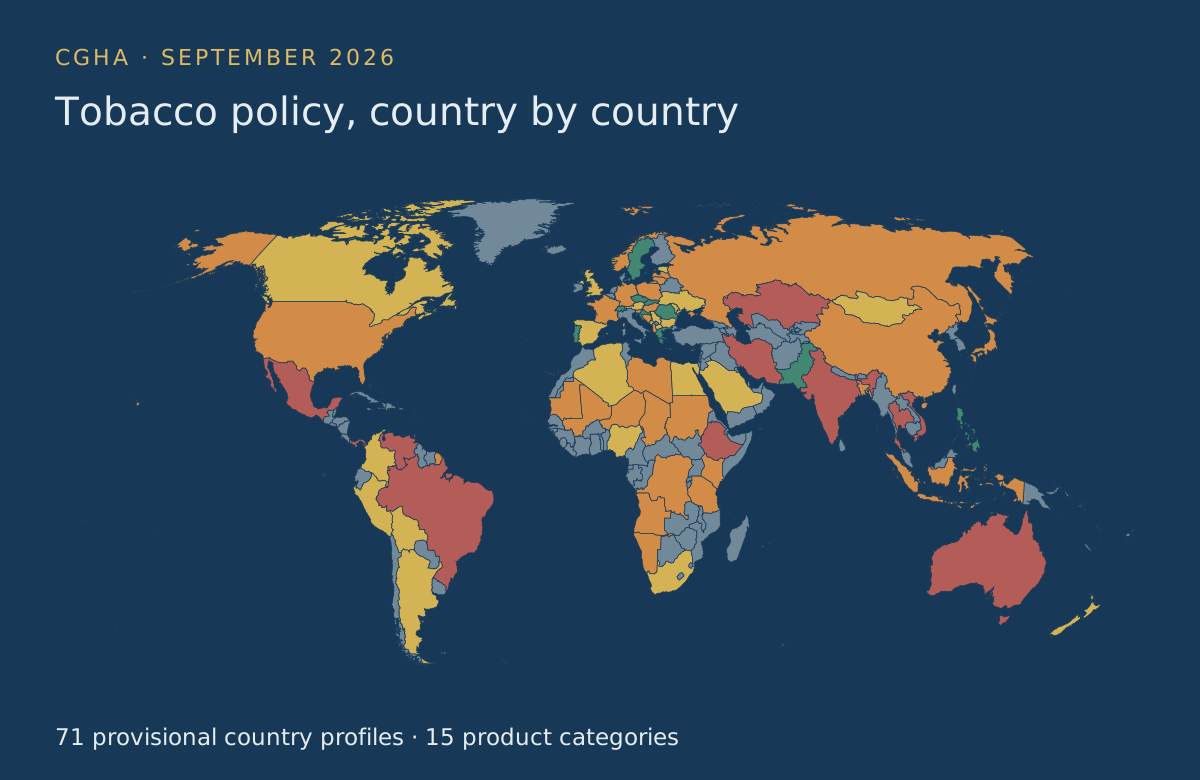
New Zealand illustrates a possible tension between outcomes and institutional approval. Official survey results show adult daily smoking at 6.8 percent in 2024/25, down from 16.4 percent in 2011/12. Civil-society criticism at COP11 addressed the government’s policy direction, including reversals and vaping, rather than treating low smoking prevalence as sufficient vindication. The disagreement should be evaluated measure by measure. An NGO rebuke is not a formal WHO sanction (New Zealand Ministry of Health, 2025; GATC, 2025).
Alignment is a form of power
International health policy is often described as a contest among member states mediated by neutral technical bodies. That account is incomplete. Governments negotiate, but the informational environment is shaped by WHO secretariats, philanthropic initiatives, advocacy coalitions, universities, consultants, journals and specialist media. These actors need not coordinate each intervention. Shared funding, careers, language and institutional access can align their incentives sufficiently to determine which claims are treated as serious before formal negotiations begin.
Such alignment can improve policy coordination and support poorer governments. The risk arises when support for a shared health objective is treated as requiring support for one set of instruments. Funding, invitations and institutional affiliation may then affect which alternatives receive attention. Demonstrating that this becomes exclusion or retaliation requires evidence of actual decisions and the standards applied.
A delegate or adviser may have to weigh a policy disagreement alongside future access, technical assistance and employment relationships. Those dependencies make pressure plausible, but do not establish that a particular intervention was coerced. Sincere agreement, diplomatic compromise and strategic silence must be distinguished empirically.
FCTC as an institutional precedent
Melillo’s Weaponising Evidence supplies a useful neutral starting point. Lawfare in her account does not mean that a lawsuit is frivolous or that one participant is necessarily acting illegitimately. It describes a warlike strategic contest in which the tobacco-control network and tobacco companies used international law to advance conflicting objectives. The FCTC could spur domestic action, while trade and investment rules could deter or reshape domestic regulation. This double-edged quality matters: the analytical task is to establish when ordinary legal strategy crosses into suppression, not to condemn legal mobilization itself. (Melillo, 2024; Ammann, 2025).
Evidence is part of that contest. Epidemiology, economic projections, national experience, expert status and legal interpretation are selected and framed for negotiations, implementation and litigation. In an organization with a medical-scientific institutional culture, control over what counts as authoritative evidence can be as consequential as control over formal text. The central accountability questions are therefore who defines the evidentiary standard, who receives access to supply or challenge evidence, which uncertainties may be acknowledged, and whether competing sources are scrutinized symmetrically.
This perspective connects three stages often discussed separately: treaty negotiation, institutional interpretation through the Conference of the Parties and secretariat, and downstream domestic or international legal effects. PABS should likewise be studied as a continuous process rather than as a single negotiating event. Choices made in Geneva can later determine access, implementation expectations, funding priorities and the legal vocabulary available to national actors.
The Bloomberg Initiative’s grants programme identifies partner organizations including WHO, the Campaign for Tobacco-Free Kids, Vital Strategies and Johns Hopkins. That public network demonstrates institutional connectedness; it does not by itself establish donor control over an assessment or delegation (Bloomberg Initiative, n.d.).
There is nothing improper in philanthropy supporting health policy. The accountability issue is concentration. The same ecosystem can help define the evidence, fund advocates, train officials, monitor compliance, brief the media and reward governments. Its judgments then appear to come from many independent directions even when the organizations share funders, personnel and assumptions. A dissenting state is not merely disputing a technical recommendation; it is challenging the network through which legitimacy is distributed.
The 2024/25 New Zealand Health Survey reported daily smoking of 6.8 percent among adults aged 15 and over. The long-term decline is substantial, although the latest annual change was small. The government’s harm-reduction approach warrants evaluation alongside conventional controls, policy reversals, youth uptake and inequalities. National aggregate outcomes alone cannot identify how much each measure contributed (New Zealand Ministry of Health, 2025).
The institutional question is whether criticism fairly weighs both outcomes and the contested policy choices. A country can achieve low smoking prevalence while adopting a mistaken measure, just as an internationally endorsed measure can disappoint. Reputational judgments should be tested against transparent evidence rather than treated as proof of either success or suppression.
Melillo’s continuous account of negotiation, implementation and litigation suggests a chain of influence. Evidence is selected before the treaty text is settled; institutional bodies then interpret the text; funding and technical assistance encourage particular forms of implementation; and later litigation or administrative action can treat those interpretations as authoritative. No stage alone determines the outcome, but advantage accumulated at one stage carries into the next.
Country comparisons can test alignment only if the same outcomes and institutional responses are measured consistently. The cases below distinguish direct civil-society criticism from a broader disagreement about lower-risk nicotine products. They do not rank entire countries as virtuous or captured.
National divergence under the FCTC
Attribution is essential. The Convention Secretariat prepares reports, services the COP and has itself urged vigilance toward novel nicotine products. The Global Alliance for Tobacco Control and organizations in the Bloomberg-supported ecosystem publish advocacy briefs, interference indexes and the ‘Dirty Ashtray’ awards. Those activities may reinforce one another, but an NGO award must not be described as a formal WHO sanction. The more defensible argument is that official framing and aligned advocacy can create a common disciplinary environment while remaining institutionally distinct. (WHO FCTC Convention Secretariat, 2019, 2025a, 2025c).
| Country | Evidence to compare | Limit |
|---|---|---|
| New Zealand | Official smoking trend and civil-society assessment of policy direction | A low aggregate rate does not establish the contribution of each policy |
| Sweden | Smoking and tobacco-related health outcomes alongside oral-nicotine use | Cross-country differences require adjustment and product-specific evidence |
| Japan | Cigarette sales and heated-product uptake over time | Sales displacement is not a direct estimate of long-term health effects |
New Zealand provides a useful comparison between strong headline outcomes and contested policy choices. Sweden and Japan raise distinct questions about substitution and evidentiary weighting. None establishes that a government’s preferred product policy is correct merely because smoking or cigarette sales declined.
Interviews could investigate whether officials lost access, altered statements or encountered specific threats. Publication would require a dated account, the person’s role, corroboration where available, consent and a clear distinction between perceived pressure and a documented institutional act. No confidential interview findings are relied on in this paper.
When alignment becomes lawfare
Public criticism or refusal of an invitation can exert pressure without constituting lawfare. This paper reserves suppressive lawfare for legal or quasi-legal proceedings whose disproportionate burdens produce silence or withdrawal independently of the merits. Funding, employment and access may amplify such proceedings, but remain distinct mechanisms requiring their own evidence.
| Pressure channel | How it disciplines |
|---|---|
| External litigation | Civil or criminal complaints impose cost, discovery, depositions and years of uncertainty regardless of final success. |
| Personal action by officials | An official treats a dispute arising from institutional work as private litigation while the organization avoids responsibility. |
| Internal legal process | Investigation, suspension and administrative appeal consume time and income inside a system controlled by the employer. |
| Confidentiality and NDAs | Broad duties, or fear about their scope, deter disclosure to journalists, legislatures and national publics. |
| Access and employment | Loss of accreditation, consultancy, appointment or institutional affiliation magnifies a legal threat. |
A case need not reach judgment to work. A demand letter may be enough where the recipient cannot finance a defense. Repeated interviews or depositions can absorb years and create new risk from minor inconsistencies. An internal investigation can end without a finding while still destroying a working relationship. The relevant harm is therefore not captured by counting judgments. It includes delay, expense, loss of role, ill health, withdrawn publications and the observable decisions of peers to speak only privately.
Francesco Zambon institutional work personal litigation
Francesco Zambon's dispute with WHO supplies the clearest documented example. Zambon coordinated a report on Italy's early COVID-19 response. WHO published it in May 2020 and removed it shortly afterwards. Zambon alleged pressure concerning the report's account of Italy's pandemic preparedness and the role of senior officials. The dispute moved from publication and internal complaint into external legal proceedings. (ILOAT, 2025).
ILO Administrative Tribunal Judgment No. 5000 records criminal and civil proceedings brought by a senior official against the complainant. The Tribunal dismissed most claims, including the contention that withdrawal of the report was retaliation. It nevertheless found a breach of WHO’s duty of care concerning its response to the official’s public declarations, awarding CHF15,000 in moral damages and CHF10,000 in costs. This limited finding must not be recast as vindication of the entire complaint (ILOAT, 2025, considerations 14, 26 and 30).
The judgment shows why responsibility must be attributed precisely. Personal proceedings, an organization’s response and the merits of an employment complaint are separate questions. The case supports scrutiny of protection and conflict procedures; it does not establish that WHO ordered a campaign of litigation or that the report’s withdrawal was unlawful retaliation.
External scrutiny and internal justice
A full assessment of pressure on journalists or staff requires individual case files, not a list of prominent disputes. Allegations about national defamation complaints, accreditation, suspension or prolonged internal appeals must identify the actor, forum, legal grounds and disposition. Those records are necessary before attributing a chilling effect or institutional direction.
International organizations’ privileges and internal justice arrangements can make accountability differ from domestic public administration. That structural difference is a reason to examine remedies, access to records and independence of review. It does not imply that immunity prevents every claim or that every internal decision is unfair.
The Zambon judgment establishes a narrow duty-of-care failure while rejecting wider allegations. The institutional argument should proceed from that limited result. Other disputes may be useful comparators, but are not treated here as adjudicated examples of a common plan.
Lessons from the FCTC intervene before PABS hardens
The most important FCTC lesson for PABS and the wider WHO Pandemic Agreement is temporal. Adoption is not the end of policy formation. It is the point at which a provisional settlement acquires legal authority, a permanent governing structure and an institutional constituency. The FCTC Conference of the Parties keeps implementation under review and may adopt protocols, annexes and amendments; its Secretariat, subsidiary bodies, guidelines and reporting processes then give operational meaning to the framework over time (WHO FCTC, 2003, arts 23–24; WHO FCTC Convention Secretariat, 2025d). The Pandemic Agreement similarly establishes a Conference of the Parties to review implementation, adopt decisions and create subsidiary bodies, while the PABS annex must be completed before the Agreement opens for signature and ratification (World Health Organization, 2025c; World Health Organization, 2026h).
That architecture is not inherently improper: complex treaties require coordination and later implementation. The risk is path dependence. Once an agreement is signed, institutions hire staff, allocate budgets, commission evidence, train officials and measure compliance around its premises. Guidance that is not itself binding law can nevertheless acquire considerable practical force through reporting expectations, technical assistance, funding conditions and reputational judgments. Positions that were contestable during negotiation may subsequently be treated as settled commitments, and proposals to revisit them may be characterized as obstruction, misinformation or improper influence rather than as ordinary policy disagreement. This is an analytical inference from the institutional structure and the FCTC experience, not a claim that every COP decision or guideline is legally binding (Melillo, 2024; Ammann, 2025).
Article 5.3 illustrates both the legitimate purpose and the danger of boundary expansion. Its purpose is to protect tobacco-control policy from the commercial and other vested interests of the tobacco industry. The COP's implementation guidelines call for comprehensive measures across all branches of government (WHO FCTC Convention Secretariat, 2013). That protection addresses a real history of industry interference. Yet, if conflict-of-interest safeguards cease to distinguish documented commercial direction from independent research, consumer testimony or good-faith disagreement, a rule against capture can become a means of deciding in advance which evidence and speakers are admissible. The FCTC cases examined here suggest that this boundary-policing deserves examination; they do not establish that every exclusion or criticism was coordinated or improper.
The FCTC is a treaty. PABS is a proposed annex to the WHO Pandemic Agreement, adopted by the World Health Assembly in May 2025. Adoption, opening for signature, ratification and entry into force are distinct stages. The institutional comparison concerns sequencing: broad premises can be settled before operational choices are completed through later instruments and decisions.
| FCTC lesson | Risk for PABS and the Pandemic Agreement | Safeguard needed before signature |
|---|---|---|
| A framework evolves after adoption | Unresolved choices may migrate from open negotiation into COP decisions, technical bodies or standard contracts. | Put essential access, benefit, accountability and review obligations in the annex itself; identify expressly what may—and may not—be deferred. |
| Guidance can acquire practical force | Advisory positions may become compliance expectations through reporting, funding and technical assistance. | Label the legal status of every instrument; publish reasons, votes and minority positions; require independent impact review. |
| Conflict rules can police debate | Legitimate protection against commercial capture may be extended to stigmatize independent criticism or inconvenient evidence. | Use evidence-based disclosure and conflict rules; distinguish control, funding and affiliation from mere agreement with a disfavoured position. |
| Professional incentives reinforce alignment | Appointments, access, delegation support and institutional standing may reward conformity without any explicit threat. | Disclose support for delegations and advisers; protect dissent, whistleblowing and good-faith technical challenge from employment retaliation. |
| The official record defines what was ‘settled’ | If successive drafts change wording but not substance, rejected alternatives can disappear and later be treated as never seriously advanced. | Archive version-to-version comparisons, national proposals, rejected language and reasons for rejection in a searchable public record. |
| Institutional commitments become costly to reverse | Contracts, budgets and careers can harden a contestable model into the default against which all alternatives must justify themselves. | Include scheduled independent reviews, measurable public-health outcomes, amendment triggers and sunset or reconsideration provisions. |
The PABS environment
The PABS process brings together states with unequal capacity to sustain legal, scientific and negotiating teams. WHO reported that the eighth IGWG meeting concluded on September 18, 2026, with work on the annex continuing. Completion of the annex remains a step toward opening the adopted Agreement for signature and ratification. The analysis here uses the published record available through October 21, 2026 (WHO, 2026h).
Attrition is not neutral. Repetition consumes travel budgets, staff time and political attention, increasing dependence on whoever can finance attendance, supply technical assistance and preserve access. Some support produces genuine resources for a country; some primarily sustains the delegation and the international status of its members. Neither proves improper influence. But where negotiators want an agreement completed and their institutional relationships preserved, the cost of reopening first principles rises with every session.
Repeated redrafting can reflect genuine efforts to resolve difficult trade-offs. It can also impose costs on delegations seeking to preserve earlier proposals. Whether it leaves foundational objections unanswered must be tested against successive texts, written submissions and recorded reasons. This paper does not assume that consultation was merely cosmetic.
The political alignment visible around the FCTC must therefore be considered in PABS, although it cannot simply be presumed to operate identically. Melillo shows how international law, organized advocacy and strategically framed evidence became mutually reinforcing across negotiation, implementation and litigation. Institutions favoring agreement can fund supporting analysis, provide access and portray continued resistance as obstruction of global solidarity. Governments and advisers questioning benefit-sharing terms, intellectual-property consequences, implementation costs or national interests operate against that current. The empirical question is whether this imbalance affects whose evidence enters the record and whether legal or quasi-legal pressure raises the cost of dissent beyond ordinary diplomacy. (Melillo, 2024; Ammann, 2025).
For smaller states, conformity may arise without a specialist delegate who is personally committed to pandemic preparedness or vaccine policy. Generalist representatives often cover several portfolios. They may reasonably assume that their government supports the process and defer to what is presented as expert opinion. The most important source of orthodoxy may therefore sit upstream—in the production, funding and certification of expertise—rather than in a direct instruction inside the negotiating room. The influence of pharmaceutical firms, major philanthropies and their associated research networks is a question for investigation, not a conclusion that can yet be assigned to a single source.
Public consensus can coexist with private disagreement in any diplomatic negotiation. Establishing coercion requires more than that possibility: dated evidence must show what was withheld, why, who exerted pressure and whether the person had a meaningful route to contest it.
The accumulating process
Meeting duration, preparation time, travel, specialist staffing and access to legal assistance provide measurable indicators of capacity. The seventh IGWG meeting in July and eighth in September illustrate the sustained commitment required. A count of scheduled days alone would not prove attrition, since it does not measure actual attendance, workload or the reasons for delay.
The sequence is not proof that the Bureau or WHO deliberately designed an attritional process. It does, however, support a narrower conclusion: time pressure repeatedly coexisted with unresolved foundational disagreements, while the institutional response was further drafting and further meetings. That creates an environment in which the ability to persist becomes part of negotiating power.
Public submissions show that objections concern both substance and procedure, including reciprocal benefits, sequence information, contracts, traceability, sovereignty and the negotiating base. Such positions should not be described as rejection of PABS unless the delegation actually rejects the system. Demands for stronger enforceable benefit sharing can reflect support for a different design (WHO, 2025a; African Union, 2026).
The IGWG6 agenda listed separate February and March texts, while contemporary accounts described a dispute over the negotiating base. This identifies a verifiable procedural question: which proposals survived each revision, and how much work was required to restore or explain them? The existence of that dispute does not establish an intention to exhaust dissenters (WHO, 2026f; Third World Network, 2026a).
Developing-country demands for stronger access and benefit obligations must be distinguished from a broader critique that local health-system investment should take priority. The former has a public submission record. The latter is a policy question for further evaluation, not a view attributed here to unnamed negotiators.
A reproducible comparison of the intermediate texts has not been completed for this paper. The official IGWG6 agenda identifies separate texts, and contemporary accounts describe objections to the negotiating base. Those sources justify investigation but do not establish that each revision preserved an unchanged policy settlement (WHO, 2026f; Third World Network, 2026a).
The evidence supports a continuing dispute over the design and enforceability of access and benefit sharing. A stronger conclusion about redrafting would require a reproducible version comparison. Apparent continuity in broad topics cannot establish that all language or policy mechanisms remained unchanged.
PABS is therefore a case about legal architecture and negotiating power, rather than demonstrated suppressive litigation. Control of the base text, binding versus aspirational duties and the scope left to future bodies warrant scrutiny. Whether employment or legal threats also restricted participation remains a separate research question.
Testing self censorship
Self-censorship is plausible where access and employment depend on institutional relationships, but it cannot be inferred from silence alone. A study should distinguish sincere agreement, ordinary diplomatic discretion, confidentiality, fear of a sanction and a documented threat. The proposed interviews would supply leads rather than establish findings without corroboration.
What the record can and cannot show
Minutes record expressed positions and do not reveal every private disagreement. That limitation does not prove pressure. A rigorous account would align successive texts, submissions, responses and dated testimony to test whether particular objections disappeared because they were resolved, rejected, withdrawn or deterred.
The relevant test is concrete: identify each material objection, locate the next version of the text, and determine whether the policy mechanism changed or was merely restated. Particular attention should be paid to proposals concerning local health-system capacity, the balance between vaccines and other pandemic responses, monetary contributions, product allocations and the discretion retained by WHO. Where intermediate on-screen text was not published, interviews with participants should identify what changed and what did not, while distinguishing recollection from documentary proof.
Paper 2 discusses a related question in climate attribution: how funding, research, communication and legal demand can reinforce one another. This analogy does not establish that the same actors or mechanisms operate in Geneva. It identifies variables to measure rather than additional evidence for the PABS claim.
The analogy matters in Geneva because the same structural question arises even where the substantive science is entirely different. If the same narrow network funds technical work, supports accredited advocacy, supplies expert advisers, shapes communications and rewards conformity, formal independence among organizations may coexist with strong alignment of incentives. The appropriate response is not to infer conspiracy from shared views. It is to map funding and affiliations, disclose conflicts, preserve access for dissenting expertise, and test whether authoritative conclusions remain open to revision when national experience or new evidence cuts the other way.
Accountability without domestic oversight
Domestic policy disputes normally leave multiple routes of challenge: legislative hearings, freedom-of-information requests, inspectors general, national courts and media with stable access to local sources. No equivalent integrated global system oversees PABS. Member states can question the text, but the process itself is not overseen by a global legislature. WHO's internal controls do not substitute for political accountability to the citizens who will bear national obligations. Meeting records cannot establish why a participant withheld a view.
External publication is therefore not an optional communications exercise. It is a partial substitute for missing oversight. Documented accounts of pressure, timelines of legal proceedings, funding and organizational maps, and careful interviews with officials and advisers can show how apparent consensus was constructed. The strongest work will distinguish formal delegates from outside advisers and direct institutional action from aligned or personal action. Such distinctions strengthen the political argument because they reveal the system without claiming a conspiracy that the evidence cannot support.
The immediate objective should be a public record: who was pressured, by whom, through which authority or dependency, and with what effect on what was said or omitted. Named accounts will be possible only where evidence and consent permit; other findings can be reported in aggregate. The point is not to turn a policy disagreement into a lawsuit. It is to show how lawsuits, internal process and institutional alignment can turn disagreement into silence.
What should change
WHO and UN bodies should disclose whether they authorize, finance or otherwise support legal complaints arising from official work. Officials pursuing personal proceedings connected to institutional disputes should trigger independent conflict and duty-of-care review. Whistleblower rules should cover contractors, secondees and technical advisers as well as permanent staff, with protected routes to appropriate national oversight bodies.
Negotiating processes should publish funding and affiliation information for participating experts and accredited advocacy bodies on a symmetrical basis. Confidentiality rules should identify protected subject matter, duration and public-interest exceptions rather than rely on broad warnings. Small states should receive genuinely independent technical assistance, not assistance conditioned on adopting the provider's policy position. Accreditation and exclusion decisions should carry written reasons and a prompt appeal.
Finally, international health institutions should stop treating reputational conformity as evidence. National experience that conflicts with institutional preference should be examined rather than stigmatized. A country with strong outcomes may still be wrong about a particular measure, but public shaming is not a substitute for comparison of results. The legitimacy of PABS will depend partly on whether dissenting states and advisers can challenge its assumptions without losing employment, access or standing.
Conclusion
Law and evidence are strategic resources in international health governance. The concern is whether procedural burdens, dependencies and barriers to review suppress informed participation. The FCTC illustrates disputes over evidence, policy instruments and institutional approval; the WHO tribunal case demonstrates a specific duty-of-care failure while rejecting broader allegations. These findings justify scrutiny without establishing a coordinated campaign.
PABS presents a prospective test of unequal capacity, institutional persistence and legal design. Continued negotiation can reflect real difficulty as well as uneven costs. Its legitimacy should be assessed through transparent texts, accessible review, reciprocal disclosure and protection for good-faith challenge. Whether repeated drafting manufactured consensus remains a hypothesis requiring a documented comparison, rather than a conclusion of this paper.
Relationship to the series
This fourth paper applies the series’ process and authority framework to international governance. Paper 1 defines the test; Paper 2 examines scientific authority; Paper 3 considers professional pressure; and Paper 5 examines organizational persistence.
New Zealand Ministry of Health (2025) New Zealand Health Survey highlights long-term decline in smoking rates. https://www.health.govt.nz/news/new-zealand-health-survey-highlights-long-term-decline-in-smoking-rates
WHO FCTC (2003) WHO Framework Convention on Tobacco Control. Geneva: World Health Organization. Available at: https://fctc.who.int/convention (Accessed: 8 September 2026).
WHO FCTC Convention Secretariat (2013) Guidelines for implementation of Article 5.3: Protection of public health policies with respect to tobacco control from commercial and other vested interests of the tobacco industry. Geneva: World Health Organization. Available at: https://fctc.who.int/resources/publications/m/item/guidelines-for-implementation-of-article-5.3 (Accessed: 8 September 2026).
WHO FCTC Convention Secretariat (2025d) Conference of the Parties (COP): mandate and treaty instruments. Available at: https://fctc.who.int/convention/conference-of-the-parties (Accessed: 8 September 2026).
World Health Organization (2025c) WHO Pandemic Agreement, adopted by the Seventy-eighth World Health Assembly on 20 May 2025. Available at: https://www.who.int/health-topics/who-pandemic-agreement (Accessed: 8 September 2026).
World Health Organization (2026h) Member States advance negotiations on pathogen access and benefit-sharing ahead of UN General Assembly meeting on pandemics, September 18. https://www.who.int/news/item/18-09-2026-member-states-advance-negotiations-on-pathogen-access-and-benefit-sharing-ahead-of-un-general-assembly-meeting-on-pandemics