Rehabilitating Nicotine and Recognising an Adult Consumer Market
Roger Bate
CGHA policy paper | November 2026
Abstract
Tobacco harm reduction provides an incomplete justification for a durable adult nicotine market. Drawing on The Politics of Acceptable Addiction, this paper examines nicotine’s inherited association with smoking, the emergence of consumer brands and the institutional obstacles to broader acceptance. It argues that the largest tobacco companies may be poorly placed to lead the next phase. Their cigarette histories limit their credibility as advocates of nicotine consumption independent of smoking, while existing authorisations and compliance capabilities can make demanding entry requirements commercially valuable. Brand building and selective regulatory reform therefore need not imply support for an open adult market. Financial returns may reflect both continuing nicotine demand and protection from competition; the evidence presented does not identify their separate contributions. The paper proposes congressional creation of a distinct framework for qualifying lower-risk consumer nicotine, with bounded FDA quality and safety powers, state leadership over retail sale and use, and replacement of the current population-health market-entry test for that category. Combustible tobacco and therapeutic nicotine would retain separate regimes. Reform would need support extending beyond incumbent manufacturers, while preserving truthful information, age restrictions and attention to unwanted dependence. Increased adult nicotine use alone would establish neither success nor failure; evaluation must consider health, consumer welfare and competition.
Scope and approach
This is a normative policy analysis focused on the United States. It draws on the author’s book, selected regulatory and judicial materials, company disclosures and published research. It is not a systematic literature review or an original epidemiological study. Commercial websites are treated as evidence of marketing at the time reviewed, not proof of authorisation, product benefit or representative consumer experience. Company figures retain their source definitions. The proposed legal framework is a legislative recommendation; existing statutory duties are distinguished from the powers that a replacement law would confer. The account of incumbent incentives is a political-economy hypothesis, not an estimated causal effect or a finding that every company follows the same strategy. The paper adds a descriptive compilation of FDA-listed pouch permissions by corporate group and an ENDS manufacturer cross-check, both as at 3 November 2026. These are administrative listing counts, not sales data or a causal analysis of concentration. Market and regulatory references were reviewed in November 2026.
The question beyond harm reduction
Must someone first smoke cigarettes before their decision to use nicotine becomes acceptable?
Consider two adults purchasing the same nicotine pouch. One has smoked for twenty years and wants an alternative. The other has never smoked and enjoys the product’s effects. Its composition, manufacturing quality and delivery mechanism are identical. The product’s formulation and route of delivery do not change with the customer’s biography, although individual responses, tolerance and health risks can differ. Yet the first transaction has a familiar justification, while the second is generally treated as a problem requiring prevention.
There is an important difference between these customers. For the smoker, switching completely to a substantially less harmful product can provide a health benefit. For someone who would otherwise use no nicotine, that benefit does not exist. A serious account of nicotine policy must preserve this distinction.
But the difference does not settle the question of market legitimacy. Adults regularly choose products that offer pleasure, convenience or effects they value without improving their health. They are permitted to drink wine without demonstrating that it replaced spirits, or coffee without establishing that it displaced something more dangerous. We regulate those markets, sometimes extensively, while accepting that health improvement is only one possible reason for consumption.
Nicotine occupies a different position in much of the public-health and regulatory debate. Its legitimacy is commonly defended through the behaviour it replaces. A common harm-reduction defence presents continued use as a tolerable consequence of escaping cigarettes. That is a powerful argument for harm reduction, but an incomplete account of what a future nicotine market might become.
The discussion prompted by Arielle Selya’s essay on population health and declining cigarette smoking opens onto this larger question. As smoking recedes, can we recognise a durable adult nicotine market whose justification includes consumer choice? Or must the entire category remain attached to cigarettes, with its acceptable customer base defined by past participation in a more dangerous activity?
My argument is that a legitimate adult market is possible, subject to meaningful conditions concerning product risk, information, dependence and protection of others. Reaching that position requires better products, a different public identity and a revised allocation of regulatory power. The firms most capable of expanding nicotine sales today may have neither the credibility nor the strongest commercial incentive to lead that broader change. Their position in an emerging market must be distinguished from their interest in opening it to others.
The inheritance of smoking
My book The Politics of Acceptable Addiction: Coffee, Nicotine, and the Collapse of Proportional Risk examines a contrast in social legitimacy: caffeine consumption is embedded in ordinary consumer routines, while nicotine use is frequently interpreted through dependence, treatment and the history of smoking. The comparison concerns cultural classification, rather than an assumption of equivalent health risks.
This difference has a history. Coffee and tea acquired their place through commerce, domestic ritual, work and sociability. Their stimulant effects became incorporated into familiar routines. Coffee could be discussed through taste, preparation, origin and experience. The consumer could enjoy it without first accounting for the pharmacology of caffeine.
Nicotine’s contemporary identity developed through a different process. For much of the twentieth century, cigarettes were ordinary objects in offices, homes, films and public life. As evidence of their dangers accumulated, their social position changed. Restrictions on smoking addressed serious disease and involuntary exposure. The cultural rejection of cigarettes had a substantial evidentiary foundation.
The difficulty emerged when that rejection became attached to nicotine in every form. Cigarettes had delivered nicotine so effectively, and on such an enormous scale, that the substance and its most familiar delivery system became almost inseparable in public understanding. The word nicotine came to evoke lung cancer, smoke-filled rooms, industry deception and premature death. Those associations shaped the reception of products that did not burn tobacco.
The result is a persistent mismatch between technical differentiation and cultural classification. A nicotine pouch can eliminate smoke without escaping smoking’s reputation. A vaping product can differ substantially from a cigarette while being interpreted as another expression of the same underlying wrong.
This is more than a communications inconvenience. People interpret unfamiliar products through categories they already understand. If nicotine signifies smoking, a new delivery system begins life under the suspicion that it merely disguises an old danger. Information about reduced exposure then has to work against a settled expectation.
The distinction between nicotine and combustion is already acknowledged by regulators. The FDA identifies nicotine as the principal driver of dependence while explaining that the toxic chemical mixture in tobacco and tobacco smoke makes tobacco use so deadly. That distinction establishes why delivery matters; it does not establish that every nicotine product is harmless. FDA, “Chemicals in Tobacco Products and Your Health.”
Rehabilitation begins by allowing this distinction to organise the discussion. Historical association should inform scrutiny, particularly given the cigarette industry’s record. It should not permanently determine the meaning or acceptable uses of every subsequent nicotine product.
The historical distinction also helps explain why purely informational responses may disappoint. Publishing a comparison of toxicants does not automatically change the social identity of a product. A person may understand that a pouch differs from a cigarette while continuing to regard its use as evidence of a failed attempt to stop smoking. The remaining barrier is interpretive: what sort of activity is this, and what sort of person participates in it? The book’s chapters on coffee, respectability and the stories surrounding cigarettes address precisely this interaction between evidence and meaning.
There is a danger in overstating this argument. Smoking did not lose its legitimacy merely because influential people ceased to practise it. Its harms were real, and protecting people from smoke did not depend on an irrational prejudice. The issue is the transfer of a justified judgement about a highly dangerous delivery system to products whose exposures and circumstances differ. A successful campaign can leave behind categories that continue to operate after their original scope has changed.
The task now is to preserve the achievements of smoking prevention while revising the inherited classification. Keeping those objectives together is more persuasive than asking people to forget what cigarettes did. The public needs an account of continuity and change: nicotine remains pharmacologically active and dependence-producing, while delivery technology changes the exposures that users experience. This account supplies a basis for scrutiny without requiring that every new product carry the full moral and medical history of its predecessor.
From treatment to consumption
Nicotine replacement therapy exposes the limits of the inherited category. Nicotine is already accepted in products intended to help smokers quit. In that setting, its use is purposeful, medically intelligible and supported by an explicit comparison with continued smoking.
That acceptance is important evidence against the proposition that nicotine’s presence alone settles a product’s acceptability. It is not proof that medicinal nicotine and every consumer product have equivalent risks. Dose, delivery speed, formulation, route of exposure and patterns of use remain relevant.
The more revealing distinction concerns the status of the user. Someone taking nicotine as treatment is understood to be addressing a problem. Someone using it for enjoyment may be understood to be creating one. The same general substance becomes intelligible through a medical purpose and suspect through a consumer purpose.
The book develops medicalisation as one explanation of this difficulty. Where discussion is organised predominantly around addiction, treatment and cessation, continued consumption can appear principally as a condition to manage on the way to stopping. That framing leaves less room to consider the user as an ordinary customer.
An adult who is satisfied with continued use need not understand himself as a patient. A former smoker may value nicotine long after the immediate challenge of quitting has passed. Another adult may choose it without any smoking history. Their circumstances require different assessments, but none is adequately understood through an assumption that consumption can be legitimate only as a temporary medical expedient.
Harm reduction explains why a smoker should have access to less harmful alternatives. Evidence that nicotine e-cigarettes can help people stop smoking strengthens that case. It does not answer every question about the legitimacy of subsequent or unrelated adult use. Cochrane, “Electronic cigarettes for smoking cessation.”
A market defined entirely through cessation contains an awkward contradiction. Its most readily accepted customers are people leaving another market. If it succeeds in helping smoking disappear, the justification for its own existence progressively contracts. Every consumer without a smoking history then appears as a departure from the market’s acceptable purpose.
There is another possibility. Tobacco harm reduction could be one major function of a broader nicotine market, alongside adult consumption for its own sake. The same product might serve both purposes. Health advice would vary with the customer’s circumstances, while legal access would depend on proportionate assessment of the product and its consequences.
This requires accepting that medical advice and market permission answer different questions. A clinician can reasonably advise someone who uses no nicotine to avoid starting. That does not automatically establish that the state should prevent an informed adult from purchasing a regulated product.
The distinction is increasingly visible in actual regulatory decisions. In January 2025, the FDA issued marketing orders for twenty ZYN nicotine pouch products under the tobacco-product premarket pathway. The orders expressly distinguish permission to market from FDA approval. They establish a product-specific regulatory decision, rather than a general finding that nicotine pouches are harmless or appropriate for everyone. FDA marketing orders for ZYN, January 2025.
In June 2026, the agency separately authorised those products to carry a specified reduced-risk claim relative to cigarettes. It also required postmarket surveillance and retained the ability to withdraw the orders if the relevant population-health conditions ceased to hold. This is an important example of an institution making distinctions within nicotine products. Its reasoning remains rooted in harm reduction and population health; it does not establish an independent consumer-welfare justification for initiation by adults who would otherwise use no nicotine. FDA modified-risk decision, June 2026.
The distinction between those two justifications is central to this paper. A product can be valuable as a substitute for cigarettes and still require a separate assessment as a consumer choice for someone who would never smoke. A mature framework needs to answer both questions openly. It cannot rely indefinitely on treating the second group as an incidental complication of serving the first.
Advice and the limits of prohibition
The distinction between advice and permission is central to a consumer framework. An individual can reasonably advise another adult to avoid nicotine while supporting that adult’s legal access to a conforming product. The positions answer different questions. Advice concerns what a person should choose in light of their circumstances. A prohibition concerns what choices the law should make unavailable, including to people whose preferences differ from those of the adviser.
The same distinction applies to public-health institutions. An agency may judge abstention the lowest-risk option for someone who does not use nicotine. That judgement can support accurate guidance without settling the legal status of the product. To justify restricting informed adult access, policy must consider the magnitude of risk, the reliability of information, dependence, effects on others and the likely consequences of the restriction itself. A health recommendation supplies relevant evidence; it is not a complete theory of permissible government intervention.
This does not imply that a warning label makes every risk acceptable. Consumers may misunderstand information, face constraints on their choices or experience costs imposed by other people. Products may have defects that are difficult for a purchaser to detect. These are reasons for regulation directed at identifiable problems. They do not establish that an agency should have an unrestricted mandate to select abstinence as every competent adult’s preferred outcome.
The normative claim in this paper is therefore explicit. For qualifying products, an informed adult’s preference has independent standing even when consumption provides no health improvement. That claim can be disputed, but it should be disputed as a judgement about liberty and welfare. Scientific findings can illuminate its consequences. They cannot determine by themselves how much authority one adult or an institution should have over another adult’s informed choices.
The cultural work of rehabilitation
The caffeine comparison is useful because it demonstrates how a dependence-producing substance can acquire an ordinary consumer identity. It does not establish equivalent risks between caffeine and nicotine.
Coffee has a language beyond its active ingredient. Consumers discuss flavour, preparation, strength, convenience and occasions of use. Manufacturers compete over those characteristics. The product’s place in daily life is understood without requiring a clinical account of each purchase.
Nicotine alternatives have a less settled public identity, although several companies are actively building consumer brands around them. Official and harm-reduction descriptions remain heavily organised around what products avoid: smoke, combustion, cigarettes and disease. These comparisons matter greatly to smokers. Commercial descriptions increasingly add flavour, convenience and experience, supplying language for consumption whose purpose extends beyond smoking substitution.
Chapter Fifteen of my book develops this difficulty through the deliberately provocative idea that nicotine needs the skills associated with advertising and category creation. The reference to Mad Men concerns an ability to understand how products acquire meaning. What role does a product play? When is it used? What do adults value about it? How do different formulations and experiences compete?
These questions are necessary for understanding a market. They also require boundaries. Nicotine’s rehabilitation should involve accurate information, adult positioning and accountable commercial conduct. Misleading health claims or attempts to recruit children would undermine the conditions on which legitimacy rests.
Cultural acceptance cannot properly be manufactured by concealing dependence. Nor should the correction of smoking-related misperceptions become a promise of harmlessness. The task is to make distinctions visible and allow adults to assess them.
The ambition is ordinary treatment: scrutiny appropriate to the product, space for lawful differentiation and a presumption that adult preferences deserve consideration. A coffee business can offer enjoyment without presenting itself as a public-health intervention. A nicotine business should be able to make an analogous claim if its products and conduct satisfy appropriate standards.
That would allow a wider range of commercial possibilities. Established tobacco companies would participate, but so might specialist producers and new entrants. A mature category could support differences in dose, delivery, design and price. Its development would be judged through product performance and consumer experience rather than merely through the number of former smokers recruited.
For this to happen, nicotine needs an identity that can survive the decline of cigarettes. Otherwise, every innovation remains rhetorically tethered to the product it is supposed to supersede.
The market already exists
The market considered in this paper is more than a future possibility. Companies already sell nicotine through formats and brands that address continuing adult consumption. The analytical task is to distinguish the market that exists from the broader legitimacy it has yet to acquire. Commercial activity can develop before its governing institutions agree on how to understand it.
The existing landscape has several layers. Medicinal nicotine includes gums, lozenges and patches familiar from smoking cessation. Commercial oral nicotine includes pouches and some nontherapeutic gums. Vapour products deliver nicotine through an aerosol, while heated-tobacco products retain tobacco but use a different delivery process from cigarettes. Traditional oral tobacco, including snus, is another established category. These formats should be distinguished in assessing exposure, evidence and consumer experience. They nevertheless demonstrate that the nicotine market can no longer be described adequately as cigarettes with a small set of quitting aids attached. PMI’s product portfolio and BAT’s brand portfolio illustrate the range offered by major manufacturers.
The most revealing examples for this paper are brands whose appeal is expressed in terms of what consumers experience. They compete over flavour, texture, moisture, packaging, strength, convenience and identity. Such marketing does not establish that a product is safe or beneficial. It establishes that producers already perceive a market in which adults choose between nicotine experiences rather than merely between methods of quitting cigarettes.
Lucy is a particularly clear example. Its homepage presents nicotine as a choice within an adult user’s routine and refers to focus, energy and relaxation. Its range includes gum, conventional pouches and Breakers, which incorporate a crushable flavour capsule. The catalogue separately lists smoking-cessation products. This distinction within one brand is significant: a similar delivery format can be offered through a therapeutic proposition or a continuing consumer proposition. Its recently promoted Revive energy gum is nicotine-free and should be excluded from any count of its nicotine products. Lucy’s product catalogue makes these distinctions visible.
Lucy’s claims about desired effects should be analysed as marketing claims. They do not establish a general net cognitive benefit from long-term use. The relevant finding here is the way the company addresses customers: as adults selecting a product to fit preferences and occasions, rather than exclusively as patients progressing towards abstinence. That is close to the change in commercial language discussed in the book’s chapter on rehabilitation.
Rogue sells pouches and gum through a vocabulary of flavour, freedom and convenience. Its subscription offer presents repeat purchasing as an ordinary routine. Sesh+ emphasises premium design and feel, offers different strengths and flavours, and sells refill bags and metal containers. Both illustrate how product differentiation can extend beyond nicotine delivery itself. Packaging, storage and the experience of using a product become competitive attributes, as they do in other consumer categories.
ALP competes on moisture, flavour, pouch count and strength, supplemented by seasonal releases and branded collaborations. FRĒ combines pouches with premium carrying tins, merchandise and sports-oriented promotion; its website presents a UFC partnership. These businesses demonstrate an attempt to make nicotine consumption socially recognisable through interests, settings and brand affiliation. They do not need an entirely new molecule to create a different consumer category. They need a differentiated product and a language through which adults can understand it.
Lifestyle branding is also visible at multinational scale. BAT’s VELO partnership with McLaren uses Formula One experiences and fandom to build engagement. Its Live Your Fandom campaign is organised around participation and identity. This evidence prevents a categorical claim that incumbents confine all advertising to cessation. It does not establish that they will lead a public campaign legitimising nicotine independently of smoking, or support regulatory changes that make entry easier for competitors. Selling a brand within an accepted framework and campaigning to change that framework are different activities.
Niche formats extend the range further. Z-Pix, formerly Zippix, advertises nicotine-infused toothpicks. Their significance is the adaptation of nicotine delivery to an existing oral habit. Product invention need not reproduce the appearance or ritual of smoking. That observation identifies a field of experimentation; it does not establish the quality, authorisation or market significance of an individual niche product.
Several boundaries are necessary when interpreting this evidence. A website demonstrates a commercial offer, not audited sales, sustained demand or customer satisfaction. Brand descriptions do not establish health outcomes. Nor does a consumer proposition necessarily mean recruitment of people who have never used nicotine. Rogue’s published terms, for example, limit its site to adults who already consume tobacco or nicotine. Serving existing adult users and inviting nicotine-naive adults to start are distinct strategies. The brands described here should not all be assigned the second strategy merely because their advertising extends beyond cessation.
The legal market must also be distinguished from products observable online. FDA marketing authorisation attaches to specified products; permission for one product does not authorise everything sold under the same brand. The agency’s nicotine-pouch list reviewed in November 2026 includes specified ZYN, on! and VELO products. The company examples above are evidence of market positioning, rather than a representation that each advertised product has the authorisations required in every jurisdiction.
The resulting picture is of an uneven but recognisable consumer market. Established firms, specialist brands and niche producers are experimenting with products and meanings. The question has shifted from whether anyone could sell nicotine outside the language of treatment to whether that emerging market can acquire a stable, accountable and proportionate place in public policy.
Why the next phase may come from outside Big Tobacco
The market evidence raises a question of leadership. The largest tobacco companies have scientific resources, brands, distribution and capital. They can commercialise products at a scale most independent producers cannot match. Yet the rehabilitation of nicotine as an independently legitimate adult choice requires more than expanding sales. It requires a credible public argument that nicotine consumption can have an acceptable purpose without a smoking history, and a willingness to support rules under which new competitors can participate.
Established cigarette companies face difficulties on both counts. Their first problem is credibility. A company whose business developed through smoking will predictably encounter suspicion when it argues for nicotine’s broader acceptance. Audiences may interpret the proposition as an attempt to replace declining cigarette revenues with continuing dependence. That response does not determine whether the argument is valid. It does affect the company’s capacity to persuade people who do not already accept it.
Tobacco harm reduction provides a more defensible public position for those firms. The customer is an existing smoker, the alternative is continued exposure to cigarettes, and the benefit concerns a reduction in established harm. A company can build a substantial noncombustible business through that proposition without defending initiation by adults who would otherwise use no nicotine. It can also use lifestyle imagery to compete for existing users without making the broader normative argument advanced here.
This gives incumbents a reason to remain principally within the harm-reduction case when addressing public policy, even if their consumer advertising has a wider vocabulary. The claim is about the relative attractiveness of different arguments, not a prediction that every statement or campaign will follow the same script. Product portfolios, management and national markets differ. Specific company positions should be examined directly.
The second problem is incentive. Regulatory requirements impose costs but can also protect businesses that have already incurred them. An authorised product, a completed evidence programme and the capacity to navigate future reviews are commercial assets where entry remains difficult. For a firm that possesses them, a more open market can increase opportunities while reducing the scarcity value of its existing position.
Such a firm may therefore favour selective reform: quicker decisions for its own applications, clearer recognition of its authorised products and enforcement against competitors lacking required permission. It may be less enthusiastic about replacing the market-entry system with standards that many more producers can meet. Those preferences can coexist without contradiction. Faster review and more competition are not synonymous, particularly when the retained requirements remain difficult for smaller firms to satisfy.
This is why the public case for an independent nicotine market should not be organised around an assumption that Big Tobacco has the most to gain. The largest firms may have much to gain from nicotine’s continued consumption but less to gain from opening the category broadly. Their preferred settlement may be a growing market with a limited set of authorised suppliers, rather than a more contestable market in which adults choose among many compliant producers.
The distinction also qualifies expectations of independent companies. A new producer may find it easier to present nicotine through contemporary uses and products because it has less corporate history to explain. That does not make its claims automatically credible or its conduct responsible. It must substantiate representations, control quality and address dependence. Nor is its preference for easier entry necessarily permanent: a successful challenger can acquire the same incentive to restrict later competitors.
Consumers, independent producers, retailers and legislators concerned with competition may consequently be more plausible sources of leadership for the broader reform. Their interests also diverge, and none should be assigned ownership of the public interest. The central implication is that commercial transition can precede institutional change while the firms benefiting most from the transition have limited incentives to support its full development.
What the companies actually support
Public company statements provide a way to test the incentive argument without attributing undisclosed motives. They show support for regulatory improvement, but improvement can mean different things: more predictable decisions, permission for additional products, enforceable distinctions between authorised and unauthorised supply, or a different statutory basis for the market. These are separate propositions.
Altria provides a particularly clear example. Its 2025 annual report describes advocacy for increased FDA authorisation of smoke-free products together with meaningful enforcement against illicit products. Its public enforcement position reports strong support for legislation directing substantial FDA resources towards enforcement. These positions establish that the company wants both an operating authorisation pathway and stronger restrictions on unauthorised supply. They do not establish that it wants every demanding entry requirement retained, or that its enforcement concerns lack a legitimate basis.
BAT makes the commercial relationship unusually explicit. In its half-year report for June 2026, management identifies FDA prioritisation guidance and federal and state enforcement as developments positioning its US nicotine portfolio to benefit. The company therefore presents regulatory implementation partly as a source of competitive opportunity. That is consistent with the proposed mechanism, although it is not a statement that BAT opposes entry by every additional compliant producer.
PMI's August 2026 ZYN ULTRA announcement celebrates additional authorisations, describes leadership in securing FDA permissions and supports science-based regulation. It also records commercialisation under the agency's recent guidance before the new marketing orders. Its emphasis is on expanding an authorised portfolio for adults already consuming nicotine, with smoking substitution a prominent justification. This statement documents a strategy within the existing system. It does not supply evidence of a position on the congressional consumer-category proposal advanced here.
The defensible conclusion is consequently narrower than an accusation of coordinated obstruction. These examples show how regulatory reform and competitive protection can be complementary for incumbent firms. They do not demonstrate a common campaign against a standards-based consumer category. No inference about a company's position on that specific proposal should be drawn merely from its absence from these selected statements. Testing that proposition further would require a defined review of lobbying disclosures, legislative submissions and responses to an actual bill.
Enforcement also has legitimate functions. Companies investing in evidence and lawful distribution can reasonably object to rivals avoiding applicable obligations. Consumers can benefit when enforcement removes adulterated goods, false claims or sales to minors. The policy problem arises when enforcement of a costly permission system is treated as equivalent to establishing a competitive market. A proposal should be assessed against both possibilities: it may improve accountability while also making an incumbent's legal position more valuable.
Who holds the current pouch authorisations
An original descriptive compilation of FDA's public list supplies a concrete snapshot. On 3 November 2026, the agency listed 67 authorised nicotine pouch products, allocated to three manufacturers. Their ultimate corporate groups are PMI, BAT and Altria. Table 2 records FDA-listed entries, rather than market shares or independently assessed formulations. FDA's current pouch list is the source of the counts.
Table 2 FDA listed nicotine pouches by corporate group
| Corporate group and manufacturer | Brand | FDA entries | Share of entries |
|---|---|---|---|
| PMI — Swedish Match USA | ZYN and ZYN ULTRA | 31 | 46.3% |
| BAT — Modoral Brands | VELO | 24 | 35.8% |
| Altria — Helix Innovations | on! and on! PLUS | 12 | 17.9% |
| Total | 67 | 100.0% |
Author compilation as at 3 November 2026. Percentages concern listed entries, not sales. VELO entries include three container versions of each of eight named variants. Ownership and source links appear in the accompanying text.
Ownership is established separately from the FDA counts. Swedish Match identifies itself as part of PMI; BAT's subsidiary disclosure includes Modoral; and Altria describes its acquisition of the remaining ownership of the on! business. Grouping manufacturers by corporate parent is the author's compilation, not a separate FDA classification.
The counting unit matters. VELO's 24 entries comprise eight named product variants, each listed in three container versions. Collapsing only the container number yields eight labels, not eight scientifically established distinct formulations. ZYN's 31 entries comprise 20 original strength and flavour variants and 11 ULTRA variants; Helix's 12 comprise six on! and six on! PLUS variants. There are therefore 51 labels after the limited VELO container consolidation. Neither 67 nor 51 should be represented as the number of independent technological innovations. FDA's 30 October 2026 VELO announcement illustrates how a single decision can add numerous listed entries.
The snapshot supports a statement about the distribution of regulatory permissions: the authorised pouch list is entirely held by subsidiaries of three established tobacco groups. It does not show their share of actual sales, the number of pending independent applications, relative application quality, or the counterfactual market under different rules. It cannot by itself establish regulatory capture. Scale, scientific capability, acquisition and application timing can also contribute to the observed pattern. The hypothesis is that the resulting legal positions can acquire scarcity value, whatever combination of causes initially produced them.
The result should not be generalised to every nicotine category. FDA's separate ENDS list, reviewed on the same date, contains 48 entries: Glas 6, JUUL Labs 8, Logic 8, NJOY 10 and Reynolds 16. Those entries mix devices, pods, cartridges and other components. They cannot sensibly be added to pouch entries as an index of consumer choice. Glas's presence is a counterexample to the suggestion that only the three large pouch-owning groups can obtain permission; FDA's May 2026 Glas decision also demonstrates continuing authorisation of new products. This paper does not claim to supply a complete inventory of medicinal nicotine, heated tobacco, snus and every other tobacco category.
The legislative implication concerns contestability. An open adult market requires a feasible path for the next compliant entrant, rather than merely several strong brands belonging to established groups. Congress should examine entry costs, elapsed time, access to scientific methods and the treatment of routine modifications alongside product counts. A rising authorisation total can represent genuine progress without resolving those structural questions.
Demand beyond substitution
An enduring nicotine market would have several sources of demand, and they should not be conflated. Some purchases replace cigarettes. Others replace a different nicotine product. Some accommodate settings in which an existing user cannot or does not want to smoke or vape. Still others may represent consumption by people without a previous nicotine habit. Growth in a particular format can therefore occur without growth in total nicotine consumption, while growth in total consumption can arise through very different combinations of initiation, frequency and dose.
This is a basic economic distinction with substantial policy consequences. A pouch producer gaining sales from a vaping brand is not necessarily expanding the population of nicotine users. A smoker adding pouches without giving up cigarettes presents a different health comparison from a smoker who switches completely. An adult beginning nicotine use for the first time presents another. Category sales cannot reveal the balance among these pathways without evidence about individual behaviour.
Demand also depends on the full cost of using a product. The retail price is only one component. Preparation, charging, carrying a device, leaving a workplace, finding a permitted place to consume and managing social reactions can all affect the experience. An oral product may appeal to an existing user because it changes these practical costs. That possibility helps explain why convenience is a recurring commercial theme. It does not establish that every convenient product improves welfare: convenience can also make consumption more frequent or less deliberate.
The distinction between functional effects and rituals matters here. The book’s interviews discuss how consumers structure breaks, work and routines around caffeine and nicotine. Those qualitative observations suggest questions for research, rather than population-wide findings. A product can satisfy the desire for nicotine while failing to replace the pause or social interaction associated with smoking. Another can succeed because it fits a different routine. Understanding these differences requires studying what adults actually do, rather than assuming that products delivering the same substance are interchangeable.
This is why the future market need not converge on the strongest or fastest-delivering product. Consumers can prefer predictability, a less intrusive experience, lower expenditure or easier control. They can also prefer intensity and immediacy. Which preferences dominate is an empirical question. Regulation and information influence the choices available, while competition determines which characteristics producers attempt to improve. A legitimate market should make those attributes intelligible, including where an apparently attractive feature increases the likelihood of unwanted dependence.
Consumer benefit cannot simply be inferred from industry revenue. Higher revenues may reflect additional users, higher prices, a shift towards premium products or more consumption by existing users. Some of these changes may reflect preferences consumers continue to endorse; others may reflect misperception, withdrawal or practices they later regret. The paper’s market argument therefore needs evidence about both demand and the quality of the decisions sustaining it. Recognising adult preferences does not require treating those preferences as perfectly informed or permanently fixed.
Growth does not belong equally to every company
Company disclosures provide a useful check on the claim that the emerging market is merely hypothetical. They also demonstrate why commercial expansion should not be equated with uniform success for incumbent tobacco businesses. In its 2025 results, Altria reported on! shipments of 177.8 million cans, up 10.9 per cent, while its total oral tobacco shipment volume fell 5.5 per cent. The figures illustrate growth within one format alongside contraction in the broader business mix. They are company-reported shipment measures, rather than a direct count of consumption or an estimate of consumer benefit. Altria includes promotional units and uses can-equivalent conventions; these figures are not measurements of absorbed nicotine. Altria’s 2025 results provide the underlying tables.
BAT’s reporting supplies another example of portfolio change. Its first-half 2026 announcement states that smokeless products accounted for 19.8 per cent of group revenue, compared with 18.2 per cent for full-year 2025. This is BAT’s reporting category and a comparison of different reporting periods, not a uniform measure of product risk. It nevertheless shows that a large producer is allocating a substantial part of its business to categories beyond combustible products. BAT’s first-half 2026 results describe its portfolio and outlook.
These disclosures should be read alongside PMI’s different product mix rather than added together as though they formed a common market dataset. Net revenue, retail expenditure, shipment volume and user counts answer different questions. Companies may also define modern oral, smokeless and smoke-free categories differently. A convincing empirical assessment would reconcile definitions, distinguish reported from adjusted figures and separate organic growth from acquisitions. This paper uses selected disclosures to establish commercial substance. A global market-size estimate would require a reconciled dataset.
The distinctions matter to the argument about repricing. A company can lose share in a growing category. It can buy an attractive brand too expensively, encounter product restrictions or fail to translate sales into profit. The eventual winners may include new firms rather than the businesses most closely associated with cigarettes. Recognising a nicotine market therefore requires more discriminating analysis of companies, not a blanket declaration that tobacco stocks have become growth investments.
Where the market could go
The next stage need not consist simply of stronger pouches, additional flavours or more intensive promotion. A more mature market could differentiate products by controllability, consistent delivery, ease of use, discreetness, disposal and the ability to reduce consumption. Consumers may value a predictable experience more than the maximum possible dose. Producers could compete to meet that preference if it can be communicated credibly and recognised within the rules governing market entry.
The analogy with coffee or craft beer concerns differentiation and consumer legitimacy. Coffee offers choices about strength, preparation, origin and occasion; beer offers taste, style and social setting. Nicotine could develop its own attributes rather than copying those markets. The analogy does not require equivalent health effects, identical regulation or uncritical acceptance of every commercial innovation.
One possible development is a clearer separation between the nicotine experience and the technologies inherited from smoking. Products that require neither combustion nor inhalation can be designed around different settings and preferences. Whether particular formats are sufficiently low risk for particular uses remains an empirical question. The commercial possibility is a category whose appeal is expressed through its own characteristics rather than through resemblance to a cigarette.
Another development could be greater transparency about what consumers actually receive. Labelled nicotine content alone is not a complete account of delivered dose or subjective effect. Comparable information about formulation, delivery and patterns of exposure could help consumers choose more reliably. Manufacturers with defensible evidence would have an incentive to improve consistency, while unsupported performance promises would become easier to challenge.
There may also be room for products serving adults who want to moderate consumption without committing to immediate abstinence. Lower-strength options, clearer information and support for gradual reduction could become part of an ordinary consumer relationship. This is a scenario for development, not a claim that existing products or subscriptions reliably achieve it. A market justified through autonomy should be able to serve changing preferences, including the preference to consume less or stop.
The most contested possibility concerns adults without a prior smoking or nicotine history. Some may choose nicotine if attractive products become more familiar. The argument for permitting such choices must rest on their own risks and welfare effects; it cannot borrow the smoker’s avoided harm. A market could legitimately serve such adults under appropriate conditions without requiring public-health agencies to recommend initiation or allowing companies to make unsubstantiated health claims. That distinction should remain explicit as the market evolves.
Commercial development is therefore a conditional prospect. It depends on evidence, consumer trust and rules that allow legitimate differentiation. Existing demand establishes an opportunity, while existing brand activity demonstrates commercial capacity. Neither establishes that incumbent producers will champion the broader legitimacy or competitive openness of the category. Those developments may require leadership from outside the firms now best positioned to sell it.
Why existing regulation may slow that development
The United States provides a clear example of the structural difficulty. Its tobacco-product framework evaluates new products through a population-health standard, while therapeutic nicotine follows a separate drug pathway. Neither should be described simply as a general licence for an adult consumer stimulant. The distinction is particularly important because FDA explicitly states that the medical-product standard of safety and effectiveness is not the tobacco-product marketing standard. FDA’s explanation of marketing orders sets out the difference.
The first source of friction is the objective of review. A PMTA must demonstrate that marketing is appropriate for the protection of public health, taking account of users and nonusers. This is broader than proving manufacturing quality or informing an individual purchaser. A preference expressed by adults is not sufficient, by itself, to satisfy that statutory standard. The system can authorise consumer products, as existing orders show, but its organising question remains different from whether informed adults would value a product at an acceptable level of risk. FDA’s PMTA overview describes the standard.
This creates a conceptual constraint as smoking declines. A product whose principal documented benefit comes from replacing cigarettes has an established argument within population-health review. A product serving adults who would otherwise use no nicotine faces a different balance. That does not make authorisation legally impossible. It means the welfare argument developed in this paper is not automatically given the weight it would receive in a more explicit adult-consumer framework. Enlarging that role may require legislative change, rather than a demand that the agency disregard its mandate.
The second source of friction is product iteration. Ordinary consumer markets evolve through repeated changes in formulation, delivery and experience. FDA defines a new tobacco product broadly enough to include many modifications, including changes in nicotine content, delivery and ingredients. The regulations allow supplemental applications and other applicable pathways; they do not make every alteration administratively identical to a first application. Nevertheless, where a modification creates a new tobacco product, further authorisation is required before marketing. That requirement can slow experimentation, including changes intended to improve an existing product. FDA’s definition of a new product and 21 CFR 1114.39 on postmarket changes explain the structure.
The third source is the relationship between evidence costs and competition. Toxicology, behavioural evidence, manufacturing documentation and regulatory work require resources. Costs that are largely fixed can be spread across more sales by a large producer than a small entrant. This is an economic mechanism, rather than a quantified finding about the cost of every application. FDA permits grouped submissions for multiple products and supplemental formats in appropriate circumstances, which can reduce duplication. Even so, policymakers should ask whether the remaining requirements generate information proportionate to their effect on entry and innovation. FDA’s application guidance describes these submission options.
The fourth source is the regulation of communication. Authorisation to sell and authorisation to make specified modified-risk claims are separate decisions. That separation protects consumers against unsupported representations. It can also mean that a company must undertake an additional evidentiary process before communicating a particular comparative advantage. ZYN’s separate marketing and modified-risk decisions illustrate the distinction. Reform should preserve substantiation while making the route to accurate, product-specific information clear and practicable. Permission to claim a reduction in risk would still not be permission to promise improved cognition or general wellbeing.
Finally, removing tobacco leaf does not remove the regulatory classification. Since the 2022 statutory change, FDA’s tobacco-product authority encompasses nicotine from any source, including synthetic nicotine, subject to the relevant statutory exclusions. A company therefore cannot create an ordinary consumer pathway simply by changing where its nicotine originates. Source, delivery, intended use and governing law are separate questions. FDA’s explanation of non-tobacco nicotine regulation makes this clear.
These mechanisms can slow development, but their effect should not be confused with a universal claim that regulation prevents innovation. Authorisations and active brands demonstrate otherwise. The argument concerns the direction, pace and distribution of development: which products are feasible, which firms can enter, what information reaches consumers, and whether improvements can be made efficiently. Rules designed to address the legacy of smoking may allow substitutes to emerge while remaining poorly aligned with the broader adult market those substitutes begin to create.
The framework is also changing. FDA’s PMTA overview notes an intention, announced in September 2026, to evaluate changes to the regulatory framework. An intention to review is not an enacted replacement. It nevertheless means the appropriate criticism concerns the requirements currently in force and the design of reform, rather than the claim that institutions are incapable of reconsideration. Other jurisdictions require separate analysis of classifications, advertising restrictions and entry pathways.
The reform question follows directly. Can evidence requirements, product standards and postmarket surveillance be arranged so that they protect children and consumers while permitting a legitimate adult market to improve? A workable answer would recognise product differences, make claims testable and preserve accountability, while giving informed adult preferences an explicit place in the discussion. Cultural rehabilitation alone cannot deliver that outcome if the legal framework continues to ask a narrower question.
What review delays establish
GAO's September 2026 review adds independent evidence. For applications submitted in 2018–2025, 131,915 remained without completed review at the end of 2025. Completed reviews averaged 507 days across tobacco application pathways; this is not a PMTA-only estimate or a measure of scientific-review time. GAO found FDA lacked the data needed to monitor scientific-review timeliness. It also documented progress, including bundling 26,658,777 individual applications into 18,197 bundles, automation and a pouch pilot. The millions of applications must not be described as millions of unrelated technologies or manufacturers. FDA attributed low authorisation rates partly to poor application quality. These findings support criticism of delay and measurement while identifying workload and improvements that a fair assessment must acknowledge.
The economic inference is separate. Uncertain waiting periods impose financing and planning costs before a product earns revenue. An established business can fund that interval from other activities; a new company may depend on outside capital. That mechanism is plausible without assuming every rejection is unjustified. The appropriate next empirical step would link applicant size, pathway, submission quality, amendment history and elapsed review time. The present evidence does not estimate how much of any difference in outcomes is caused by firm size.
For Congress, the distinction between speed and structure remains important. More staff and clearer review procedures may reduce waiting within the existing population-health system. They do not decide whether qualifying adult consumer products should require that kind of permission in the first place. A statutory reform should address both questions and publish separate measures of agency processing time, applicant response time and total elapsed time. Otherwise improved throughput can conceal continuing uncertainty for entrants.
Institutions and the persistence of a category
The book’s account of media and philanthropy offers a hypothesis about why this transition may encounter resistance even as products and behaviour change.
Institutions develop expertise, funding arrangements and measures of success around particular problems. Tobacco control achieved much by reducing smoking and challenging industry deception. Those achievements helped establish organisations, professional identities and effective political coalitions.
A transition towards substantially less harmful products changes the problem those institutions face. If adult nicotine consumption can continue legitimately, eliminating use becomes an incomplete objective. Institutions must distinguish products more carefully, assess substitution and explain how they weigh preferences that do not produce a medical benefit.
That is a demanding adjustment. It asks an established system to reconsider both its methods and its preferred destination.
Bloomberg Philanthropies is a significant participant in that system. Its own descriptions identify a global tobacco-control network, mass-media campaigns, an initiative opposing flavoured e-cigarettes and the STOP tobacco-industry watchdog. These are documented commitments to particular interventions and objectives. Bloomberg Philanthropies, “Reducing Tobacco Use.”
The influence of such funding need not take the form of instructions to individual researchers or editors. Funding helps determine which questions receive sustained investigation, which organisations develop communications capacity and which experts are readily available to policymakers and journalists. These choices can reinforce a shared understanding of the problem.
My hypothesis is that an ecosystem organised around reducing tobacco use may struggle to accommodate a durable consumer market in nicotine. A product’s growing popularity can be interpreted primarily as evidence that dependence is spreading, even when the product differs materially from cigarettes. Under such a framing, adult satisfaction may receive less attention. Establishing the prevalence of that pattern would require systematic analysis of research priorities and coverage.
This interpretation must be tested through specific examples. Funding does not invalidate a study, and institutional alignment does not establish that a journalist’s conclusion is false. Bloomberg Philanthropies, Bloomberg’s commercial information businesses, independent news organisations and tobacco-control researchers are distinct actors. Their relationships and claims require separate examination.
The stronger criticism concerns framing. A report may accurately state that a product contains nicotine, can produce dependence and has uncertain long-term effects, while leaving readers poorly informed about how it differs from smoking. Repetition of those statements can maintain the original category even as the products within it change.
Conversely, commercial messaging can emphasise reduced exposure while understating remaining risks. Institutional criticism should apply the same demand for proportion and specificity to both sides.
The question is whether evidence can change the category. A framework that interprets every successful nicotine product as a defeat has already decided that a legitimate adult market cannot exist. That is a policy commitment with scientific implications, rather than a conclusion science alone requires.
The scope of the policy response matters as much as its stated motivation. Bloomberg Philanthropies’ September 2019 announcement of a $160 million initiative named banning all flavoured e-cigarettes among its objectives. The initiative was explicitly framed around youth protection and led by the Campaign for Tobacco-Free Kids. A restriction on a product category can nevertheless reach adult consumers as well as children. Its justification therefore requires attention to both groups and to the alternatives available to each. Bloomberg Philanthropies announcement, September 2019.
This is where disagreement becomes a question of objectives. If success is defined as the disappearance of nicotine consumption, the emergence of an attractive adult product can appear to frustrate the goal even when its risks are materially lower than smoking. If success includes reducing disease while respecting informed adult choices, the same development becomes a candidate for regulated acceptance. Youth protection remains necessary under either approach. It does not remove the need to explain what adults should be allowed to choose.
The book’s institutional argument is strongest when it makes those value judgements visible. It should prompt questions about how an organisation defines success, how funding supports that definition and what evidence would lead it to revise its position. The equivalent questions apply to manufacturers: which harms would cause them to change a product, withdraw a claim or accept a restriction? Credibility should depend on willingness to answer such questions and respond to evidence, rather than on assigning permanent virtue to either institutional camp.
What investors may be recognising
Financial markets introduce a different assessment. Investors ask whether consumers will continue buying products, whether businesses can earn durable profits and how regulation will affect those profits. Their conclusions can diverge from the outcomes advocacy organisations hope to achieve.
For a cigarette company, declining volumes can support the familiar investment model of a mature business: protect margins, raise prices where possible, distribute cash and manage contraction. A company with growing noncombustible operations may present a different possibility. Investors can begin to value innovation, category expansion and a longer commercial life for nicotine.
That possibility is central to the repricing hypothesis. If demand for nicotine survives the decline of smoking, the disappearance of cigarettes need not imply the disappearance of the underlying market. But the value assigned to a particular company can also depend on how effectively regulation protects it from competitors. A durable market and an open market are distinct investment propositions.
There is evidence that the composition and financial performance of at least one major company have changed substantially. Philip Morris International reported that its smoke-free business generated $16.9 billion in net revenues in 2025, representing 41.5 per cent of annual net revenues. This is the company’s own reporting category; it includes products with differing characteristics and should not be treated as a single health-risk classification. PMI, “Value Report 2025.”
Its shareholder-return record also warrants attention. PMI’s 2025 annual report shows that $100 invested at the end of 2020, with dividends reinvested, became $247.10 by the end of 2025. The equivalent S&P 500 figure was $196.20. Between the end of 2023 and the end of 2025, PMI’s reported cumulative-return value rose from $133.30 to $247.10. These figures establish strong returns over a defined period. They do not isolate how much came from changed earnings expectations, valuation multiples, interest rates or enthusiasm for particular products. PMI, 2025 Form 10-K, stock-performance comparison.
Figure 1 Cumulative shareholder returns
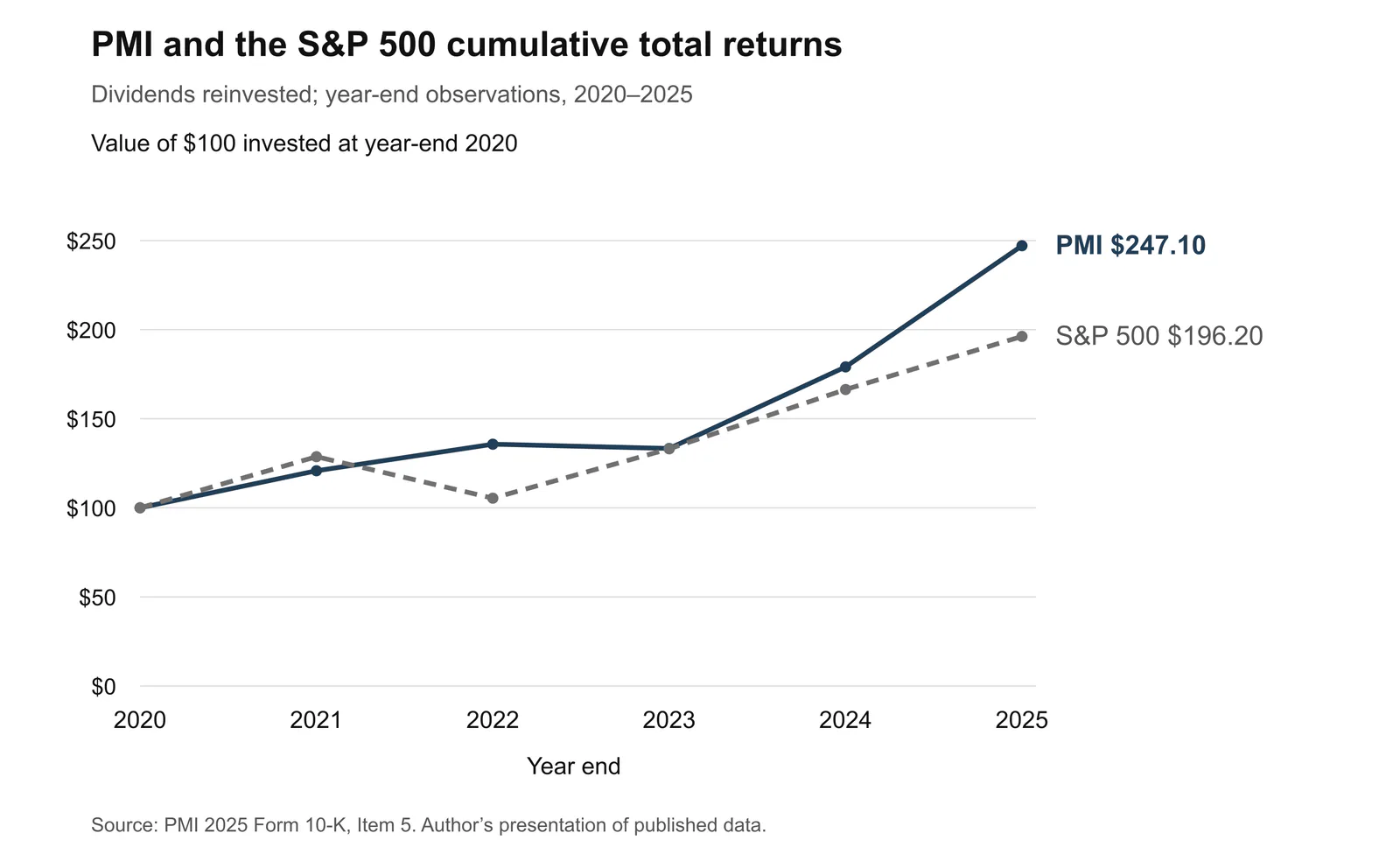
Author’s presentation of PMI’s published year-end data. Lines connect annual observations; they do not show within-year movements. This descriptive comparison does not identify the causes of performance or measure consumer health benefits.
This record creates a useful comparison with research published in Tobacco Control in 2024. Evans, Sayed and van Walbeek examined nine companies using data through 2023, documented weak performance after 2016 and discussed the financial case for divestment. They explicitly acknowledged uncertainty about future returns and whether novel products could offset cigarette declines. Their funding disclosure identifies the Gates Foundation through the African Capacity Building Foundation, rather than Bloomberg Philanthropies. Evans, Sayed and van Walbeek, “Evaluating the financial case for investing in, or divesting from, tobacco investments.”
Later performance does not erase that historical analysis. It does demonstrate why a study ending in 2023 cannot settle the subsequent investment case. Companies may diverge as product portfolios and execution differ. A sector-wide judgement can become less informative when one business develops substantial new revenues while another remains more dependent on declining cigarette sales.
Two explanations of investor confidence are consistent with the evidence presented. Investors may increasingly distinguish the future of nicotine from the future of smoking. They may also expect a limited group of authorised suppliers to capture continuing demand behind difficult entry requirements. Both mechanisms could operate simultaneously. Establishing their relative importance would require earnings forecasts, valuation multiples, regulatory developments and company-specific analysis. Strong returns alone do not identify either mechanism.
The relevant mechanism can be described without assuming that markets have delivered a final verdict. A business expected to distribute the proceeds of a slowly contracting cigarette franchise has one valuation logic. A business expected to earn growing cash flows from differentiated nicotine products has another. Expectations about the duration of earnings, opportunities to reinvest and the risk of regulatory interruption can change the price investors will pay for a given level of current profit. That is the possible reclassification from a declining cigarette business to a continuing nicotine business.
PMI’s acquisition of Swedish Match illustrates a concrete commitment to that possibility. In December 2022, PMI described its acquisition of more than 93 per cent of Swedish Match’s shares as a step towards expanding its oral nicotine portfolio and accelerating its smoke-free strategy. An acquisition is a management decision to allocate capital, not proof that the resulting investment will succeed. It is nevertheless evidence that the proposed future involves ownership, production and distribution, rather than branding alone. PMI on the Swedish Match acquisition, December 2022.
Several distinctions are essential when interpreting subsequent returns. A price rise can follow higher expected earnings without an increase in the valuation multiple. An increase in the multiple can reflect lower interest rates or a changed assessment of risk. A company can also benefit from its remaining cigarette operations while expanding noncombustible products. Attributing all performance to nicotine’s rehabilitation would therefore exceed the evidence presented here. The narrower finding is that a substantial alternative-products business and strong shareholder returns coexist with advocacy for restrictions and financial divestment.
The deeper institutional tension therefore has three sides. Some tobacco-control organisations may view continued profitability principally as evidence that dependence is being perpetuated. Investors may value continuing demand and successful substitution. Incumbent manufacturers may favour that transition while retaining barriers that help them capture its proceeds. An open-market reform agenda cannot simply adopt any one of those perspectives as its measure of success.
A rising share price establishes neither consumer welfare nor product safety, and it does not identify an incentive to support open competition. The commercial resilience documented here warrants examination of nicotine’s future beyond cigarettes, while leaving the distribution of gains and the case for reform unresolved.
There is also a policy question for advocates of divestment and financial exclusion. If a firm is moving towards demonstrably less harmful products, should that change affect its treatment? A framework that assigns the same status regardless of product mix offers limited recognition of transition. Whether that treatment is inconsistent depends on the stated objective of the divestment policy; whether it discourages transition requires separate evidence.
Rehabilitating nicotine does not rehabilitate every company that sells it. It requires judging what companies produce and how they behave, including whether their conduct supports informed adult choice.
A market whose customers can choose and leave
The hardest test of this argument remains the adult who would never have smoked. No avoided cigarette consumption can be credited to that person’s decision. Any health risk and unwanted dependence must be considered against the benefits the person actually experiences.
Those benefits need not be medical. Adults can value enjoyment, ritual or a subjective effect without proving improved productivity. Yet repeated purchases cannot simply be counted as evidence of satisfaction. Dependence may sustain consumption that the customer regrets.
A legitimate market therefore needs to protect choice over time. Before starting, consumers should understand the possibility of dependence. During use, they should receive reliable information about dose and product characteristics. If they want to stop, they should have access to help. Research should measure regret, unsuccessful attempts to quit and interference with daily life alongside sales and prevalence.
This is where the caffeine analogy remains helpful and limited. Research recognises both physiological dependence and clinically significant problems among some caffeine users. Ordinary acceptance has not made those problems imaginary. It has allowed a distinction between patterns of use rather than treating every regular consumer as having the same experience. Meredith and colleagues, “Caffeine Use Disorder.”
A future market also needs credible protection for children and attention to vulnerable populations. Adult legitimacy depends partly on maintaining those boundaries. Product standards, accurate labelling, controls on harmful constituents and enforcement against deceptive claims would remain central.
In the United States, implementing a different framework would require attention to existing law. The tobacco-product premarket standard considers population-wide risks and benefits, including users and nonusers. It is distinct from the pharmaceutical approval pathway, even though both operate within the FDA. A broader consumer-market approach cannot simply be assumed to exist within the present statute. 21 U.S.C. § 387j(c)(4).
Governing an enduring market
A consumer framework should begin by separating the regulatory questions that smoking once bundled together. Product safety concerns composition, delivery, manufacturing and exposure. Consumer protection concerns information, claims, pricing practices and the ability to make meaningful decisions. Youth protection concerns access, promotion and supply. Environmental and bystander effects depend on the product and circumstances of use. These questions interact, but a single judgement about nicotine’s undesirability cannot answer them all.
The distinction has practical consequences for innovation. A manufacturer that reduces contaminants, improves dose consistency or designs a product that consumers find easier to stop using should have a reason to make that improvement. Regulation that treats every product as equally unacceptable can weaken the relevance of such differentiation. A proportionate system would create visible rewards for safer design while retaining mechanisms for identifying harms that become apparent only after wider use. The balance between premarket evidence and continuing surveillance should be justified for the product concerned.
Communication also needs two audiences. Smokers require a clear account of the gains and limitations of switching completely. Adults who do not use nicotine require an account of the product’s own risks, including dependence, without borrowing the smoker’s benefit. A comparative statement can be accurate and still be incomplete for the second audience. A credible adult market must be able to communicate both messages without turning the first into a universal endorsement or the second into an assertion that all delivery systems are equivalent.
Risk assessment should avoid unsupported generic safety percentages. The hazards of a vaping device, an oral pouch and medicinal nicotine cannot be collapsed into one estimate merely because none is a cigarette. Long-term evidence also develops at different speeds for different products. Absolute-risk assessment should become more important as smoking ceases to be the relevant alternative for a larger share of consumers. The ambition to rehabilitate nicotine makes careful product assessment more necessary, because a mature market must stand on evidence about its own products.
Dependence makes welfare assessment particularly demanding. A person can be satisfied with regular use, experience withdrawal and still regard the habit as worthwhile. Another can buy the same product repeatedly while wishing to stop. These are different experiences, and a purchase record alone will not distinguish them. Research should follow consumers over time, comparing expectations before initiation with subsequent satisfaction, regret, expenditure, symptoms and attempts to reduce use. It should also examine how dose and delivery affect those outcomes.
A useful test is how the market treats a customer who wants to leave. Information should be available without stigma, and assistance should not depend on first identifying oneself as a smoker. Commercial practices should not obstruct cessation or exploit a consumer’s expressed difficulty controlling use. These expectations follow from the adult-choice argument itself: the justification for entry is weakened if subsequent choice becomes substantially less informed or less manageable than consumers were led to expect.
The effect of regulation on competition deserves similar attention. Evidence requirements may be necessary while still favouring large firms able to bear fixed compliance costs. Category rehabilitation should not become a mechanism for protecting established businesses from challengers. Policymakers should ask whether a requirement yields useful information, whether comparable evidence can be shared appropriately and whether rules recognise meaningful improvements. The desired outcome is a trustworthy market in which firms compete over products and conduct, rather than one whose legitimacy rests on the identity of its largest participants.
Prices and the direction of substitution
Taxation can preserve or obstruct the distinctions a market is supposed to make. If policy makes one format more expensive or less accessible, demand may move towards another. The relevant outcome is not simply whether sales of the targeted product fall, but which behaviours replace them. That question applies to cigarette taxes, vaping taxes, restrictions on flavours and limits on retail channels.
Research offers grounds for taking substitution seriously, while also cautioning against universal assumptions. A retail-panel study, The Effects of E-Cigarette Taxes on E-Cigarette Prices and Tobacco Product Sales, reports evidence that e-cigarette taxes reduced e-cigarette sales and increased cigarette sales in the markets and period studied. This is evidence about particular products and settings, rather than a coefficient that can be transferred automatically to pouches or every subsequent regulation. The published study sets out the design and limitations.
Other work has reached different conclusions about the relationship between cigarettes and e-cigarettes. A household-panel study reports patterns consistent with complementarity under its data and methods. That difference need not be resolved by declaring one relationship to hold everywhere. Consumer groups, periods, product development and the policy being examined can change the relevant comparison. The relationship between cigarettes and electronic cigarettes illustrates why market-wide assumptions require testing.
For this paper, the implication is methodological and practical. A restriction may protect one group and shift another towards a worse alternative. A tax structure intended to discourage dependence may weaken the price advantage of a less harmful format. Equally, very low prices could encourage initiation or heavier consumption. Proportionate policy needs estimates of these competing responses, accompanied by uncertainty, rather than a presumption that less use of the regulated product necessarily improves outcomes.
Risk-sensitive taxation is therefore a direction for analysis, not a ready-made schedule of tax rates. Its design would need to consider health harms, substitution, external costs, enforcement and the available evidence about unwanted dependence. It should also be distinguished from ordinary sales taxation and from using the category as a convenient revenue source. If the tax base itself creates a fiscal interest in continuing consumption, governments should make that interest visible rather than presenting every revenue measure as a health intervention.
There is a comparable issue in informal supply. Restrictions can reduce demand, change products or redirect purchases. The presence of an informal market does not prove that a restriction is unjustified, but neither is it irrelevant to the assessment. Product quality, age controls and the ability to recall defective goods can differ across supply channels. A market policy must compare the outcomes it can realistically produce with feasible alternatives, rather than assuming that demand disappears when lawful access becomes difficult.
The strongest objections
The most serious objection is that recognising a legitimate market risks normalising dependence and attracting adults who would otherwise avoid it. That concern cannot be answered by repeating the gains available to smokers. The paper’s response is to require an independent assessment of the new user’s risks and welfare, including the possibility of regret. Legal availability, medical advice and permission to make a particular advertising claim should remain separate decisions. An adult market can be legitimate without a public campaign encouraging initiation.
A second objection concerns the reliability of consent. A person may understand that a product is dependence-producing in the abstract while underestimating the difficulty of stopping. Warning labels alone may not resolve that problem. Evidence about actual understanding, initial expectations and later experience should therefore inform rules on claims, disclosure and design. Where consumers systematically misunderstand a material attribute, simply describing the purchase as voluntary is inadequate. Where an informed adult continues to endorse a manageable pattern of use, describing that choice as inherently invalid also requires justification.
A third objection is that the argument offers cigarette companies an undeserved route to respectability. It need not. Product-level assessment and company-level accountability serve different purposes. A firm’s record of deception is relevant to the scrutiny of its claims and conduct. It does not determine the chemistry of every later product, just as an improved product does not erase misconduct. A market can reward genuine improvements while retaining accountability for misleading representations and enforcement against unlawful behaviour.
The commercial interests of established firms are mixed across cigarettes, alternatives and regulatory protection. Genuine investment in less harmful products can coexist with support for entry requirements that disadvantage competitors. The case for reform should therefore assess product improvements and competitive effects separately. It should not make support for a manufacturer’s transition conditional on accepting that manufacturer’s preferred regulatory settlement.
A fourth objection is that commercial success can reflect the exploitation of dependency. It can. That is why financial returns and consumer welfare are not interchangeable in this paper. Stronger revenue could reflect greater satisfaction, higher prices or unwanted consumption. The appropriate response is to examine the mechanism and the distribution of outcomes. A profitable market can contain serious consumer harms; a market in which a producer fails can still have served customers well. Profit is evidence about a business, not a moral score for the category.
A fifth objection concerns harms that take many years to emerge. Uncertainty is particularly important for products with relatively short histories of widespread use. A response should specify what is known, what remains uncertain and which exposures are under examination. It should make provision for surveillance, enforceable standards, withdrawal and revision of claims. The difficulty of observing long-term outcomes supports carefully designed oversight. It cannot by itself establish either that all access should wait for complete certainty or that current evidence is sufficient for unrestricted marketing.
Finally, critics may object to comparing nicotine with coffee or alcohol because those substances have different effects and histories. That is correct as an objection to treating them as toxicological equivalents. The comparison made here concerns justification: adults are ordinarily permitted to value experiences that do not improve health, while the risks and consequences shape the rules. Nicotine still requires its own evidence. The analogy asks for a consistent method of reasoning, not identical regulatory treatment.
Congress and the boundary of FDA authority
The reform proposed here requires a legislative destination. Faster PMTA review would be useful, but would leave its central premise intact: that permission under that pathway requires a population-health determination. Recognising a durable adult market requires Congress to decide that qualifying consumer products may be sold when they meet defined conditions. FDA would enforce those conditions, while states would take the principal role in retail regulation. This is a redistribution and limitation of authority, with specified protections retained.
The strongest justification for exceptional tobacco regulation is the extraordinary harm of smoking. That provides a defensible basis for retaining stringent federal oversight of combustible tobacco alongside state controls. It does not establish that every product containing nicotine should remain subject to the same market-entry logic. The historical claim must nevertheless be accurate: the 2009 law expressly included smokeless tobacco, and the 2022 amendment directly extended the framework to synthetic-nicotine products. The proposed distinction is a recommendation to change the law, rather than a claim that FDA has invented its entire present jurisdiction. The statutory scope of FDA tobacco authority makes this clear.
Combustion is the starting boundary because of its contribution to the risks associated with smoking. Its absence cannot be the only eligibility criterion. A noncombustible product might contain harmful constituents, deliver nicotine unpredictably or expose users through a route requiring particular scrutiny. Congress should therefore establish a defined category of qualifying lower-risk consumer nicotine with criteria addressing composition, delivery, manufacturing, exposure and intended use. Products outside that category would not acquire an exemption simply by describing themselves as smoke-free.
Therapeutic nicotine should remain within the drug framework. A product represented as treating disease or helping patients through a therapeutic intervention presents different evidentiary questions from an ordinary consumer offer. Combustible products would remain within tobacco regulation. Qualifying consumer products would occupy a third category, with their own obligations and limits on claims. The governing distinction would concern the product and its intended use, rather than whether a purchaser could establish a smoking history.
The comparison with caffeine and alcohol should be equally precise. Neither market operates solely under state law. Federal food law governs relevant aspects of caffeine-containing products; alcohol combines federal controls with extensive state authority. These examples demonstrate that adult consumption can be recognised as lawful while quality, information and retail practices remain regulated. They do not supply a ready-made nicotine statute. FDA’s food-ingredient framework and TTB’s account of federal and state responsibilities describe the existing arrangements.
What a consumer nicotine statute would change
Congress should first create an explicit exception from the existing tobacco provisions for products meeting the new definition, together with an affirmative replacement framework. The exception would need to address the current definition of tobacco products, the application of the tobacco subchapter and its market-entry and claims provisions. A narrow amendment removing a name or changing the source of nicotine would be inadequate. So would an exemption that inadvertently moved ordinary consumer products into another unsuitable approval regime. Therapeutic claims would continue to trigger the appropriate medical scrutiny. The Food, Drug, and Cosmetic Act’s definitions show why coordinated drafting is necessary.
The operative change would be an express exemption of the qualifying category from the present tobacco premarket requirements, including the PMTA population-health test, coupled with replacement obligations. In its place, manufacturers would register, disclose required information and demonstrate conformity with published product and manufacturing standards through a prescribed process. Lawful access would follow compliance with those conditions. It would no longer depend on persuading FDA that the product’s existence produces a predicted net health benefit across users and nonusers.
That distinction separates product conformity from a licence to determine the category’s acceptable social purpose. FDA could inspect manufacturing, verify nicotine content and dose consistency, enforce limits on contaminants, require traceability and respond to defects. Its powers to require corrective action, suspend sale or recall products should be expressly stated. The agency would retain substantial responsibilities, but its grounds for restricting a compliant product would be bounded by the new statute.
Eligibility should not recreate the displaced population-health test under another name. For established categories, Congress could require published, product-relevant criteria and a conformity process, with evidence scaled to material differences. Genuinely novel delivery routes or exposures could face a separate, time-bounded assessment of specified safety questions. The agency would need to identify the evidence required and explain decisions by reference to those criteria. A finding that some informed adults might take up nicotine would not, by itself, disqualify a conforming product.
The details require scientific and legal development. This paper does not propose an unsupported universal risk threshold, maximum dose or list of ingredients. Congress should establish the principles, procedural limits and responsibilities, while commissioning or authorising the technical standards needed to implement them. The objective is predictability without pretending that every delivery system has an identical evidence base.
Communication would require a corresponding statutory settlement. Ordinary descriptions of flavour, format and verified composition should have a clear route to lawful use. Comparative risk statements would require substantiation appropriate to the claim, with a defined process for standard statements where evidence supports them. Therapeutic or performance claims would require the evidence and legal treatment appropriate to those representations. Exemption from the present tobacco gatekeeping regime would not become permission to advertise nicotine as harmless or medically beneficial without support.
Table 1 Current framework and proposed congressional settlement
| Function | Current framework | Proposed qualifying consumer category |
|---|---|---|
| Market entry | Applicable tobacco premarket requirements, including PMTA population-health review. | Published eligibility and conformity requirements; registration and defined review for novel safety questions. |
| Federal role | FDA tobacco oversight includes product review, standards, claims and enforcement. | Bounded FDA powers over manufacturing, contaminants, content, traceability, inspections and recalls. |
| Retail and use | States already regulate many sales and use matters; federal duties and preemption also apply. | States lead retail licensing, channels, taxation and use; national minimum sales age of 21 retained. |
| Claims | Separate tobacco modified-risk pathway; therapeutic products follow drug law. | Substantiated consumer and comparative claims under a defined replacement process; therapeutic claims retain medical scrutiny. |
| Cigarettes and medicines | Combustible tobacco and therapeutic nicotine have separate existing regimes. | Those regimes retained; noncombustion alone does not establish eligibility. |
| Legal change | Authority and limits established by existing federal statutes. | Congress creates exceptions, replacement obligations, revised preemption and transition rules. |
Sources: author’s proposal compared with 21 U.S.C. §387a, §387j and §387p. The proposed column is not current law.
States and the retail market
States would take the lead on retail licensing, sales channels, taxation, enforcement of age restrictions and rules governing use. The proposed statute should retain a national minimum sales age of 21 and specify age-verification obligations, rather than assuming that an exception from tobacco regulation automatically preserves existing safeguards. Tribal powers and the allocation of authority between states and local governments would also need explicit attention.
Existing law already preserves extensive state and local powers while preempting certain differing product requirements. That settlement would need revision for the new category. A credible model could retain nationally consistent rules for manufacturing and core product information, while allowing substantial variation in retail regulation. The bill should state which requirements are uniform, which states may strengthen and what remedies remain available to consumers. The current preemption and preservation provisions identify the issues Congress would have to resolve.
State leadership introduces tradeoffs that proponents should acknowledge. States may choose restrictive rules, divergent taxes, limits on flavours and retail channels, or sales prohibitions to the extent permitted by the new statute. A state-led system does not guarantee that the author's preferred market will emerge everywhere. If the purpose is local accountability and experimentation, some policy variation is part of the proposal. If the purpose includes guaranteed national access to every conforming product, that is an additional federal policy choice requiring separate justification.
The proposal here favours state leadership in retail decisions alongside a coherent national framework for product conformity. State licensing should not automatically become fifty repetitions of the same manufacturing assessment. Conversely, compliance with national product standards should not be presented as a general exemption from state retail law. The legislation would need to distinguish bona fide sales conditions from requirements that duplicate or contradict the agreed national product rules, with a practicable mechanism for resolving disputes.
Online sales and imports make this allocation particularly important. Age verification, the applicable state’s rules, tax collection, traceability and responsibility for defective imports should be addressed directly. A domestic manufacturer should not bear obligations that an overseas direct seller can evade in practice. These are implementation questions for a consumer market, rather than arguments that only the present PMTA structure can govern it.
Can an agency be expected to surrender its remit
The institutional argument in the book extends to the allocation of regulatory power. An agency develops staff expertise, procedures and performance measures around its responsibilities. A proposal to narrow those responsibilities may challenge its understanding of the problem and its institutional mission. That is a political-economy hypothesis about incentives, not evidence that particular officials are acting dishonestly or that every safety objection conceals a defence of jurisdiction.
More importantly, a favourable agency leadership could not simply substitute the framework proposed here for duties Congress has imposed. Administrative flexibility has limits. FDA’s September 2026 announcement contemplates changes to the PMTA framework while retaining the statutory population-health standard. That can improve implementation. It cannot supply the durable congressional decision that a defined adult-consumer category should be governed through a different standard. FDA’s reform announcement expressly recognises the continuing statutory requirements.
There are precedents for changing FDA’s remit. Congress directed the transfer of catfish inspection to USDA, implemented in 2016. Through the 21st Century Cures Act, it also excluded specified software functions from the medical-device definition. These examples demonstrate legislative tools for transferring or narrowing jurisdiction; they do not show that either model is substantively suitable for nicotine. They also involve change imposed by law, rather than a general expectation of voluntary institutional retreat. FDA’s account of the inspection transfer and its explanation of the software exclusions provide the relevant precedents.
The conclusion is that Congress should own the policy choice. The case should be presented as a change in the statutory purpose and limits of regulation, with defined protections and a workable receiving framework. A promise that FDA will exercise the same powers more sympathetically offers less certainty to consumers, manufacturers and investors than a clear legislative boundary.
Litigation and the limits of a judicial route
Litigation can address unlawful requirements, procedural defects and agency action outside statutory authority. It can also establish limits that legislation must respect. It is a less direct route to the complete institutional arrangement proposed here. A court deciding whether FDA lawfully denied a particular application would not ordinarily design a new national product standard, allocate retail responsibilities to states or create the transition provisions needed for an entire category.
Current tobacco law provides a specific route for review of certain product standards and marketing denials, with a thirty-day petition deadline. The forum, claim, standing and remedy require case-specific analysis. A successful challenge could set aside an order or requirement without removing the statutory PMTA obligation. The distinction between winning a product dispute and changing the governing regime must remain clear. 21 U.S.C. § 387l supplies the review provisions.
Recent Supreme Court decisions also counsel against assuming that a broad challenge will produce the desired restructuring. In Wages and White Lion in 2025, the Court rejected central arguments against FDA’s treatment of vaping applications and remanded a remaining issue. In FCC v. Consumers’ Research the same year, it upheld the challenged delegation in that different statutory setting. Neither decision settles every possible nicotine claim, but neither provides a ready-made judicial route to state-led consumer regulation. Wages and White Lion and Consumers’ Research frame the limits of those analogies.
A constitutional challenge to the existing framework would require a sustainable legal theory, a plaintiff suffering a cognisable injury and a remedy connected to the violation established. Even success might leave uncertainty about surviving statutory provisions and other federal powers. Legislation is therefore the principal route advanced here. Litigation remains relevant to particular overreach and to enforcing the limits of any replacement statute, rather than serving as a presumed substitute for congressional design.
Keeping a standards regime from becoming permission by another name
A legislative change would accomplish little if the replacement retained the same discretion through a different procedural label. The distinction should be visible in the decisions an official is authorised to make. Under the proposed system, a conforming product within an eligible category would have a defined route to lawful sale. FDA could identify a failure to meet a standard, require evidence relevant to conformity or act on a specified safety ground. A general preference for abstinence would not be a statutory ground for withholding access. Current FDA decisions already require a lawful basis and reasoned explanation; the proposed change narrows the governing test rather than inventing those procedural protections.
Standards would need public reasons and a reviewable evidentiary basis. Limits addressing contaminants, inconsistent delivery or hazardous design would be connected to the exposure or defect concerned. If a standard effectively excluded an entire format, the agency should have to explain why that consequence was necessary under the authority Congress supplied. The requirement to give reasons would help distinguish targeted protection from the reintroduction of a general elimination objective.
Procedure matters as much as stated purpose. Congress could require the agency to identify missing information within a defined period and decide disputed conformity questions by reference to published criteria. Material delays should have a specified remedy. A deadline alone does not establish that a product is safe, so automatic market access after any missed deadline would require careful limits, particularly for genuinely novel exposures. The design should prevent indefinite administrative limbo without turning inaction into an unqualified safety determination.
There should also be a distinction between routine product improvement and a new safety question. A change in packaging appearance need not receive the same assessment as a changed delivery mechanism. A manufacturer should explain why an alteration does or does not affect conformity, with proportionate documentation and audit powers. This would preserve accountability while reducing the incentive to leave an inferior formulation unchanged simply because reopening review is costly.
Emergency powers should remain available for credible, urgent risks, accompanied by prompt explanation and review. Continuing a restriction would require evidence supporting its scope and duration. Firms would retain duties to report defects and cooperate with recalls. These powers provide a reason to trust the lawful market, while their limits make investment less dependent on shifts in institutional preference.
The existing PMTA statute illustrates why clarity about the legal test is indispensable: it already contains a 180-day decision provision as well as population-health and other grounds for denial. The reform proposed here changes the governing decision, rather than assuming that another deadline alone resolves every source of friction. The current application provisions set out those distinct elements.
A transition that preserves accountability
Congress should specify how existing products and pending applications move into the new framework. A defined transition could require registration, disclosure, testing and compliance within stated periods, with stricter treatment of products presenting identified risks. Existing authorisations might provide relevant evidence, but should not confer permanent exemption from new product standards. Products without authorisation should not automatically acquire a blanket assurance of quality merely because the law changes.
The transition should preserve enforcement against contamination, inaccurate content, sales below the applicable legal age and deceptive claims. Rules would need to identify which existing orders and obligations continue, which lapse and which are replaced. Businesses and consumers should be able to determine the governing conditions without relying on an indefinite promise of enforcement discretion. Adequate implementation time matters, but so do deadlines that prevent transition from becoming permanent uncertainty.
Funding should match the bounded federal tasks. Inspections, laboratory capability, import oversight and recalls require resources even when case-by-case population-health licensing ends. States likewise need capacity to enforce retail obligations. Narrowing jurisdiction should be assessed by the quality of the resulting allocation, including whether responsibilities can actually be performed, rather than by an agency budget reduction alone.
Postmarket surveillance should test the new framework against stated outcomes: conformity, defects, adverse effects, youth access, unwanted dependence and patterns of substitution. Manufacturers should provide relevant information, with independent access and privacy protections specified. Evidence of material harm should permit proportionate intervention, while favourable evidence should support revision of unnecessary restrictions. Repeated detection of noncompliance by one firm should not automatically establish that every conforming product requires a return to the former regime.
The coalition for reform should not be expected to originate principally with the largest cigarette manufacturers. Consumer organisations can articulate the case for informed adult choice; independent producers can identify barriers and foregone innovations; retailers can describe access and enforcement; and legislators can assess competition and federal-state responsibilities. Incumbents should be invited to support specific reforms, but their participation should not determine whether the project proceeds. Their interests in faster decisions may not extend to a general reduction in entry barriers.
A coalition would need to distinguish support for this settlement from requests for preferential treatment. A proposal that accelerates existing suppliers’ applications while preserving unnecessary obstacles for challengers would not achieve the objective. Nor would exemption from quality obligations for small firms. The political case is a common, proportionate route to lawful entry: preserve strong oversight of combustible tobacco, retain medical regulation for therapeutic products, replace population-health permission for qualifying consumer nicotine with enforceable standards, and give states the lead in retail regulation.
An evidence programme for congressional oversight
Congress should define in advance what the replacement framework is intended to improve and how it will be evaluated. Administrative performance, consumer outcomes and health outcomes should be reported separately. A faster route to market would be an administrative achievement, not proof of improved health. Lower smoking would be an important health outcome, not proof that every new nicotine user was satisfied. Separating the measures makes claims of success more accountable.
The administrative record should track time to lawful entry, the information requested, reasons for objections, compliance costs and the treatment of modifications. Results should distinguish first-time entrants from established authorisation holders and report changes in the number and concentration of suppliers. Faster decisions for incumbents alone would not establish broader access. These measures should be accompanied by inspections, noncompliance findings and corrective actions, so that competition is assessed alongside product conformity.
Consumer research should follow people through changes in products and preferences. Surveys should distinguish experimentation from regular use, product switching from additional consumption and satisfaction from inability to stop. People who discontinue use should remain in the evidence base; a survey restricted to current customers would miss some who left because of problems. Similarly, customer testimonials cannot establish the experience of everyone who tried a product.
Health surveillance would need exposure-specific measures and attention to the time required for outcomes to appear. Changes in symptoms, adverse events and relevant biomarkers may provide earlier information than disease incidence, but should not be presented as interchangeable endpoints. Studies should report what each measure can and cannot establish. Research on one product should be transferred to another only where the relevant similarities are justified.
The federal-state structure could support evaluation of differing retail policies, but variation would not automatically create a clean experiment. States adopting restrictions may differ in smoking trends, enforcement, income and consumer preferences before the policy begins. Researchers would need to examine prior trends, cross-border purchases, online sales and other simultaneous changes. Findings should identify the people and settings to which they apply rather than promise a universal effect from a single state’s experience.
Commercial data would be valuable but require consistent definitions. Shipments to distributors, retail sales, nicotine content sold and numbers of users measure different aspects of the market. Public reporting should make definitions and revisions visible. Manufacturer funding and advocacy funding should be disclosed, while access to methods and data should support independent examination where privacy and confidentiality permit. Declaring a source interested is not a substitute for assessing its evidence.
Finally, Congress should require a public review after a defined implementation period, with continuing surveillance thereafter. The review should consider whether the allocation of responsibility is working, whether particular standards need revision and whether harms require targeted intervention. It should also identify obligations that have failed to deliver their expected benefit. Review should permit correction in both directions without making every manufacturer’s continued existence depend on repeatedly securing discretionary approval of the whole category.
Measuring success beyond prevalence
The eventual policy objective should be explicit. It would combine rapid movement away from smoking with proportionate management of a possible enduring nicotine market. Adult nicotine use might fall, remain stable or rise. Those movements would require examination of who was using which products and with what consequences.
Suppose an adult nicotine market expands as smoking declines. Its evaluation should distinguish smokers who switch completely, people who continue smoking while adding another product, former smokers, and people without previous nicotine use. Their counterfactuals differ. So do the health consequences and the relevance of satisfaction, regret and dependence. Counting them together as nicotine users conceals precisely the distinctions that a proportionate framework needs.
There is a corresponding research question about social costs. Healthcare expenditure, effects on households, accidental exposure and the consequences of enforcement should be examined where relevant. The fact that adults choose a product does not eliminate costs imposed on others. Equally, identifying a possible external cost does not establish that eliminating the entire category is the most effective response. Intervention should be connected to the particular harm and compared with feasible alternatives.
For an academic working paper, these propositions support a research programme rather than a numerical claim that the optimal market must be larger or smaller. Its size would emerge from preferences, product development, information and regulation. The normative commitment is that adult welfare includes more than the minimisation of one health-risk indicator. That commitment should be stated explicitly, leaving empirical research to assess the consequences of different arrangements.
A rise in use would not automatically establish failure. Nor would a fall establish success if consumers had been pushed towards more dangerous products or less accountable suppliers.
This is the destination implied by nicotine’s rehabilitation. Consumers could regard themselves as customers rather than permanent patients. Companies could compete over products whose legitimate purpose extended beyond a shrinking population of smokers. Regulators could distinguish risks, protect informed choice and revise rules as evidence accumulated.
The central question is whether public institutions can recognise that future as something other than an unfinished campaign against cigarettes. Consumers and businesses are already exploring it, but the commercial success of incumbent producers should not be mistaken for leadership of the broader project. Their cigarette histories complicate the legitimacy argument, while their authorisations and compliance capabilities can make entry barriers valuable. Investors may be pricing both continuing demand and restricted competition. A public case for rehabilitation must therefore stand independently of incumbent commercial interests.
In the United States, Congress should establish a framework that separates qualifying consumer nicotine from the exceptional tobacco market-entry regime. FDA would retain bounded quality and safety responsibilities, while states would lead retail regulation. Support may need to come principally from consumers, challengers and legislators concerned with informed choice and competition. The reform should give compliant products a predictable route to sale, rather than promise a more profitable settlement for the companies already authorised to supply them.
Adults should not have to acquire a dangerous smoking habit before their interest in nicotine can be taken seriously. The work of tobacco harm reduction is to help people leave cigarettes behind. The next task is to decide, openly and proportionately, what legitimate choices can exist beyond them.
Selected sources and further reading
Roger Bate, The Politics of Acceptable Addiction: Coffee, Nicotine, and the Collapse of Proportional Risk, Cambridge Scholars Publishing. The arguments developed here draw especially on the chapters on cultural legitimacy, media and philanthropy, rehabilitation, and institutional change.
Arielle Selya, Rethinking Population Health Implications in an Era of Declining Cigarette Smoking. Starting point for the discussion; the independent adult-market argument is developed by this paper.
U.S. Food and Drug Administration, Nicotine Is Why Tobacco Products Are Addictive. Official discussion of nicotine, delivery systems and dependence.
National Academies of Sciences, Engineering, and Medicine, Public Health Consequences of E-Cigarettes, 2018. Evidence assessment specific to e-cigarettes, rather than the whole nicotine category.
Centers for Disease Control and Prevention, Nicotine Pouches. Public-health guidance and discussion of evidence gaps.
Lead photograph: Towfiqu Barbhuiya / Pexels.