Roger Bate | CGHA
An initial analysis of the Palau research
The central finding
International nicotine prohibition is an absurd response to the arrival of cleaner ways to consume an ancient stimulant. Public health has spent decades trying to separate nicotine consumption from the diseases caused by tobacco. When technology makes that separation easier, a campaign to subject the molecule itself to international drug control moves in the wrong direction. The result could be to restrict the alternatives people use to escape smoke while entrenching the markets that already cause the greatest harm.
Palau’s initiative exposes a profound confusion about the purpose of public health. A country with a widespread carcinogenic chewing habit is helping to put nicotine itself before the machinery of international drug control. The result could be tighter barriers to cleaner nicotine while the dangerous habits those products might displace persist. This is a grotesque inversion of priorities.
The campaign’s arguments suggest that the objective has shifted from reducing disease to ending non-medical nicotine use. If continued consumption counts as failure after smoke has been removed, successful harm reduction becomes another problem for campaigners to eliminate. Adults who avoid serious harm become targets because they still enjoy a stimulant.
An ancient stimulant and a modern category error
Humans have used nicotine-containing plants for millennia. Archaeologists reported evidence of tobacco use approximately 12,300 years ago. Demand for nicotine long predates the companies, devices and marketing campaigns now blamed for creating it. The age of a habit does not establish its safety, but it should discourage the fantasy that eliminating lawful modern products will eliminate the underlying demand. [5]
Contemporary nicotine medicines demonstrate that nicotine can be used safely and effectively under established conditions. The FDA describes approved replacement therapies in those terms and distinguishes nicotine’s role in dependence from the toxic mixture responsible for smoking’s serious diseases. Cigarettes deliver both a desired stimulant and a lethal exposure. Those two things can be separated. [6]
Dose, formulation, contaminants and route of administration matter. Nicotine can produce dependence and acute toxicity, and exposure during pregnancy and adolescence warrants particular care. These are reasons for proportionate product regulation. They do not erase the enormous difference between consuming nicotine and inhaling burning tobacco.
The practical opportunity is considerable. The FDA’s January 2025 authorisation of 20 ZYN products rested partly on findings of lower risks of cancer and other serious conditions than cigarettes and most smokeless tobacco products. Cochrane finds high-certainty evidence that nicotine e-cigarettes help more people quit smoking than nicotine replacement therapy. Both findings make hostility to the molecule difficult to defend. [7,8]
I am dependent on caffeine, and I am comfortable with that. Nicotine and caffeine need not have identical effects for the comparison to expose a principle. Dependence does not, by itself, establish that an adult’s choice should be prohibited. Health policy needs an account of the resulting harm and of whether its proposed intervention would reduce it.
What Palau has actually requested
Palau says it notified the UN Secretary-General on 10 June 2026 under Article 2 of the 1971 Convention on Psychotropic Substances, asking for a WHO critical review of nicotine. The campaign reports confirmation of a 2027 review agenda and anticipates a possible Commission on Narcotic Drugs vote in March 2028. The proposed outcome remains undecided; nicotine has not become a scheduled drug. [1,12,29]
The institutional choice is substantive. Article 5 of the convention generally limits substances in Schedules II to IV to medical and scientific purposes, with applicable exceptions; Schedule I has still tighter conditions. Article 22 provides for punishable offences under implementing laws, subject to constitutional and domestic legal constraints. Scheduling would therefore carry implications well beyond ordinary retail standards. The convention is not simply an international product-labelling scheme. [9]
ASH says its support for a critical review does not prejudge the outcome. Nevertheless, choosing the international drug-control system as the forum has consequences: it makes scheduling the organising question, rather than asking which combination of products and rules would prevent the most disease. [10,11]
The campaign’s proposal page says controls would reach the molecule across product formats, and discusses possible exemptions for nicotine medicines. Clive Bates argues that the likely practical approach would instead target extracted or synthetic nicotine while leaving tobacco products outside that particular prohibition. His interpretation should not be reported as settled law, especially given the campaign’s broader public wording. [12,13]
Either route needs an explicit defence. A broad prohibition raises formidable questions about existing tobacco consumers and supply chains. Selective controls that bear most heavily on cleaner alternatives create a particularly perverse competitive advantage for cigarettes. No reassuring reference to licensing resolves that dilemma.
Betel nut and the rank hypocrisy of selective prohibition
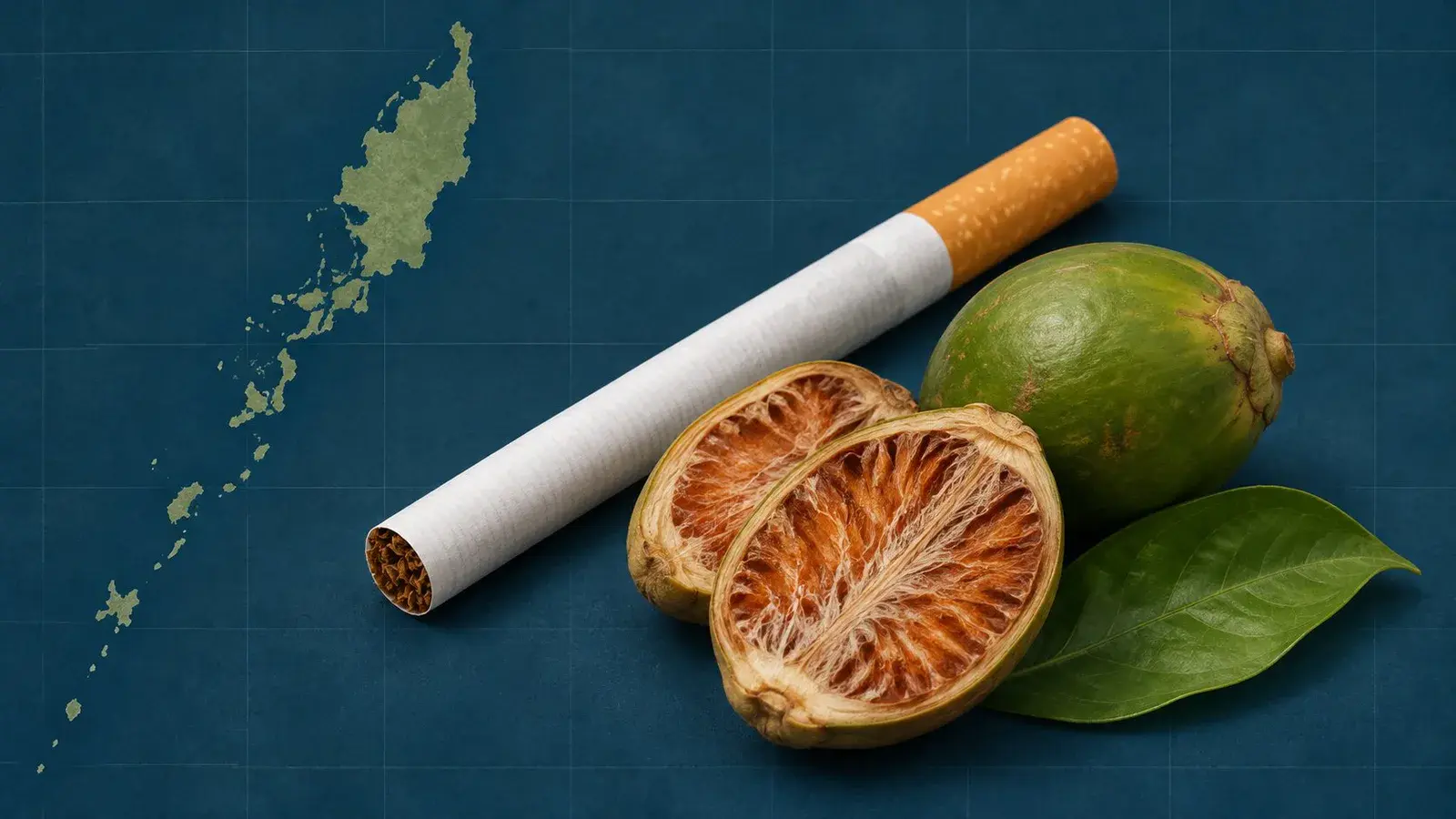
Palau’s own data make the campaign especially striking. Its Hybrid Survey report, covering 2016, recorded cigarette smoking at 20.6 percent and chewing betel nut with tobacco at 46.2 percent among adults aged 25 to 64. These historical figures establish the scale of a hazardous oral habit alongside smoking. [14]
Areca nut, commonly called betel nut, is carcinogenic to humans. IARC concluded that betel quid without added tobacco causes oral cancer. Tobacco adds hazards; its absence does not make the areca preparation safe. Here is an established cancer hazard embedded in domestic consumption, while nicotine medicines demonstrate that the stimulant being targeted internationally can be used safely under established conditions. [6,15]
Palau does recognise betel-related harm. Its 2025–2030 health plan schedules ministry policies on tobacco, nicotine and betel-nut use, together with cessation services. Those are stated commitments, rather than evidence here that every measure has been implemented. But the contrast in policy ambition is unmistakable: domestic institutional policies and cessation measures for carcinogenic chewing, international drug-control machinery for nicotine. [30]
Meanwhile, current Australian government travel advice describes Palau’s ban on importing, advertising, selling and using vapes. A smoker considering a smoke-free substitute therefore faces prohibition, while the country’s own health strategy addresses its established chewing habit through a range of domestic measures. [31]
This is rank hypocrisy in the treatment of risk. The objection is not that Palau should criminalise everyone who chews areca. It is that a government invoking health to pursue nicotine internationally should explain why cleaner delivery deserves a more sweeping response than an entrenched carcinogenic practice. Cultural familiarity cannot substitute for a comparison of harms.
Alcohol reinforces the inconsistency. The survey’s all-adult dashboard recorded past-month alcohol use at 41.1 percent and binge drinking at 27.3 percent. Alcohol causes cancer and contributes to injuries, violence and road crashes. Neither dependence nor enjoyment alone explains why nicotine should be singled out for international scheduling. [14,16]
A programme that blocks cleaner alternatives while treating continued nicotine use as the central failure has lost sight of reducing ill health. Its practical test should be whether fewer people get cancer, cardiovascular disease and other serious illnesses. Diplomatic applause for attacking a molecule is a poor substitute.
The campaign is visible even when the accounts are not
The initiative has identifiable public actors. Its website names President Surangel S. Whipps Jr. and First Lady Valerie R. Whipps, chair of the Coalition for Tobacco Free Palau, and scientific contributors Coral Gartner, Carolyn Dresler, Charis Girvalaki and Thomas Münzel. ASH in the United States reports providing scientific and legal support; its October submission carries support from more than 100 organisations in 47 countries. [10,11,17,18]
The European Network for Smoking and Tobacco Prevention promoted the launch under the headline, “The molecule behind 7 million deaths a year has never been regulated.” That framing transfers the emotional force of tobacco’s mortality burden onto nicotine itself. Yet an assessment of purified nicotine must distinguish dependence from the mortality attributable to smoke, other tobacco constituents and specific oral preparations. Mortality associated with tobacco cannot simply be assigned to every product containing its principal stimulant. [19]
The dossier offers a serious version of the proponents’ argument: newer products can deliver nicotine rapidly and at high doses, increase dependence and expose young people to risk. It also recognises therapeutic nicotine. Those are reasons to examine dose, delivery, marketing and access. They do not demonstrate that every consumer format belongs under a prohibition-oriented treaty. [18]
The scientific dossier needs a much harder examination
The dossier’s cardiovascular section groups oral nicotine pouches with products said to expose users or bystanders through mainstream, sidestream and second-hand smoke. Pouches produce no smoke. This is a basic category error in a document seeking international controls on a molecule across very different delivery systems. [18, pp 13–14]
Its cancer discussion relies heavily on biological mechanisms, including effects on cell signalling and tumour growth, and invokes evidence about continued smoking after a cancer diagnosis. Such evidence cannot isolate nicotine from the many other exposures in tobacco smoke. Laboratory mechanisms can identify questions for investigation; they do not establish the cancer incidence attributable to long-term purified nicotine use. [18, pp 15–16]
Human evidence deserves more weight. A prospective analysis of 3,320 Lung Health Study participants recorded nicotine replacement use over five years and followed cancer outcomes for a further 7.5 years. Nicotine replacement was not a statistically significant predictor of lung cancer, whereas continued smoking was. That directly challenges any easy transfer of smoking’s cancer burden to nicotine. [25]
The EAGLES cardiovascular trial included 8,058 treated smokers assigned to varenicline, bupropion, nicotine patches or placebo. Major cardiovascular events were uncommon and did not differ significantly between treatment groups. A separate trial randomising 525 smokers to eight, 24 or 52 weeks of nicotine patches found no association between treatment duration and adverse effects. [23,24]
These studies concern therapeutic products, populations and exposure periods; they cannot certify lifetime safety for every consumer formulation. They nevertheless provide relevant human evidence that a case for molecule-wide controls must confront. The dossier’s cited review by Benowitz and Burbank also distinguishes nicotine’s cardiovascular effects from the much greater risk of smoking. [26]
The claim of a regulatory vacuum also needs precision. Since April 2022, US law has extended FDA tobacco-product authority to nicotine from any source, including synthetic nicotine. Existing powers can be ineffective or poorly enforced, but a new product is not automatically outside all regulation. Supporters should establish why enforceable product standards cannot address the specific risks they identify. [28]
WHO has considered nicotine before. Its thirtieth Expert Committee report, published in 1998, did not recommend a critical review at that time, while leaving the issue open if relevant new evidence emerged. The present case therefore needs to demonstrate what has changed and why treaty scheduling would improve health compared with risk-based regulation. [27]
Who pays for this campaign
Bloomberg’s influence in tobacco control is documented. In February 2023, its initiative announced another US$420 million over four years, bringing the total commitment then reported to more than US$1.58 billion. Public statements allocated US$280 million to tobacco-use reduction in lower- and middle-income countries and US$140 million to reducing teenage e-cigarette use in the United States. That is a substantial capacity to shape organisations, priorities and campaigns. [2]
A separate relationship with Palau is also documented. A 23 June 2026 announcement of a US$260 million expansion of the Bloomberg Ocean Initiative included Palau’s president praising its support for small island nations and ocean treaty diplomacy. This was a global conservation commitment, not a US$260 million payment to Palau. [3]
The announcement came thirteen days after the nicotine notification. That timing and the existing relationship justify asking whether the programmes share funders, advisers or other support. No payment record or agreement establishing a Bloomberg-funded nicotine bargain was identified in the materials reviewed.
ASH’s public 2024 Form 990 lists contributor amounts without corresponding donor names in its public Schedule B. It predates the notification. The campaign identifies its participants but the sources reviewed do not supply a consolidated budget showing who paid for the notification, website, travel and professional services. Those accounts should be published. [4,17]
Donors can shape policy without buying a diplomatic decision. Funding determines which approaches acquire staff, studies, conferences and international reach. A campaign seeking to reshape international law should disclose its direct and indirect grants, commissioned work and in-kind support. Public-health credentials should invite the same financial scrutiny demanded of commercial advocacy.
Illicit traders could benefit without funding the campaign
No documentary evidence reviewed establishes illicit-trader funding of the initiative. The market incentive, however, is straightforward: restrict lawful supply while demand persists, and illicit suppliers gain an opportunity. Organised crime can exploit a policy without having financed it.
Australia supplies a warning. Its Illicit Tobacco and E-cigarette Commissioner estimated an illicit share of 95.7 percent of the e-cigarette market in 2024–25 and described criminal harms associated with the illicit trade. This official estimate does not isolate the effect of any single rule. It illustrates the need to assess the suppliers who replace a restricted legal market. [20]
Substitution back to cigarettes also deserves more than a rhetorical dismissal. A US retail-sales study by Friedman and colleagues estimated that restrictions on e-cigarette flavours increased cigarette sales. Other research, including a California study of a broader flavoured-tobacco law, found declines in both cigarette and e-cigarette sales. Different policies, datasets and settings can produce different results. The evidence supports investigating substitution; it does not justify claiming that every restriction invariably increases smoking. [21,22]
Incumbent cigarette sellers can also benefit when alternatives face greater barriers. A rule can protect a dangerous incumbent product even when its sponsors oppose the companies selling it. Its competitive effect matters more than the rhetoric surrounding it.
The perverse possibility is a policy celebrated as resistance to commercial addiction that gives unregulated dealers new customers and makes the cigarette market harder to displace. Those outcomes would be a failure of policy design regardless of who financed the campaign.
What a credible assessment must establish
The right comparison is the world with the proposed control against the world with feasible alternatives. Comparing nicotine consumption with an imaginary world in which nobody wants nicotine cannot establish the effect of a law.
First, proponents should publish the intended legal scope: the schedule sought, the treatment of cigarettes and traditional oral preparations, and the proposed exemptions for medicines and consumer products. A review should make clear which questions are scientific and which require a legal or political choice.
Second, assessment should distinguish product-specific health risks from nicotine exposure itself. Evidence from smoking, animal experiments, short-term physiological changes and long-term use of purified nicotine answers different questions. Those findings should not be collapsed into a single claim of toxicity. Uncertainty about long-term consumer products warrants proportionate surveillance and standards; it is not a licence to ignore the much better established harm of continued smoking.
Third, decision-makers should compare scheduling with enforceable age limits, manufacturing standards, limits on contaminants, truthful labelling, child-resistant packaging and penalties for unlawful sales. The availability and cost of compliant products matter. A tightly controlled legal route that consumers cannot or will not use may leave the practical market to suppliers who follow no standards.
Fourth, publish the funding and governance record. That should identify direct and indirect grants, in-kind assistance, paid legal and scientific work, travel sponsorship and who commissioned the campaign. Disclose relevant relationships across sectors, including ocean conservation, while explaining whether any connection actually exists. Disclosure should clarify the record rather than invite guilt by association.
Finally, commit to outcomes that could falsify the policy’s promised benefits. Monitor smoking, harmful oral-product use, switching, youth initiation, poisonings, illicit supply and enforcement costs. Track harms to consumers and non-users. A fall in lawful pouch or vape sales is insufficient evidence of success if the same consumers move to cigarettes or unregulated products.
The absurdity does not require a conspiracy
Palau’s initiative turns a practical question—how to reduce disease among people who consume nicotine—into a campaign against their continued preference. Its domestic experience with carcinogenic chewing makes that misdirection especially conspicuous.
The campaign owes the public a credible comparison of health outcomes, an explicit account of the restrictions it seeks and disclosure of who finances its work. Bloomberg’s programme-level influence is documented; campaign-specific funding remains unanswered. Benefits to illicit traders are a foreseeable policy concern, not evidence of sponsorship.
Public health should make dangerous consumption easier to leave behind. Cleaner nicotine delivery offers that opportunity. An abstinence campaign that obstructs it cannot claim success merely because fewer lawful products are sold. If smoking and hazardous chewing persist while safer choices disappear, the policy has failed the people it claims to protect.
References
- Republic of Palau. The formal notification. 10 June 2026. Campaign account of the filing. Source
- Bloomberg Philanthropies. Additional US$420 million commitment to reduce tobacco use globally. 2 February 2023. Announcement reproduced by Philanthropy New York. Source
- Bloomberg Philanthropies. US$260 million ocean protection commitment. 23 June 2026. Announcement reproduced by Woods Hole Oceanographic Institution. Source
- Action on Smoking and Health. Form 990 FY 2024 public disclosure copy. See Schedule B, PDF pp 22–23. Source
- Duke D et al. Earliest evidence for human use of tobacco in the Pleistocene Americas. Nature Human Behaviour. 2022. doi 10.1038/s41562-021-01202-9. Source
- US Food and Drug Administration. Nicotine Is Why Tobacco Products Are Addictive. Current web guidance accessed 5 November 2026. Source
- US Food and Drug Administration. FDA Authorizes Marketing of 20 ZYN Nicotine Pouch Products after Extensive Scientific Review. 16 January 2025. Source
- Cochrane. Electronic cigarettes for smoking cessation. Living review and public evidence summary accessed 5 November 2026. Trial evidence does not establish lifetime safety. Source
- United Nations. Convention on Psychotropic Substances 1971. Articles 2, 5, 7 and 22. Text reproduced by the European Union Drugs Agency. Source
- Action on Smoking and Health. Tobacco Endgame Policy Innovation and a Critical Review of Nicotine under the UN Narcotics System. Accessed 5 November 2026. Source
- Action on Smoking and Health. Written statement for the 49th ECDD public information meeting and civil-society letter. October 2026. Source
- Republic of Palau. What is being proposed. Campaign proposal and expected timeline, accessed 5 November 2026. Source
- Bates C. The worst idea in the history of tobacco control. The Counterfactual. 6 July 2026. Advocacy analysis, not an authoritative legal determination. Source
- Republic of Palau Ministry of Health. Palau Hybrid Survey Final Report 2017, reporting 2016 survey data. See comparison of smoking and betel nut with tobacco. Source
- WHO and IARC. IARC Monographs Programme finds betel-quid and areca-nut chewing carcinogenic to humans. 7 August 2003. Source
- World Health Organization. Alcohol. Fact sheet, 28 June 2024. Source
- Republic of Palau. About the Nicotine Review initiative. Named leaders and scientific contributors. Source
- Republic of Palau. Supporting scientific dossier requesting a critical review of nicotine. June 2026. See authorship on p 2, executive summary and conclusions. Source
- European Network for Smoking and Tobacco Prevention. Palau calls United Nations to Review Nicotine. 10 June 2026. Source
- Australian Illicit Tobacco and E-cigarette Commissioner. Annual Report 2024–25. Illicit-market estimates and qualifications, pp 12–13. Source
- Friedman AS, Liber AC, Crippen A, Pesko MF. E-cigarette flavor restrictions’ effects on tobacco product sales. American Journal of Health Economics. Published online 23 March 2026. doi 10.1086/734689. Source
- Changes in E-Cigarette and Cigarette Sales in California and Neighboring States Following a Law Prohibiting Flavored Tobacco Product Sales. American Journal of Public Health. 2025;115:1933–1937. doi 10.2105/AJPH.2025.308182. Source
- Benowitz NL et al. Cardiovascular Safety of Varenicline, Bupropion, and Nicotine Patch in Smokers: A Randomized Clinical Trial. JAMA Internal Medicine. 2018;178:622–631. doi 10.1001/jamainternmed.2018.0397. EAGLES was sponsored by Pfizer and GlaxoSmithKline. Source
- Schnoll RA et al. Long-term nicotine replacement therapy: a randomized clinical trial. JAMA Internal Medicine. 2015;175:504–511. doi 10.1001/jamainternmed.2014.8313. Source
- Murray RP, Connett JE, Zapawa LM. Does nicotine replacement therapy cause cancer? Evidence from the Lung Health Study. Nicotine & Tobacco Research. 2009;11:1076–1082. doi 10.1093/ntr/ntp104. Source
- Benowitz NL, Burbank AD. Cardiovascular toxicity of nicotine: Implications for electronic cigarette use. Trends in Cardiovascular Medicine. 2016;26:515–523. doi 10.1016/j.tcm.2016.03.001. Source
- WHO Expert Committee on Drug Dependence. Thirtieth report. WHO Technical Report Series 873. 1998. Section on nicotine and WHO ECDD repository entry. Source
- US Food and Drug Administration. Regulation and Enforcement of Non-Tobacco Nicotine Products. Authority effective 14 April 2022. Source
- Republic of Palau. Nicotine Review campaign home page. Campaign report of October 2026 developments, accessed 5 November 2026. Source
- Republic of Palau. Strategic Plan for NCD Prevention and Control 2025–2030. April 2024. See pp 25–27 and year-one action plan. Source
- Australian Department of Foreign Affairs and Trade. Smartraveller: Palau. Local laws and vape prohibition. Accessed 5 November 2026. Source