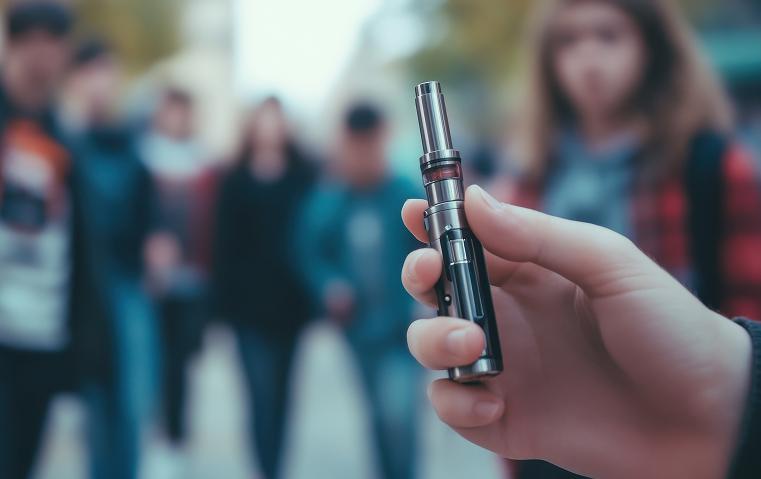
No one should encourage children to vape. But public health still requires proportion. The proposed PROTECT Act would authorize $100 million a year for five years for research, surveillance, campaigns and grants against youth vaping — expanding the institutional response after youth use has already fallen dramatically.
An Alarming Decline
The bill’s sponsors call youth vaping an “alarming rise” and cite more than 1.4 million current middle- and high-school users. In context, the direction is the opposite. Roughly 5.4 million students reported current e-cigarette use in 2019; the figure fell to 1.63 million in 2024, and the sponsors’ newer figure is lower still — a decline of about 70 percent from the peak.
Remaining use should not be ignored, particularly frequent and daily use. But “current use” includes any use in the previous 30 days, combining a one-time experiment with daily dependence. Experimentation, occasional use and addiction are not interchangeable measures.
Bloomberg’s Private Campaign Goes Public
Bloomberg Philanthropies committed $160 million in 2019 to a US campaign against flavored e-cigarettes and has committed more than $1.5 billion to tobacco control internationally. Its network includes organizations now supporting the PROTECT Act. The legislation would move much of this privately built agenda onto the federal balance sheet through $500 million in public research, communications and grants.
There is no evidence that Bloomberg directed the bill, and endorsement does not prove that any organization will receive funds. The relevant incentive is more ordinary: institutions help define an emergency, support public spending to address it and may be eligible to participate in the resulting programme — while the measured emergency is receding.
The Makary Mistake Repeated
The bill echoes former FDA Commissioner Marty Makary’s skepticism toward the federal survey showing youth vaping near 5 or 6 percent. Its sponsors cite the reduced number of users while writing as if the country faces a new surge. Public health loses credibility when both rising and falling numbers are made to prove the need for the same policy.
Proportion Matters
Vaping is not harmless, especially for young people who have never smoked. But cigarettes do most of their damage through combustion, not nicotine alone. The FDA acknowledges that e-cigarettes can generally offer adults who smoke a lower-risk alternative, while a major British evidence review found substantially lower exposure to harmful substances than from smoking.
The honest message is comparative: young nonsmokers should not vape, while smokers who switch completely can greatly reduce exposure to the toxic substances behind most smoking-related disease. Alcohol illustrates why comparison matters. Excessive drinking contributes to an estimated 4,000 deaths each year among Americans under 21; there is no comparable evidence of thousands of youth deaths from ordinary nicotine vaping.
Forbidden Fruit
Federal law already bans tobacco-product sales to people under 21, and retailers must verify younger customers’ ages. Those rules should be enforced, particularly against repeat offenders, without confusing age enforcement with the removal of products used by adults. Severe restrictions can redirect persistent demand toward unauthorized sellers that do not meet manufacturing, marketing or age-checking standards.
A 2021 observational study associated San Francisco’s flavored-tobacco sales ban with higher odds of recent cigarette smoking among underage high-school students relative to other districts. The disputed result does not establish causation, but it shows why policy must measure total behavior rather than only the prohibited product. A restriction that reduces vaping but increases smoking has not protected children.
The Missing Comparison
The bill emphasizes flavors, marketing, youth access and possible harms but gives little equivalent attention to adult switching, illicit supply or the danger of making smokers believe that changing products offers no benefit. A 2025 Cochrane review found high-certainty evidence that nicotine e-cigarettes produced higher quit rates than nicotine-replacement therapy.
The FDA’s 2026 authorization of products using age-verification technology also suggests that adult and youth access need not be treated as inseparable. Products can be available to adult smokers under marketing controls and continuing surveillance. A programme that defines vaping only as the problem cannot neutrally assess its role as part of the solution.
Risk of Delaying the End of Smoking
About 28 million American adults still smoke, and cigarettes plus secondhand exposure cause more than 480,000 US deaths each year. Even a small delay in switching to substantially safer products could outweigh modest additional reductions in youth experimentation. Yet the PROTECT Act offers no serious mechanism for weighing those competing effects.
If the initiative lowers one survey category while discouraging adult switching, strengthening illicit sales or preserving cigarette use, it could still declare success. The relevant outcome is not use of one product; it is total disease, disability and premature death.
What Is the Objective?
Tobacco policy should reduce disease and premature death, not eliminate nicotine regardless of relative risk. Parents and schools should discourage youth vaping, frequent young users should receive sensible cessation help and age limits should be enforced. None of that requires pretending vaping is smoking or describing a roughly 70 percent decline as a rise.
Bottom Line
The most dangerous nicotine product remains the cigarette, and the largest unresolved tobacco problem remains adult smoking. Spending half a billion dollars making alternatives less available, less attractive and less trusted may marginally reduce youth experimentation. It may also delay the end of combustible tobacco — an extraordinarily expensive way to make public health worse.