

Introduction
Prediction markets have moved rapidly from the margins of finance to the center of American legal and regulatory debate. During the 2024 presidential election, Polymarket became a widely cited alternative to conventional polling, at times assigning materially different probabilities to electoral outcomes. Kalshi's litigation with the Commodity Futures Trading Commission (CFTC) forced courts and regulators to reconsider the legal boundaries of event contracts. More recently, a CFTC enforcement action against a former White House employee who traded using advance knowledge of presidential speeches raised familiar questions about conflicts of interest and market integrity that have long occupied securities regulators. Collectively, these episodes demonstrate something important. Prediction markets are no longer an academic curiosity. They have become a significant financial innovation requiring a coherent regulatory response (Arrow et al. 2008; Wolfers and Zitzewitz 2004; KalshiEX LLC v. Commodity Futures Trading Commission 2023-2026; Commodity Futures Trading Commission 2026d).
The immediate debate concerns prediction markets. The broader question is how governments should regulate financial innovation more generally. Artificial intelligence, decentralized finance, tokenized assets, cryptocurrencies, retail derivatives, online sports betting, and prediction markets all challenge legal frameworks developed for institutions that once occupied relatively distinct economic roles. Increasingly, technological innovation is moving faster than the statutes intended to govern it (Goldfarb & Tucker 2019; SEC 2021).
For much of the twentieth century those distinctions appeared relatively straightforward. Securities markets primarily allocated capital. Commodity futures facilitated hedging and price discovery. Insurance pooled and transferred risk. Gambling was generally regarded as entertainment and regulated principally by the states. Regulatory institutions evolved around those economic functions. Increasingly, however, those functions overlap. A retail investor can purchase zero-day options, speculate on Bitcoin, trade contracts linked to Federal Reserve decisions, or wager on a baseball game without leaving the same smartphone. The underlying technologies differ, but each involves allocating capital under uncertainty (Knight 1921; Working 1949; Goldfarb & Tucker 2019).
Prediction markets illustrate this broader transformation particularly clearly. Their contracts resemble derivatives in legal structure, commodity futures in settlement, insurance in their treatment of uncertainty, and gambling because participants profit from correctly anticipating future events. Yet they fit comfortably into none of those categories. Much of the current policy debate therefore begins by asking the wrong question: are prediction markets really financial markets or really gambling? The answer is almost certainly both—and neither. Like many successful innovations, they combine functions that earlier generations of legislators assumed would remain institutionally separate.
The more useful question is different. How should policymakers regulate markets whose economic functions no longer correspond neatly to inherited legal classifications?
This paper argues that regulation should begin with economics rather than legal history. Markets should be evaluated according to the functions they perform, the market failures they generate, and the likelihood that regulatory intervention will improve outcomes relative to realistic institutional alternatives. That is neither an argument for deregulation nor an argument against consumer protection. Effective regulation often remains essential for protecting property rights, enforcing contracts, deterring fraud, preventing manipulation, and addressing demonstrable consumer harms. The key point is whether particular interventions are likely to outperform the imperfect markets they seek to improve (Coase 1960; Buchanan and Tullock 1962; Pirrong 1995).
No institution allocates resources under uncertainty without error. Markets, governments, expert judgment, and polling all fail under some circumstances. The relevant question is therefore comparative rather than absolute. Before intervening, policymakers should identify the relevant market failure and demonstrate that the proposed intervention is likely to perform better than the imperfect institution it replaces. This comparative perspective, central to modern law and economics, has too often been absent from contemporary debates over prediction markets (Coase 1960; Buchanan and Tullock 1962; Hayek 1945).
Prediction markets provide an unusually useful case study because they sit at the intersection of several established regulatory traditions while fitting neatly into none of them. More importantly, they are best understood not simply as the subject of this paper but as its first case study. The broader analytical framework developed here is intended to apply whenever financial innovation evolves more rapidly than the legal categories designed to govern it. How policymakers respond to prediction markets is therefore likely to influence future debates over artificial intelligence, decentralized finance, tokenized assets, and other innovations that similarly blur traditional institutional boundaries.
The paper proceeds in five parts. It first explains why prediction markets resist conventional legal classification, then develops a function-based alternative, examines the principal market failures that might justify intervention, considers how markets and regulatory institutions learn over time, and concludes with a practical framework for regulating financial innovation.
1. Prediction Markets and the Problem of Classification
Prediction markets are frequently described as a new financial innovation. In reality, markets organized around uncertainty have existed for centuries. Marine insurance developed because merchants sought to transfer the risks associated with dangerous voyages. Commodity futures emerged to allow farmers, merchants, and processors to manage exposure to uncertain harvests and fluctuating prices. Financial options created additional opportunities to hedge against—or speculate upon—future price movements. Organized betting on elections has existed in the United States since at least the nineteenth century. What is genuinely new is not the existence of markets tied to uncertain outcomes, but the combination of digital technology, standardized contracts, and mass participation that now allows large numbers of individuals to express views on future events almost instantaneously (Knight 1921; Working 1949; North 1990; Hanson 2003; Wolfers and Zitzewitz 2004).
This evolutionary perspective matters because institutions rarely emerge fully formed. Markets develop as technology changes, transaction costs fall, and new commercial opportunities become viable. Prediction markets are best understood as the latest stage in that process rather than as a radical departure from earlier forms of risk trading and speculation. They reduce the costs of creating, trading, and settling contracts linked to objectively verifiable future events, much as electronic securities trading transformed equity markets during the late twentieth century (Coase 1937; North 1990; Goldfarb and Tucker 2019).
Modern prediction markets allow participants to buy and sell contracts whose value depends upon objectively verifiable future events. Some concern inflation, unemployment, Federal Reserve decisions, tariffs, weather, or corporate earnings. Others concern elections, legislation, sporting events, entertainment awards, or geopolitical developments. During the research for this paper, I purchased a contract predicting that the U.S. government would not officially acknowledge the existence of extraterrestrial life before the end of 2028. The financial significance of the trade was trivial, but the contract itself was revealing. On the same exchange, participants could trade contracts linked to inflation, tariffs, baseball games, Academy Awards, and the possible existence of aliens. Prediction markets increasingly organize contracts around uncertainty itself rather than around traditional financial products or conventional sporting contests. Whether every such contract is socially valuable is a separate question from how the underlying institution should be regulated.
Economists have long been interested in prediction markets because they can aggregate dispersed information through prices. Individuals possessing superior information, stronger analysis, or greater confidence have incentives to trade, allowing some of their knowledge to become reflected in market prices. Unlike opinion polls, in which respondents generally incur little cost for expressing uninformed views, prediction markets require participants to place capital at risk. Accurate forecasts are rewarded and errors penalized. Prediction markets are therefore not simply speculative institutions; they also have the capacity to generate and aggregate information (Hayek 1945; Arrow et al. 2008; Berg, Nelson and Rietz 2008; Snowberg, Wolfers and Zitzewitz 2013).
That informational function gives prediction markets a social significance beyond the returns earned by traders. A continuously updated price can help journalists, businesses, researchers, and public officials see how dispersed participants interpret new evidence about inflation, monetary policy, regulatory approvals, weather, disease outbreaks, elections, or geopolitical risk. It may also reveal when official forecasts or expert consensus are losing credibility. Market prices should not be treated as verdicts: thin liquidity, poorly specified contracts, or herd behavior can make them wrong. But used alongside polling, modeling, and expert judgment, they provide an independent and rapidly updating signal. Regulation that eliminates such markets therefore sacrifices not only opportunities for speculation but a potentially useful source of public information (Wolfers and Zitzewitz 2004; Snowberg, Wolfers and Zitzewitz 2013).
The rapid convergence of prediction markets, sports betting, and retail options trading also suggests that these products increasingly compete for the same consumers, further weakening regulatory approaches built around historical legal categories (Baker et al. 2026).
This does not imply that prediction markets consistently outperform alternative forecasting methods. Like every other organization for processing information, they sometimes perform poorly. Thin liquidity, concentrated positions, poor contract design, ambiguous settlement criteria, and uncertainty about regulatory treatment can all produce misleading prices. Opinion polls suffer from sampling error, methodological differences, nonresponse bias, and model uncertainty. Expert judgment is vulnerable to overconfidence, confirmation bias, and groupthink (Tetlock 2005; Kahneman 2011). The relevant question is therefore not whether prediction markets are perfect, but whether under particular conditions they produce more useful information than realistic alternatives.
Recent experience illustrates both the promise and the limitations of these markets. During the 2024 presidential election, Polymarket became a frequent point of comparison with conventional polling and at times assigned materially different probabilities to electoral outcomes. Markets linked to inflation and Federal Reserve decisions are increasingly followed by investors and journalists because they summarize changing expectations continuously as new information becomes available. At the same time, controversies surrounding election contracts, market liquidity, settlement rules, and access by U.S. users demonstrate that prediction markets remain evolving institutions whose governance arrangements are still being tested (Arrow et al. 2008; Wolfers and Zitzewitz 2004; Commodity Futures Trading Commission 2024–2026).
Kalshi illustrates the resulting classification problem particularly well. Legally, it operates as a designated contract market regulated by the Commodity Futures Trading Commission. Economically, however, it combines characteristics traditionally associated with several different institutions. Its contracts resemble derivatives in legal structure and commodity contracts in their trading and settlement arrangements. They also resemble gambling because participants can profit from correctly anticipating uncertain future events.
Yet Kalshi generally operates as an exchange rather than as a bookmaker. It maintains an order book, matches opposing positions, administers standardized contracts, and earns transaction fees rather than ordinarily taking the opposite side of each customer’s trade. Participants are therefore trading contracts with one another through the exchange, although market makers may provide liquidity, rather than simply wagering against the platform itself. This institutional distinction does not eliminate legitimate regulatory concerns, but it does suggest that prediction markets should not automatically be analyzed as sportsbooks under another name (KalshiEX LLC v. Commodity Futures Trading Commission 2023–2026; Commodity Futures Trading Commission 2024–2026).
The distinction is economically significant. Traditional sportsbooks generally set or display odds, accept customer wagers, manage their own exposure, and earn revenue through the bookmaker’s margin. An exchange instead provides a venue in which participants take opposing positions, with the platform earning fees for facilitating transactions. The exchange model does not eliminate concerns about manipulation, consumer losses, or market integrity, but it changes their character. Exchange governance, liquidity, surveillance, contract design, settlement, and the conduct of market makers become at least as important as the consumer-protection issues traditionally associated with gambling.
Polymarket illustrates how rapidly these institutional models are evolving. Its original global platform was built around cryptocurrency infrastructure and operated outside the conventional U.S. regulatory framework, raising questions concerning jurisdiction, governance, settlement, and access by U.S. users. In 2025, however, Polymarket acquired a CFTC-regulated exchange and clearinghouse, and Polymarket US subsequently began operating within the federal derivatives framework. Comparing Kalshi, the original global Polymarket platform, and Polymarket US reinforces an important point: prediction markets are not a single product. They are a family of institutions employing different technologies, governance structures, methods of settlement, and regulatory arrangements.
The broader issue extends well beyond prediction markets themselves. Consumers increasingly move among Robinhood, Coinbase, DraftKings, Kalshi, Polymarket, and traditional brokerage platforms with remarkable ease. From the user’s perspective, these products increasingly compete for the same discretionary dollars through similar digital interfaces. A consumer can purchase Nvidia shares, speculate on Bitcoin, trade a contract linked to the next Federal Reserve meeting, and place a wager on a baseball game within minutes. Regulators, by contrast, continue to treat these activities as belonging to separate legal worlds governed by different agencies, statutes, and regulatory philosophies (Goldfarb and Tucker 2019; Securities and Exchange Commission 2021; IOSCO 2017).
The economic convergence described above is no longer merely conceptual. Prediction markets remain much smaller than the securities markets, but their recent growth has been exceptional. Because these industries report activity differently, Table 1 distinguishes transaction volume, betting handle, and operator revenue rather than collapsing them into a single measure.
Table 1. Scale and Growth of Selected Speculative Markets
Market or benchmark | Latest activity | Recent growth | Interpretation |
|---|---|---|---|
U.S. equities | 17.7 billion shares traded per day through November 2025 | +51% year over year | A vast, mature securities market. Share volume is not equivalent to dollars wagered. |
U.S. listed options | 15.3 billion contracts cleared in 2025 | +27.5% from 12.0 billion in 2024 | Rapid growth within an established federal regulatory framework. |
Legal U.S. sports betting | $166.94 billion handle; $16.96 billion operator revenue in 2025 | Handle +11.0%; revenue +22.8% | Handle is the amount wagered; revenue is what licensed sportsbooks retain. |
Prediction markets | Approximately $24 billion in global monthly volume in April 2026 | More than fourfold from under $5 billion in September 2025 | The fastest-growing category shown by reported transaction volume, not platform revenue. |
DraftKings (company benchmark) | $53.6 billion sportsbook handle; $6.05 billion total revenue in 2025 | Handle +11.4%; revenue +27.0% | A transparent public-company benchmark; total revenue includes more than sportsbook activity. |
Notes: Metrics are identified rather than treated as directly equivalent. Equity and options markets report trading units; sportsbooks report handle and revenue; prediction markets generally report contract volume. Prediction-market platforms do not publish audited revenue figures directly comparable with DraftKings. Sources: SIFMA (2025); OCC (2026); American Gaming Association (2026); Pew Research Center (2026); DraftKings (2026).
That divergence explains why prediction markets have become such an important case study. They expose a broader tension between economic reality and inherited legal categories. The question is no longer merely whether prediction markets resemble gambling or finance. The more fundamental question is whether legal classifications developed for twentieth-century institutions remain the appropriate starting point for regulating twenty-first-century financial innovation.
2. Regulating Markets by Function Rather than History
Every regulatory system begins by classifying economic activity. Legislators determine whether a product should be regulated as a security, a commodity, an insurance contract, a banking product, or a form of gambling because different legal frameworks apply to each. Historically, this approach worked reasonably well. Securities markets primarily allocated capital. Commodity futures facilitated hedging and price discovery. Insurance pooled and transferred risk. Gambling was generally regarded as entertainment and regulated principally by the states. Although these categories were never perfectly distinct, they broadly reflected the principal economic functions being performed (Knight 1921; Working 1949; Commodity Exchange Act).
Technological convergence increasingly exposes the weakness of regulation organized around historically separate product categories (Goldfarb and Tucker 2019; Securities and Exchange Commission 2021).
Prediction markets illustrate this transformation particularly well. They undoubtedly facilitate speculation, but speculation has never been unique to prediction markets. Investors speculate every day through equities, options, commodity futures, foreign exchange, cryptocurrencies, leveraged exchange-traded funds, and a wide range of derivative products. Simply describing prediction markets as speculative therefore tells policymakers very little about how they should be regulated (Knight 1921; Hanson 2003; Wolfers and Zitzewitz 2004).
What distinguishes prediction markets is not speculation alone but their capacity to aggregate dispersed information into continuously updated prices. Contracts linked to inflation, monetary policy, tariffs, FDA approvals, weather, corporate earnings, or elections generate market-based forecasts alongside opportunities for speculative trading. Indeed, the informational function depends upon the speculative one. Individuals reveal information precisely because they have incentives to trade upon it. Speculation is therefore not incidental to prediction markets; it is one of the mechanisms through which they produce socially valuable information (Hayek 1945; Arrow et al. 2008; Berg, Nelson and Rietz 2008; Snowberg, Wolfers and Zitzewitz 2013).
Recognizing this point changes the regulatory question. Rather than asking whether prediction markets resemble gambling, regulators should begin with economics: identify the functions a market performs, specify the market failures associated with those functions, and determine whether intervention is likely to improve outcomes relative to realistic institutional alternatives. Only after answering those questions should policymakers decide which regulatory framework is appropriate.
Too frequently, policymakers begin by identifying the closest historical analogy. Once a product has been labeled a security, a derivative, or a form of gambling, the accompanying regulatory framework largely follows automatically. Innovation is therefore forced into categories developed for institutions serving different economic purposes. The burden falls upon innovators to explain why inherited rules should not apply. A functional approach reverses that burden. Those advocating regulation should demonstrate not merely that market imperfections exist but that proposed interventions are likely to perform better than the imperfect institutions they seek to replace (Coase 1960; Buchanan and Tullock 1962).
Market imperfections justify regulation only when they generate identifiable harms that intervention can realistically reduce at acceptable cost. Because regulation itself raises costs, discourages entry, and may inhibit useful experimentation, policymakers must compare imperfect markets with realistic regulatory alternatives rather than with idealized regulation (Coase 1960; Buchanan and Tullock 1962; Niskanen 1971).
A simple example illustrates the point. Suppose three investors believe inflation will exceed current expectations during the coming year. One purchases Treasury Inflation-Protected Securities. Another buys commodity futures. A third purchases a prediction contract paying out if inflation exceeds a specified threshold. Economically, all three are expressing essentially the same expectation about future inflation through different financial instruments. Yet each transaction falls under a different regulatory framework that evolved through separate legislative histories rather than through any unified economic theory of uncertainty markets. History explains those distinctions. Economics does not necessarily justify them.
This does not imply that every market should be regulated identically. Securities regulation appropriately emphasizes disclosure, fiduciary obligations, insider trading, and investor protection. Commodity regulation focuses heavily on market integrity, manipulation, position limits, and orderly trading. Gambling regulation has traditionally emphasized underage participation, consumer protection, and gambling-related harms. Different markets create different risks. The point is not to eliminate regulatory distinctions but to ensure that they reflect contemporary economic realities rather than historical inheritance alone (IOSCO 2017; Securities and Exchange Commission 2021; Commodity Exchange Act).
The institutional consequences of classification are summarized in Table 2. Economically similar forms of speculation are assigned to markedly different regulators, levels of government, and substantive rules. The prediction-market dispute is therefore not simply semantic: classification determines who regulates, which harms receive priority, and whether federal law displaces state authority.
Table 2. Who Regulates Speculative and Risk-Transfer Markets?
Product or market | Primary regulator | Governmental level | Principal focus and boundary |
|---|---|---|---|
Public stocks | SEC; FINRA and exchanges as self-regulatory organizations | Primarily federal | Disclosure, investor protection, market integrity, and broker conduct; limited state securities-law roles remain. |
Listed securities options | SEC; FINRA, exchanges, and OCC | Primarily federal | Suitability, disclosure, margin, manipulation, and clearing. Options on futures or commodities generally fall under the CFTC. |
Commodity futures and options | CFTC; NFA and designated contract markets | Federal | Price integrity, manipulation, clearing, position risk, and market surveillance. |
Insurance | State insurance departments, coordinated through NAIC standards | Primarily state | Solvency, pricing, reserves, licensing, and consumer protection; McCarran–Ferguson preserves state primacy. |
Sports betting | State gaming or lottery commissions; tribal gaming authorities | State and tribal, with a federal overlay | Licensing, game integrity, responsible gambling, taxation, and location rules; federal criminal and anti-money-laundering laws also apply. |
State lotteries | State lottery agencies or commissions | State | Game authorization, consumer protection, revenue collection, and allocation of proceeds; usually operated or expressly authorized by the state. |
Prediction markets and event contracts | CFTC when traded through a designated contract market | Federal, but contested | Contract review, surveillance, fraud, manipulation, and exchange compliance. States dispute federal displacement when contracts resemble sports betting. |
Offshore prediction markets | Foreign authorities, if any | Non-U.S. or outside the U.S. regulated framework | Oversight varies substantially and should not be conflated with CFTC-regulated U.S. exchanges. |
Notes: The central anomaly is that economically similar sports positions may be regulated by state or tribal gaming authorities when offered by a sportsbook, but by the CFTC when listed as event contracts on a designated contract market. The CFTC asserts exclusive federal jurisdiction over regulated derivatives markets; state gaming authorities continue to contest that position. Sources: SEC (2021); CFTC (2026a, 2026c); NAIC (2026); American Gaming Association (2026).
That boundary is now the subject of a direct appellate conflict. In April 2026, the Third Circuit held at the preliminary-injunction stage that federal commodities law likely preempted New Jersey's attempt to regulate Kalshi's sports contracts. In August, the Ninth Circuit reached the opposite conclusion as to Nevada, holding that Kalshi had not shown that its sports contracts qualified as swaps or that federal law displaced Nevada's gaming rules. The disagreement strengthens the case for an economics-first framework, but it also means the immediate jurisdictional question may ultimately require Supreme Court or congressional resolution (KalshiEX LLC v. Flaherty 2026; KalshiEX, LLC v. Assad 2026).
The evolution of online sports betting illustrates how this process can occur in practice. During the research for The House Always Wins (Bate 2026), I observed how DraftKings, FanDuel, regulators, and responsible gaming organizations gradually shifted their attention from customer acquisition toward long-term sustainability. Identity verification, deposit and spending controls, behavioral monitoring, self-exclusion, customer education, and responsible gaming initiatives became increasingly sophisticated as markets matured. These developments reflected regulatory expectations, but they also reflected commercial incentives. Public trust, political legitimacy, and effective governance increasingly became competitive advantages rather than merely regulatory obligations (Bate 2026; DraftKings; FanDuel; National Council on Problem Gambling).
Prediction markets appear to be entering a comparable phase. Kalshi's sports offering still differs substantially from that of established sportsbooks, although the gap is narrowing as the exchange introduces player-stat contracts and combination markets. Established sportsbooks continue to provide a much broader entertainment product, including extensive live betting, promotional offers, and integrated parlays. More fundamentally, however, the institutional design differs. Participants generally trade contracts with one another through an exchange rather than wagering directly against a bookmaker. Whether these models ultimately converge remains uncertain, but it would be premature to assume they present identical regulatory problems simply because both involve uncertain future events (KalshiEX LLC v. Commodity Futures Trading Commission 2023–2026; Commodity Futures Trading Commission 2024–2026).
The broader lesson extends well beyond prediction markets. Financial innovation rarely arrives neatly packaged within existing statutory categories. Policymakers should therefore resist the temptation to begin by asking where a new product fits within existing law. A more useful starting point is to ask what the product actually does, what benefits it creates, what market failures it generates, and whether intervention is likely to improve outcomes. Classification should be the conclusion of regulatory analysis rather than its starting point. Recent work on retail betting markets reaches a similar conclusion, arguing that regulation organized around historical product categories becomes increasingly ineffective as financial products converge in function (Baker et al. 2026).
3. What Problem Is Regulation Trying to Solve?
The justification for regulation begins not with the existence of markets but with the existence of identifiable market failures. Every intervention imposes costs. Compliance requirements raise operating expenses, barriers to entry reduce competition, and restrictions on voluntary exchange inevitably limit consumer choice. Those costs may be justified, but only where intervention is likely to improve outcomes relative to the imperfect market it replaces. Within the economic framework adopted here, the existence of a market failure is therefore a necessary condition for regulation, but it is not, by itself, a sufficient one (Coase 1960; Buchanan and Tullock 1962; Niskanen 1971).
This principle is particularly important for prediction markets because many criticisms directed at them are neither novel nor unique. Fraud, manipulation, misuse of material nonpublic information, conflicts of interest, speculative excess, and consumer harm have challenged securities exchanges, commodity futures markets, insurance markets, and sportsbooks for decades. The relevant policy question is therefore not whether these risks exist—they plainly do—but whether prediction markets create distinctive problems that justify materially different regulatory treatment (IOSCO 2017; Commodity Exchange Act; Securities and Exchange Commission 2021).
Fraud presents the clearest case for intervention. Markets cannot function if participants lack confidence that contracts will be honored, settlement rules consistently applied, or counterparties treated fairly. Preventing fraud has therefore been one of the oldest and least controversial functions of commercial regulation. Prediction markets are no exception. Clear contract specifications, transparent settlement procedures, credible dispute resolution, and effective enforcement are prerequisites for functioning exchanges regardless of whether the underlying contract concerns wheat, Treasury securities, inflation, elections, or sporting events (Pirrong 1995; IOSCO 2017).
Experimental evidence finds that attempted manipulation often attracts informed traders to the other side of the market and may therefore improve rather than degrade price accuracy. A prominent real-world example occurred on Intrade during the 2012 presidential election, when a large trader spent millions supporting Mitt Romney contracts at prices apparently above prevailing assessments. Other participants traded against the distortion, and the trader ultimately suffered losses exceeding $4 million. The episode suggests both that manipulation can affect prices temporarily and that sustaining it becomes increasingly expensive when informed counterparties and adequate liquidity are present (Hanson, Oprea and Porter 2006; Rothschild and Sethi 2016). This does not eliminate the need for oversight. It suggests that surveillance and enforcement are likely to prove more effective than restrictions on the existence of the market itself.
Applied concretely, that analysis points toward a graduated response. If the concern is that a large trader can distort the price of an illiquid election or policy contract, regulators should first require transparent position reporting, credible market surveillance, enforceable anti-manipulation rules, and, where evidence warrants them, contract-specific position limits. Prohibiting the contract may prevent manipulation, but it also eliminates the price-discovery function that made the market potentially valuable. The relevant comparison is therefore between targeted safeguards and suppression of the market, not between an imperfect market price and an imagined price immune from strategic trading.
Two completed Kalshi cases show that the existing system can identify and punish misconduct. In one, a political candidate traded on his own candidacy, conduct prohibited because he could directly or indirectly influence the outcome. Kalshi disgorged the profits, imposed an additional penalty, and suspended him for five years. In the other, surveillance systems flagged a YouTube editor whose highly successful trades suggested advance knowledge of forthcoming videos. Kalshi froze the account, prevented the withdrawal of profits, imposed a financial penalty exceeding $20,000, and suspended the trader for two years. Both cases were reported to the CFTC, which subsequently issued an enforcement advisory confirming its authority over misuse of nonpublic information, fraud, manipulation, and other prohibited conduct on designated contract markets (Commodity Futures Trading Commission 2026b; Kalshi 2026).
A subsequent federal case makes the point even more clearly. In August 2026, the CFTC ordered former White House technical adviser Gabriel Perez to disgorge $107,539 in profits, pay a $65,000 civil penalty, and accept a three-year trading ban. Perez had used advance access to presidential speeches to trade 43 contracts concerning words the president would mention. The enforcement action addressed the precise misconduct, misappropriation of material nonpublic information, without requiring the underlying market to be reclassified or prohibited (Commodity Futures Trading Commission 2026d).
These cases show how conduct-based rules can travel across institutional categories. Trading on confidential information or on an outcome one can influence creates essentially the same integrity problem whether the transaction occurs through a security, a commodity derivative, or an event contract. The practical response is to define prohibited conduct, preserve and examine trading records, report suspicious activity, and enforce conflicts rules against the individual concerned. Relabeling the venue as gambling would neither identify the misconduct more accurately nor make it easier to detect. Here, exchange surveillance and existing commodity-law authority addressed the actual wrongdoing without suppressing the market itself.
Some contracts raise ethical concerns even when they are honestly administered. Markets tied to assassination, terrorist attacks, violent death, or an identifiable person’s private tragedy may be repugnant, may inflict additional harm on victims and families, and may undermine confidence in the exchange. A sharper problem arises when a participant can influence the result or trade on privileged knowledge—for example, when a political insider trades on an official decision or a person with control over an event profits from its occurrence. Yet subject matter alone should not decide the issue. Markets concerning wars, disease outbreaks, or natural disasters address grim events but may still provide valuable warnings. The relevant distinctions are among distaste, harm imposed on identifiable third parties, informational value, and a credible incentive or ability to help cause the predicted outcome.
That distinction supplies an operational rule. Contracts should face heightened review or prohibition when traders can materially influence the outcome, when the contract creates a plausible financial reward for causing harm, or when listing it imposes serious harms on identifiable third parties that disclosure and narrower safeguards cannot reasonably reduce. Exchanges should exclude people able to control the outcome, enforce restrictions on material nonpublic information, scrutinize contracts involving violence, apply position limits where manipulation or incentive effects are credible, and decline contracts whose informational value is slight relative to their risks. This approach does not pretend that ethical judgments can be eliminated. It requires regulators to connect those judgments to specified mechanisms of harm rather than treating offensiveness alone as a sufficient regulatory category (Commodity Exchange Act; Commodity Futures Trading Commission 2024–2026).
Consumer protection presents the most politically contentious issue because it is also the area where policymakers are most tempted to regulate broad categories of activity rather than identifiable harms. Every speculative market attracts participants who underestimate risk, overestimate their own abilities, or continue trading beyond prudent financial limits. Prediction markets are unlikely to prove different. Yet financial losses alone do not constitute evidence of market failure. Investors routinely lose money trading equities, options, commodity futures, cryptocurrencies, and venture capital. The appropriate question is therefore not whether participants incur losses but whether prediction markets generate distinctive consumer harms that justify intervention beyond that already applied to comparable financial products (Kahneman 2011).
That distinction also sets a limit on the consumer-protection case. Adults sometimes make bad bets, misjudge probabilities, or continue trading after losses. Those behaviors may be unwise, but they do not by themselves establish a market failure or justify regulatory intervention. A coherent case for intervention requires an additional mechanism of harm: deception or materially misleading information; impaired control associated with addiction; platform practices deliberately designed to exploit such impairment; or substantial costs imposed on identifiable third parties. Without such a mechanism, regulation risks converting disagreement with an adult's choices into a rationale for paternalism.
This does not make the experience of gambling regulation irrelevant. Voluntary self-exclusion, user-selected deposit or spending limits, clear disclosure of prices and fees, and tools that allow customers to interrupt their own activity can help individuals who actively want assistance controlling their behavior without substituting the regulator's preferences for theirs. More intrusive measures require stronger evidence. A mandatory cooling-off period, for example, should not be justified merely because some traders chase losses; regulators should have evidence that the behavior reflects impaired control, that the intervention addresses that mechanism, and that its benefits exceed the costs imposed on ordinary participants. The same burden of proof that applies elsewhere in this paper should apply to consumer protection.
Prediction markets appear to be entering a comparable stage of development. During the preparation of this paper I opened and actively used a Kalshi account to better understand the customer experience. My first impression was not that I had entered a sportsbook. The platform felt much closer to an exchange organized around uncertainty. Contracts ranged from inflation and tariff policy to baseball games and the possibility that the United States government might officially acknowledge extraterrestrial life before the end of 2028. The experience was eclectic rather than specialized, but it also highlighted an important institutional distinction. Participants generally trade contracts with one another through the exchange rather than wager directly against a bookmaker. Identity verification, contract specifications, and confirmation screens introduced some friction into the trading process. These observations do not imply that prediction markets deserve lighter regulation. They do suggest that they should be evaluated according to their own institutional characteristics rather than assumed to create identical risks to those associated with conventional sportsbooks (KalshiEX LLC v. Commodity Futures Trading Commission 2023–2026).
The broader lesson is that regulatory analysis should remain focused on identifiable market failures rather than institutional novelty. Prediction markets undoubtedly present genuine challenges. Some contracts may invite manipulation. Others may generate gambling-related harms or raise legitimate ethical concerns. Those possibilities deserve careful empirical evaluation. But novelty alone is not a market failure. Policymakers should intervene because particular harms have been demonstrated and because there is good reason to believe intervention will improve outcomes—not simply because a new institution fails to resemble familiar ones (Coase 1960; Buchanan and Tullock 1962; Pirrong 1995).
The discussion so far has focused primarily on the behavior of individual markets. The next question is broader. How do markets, firms, and governments themselves evolve over time, and what does that imply for the design of regulatory institutions?
4. Institutions Learn: Markets, Governments, and Competition
Prediction markets are often discussed as though regulation were a contest between markets and governments. Markets innovate. Governments regulate. Markets pursue profits while governments pursue the public interest. Although politically attractive, this dichotomy bears little resemblance to how institutions actually evolve. Governments are legislators, regulators, litigants, tax collectors, and, in many jurisdictions, gambling operators. Firms are profit-seeking organizations, but they are also governance institutions that develop rules, compliance systems, surveillance mechanisms, and reputations over time. Consumers learn. Courts learn. Regulators learn. Exchanges learn. The relevant comparison is therefore not between markets and governments but among competing institutions, each possessing different incentives, information, and constraints (Coase 1960; North 1990; Buchanan and Tullock 1962).
This perspective has long occupied a central place in institutional economics. Ronald Coase argued that institutions should be compared against realistic alternatives rather than hypothetical perfection. Douglass North emphasized that institutions evolve because they reduce transaction costs while adapting to changing economic conditions. Hayek demonstrated that decentralized systems generate knowledge unavailable to central planners. Together these insights suggest that regulatory analysis should focus less on abstract ideals and more on how alternative institutional arrangements actually perform under real-world conditions (Hayek 1945; Coase 1960; North 1990).
State lotteries make the contrast particularly revealing. A lottery ticket contributes virtually no information and offers the purchaser no meaningful opportunity to improve the expected outcome through research or judgment; its principal institutional function is to raise government revenue. Prediction markets, and to a lesser extent sports wagering, are different. Skill does not guarantee success, but successful participants often devote substantial effort to gathering information, constructing probabilities, and identifying mispriced contracts. Governments therefore frequently reserve their most favorable treatment for the form of speculation that produces the least information but the most direct public revenue. (Clotfelter and Cook 1989).
Lotteries make the potential conflict particularly visible. The state is not merely permitting an activity and taxing it; in most jurisdictions it authorizes, operates, or directly benefits from the product while simultaneously deciding which competing forms of speculation may legally be offered. A private sportsbook or prediction exchange seeking to restrict a competitor would properly attract scrutiny of its incentives. Public institutions should not be exempt from the same analysis. A government that receives revenue from lotteries and licensed gambling has a fiscal interest in the regulatory boundaries separating those products from prediction markets.
This does not establish that restrictions on prediction markets are motivated by revenue protection, nor does it invalidate legitimate concerns about fraud, manipulation, addiction, or third-party harm. It does mean that government is not a disinterested referee. When regulators distinguish among economically similar forms of speculation, their own fiscal and institutional interests belong in the comparative analysis. The appropriate burden is therefore symmetrical: private firms should have to justify conduct that harms consumers or market integrity, while governments should have to justify restrictions that protect incumbent regulatory and revenue arrangements from competition.
Public-choice economics provides a framework for understanding this problem. Regulators and public institutions respond to incentives just as consumers and businesses do. Regulatory outcomes may therefore reflect fiscal interests, bureaucratic incentives, and institutional history alongside genuine concerns about consumer welfare. Applying the same analytical framework to governments that economists routinely apply to private firms encourages a more balanced assessment of regulatory proposals.
The evolution of legal sports betting demonstrates how institutional learning occurs in practice. Following Murphy v. NCAA, operators understandably focused on customer acquisition, promotional offers, and rapid geographic expansion. As competition intensified, however, attention gradually shifted toward responsible gaming, identity verification, behavioral monitoring, customer protection, and long-term retention. During the research for The House Always Wins, I observed this evolution through interviews with operators, regulators, academics, and gamblers. The important point was not simply that regulation became more sophisticated. Markets themselves evolved. Firms increasingly recognized that trust, legitimacy, and effective governance had become valuable commercial assets rather than regulatory obligations imposed from outside (Bate 2026; Murphy v. NCAA 2018; DraftKings; FanDuel).
Prediction markets appear to be entering a comparable stage of development. Existing governance arrangements should not be regarded as permanent. Exchanges will almost certainly refine surveillance systems, improve contract design, strengthen consumer protections, and develop more sophisticated mechanisms for identifying suspicious trading. Regulators will likewise accumulate experience through enforcement actions, litigation, market observation, and technological change. Institutional learning should therefore be expected rather than regarded as evidence that regulation has somehow failed (Pirrong 1995; Commodity Futures Trading Commission 2026b).
This observation has important implications for public policy. Regulation that attempts to prescribe detailed institutional arrangements at an early stage risks freezing markets before competition has revealed better alternatives. Financial history repeatedly demonstrates that governance innovations emerge gradually through interaction among commercial incentives, competition, litigation, judicial interpretation, and regulation rather than through legislative design alone. Organized exchanges, standardized contracts, clearinghouses, disclosure practices, and surveillance systems all evolved incrementally as markets matured (Coase 1937; Coase 1960; North 1990; Pirrong 1995).
Federalism reinforces this process of institutional discovery. Since Murphy, states have adopted markedly different approaches to taxation, licensing, advertising, consumer protection, and responsible gaming. Some have emphasized stronger restrictions on advertising, others have concentrated on self-exclusion programs or behavioral monitoring, while still others have relied more heavily on market competition. This diversity should not necessarily be viewed as inconsistency. It creates opportunities to compare institutional performance under different regulatory arrangements and to modify policy in light of accumulating evidence. As Justice Louis Brandeis famously observed, states may serve as laboratories of democracy. They also function as laboratories of institutional learning.
Competition performs a similar role within markets themselves. Exchanges compete not only on products and prices but increasingly on governance. Platforms perceived as vulnerable to manipulation, weak contract design, or poor consumer protection will struggle to attract liquidity over time. During my own experience using Kalshi, I was struck less by the sophistication of individual contracts than by the platform's willingness to experiment. Some contracts appeared likely to generate valuable information. Others seemed unlikely ever to attract meaningful liquidity. That is precisely how competitive markets discover value. Consumers reveal preferences, exchanges respond, successful products expand, and unsuccessful ones disappear without requiring legislative intervention.
This evolutionary perspective also explains why prediction markets should not be evaluated solely through the lens of sports betting. Sports contracts have attracted disproportionate political attention because they blur existing regulatory boundaries most visibly. Yet they represent only one application of a much broader institutional innovation. Markets predicting inflation, monetary policy, weather, disease outbreaks, corporate earnings, geopolitical developments, or other objectively verifiable events perform informational functions extending well beyond entertainment. Different classes of contracts may therefore justify different regulatory approaches even when they employ identical trading mechanisms. Economic function, rather than institutional ancestry, should remain the starting point for regulatory analysis (Arrow et al. 2008; Hanson 2003; Wolfers and Zitzewitz 2004).
Institutional learning does not argue for regulatory passivity. Nor does it imply that markets inevitably solve every governance problem. It suggests something more modest and, I would argue, more useful. Policymakers should recognize that markets, firms, regulators, courts, and consumers all adapt in response to new information. Effective regulation should therefore encourage learning rather than assume legislators can identify the optimal institutional design before markets themselves have had an opportunity to evolve. That principle extends well beyond prediction markets. It applies equally to artificial intelligence, decentralized finance, tokenized assets, and financial innovations yet to emerge.
Box 1. Can Prediction Markets Test Tobacco-Control Claims?
Prediction markets could illuminate policy questions far beyond elections, sports, and economic statistics. Tobacco regulation is a useful test case because advocates and critics routinely make confident, competing claims whose outcomes are measurable but often assessed only years later. Those claims can be translated into objectively resolvable event contracts.
Possible contracts: Will U.S. adult cigarette smoking fall below 8 percent by 2030? Will the FDA authorize a flavored vaping product by a specified date? Will adult nicotine-pouch use exceed conventional smokeless-tobacco use? Will measured illicit sales rise after a state flavor ban or large excise-tax increase? Will the European Union adopt taxes differentiated according to product risk? Will a future WHO Framework Convention on Tobacco Control meeting formally acknowledge differences in risk among nicotine products?
Such markets would not determine whether a policy is desirable or substitute for epidemiology or clinical evidence. They would aggregate information held by regulators, researchers, retailers, consumers, manufacturers, enforcement officials, and public-health specialists, producing continuously updated estimates rather than occasional forecasts from institutions whose reputations or budgets may be tied to particular positions.
Contract design would be decisive. Each outcome would need an unambiguous threshold, date, jurisdiction, and pre-specified data source. Thin markets should be treated cautiously, and contracts should be screened for manipulation or participation by people able to control the outcome. Even modest markets, however, could force policy advocates on all sides to state their expectations in falsifiable terms.
Kalshi or another regulated operator could test the idea through a pilot series of public-policy contracts developed with independent researchers. The same method could then be applied to education, health, trade, energy, criminal justice, and other areas in which governments and campaigners make measurable predictions. Over time, archived market prices could reveal not merely what informed participants expected, but which institutions repeatedly forecast well and which forecast badly.
5. A Framework for Regulating Financial Innovation
Prediction markets should neither be exempt from regulation nor forced into legal categories developed for institutions serving different economic purposes. The argument developed throughout this paper is that financial innovation increasingly blurs traditional regulatory boundaries while legal systems continue to rely upon classifications inherited from an earlier technological era. The objective should therefore be neither deregulation nor regulatory expansion for its own sake, but regulation grounded in economic function, demonstrable market failure, and comparative institutional analysis (Coase 1960; Buchanan and Tullock 1962).
In operational terms, policymakers should apply a four-stage test. First, identify the economic function the product performs. Second, identify the specific mechanism of harm or market failure rather than treating novelty, financial loss, or behavior regulators consider unwise as sufficient evidence. Third, compare a targeted intervention with existing law, market-based correction, and more restrictive alternatives, including prohibition. Fourth, adopt the least restrictive measure reasonably likely to produce a net improvement, and revise it as evidence accumulates. This is the paper's economics-first decision rule.
Figure 1. A Framework for Regulating Financial Innovation
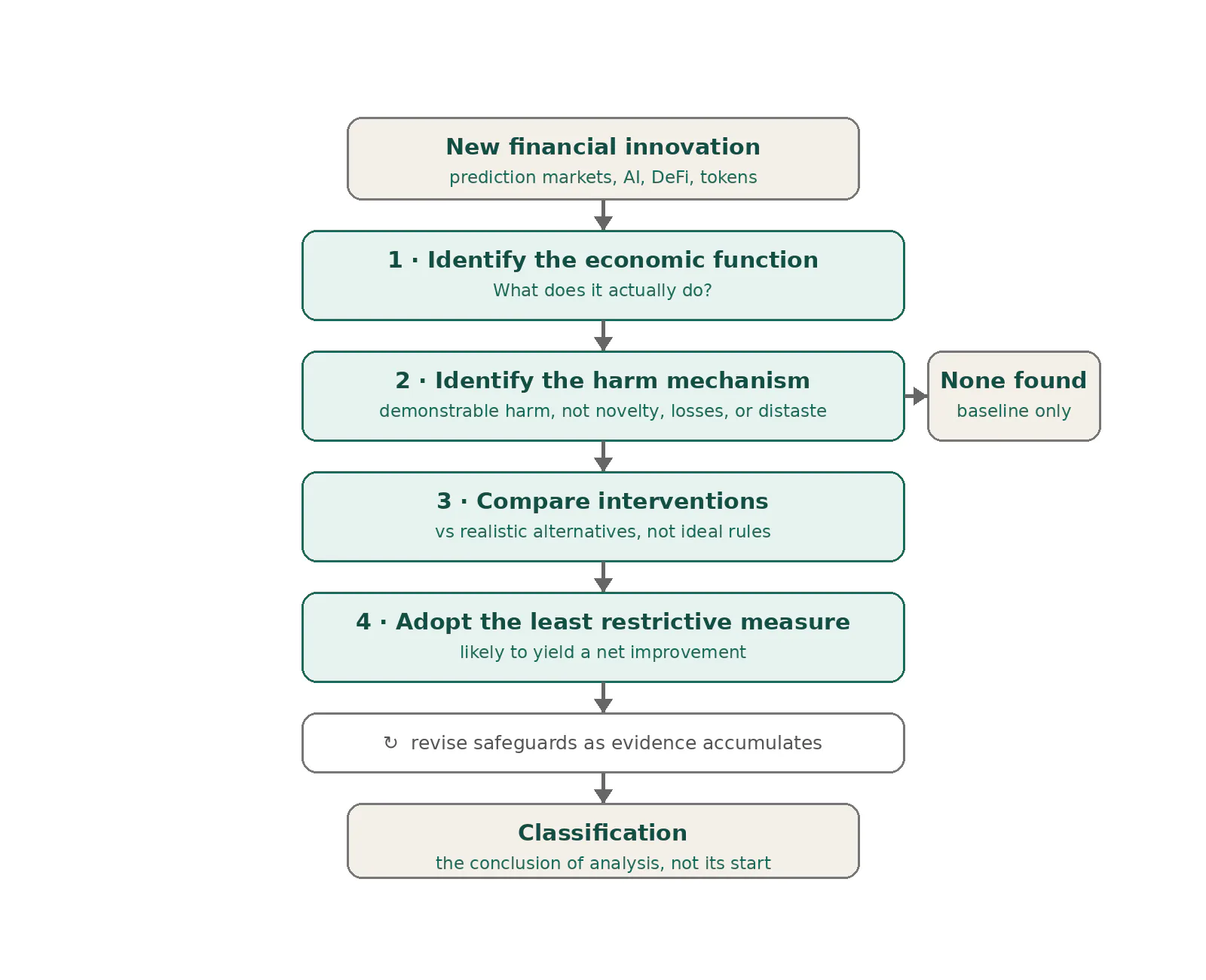
Note: If no demonstrable market failure is identified, baseline rules remain appropriate. Classification follows the functional and comparative analysis rather than preceding it.
Several broad principles follow.
Begin with economic function rather than legal inheritance.
Financial innovation increasingly combines functions that legislators once assumed would remain institutionally separate. Prediction markets facilitate speculation, aggregate dispersed information, and permit limited forms of risk transfer. Artificial intelligence, decentralized finance, tokenized assets, and future innovations are likely to blur other longstanding distinctions in similar ways. Policymakers should therefore begin by asking what economic functions a market performs rather than which existing statute most closely resembles it (Hayek 1945; Arrow et al. 2008; Goldfarb and Tucker 2019).
Require evidence before intervening.
The existence of market imperfections is not, by itself, sufficient justification for regulation. Intervention should be based upon identifiable market failures together with evidence that the proposed regulatory response is likely to improve outcomes relative to realistic institutional alternatives. This principle is neither ideological nor unique to prediction markets. It follows directly from comparative institutional analysis and should apply equally to every financial innovation (Coase 1960; Buchanan and Tullock 1962; Pirrong 1995).
Regulate harmful conduct rather than unfamiliar institutions whenever possible.
Fraud, manipulation, deceptive practices, misuse of confidential information, and failures of contract enforcement undermine market integrity regardless of the institutional setting in which they occur. Rules directed toward harmful conduct are therefore likely to prove more durable than rules directed toward particular technologies because technologies evolve while the underlying principles of commercial law remain comparatively stable (Commodity Exchange Act; IOSCO 2017; Securities and Exchange Commission 2021).
Favor proportionate interventions over categorical restrictions.
Consumer protection should target identifiable mechanisms of harm rather than poor choices as such. Measures that preserve individual agency—clear disclosure, voluntary self-exclusion, user-selected limits, and effective tools for customers seeking help—present a relatively modest intrusion. Mandatory behavioral interventions require a stronger evidentiary case, particularly where they restrict informed adults who understand the risks they are taking. The relevant test remains comparative: identify the harm, show how the intervention addresses it, and ask whether the expected benefit exceeds the costs imposed on legitimate participation.
Allow institutions to evolve.
Markets, firms, regulators, courts, and consumers all learn through experience. During the research for The House Always Wins, I observed how legal sportsbooks progressively strengthened governance, responsible gaming, and consumer protection as markets matured (Bate 2026). Prediction markets appear to be entering a similar phase of institutional development. Regulation should facilitate that learning process rather than freeze today's institutional arrangements into permanent legal structures before competition has revealed superior alternatives (North 1990; Pirrong 1995).
Use federalism to generate evidence.
Different states will continue experimenting with taxation, licensing, consumer protection, advertising, and responsible gaming. Some approaches will prove more successful than others. A decentralized system allows policymakers to compare institutional performance, abandon unsuccessful policies, and adopt successful innovations voluntarily. Federalism therefore generates knowledge as well as constitutional diversity.
Maintain technological neutrality.
Prediction markets are unlikely to be the final innovation challenging inherited regulatory categories. Artificial intelligence, decentralized finance, tokenized assets, algorithmic trading, and technologies yet to emerge will create similar problems. Durable regulatory systems should therefore rest upon enduring economic principles rather than the characteristics of any particular technology (Goldfarb and Tucker 2019; Securities and Exchange Commission 2021).
Taken together, these principles suggest a broader shift in regulatory philosophy. Policymakers should move away from asking where new products fit within existing statutory categories and toward asking what market failures actually require correction. Classification should become the consequence of analysis rather than its starting point.
This framework does not imply that every prediction market deserves approval. Some contracts may create risks sufficiently serious to justify additional restrictions or, in some cases, prohibition. Others may generate relatively little informational value while functioning primarily as entertainment. Such judgments are both legitimate and unavoidable. The argument advanced here is simply that they should rest upon empirical evidence, demonstrable harms, and realistic institutional comparison rather than historical analogy alone.
In institutional terms, this points toward a layered regime rather than a new regulator created specifically for prediction markets. The CFTC should maintain the federal baseline for event contracts traded on designated contract markets, including common rules against fraud, manipulation, misuse of material nonpublic information, and trading by people able to control outcomes. Exchanges should conduct initial contract review, monitor positions and suspicious activity, publish clear settlement rules, and enforce participant exclusions. Consumer protections should be calibrated to the contract and observable patterns of use rather than imported wholesale from either securities or gambling law. Federal authorities should consult state and tribal regulators when products closely replicate sports betting, while still resolving jurisdiction according to economic function and governing law rather than labels alone. Low-risk markets with plausible forecasting or hedging value should have a straightforward route to listing; contracts involving violence, outcome control, or serious third-party harms should receive heightened review. Regulators should then evaluate performance and revise safeguards as evidence accumulates.
Prediction markets are therefore best understood not as an isolated regulatory problem but as the first prominent example of a broader challenge that policymakers are likely to confront repeatedly during the coming decades. Financial innovation will continue to blur institutional boundaries. Effective regulation will increasingly depend upon understanding economic function rather than institutional ancestry.
Conclusion
Prediction markets are among the first major financial innovations of the twenty-first century to expose the growing mismatch between technological change and inherited legal categories. Their significance lies not simply in the contracts they trade but in the broader regulatory questions they raise. When innovation blurs the boundaries between investing, insurance, gambling, and information markets, should policymakers continue relying upon classifications developed for another era, or should regulation evolve alongside the institutions it governs?
This paper has argued for the latter approach.
Prediction markets resist simple classification because they perform several economic functions simultaneously. They facilitate speculation, aggregate dispersed information, and permit limited forms of risk transfer. That complexity is precisely why they should not automatically be assigned to regulatory frameworks developed for institutions serving different economic purposes.
The appropriate response is neither deregulation nor reflexive intervention. It is regulation grounded in economic function, demonstrable market failure, and comparative institutional analysis. Fraud should be deterred. Manipulation should be punished. Consumer harms should be addressed where they can be demonstrated. But policymakers should also recognize that regulation is itself an imperfect institution whose costs and unintended consequences deserve the same scrutiny routinely applied to markets. The appropriate comparison is therefore not between imperfect markets and ideal regulation but between alternative institutional arrangements operating under real-world conditions (Coase 1960; Buchanan and Tullock 1962; North 1990).
The durable lesson is methodological: begin with economic function, identify a demonstrable mechanism of harm, and compare proposed interventions with realistic alternatives. That approach will remain useful long after today's debates over Kalshi, Polymarket, and prediction markets have passed.
Legislators cannot write a separate regulatory framework for every innovation that emerges. They can, however, establish principles capable of adapting as technology changes. Prediction markets matter in their own right, but they are also a major test of whether regulatory systems can move from classifying products according to institutional history toward regulating them according to the functions they actually perform.
References
American Gaming Association (2026) ‘Commercial Gaming Revenue Hits $78.7 Billion in 2025, Driving Record $18.1 Billion in Gaming Taxes Nationwide’, 26 February. Available at: https://www.americangaming.org/commercial-gaming-revenue-hits-78-7-billion-in-2025-driving-record-18-1-billion-in-gaming-taxes-nationwide/
Arrow, K.J., Forsythe, R., Gorham, M., Hahn, R., Hanson, R., Ledyard, J.O., Levmore, S., Litan, R., Milgrom, P., Nelson, F.D., Neumann, G.R., Ottaviani, M., Schelling, T.C., Shiller, R.J., Smith, V.L., Snowberg, E., Sunstein, C.R., Tetlock, P.C., Tetlock, P.E., Varian, H.R., Wolfers, J. and Zitzewitz, E. (2008) 'The Promise of Prediction Markets', Science, 320(5878), pp. 877–878.
Baker, S.R., Balthrop, J., Johnson, M.J., Kotter, J.D. and Pisciotta, K. (2026) ‘Retail Betting Markets’, NBER Working Paper No. 35520. Cambridge, MA: National Bureau of Economic Research.
Bate, R. (2026) The House Always Wins: The Business, Politics, and Human Cost of Sports Betting. New York: Post Hill Press.
Berg, J.E., Nelson, F.D. and Rietz, T.A. (2008) 'Prediction Market Accuracy in the Long Run', International Journal of Forecasting, 24(2), pp. 285–300.
Brandeis, J., dissenting, New State Ice Co. v. Liebmann, 285 U.S. 262, 311 (1932).
Buchanan, J.M. and Tullock, G. (1962) The Calculus of Consent: Logical Foundations of Constitutional Democracy. Ann Arbor: University of Michigan Press.
Clotfelter, C.T. and Cook, P.J. (1989) Selling Hope: State Lotteries in America. Cambridge, MA: Harvard University Press.
Coase, R.H. (1937) 'The Nature of the Firm', Economica, 4(16), pp. 386–405.
Coase, R.H. (1960) 'The Problem of Social Cost', Journal of Law and Economics, 3, pp. 1–44.
Commodity Exchange Act, 7 U.S.C. §§1–27f.
Commodity Futures Trading Commission (2026a) ‘CFTC Reaffirms Exclusive Jurisdiction over Prediction Markets in U.S. Circuit Court Filing’, Press Release No. 9183-26, 17 February.
Commodity Futures Trading Commission (2026b) Division of Enforcement Issues Prediction Markets Advisory. Press Release No. 9185-26.
Commodity Futures Trading Commission (2026c) Understanding Prediction Markets and Event Contracts. Washington, DC: CFTC.
Commodity Futures Trading Commission (various years) Orders, opinions and guidance relating to event contracts and designated contract markets.
DraftKings Inc. (2025) Responsible Gaming. Available at: https://www.draftkings.com/responsible-gaming
DraftKings Inc. (2026) Annual Report for the Fiscal Year Ended December 31, 2025. Boston, MA: DraftKings Inc.
FanDuel Group (2025) Responsible Play. Available at: https://www.fanduel.com/responsible-gaming
Goldfarb, A. and Tucker, C. (2019) 'Digital Economics', Journal of Economic Literature, 57(1), pp. 3–43.
Hanson, R. (2003) 'Combinatorial Information Market Design', Information Systems Frontiers, 5(1), pp. 107–119.
Hanson, R., Oprea, R. and Porter, D. (2006) 'Information Aggregation and Manipulation in an Experimental Market', Journal of Economic Behavior & Organization, 60(4), pp. 449–459.
Hayek, F.A. (1945) 'The Use of Knowledge in Society', American Economic Review, 35(4), pp. 519–530.
International Organization of Securities Commissions (IOSCO) (2017) Objectives and Principles of Securities Regulation. Madrid: IOSCO.
Kahneman, D. (2011) Thinking, Fast and Slow. New York: Farrar, Straus and Giroux.
Kalshi (2026) 'Two Insider Cases We’ve Recently Closed', 25 February. Available at: https://news.kalshi.com/p/kalshi-trading-violation-enforcement-cases
KalshiEX LLC v. Commodity Futures Trading Commission (2023–2026), litigation filings and judicial opinions.
Knight, F.H. (1921) Risk, Uncertainty and Profit. Boston: Houghton Mifflin.
Murphy v. National Collegiate Athletic Association, 584 U.S. ___ (2018).
National Council on Problem Gambling (2025) Responsible Gambling Resources. Washington, DC.
National Association of Insurance Commissioners (2026) McCarran–Ferguson Act. Washington, DC: NAIC.
National Association of State and Provincial Lotteries (NASPL) (2025) Annual Sales and Revenue Report.
Niskanen, W.A. (1971) Bureaucracy and Representative Government. Chicago: Aldine.
North, D.C. (1990) Institutions, Institutional Change and Economic Performance. Cambridge: Cambridge University Press.
Options Clearing Corporation (2026) 2025 Annual Report. Chicago, IL: OCC.
Pew Research Center (2026) ‘Trading Volume on Prediction Markets Has Soared in Recent Months’, 27 May.
Pirrong, S.C. (1995) 'The Self-Regulation of Commodity Exchanges', Journal of Law and Economics, 38(1), pp. 141–206.
Securities and Exchange Commission (2021) Staff Report on Equity and Options Market Structure Conditions in Early 2021. Washington, DC: U.S. Securities and Exchange Commission.
Securities Industry and Financial Markets Association (2025) ‘Four Top Takeaways from SIFMA’s 2025 State of the Industry Briefing’, 3 December.
Rothschild, D.M. and Sethi, R. (2016) 'Trading Strategies and Market Microstructure: Evidence from a Prediction Market', Journal of Prediction Markets, 10(1), pp. 1–29.
Snowberg, E., Wolfers, J. and Zitzewitz, E. (2013) 'Prediction Markets for Economic Forecasting', in Elliott, G. and Timmermann, A. (eds.) Handbook of Economic Forecasting, Vol. 2. Amsterdam: Elsevier, pp. 657–687.
Tetlock, P.E. (2005) Expert Political Judgment. Princeton: Princeton University Press.
Working, H. (1949) 'The Theory of Price of Storage', American Economic Review, 39(6), pp. 1254–1262.
Wolfers, J. and Zitzewitz, E. (2004) 'Prediction Markets', Journal of Economic Perspectives, 18(2), pp. 107–126.
Commodity Futures Trading Commission (2026d) 'CFTC Orders Gabriel Perez to Pay $172,000 for Insider Trading of Mention Market Event Contracts', Press Release No. 9289-26, 28 August. Available at: https://www.cftc.gov/PressRoom/PressReleases/9289-26
KalshiEX LLC v. Flaherty, No. 25-1922 (3d Cir. 2026).
KalshiEX, LLC v. Assad, No. 25-7516 (9th Cir. 2026).