Abstract
Vaccination is neither a single technology nor a single moral proposition. The smallpox vaccine, oral polio vaccine, seasonal influenza vaccine, human papillomavirus vaccine and the first-generation COVID-19 vaccines differ in platform, purpose, effectiveness, durability and risk. Treating them as one indivisible category has produced two opposing errors: an official culture that has too often treated every vaccine recommendation as beyond legitimate challenge, and a dissident culture increasingly tempted to infer that because some claims were exaggerated, the entire history of vaccination is fraudulent.
The historical record supports a more discriminating conclusion. Improvements in sanitation, nutrition, housing and clinical care caused enormous declines in infectious-disease mortality before many vaccines arrived. Critics such as Aaron Siri are right to insist that falling mortality should not automatically be credited to vaccination. But mortality and incidence are different. Measles infection remained nearly universal in American childhood until vaccination; paralytic polio collapsed immediately after vaccine introduction; invasive Haemophilus influenzae type b disease almost disappeared after conjugate vaccination; and smallpox was eradicated globally. Sanitation alone cannot explain the timing or specificity of these declines.
The safety critique also contains important truths. Some pre-licensure trials were too small or too short to detect rare or delayed harms. Later products were sometimes compared with earlier vaccines or active adjuvant-containing controls rather than saline. Post-market surveillance is therefore indispensable, yet authorities have sometimes been slow, defensive or opaque when signals emerged. Vaccine-associated paralytic polio, rotavirus-vaccine intussusception, Pandemrix-associated narcolepsy, adenovirus-vector vaccine thrombosis and mRNA-vaccine myocarditis are not inventions. They are documented injuries.
Nevertheless, the absence of a saline-controlled licensing trial for every currently used formulation does not show that a vaccine lacks evidence of safety or benefit. Ethical and methodological questions change once an effective product exists. Evidence then accumulates through randomized trials, disease surveillance, natural experiments, linked health records and active safety systems. Vaccine attorney and author Aaron Siri is strongest when exposing overstatement, weak comparators, liability arrangements and institutional conflicts. His case is weakest when a valid criticism of one evidentiary component is allowed to discredit converging evidence from all the others.
The appropriate conclusion is product-specific and population-specific. Routine vaccination against measles, polio, Hib, tetanus, rubella and HPV has a strong evidentiary basis and large benefits. Influenza vaccination provides real but modest and variable absolute benefit for healthy adults, with a stronger rationale for older and vulnerable people. COVID vaccination had a favorable benefit-risk balance for older and high-risk adults during the early pandemic, but universal mandates, claims of durable transmission prevention and repeated vaccination of low-risk young people were not justified with equal confidence. Trust will return only when public health abandons slogans and states these differences plainly.
The paper also evaluates whether vaccine data can be corrupted. Deliberate fabrication is only one possibility; misclassification, selective ascertainment, unstable definitions, unpublished data, model-dependent claims and rhetorical conversion of preliminary associations into established causes can also distort the record. International comparison is used as a robustness test. British measles data reproduce the US distinction between a pre-vaccine decline in case fatality and a post-vaccine collapse in incidence; Dutch low-coverage outbreaks provide a contemporary control; English and Swedish registries show HPV-associated reductions in cervical cancer; and Australian and European surveillance broadly replicate the decline of established vaccine-preventable disease. Confidence is highest where independent evidence converges across methods and jurisdictions, and lowest where conclusions depend on opaque coding, passive reports or modeled counterfactuals. The CGHA standard is therefore dual: quantify the benefit-risk balance and audit the integrity of the process that produced it.
1. Introduction
Vaccination is among the most consequential and contested interventions in modern medicine. Its history includes the eradication of smallpox, the near-elimination of paralytic poliomyelitis in most countries, and large reductions in measles, rubella, invasive Haemophilus influenzae type b (Hib) disease and cervical cancer. It also includes products that caused identifiable injuries, safety signals detected only after mass use, overstated claims about effectiveness, coercive policies and institutional responses that frequently treated legitimate questions as threats to public health.
The resulting debate is commonly organized around two totalizing narratives. In the first, vaccines are treated as a coherent class of exceptionally safe and effective products whose modern record validates broad confidence in vaccination policy. In the second, pre-vaccine mortality declines, weaknesses in licensing trials, liability protections and the handling of COVID-19 are taken to discredit much or all of the vaccine enterprise. Neither approach adequately distinguishes products, populations, outcomes or time periods.
This paper asks four questions. First, what can historical mortality and morbidity data legitimately establish about vaccine impact? Second, how should effectiveness be measured across diseases with different transmission patterns and clinical endpoints? Third, what do documented adverse effects and limitations in pre- and post-licensure evidence imply for benefit-risk assessment? Fourth, how should the strongest contemporary critiques of vaccination be weighed against the evidence of benefit?
Two sources of criticism receive particular attention because they illustrate the wider post-COVID debate. Aaron Siri is an American attorney known for vaccine-related litigation, freedom-of-information actions and representation of people challenging vaccine requirements. His book Vaccines, Amen presents a broad indictment of vaccine licensing, safety testing, liability protection and the historical claims made for vaccination. The Brownstone Institute is an independent policy organization founded during the COVID-19 period that became a prominent home for critics of lockdowns, mandates and public-health institutions. Its contributors do not hold a single position on vaccines: some defend established childhood vaccination while criticizing COVID policy; others question much more of the conventional vaccine history. Readers need not know either Siri or Brownstone in advance. They are examined here as influential examples of arguments now circulating far beyond specialist circles.
The objective is not to produce a defense of the existing vaccination schedule or an indictment of vaccination as a category. It is to establish a replicable framework in which every vaccine recommendation is evaluated by product, recipient, endpoint, time horizon, background disease risk and evidentiary confidence. The central proposition is that vaccination's strongest achievements survive skeptical examination, but that institutional overstatement and failure to acknowledge product-specific harms have weakened the trust needed to sustain those achievements.
The Center for Global Health Accountability begins from a simpler discipline: data drive the conclusion; the desired conclusion must never drive the data. That principle requires more than assembling official numbers. It requires asking how a case was defined, who recorded it, what comparison group was used, whether denominators changed, which outcomes were omitted, whether inconvenient findings were delayed, and whether independent investigators can reproduce the result. Official data deserve serious weight, but not automatic immunity from audit.
The Pennsylvania announcement of two 'measles-associated deaths' makes the distinction concrete. The state confirmed measles infection and lack of vaccination but released no clinical histories, death certificates, autopsy findings or causal assessment that would allow outsiders to distinguish death from measles, death to which measles contributed, and death while infected with measles. Subsequent reporting established that one individual was an infant and clarified that the state uses 'measles-associated' even when measles has not been assessed by the medical certifier or coroner as the immediate cause. The Lancaster County coroner said his office had handled no death certified as caused by measles and was investigating one person who died with measles but, in his assessment, not from it. The second death may have been certified outside the coroner's office. Measles may therefore still prove to have caused or materially contributed to one or both deaths, but that conclusion was not publicly auditable when political blame was assigned. A data-driven institution should be able to say both that measles vaccination is highly effective and that an unverified attribution remains unverified.
2. Methods
This study is a structured narrative review and comparative benefit-risk analysis. It integrates randomized trials, systematic reviews, national surveillance series, linked-record observational studies, historical mortality and morbidity data, regulatory safety assessments and selected critical literature. The analysis is organized at the vaccine-disease level rather than treating vaccination as a homogeneous exposure. Sources were selected for their relevance to major claims, methodological transparency and ability to illuminate competing interpretations; preference was given to primary studies, official surveillance and systematic reviews. Because this is not a preregistered systematic review, the synthesis should be interpreted as analytical rather than exhaustive.
A CGHA data-integrity screen was applied to major claims. Each dataset was assessed, where information permitted, for definitional stability, numerator accuracy, denominator completeness, ascertainment intensity, missingness, coding discretion, funding or institutional conflicts, access to underlying records, correction procedures and independent replication. 'Corruption' was not used as a synonym for disagreement. It was divided into fraud or fabrication; administrative or diagnostic misclassification; selective collection or publication; model-dependent inflation; and technically accurate data presented in a materially misleading way.
Evidence was separated into six domains: biological efficacy under trial conditions; real-world effectiveness; absolute disease burden; duration and waning; indirect effects on transmission; and adverse events attributable to vaccination. Outcomes were not combined prematurely. Infection, symptomatic disease, hospitalization, permanent disability, transmission and death were assessed separately because a vaccine may perform differently against each endpoint.
Historical attribution was assessed by comparing mortality and morbidity before and after introduction, examining the timing and disease-specificity of changes, and distinguishing declining case fatality from declining incidence. Evidence was considered stronger when several designs converged: randomized efficacy, temporal discontinuity after introduction, divergence by coverage, concentration of outbreaks among susceptible populations, biological plausibility and reproducibility across settings.
Critical claims were evaluated symmetrically. A temporal event following vaccination was not counted as causally attributable without evidence above the expected background rate, a compatible risk window, epidemiological association or a persuasive mechanism. The same principle was applied to deaths occurring in infected people: infection alone was not assumed to establish that the disease caused or materially contributed to death.
Relative vaccine effectiveness for outcome o was defined as VE_o = 1 - (R_v,o / R_u,o), where R_v,o and R_u,o are risks among comparable vaccinated and unvaccinated populations. Absolute risk reduction was ARR_o = R_u,o - R_v,o, and the number needed to vaccinate was NNV_o = 1 / ARR_o. These quantities are conditional on population, follow-up interval and background incidence; therefore no effectiveness estimate was treated as timeless.
For historical measles mortality, the counterfactual separated infections from case fatality. Let C0,t denote infections expected without vaccination, C1,t observed or modeled infections with vaccination, and f_t the case-fatality rate expected in year t after allowing for improvements in nutrition, living conditions and clinical care. Deaths prevented in year t are (C0,t - C1,t) x f_t. Vaccination is thereby assigned no credit for the pre-existing decline in f_t.
For a general vaccine v, age-risk stratum a and horizon T, net health benefit can be expressed as NHB_v,a,T = sum_o N(R_u,o - R_v,o)W_o - sum_j NP(AE_j|v,a)W_j. W represents a common severity metric such as quality-adjusted life-years (QALYs) or disability-adjusted life-years; AE_j represents causally attributable adverse events. Uncertainty should be propagated through probabilistic sensitivity analysis rather than hidden in a point estimate.
Model form was matched to disease biology. Dynamic transmission models are required when vaccination changes the force of infection and creates indirect protection; static individual-risk models are appropriate for non-transmissible hazards such as tetanus; cohort or Markov models are appropriate when benefits emerge over decades, as with HPV and hepatitis B; and influenza and COVID-19 require season-, variant-, age-, prior-immunity- and time-since-dose-specific estimates.
International evidence was used to test whether US findings reproduced under different institutions, introduction dates, coding systems and coverage patterns. The principal comparators were England and Wales for long-run mortality and notification series; the Netherlands for measles outbreaks in geographically and socially clustered low-coverage communities; Sweden, England and Japan for HPV natural experiments and linked cancer outcomes; Australia for notifications, hospitalizations and deaths across vaccine-preventable diseases; the EU/EEA for multinational measles surveillance; and Britain and the Nordic countries for passive and linked-record safety surveillance.
International sources were not presumed independent merely because they came from different countries. A national estimate that imports WHO parameters, or several agencies repeating the same model, was treated as one analytical lineage rather than multiple confirmations. Evidence received greatest weight when the underlying events were laboratory-confirmed or histologically verified, denominators were population-based, definitions were published, individual records could be linked, and the result was replicated under a different data-generating system. Crude pre-versus-post calculations and passive adverse-event reports were retained as signals or illustrative estimates, not treated as causal counts.
3. Results
The evidence did not support a single verdict applicable to all vaccines. It instead revealed a gradient: exceptionally strong historical and causal evidence for smallpox, polio, measles morbidity reduction and Hib; strong but delayed cancer-prevention evidence for HPV; more complex but generally favorable findings for pneumococcal, rotavirus and hepatitis B vaccination; variable and often modest absolute effectiveness for seasonal influenza vaccination; and sharply age-, period- and endpoint-dependent benefit-risk estimates for COVID-19 vaccination.
The principal results were not dependent on trusting a single agency or database. The strongest conclusions were supported by convergent evidence across trials, surveillance systems, countries, coverage gradients and disease-specific timing. Confidence was lower where estimates depended heavily on coding choices, modeled counterfactuals, passive reporting, changing diagnostic intensity or unpublished individual-level records. Thus, possible data corruption is not an all-or-nothing objection: it changes the weight assigned to particular claims.
3.1 Mortality, morbidity and the meaning of vaccine success
Four outcomes are routinely blurred. A vaccine may prevent infection, symptomatic disease, severe disease or transmission. It may perform differently against each, and performance may change with age, time and pathogen evolution. Efficacy is the relative reduction observed under trial conditions; effectiveness is performance in ordinary use. A 90 percent relative reduction can describe a large or tiny absolute benefit depending on baseline risk.
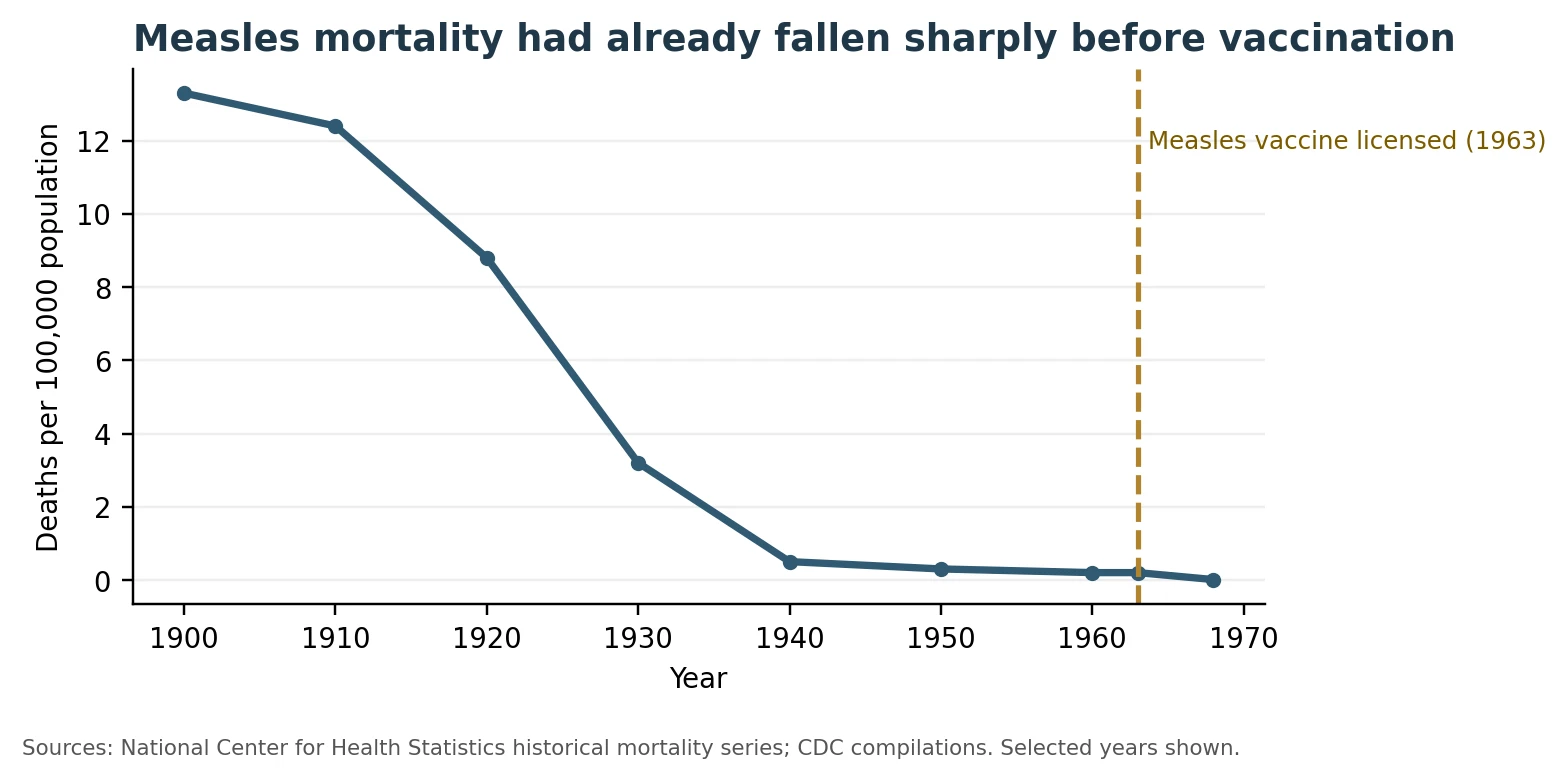
Historical mortality graphs create another confusion. In rich countries, deaths from measles, pertussis and diphtheria declined greatly before vaccination because children were better nourished and medical treatment improved. That is important and often omitted from triumphalist histories. Yet a reduction in case fatality is not a reduction in infection. Immediately before the measles vaccine, an estimated three to four million Americans—roughly an entire birth cohort—were still infected annually. After vaccination, incidence fell by more than 95 percent and endemic transmission was eliminated by 2000. The pre-vaccine mortality decline limits the number of American deaths plausibly credited to the vaccine; it does not negate the collapse in disease.
A fair assessment therefore asks: What was happening to incidence as well as mortality? Did decline accelerate at vaccine introduction? Did similarly situated populations with different coverage diverge? Do outbreaks concentrate among susceptible people? Is there biological and trial evidence consistent with surveillance? No single chart answers all these questions.
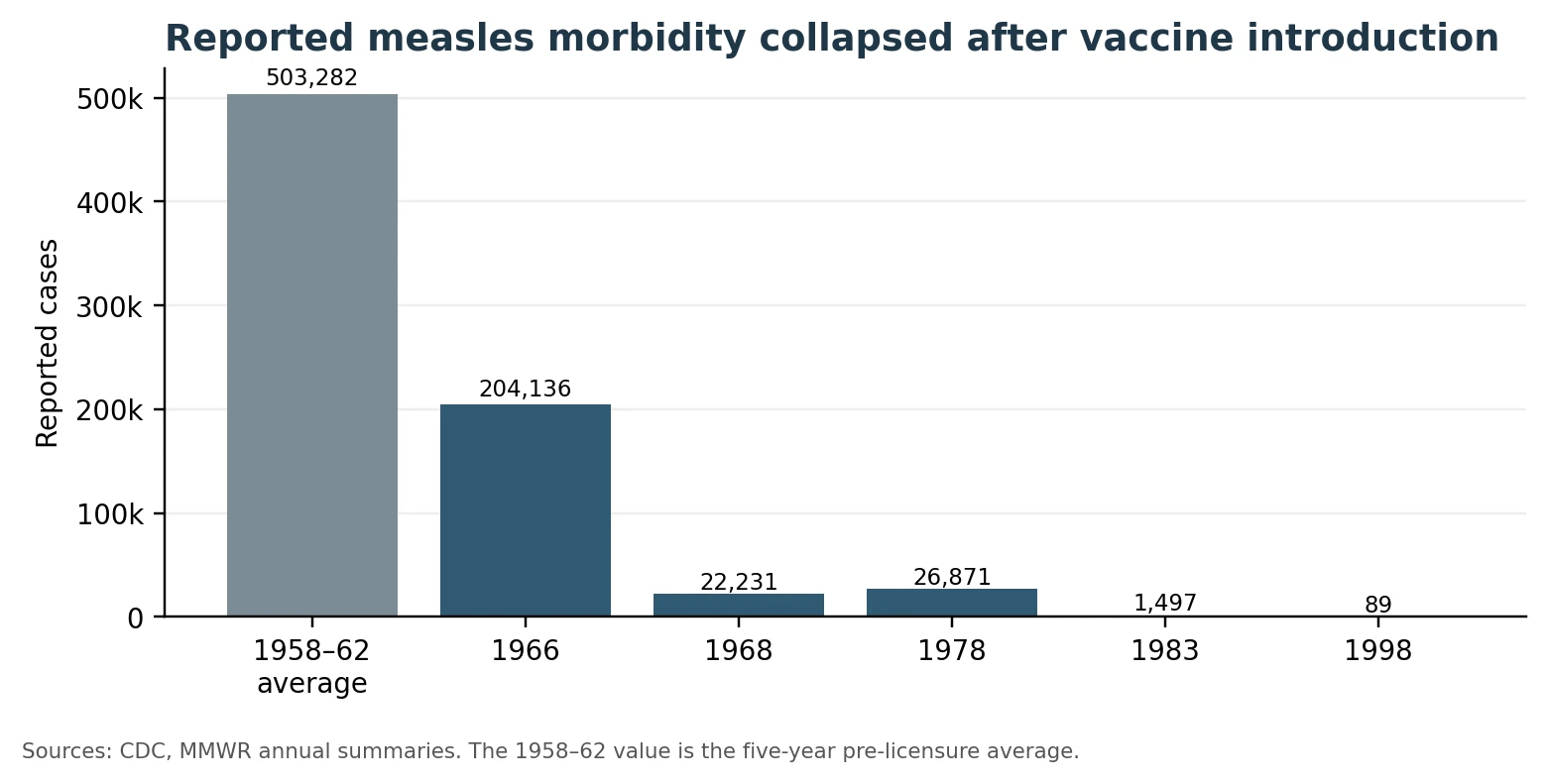
The historical data also demonstrate why source selection matters. Mortality series, notified cases, estimated infections and modeled counterfactuals measure different quantities. Reporting completeness changed, but a changing reporting fraction cannot plausibly explain a fall from hundreds of thousands of reported measles cases to double digits while outbreaks remained visible when coverage fell. The morbidity conclusion is therefore far less sensitive to data-integrity concerns than the precise number of deaths attributed to vaccination.
A transparent measles counterfactual
The most defensible model separates the non-vaccine decline in case fatality from the vaccine-driven decline in incidence. Let C₀ be annual infections without vaccination, C₁ observed infections after vaccination, and fₜ the case-fatality rate expected from nutrition and medical care in year t. Deaths prevented are then (C₀ − C₁) × fₜ. Vaccination receives no credit for the fall in fₜ that occurred before or would plausibly have continued after 1963.
Immediately before licensure, the United States experienced an estimated 3–4 million infections annually, about 503,000 reported cases, and 432 reported measles-associated deaths. This implies roughly 11–14 deaths per 100,000 infections when the estimated—not merely reported—denominator is used. Once endemic transmission was eliminated, C₁ approached zero. Even if medical progress would independently have reduced the residual case-fatality rate by another 50–80 percent, preventing 3–4 million annual infections would still plausibly prevent roughly 80–250 deaths per year, in addition to hospitalizations, encephalitis and other morbidity. Holding the 1958–62 fatality rate constant yields about 400–500 deaths prevented annually; that should be treated as an upper scenario, not the preferred estimate.
A formal state-level Project Tycho analysis used pre-vaccination time-series models rather than this simple scenario approach and estimated that US vaccination prevented 29.8 million reported cases and 32,000 deaths between 1964 and 2014. The morbidity conclusion is robust; the death estimate is much more sensitive to assumptions about under-reporting, changing case fatality, population growth and the no-vaccine counterfactual.
| Quantity | Pre-vaccine evidence | Conservative interpretation | What vaccination can claim |
|---|---|---|---|
| Annual infections | 3–4 million estimated | Would likely remain near one birth cohort without population immunity | Nearly all prevented after elimination |
| Reported cases | 503,282 annual average, 1958–62 | Reliable lower-bound morbidity measure | Fall to 89 in 1998 is overwhelmingly post-vaccine |
| Deaths | 432 annual average, 1958–62 | Allow continued non-vaccine decline in case fatality | Plausible steady-state range: about 80–250 yearly; 400–500 upper scenario |
| Hospitalizations | About 48,000 annually in the pre-vaccine era | Admission practice would change over time | Large reduction is certain; exact counterfactual is less secure |
| Encephalitis | About 1,000 cases annually | Treatment may improve outcome but does not prevent infection | Large morbidity benefit from infections avoided |
3.2 Established childhood vaccines
Smallpox is the strongest case. Variolation and vaccination predated modern sanitation, and coordinated vaccination and surveillance eradicated a human disease from the world. The early vaccines were considerably more reactogenic than modern routine vaccines and would not satisfy current safety expectations. Their benefit was nevertheless overwhelming against a disease capable of killing roughly three in ten infected people.
Polio provides an almost equally clear natural experiment. The United States recorded more than 21,000 paralytic cases in 1952. Inactivated vaccine arrived in 1955 and oral vaccine in 1961; reported disease fell below 100 cases by 1965. Better sanitation cannot explain a collapse synchronized so closely with immunization, especially because improved sanitation may initially have increased paralytic disease by delaying infection beyond infancy. The oral vaccine also created a rare but genuine harm—vaccine-associated paralysis—and circulating vaccine-derived virus can emerge where population immunity is low. Switching wealthy countries to inactivated vaccine was a rational adjustment, not evidence that vaccination itself failed.
Measles mortality had become uncommon in the United States before 1963, but morbidity remained substantial: hundreds of deaths, tens of thousands of hospitalizations and roughly a thousand cases of encephalitis in a typical year, according to contemporaneous estimates. Vaccination converted a nearly universal childhood infection into an imported rarity. Recent outbreaks in low-coverage communities confirm rather than weaken that causal inference.
Hib is another unusually clean case. Before conjugate vaccines, invasive Hib caused about 20,000 American cases annually and was a leading cause of bacterial meningitis and acquired intellectual disability. Within less than a decade of infant vaccination, invasive childhood disease was nearly eliminated. Pneumococcal conjugate vaccines similarly reduced vaccine-type invasive disease and produced indirect protection, although serotype replacement means the ecological result is more complicated than a simple disappearance.
Tetanus differs because it is acquired from environmental spores and cannot be eliminated by herd immunity. Clean obstetric practice reduced neonatal tetanus, but vaccination directly protects individuals by inducing antitoxin. Rubella vaccination prevents congenital rubella syndrome, a benefit easily missed if attention is restricted to the usually mild childhood rash. These examples demonstrate why each pathogen and endpoint must be considered separately.
The morbidity record across established childhood vaccines
| Disease | Baseline annual morbidity | 1998 morbidity | Necessary qualification |
|---|---|---|---|
| Smallpox | 48,164 | 0 | Eradication also required surveillance and isolation |
| Diphtheria | 175,885 | 1 | Treatment and living conditions reduced fatality too |
| Pertussis | 147,271 | 6,279 | 95.7% decline; acellular protection wanes |
| Tetanus | 1,314 | 34 | No herd immunity; clean wounds and obstetrics also matter |
| Paralytic polio | 16,316 | 0 wild-virus cases | Oral vaccine itself rarely caused paralysis |
| Measles | 503,282 | 89 | Reported cases understate infections in both eras |
| Mumps | 152,209 | 606 | Baseline reporting began after licensure |
| Rubella | 47,745 | 345 | Main benefit includes congenital rubella prevention |
| Invasive Hib | 20,000 | 54 confirmed Hib | Surveillance definitions changed |
3.3 HPV vaccination and cancer prevention
The HPV vaccine debate initially depended on prevention of persistent infection and precancerous lesions because invasive cancers take years to develop. That created space for reasonable questions and extravagant allegations. Population evidence has now matured. A Swedish study following 1.67 million girls and women found invasive cervical cancer incidence of 47 per 100,000 among vaccinated women and 94 per 100,000 among unvaccinated women; after adjustment, vaccination before age 17 was associated with an 88 percent lower risk.
This does not make every feature of the original Gardasil program exemplary. The use of an aluminium-containing comparator in much of the clinical program complicates attribution of nonspecific symptoms, and manufacturers and advocates sometimes communicated too aggressively. Cervical screening remains necessary. But the central claim—that preventing oncogenic HPV prevents cancer—is no longer merely theoretical. The benefit is substantial, particularly when vaccination occurs before exposure.
3.4 Seasonal influenza vaccination
Influenza vaccination is among the clearest examples of why “effective” needs an absolute number. The 2018 Cochrane review of healthy adults found that inactivated vaccine reduced laboratory-confirmed influenza from about 2.3 percent to 0.9 percent in the seasons studied: a meaningful relative reduction, but an absolute reduction of 1.4 percentage points, requiring approximately 71 healthy adults to be vaccinated to prevent one case. Influenza-like illness fell from 21.5 to 18.1 percent. Evidence for reductions in hospitalization and time off work was of low certainty.
Effectiveness changes each year with antigenic match, prior immunity and circulating strains. The case is stronger for people at high risk of complications, although randomized mortality evidence in the elderly is limited and observational studies are vulnerable to healthy-vaccinee bias. Public campaigns that imply a uniformly powerful benefit invite disappointment. A more honest message is that the vaccine is generally low risk, often moderately protective, and most worthwhile for those with the greatest baseline risk.
3.5 COVID-19 vaccination
The original Pfizer and Moderna trials showed roughly 95 percent relative efficacy against symptomatic COVID over a short period against the ancestral strain. They were not powered to establish a mortality benefit, durable transmission prevention or rare harms. During the lethal pre-Omicron period, subsequent evidence supported substantial protection against hospitalization and death, especially for older adults. For an elderly person in 2021, the absolute benefit could be large.
Policy converted that limited but important finding into claims the evidence could not sustain. Protection against infection and transmission waned and was eroded by viral evolution. Prior infection was discounted. Mandates continued after the communal-protection rationale had weakened. Benefits and risks were discussed as though they were similar for an 80-year-old diabetic and a healthy 16-year-old boy.
The harms were also real. Adenovirus-vector vaccines caused the rare clotting syndrome now called VITT; the CDC ultimately identified nine deaths causally associated with the Johnson & Johnson vaccine. Pfizer and Moderna vaccines can cause myocarditis, with the highest risk after a second dose in adolescent and young adult males. Most recognized cases resolved clinically, but hospitalization and persistent MRI abnormalities make “mild” an inadequate universal description.
At the same time, raw VAERS reports do not demonstrate hundreds of thousands of vaccine deaths, and population evidence does not support claims of mass mortality caused by mRNA vaccination. The reasonable judgment is age-stratified: strong early benefit for older and high-risk adults; smaller and progressively less certain marginal benefit for healthy young people, particularly after infection; and an exceptionally weak ethical basis for coercion once transmission protection became transient.
COVID-19 also exposed serious data-governance weaknesses. Case definitions, testing intensity, variant prevalence, prior immunity and time since dose changed rapidly, while public summaries often compared non-equivalent groups or reported relative effects without absolute risks. These limitations do not nullify randomized-trial and linked-record evidence of early protection against severe disease in high-risk adults. They do make broad, enduring claims - particularly about infection, transmission and low-risk populations - substantially less secure than the initial headline efficacy figure suggested.
3.6 Comparative vaccine-level findings
Smallpox: historically decisive. Eradication is compelling evidence of extraordinary benefit, achieved with vaccines that also carried appreciable risks by modern standards.
Polio: decisive against paralysis and wild-virus transmission. Oral vaccine’s rare paralysis and capacity to seed vaccine-derived outbreaks require explicit recognition and context-specific product choice.
Measles–mumps–rubella: strong benefit, especially through prevention of measles outbreaks, congenital rubella and serious complications. Febrile seizures occur rarely; the evidence does not support an MMR–autism association. Mortality claims in modern America should remain proportional to today’s low absolute fatality risk.
Diphtheria, tetanus, pertussis and Hib: generally favorable. Protection against tetanus and diphtheria is strong; acellular pertussis protection wanes and is less effective at blocking carriage than public messaging once implied. Hib conjugate vaccination is one of the clearest modern successes.
Pneumococcal and rotavirus vaccines: meaningful reductions in severe childhood disease, balanced against serotype replacement for pneumococcus and a small intussusception risk for rotavirus products. Product choice and surveillance matter.
Hepatitis B: highly effective at preventing chronic infection, cirrhosis and liver cancer. Universal birth dosing captures maternal infections missed by screening and later household exposure, but the absolute immediate benefit is lower for an infant born to a reliably tested negative mother in a low-risk household. That is a legitimate policy question, not evidence that the vaccine is worthless.
HPV: increasingly compelling cancer-prevention evidence, especially before sexual exposure. Earlier trial-comparator and communication criticisms remain legitimate but no longer erase the observed reduction in invasive cancer.
Influenza: variable, modest in absolute terms for healthy adults and more valuable for high-risk people. Annual slogans should give way to season- and risk-specific estimates.
COVID-19: beneficial for older and vulnerable people, especially during early high-severity waves; much less compelling as a recurring universal recommendation for low-risk young people. Mandates and claims of durable transmission prevention exceeded the evidence. Myocarditis and VITT must be acknowledged without inflating them into mass mortality.
3.7 International replication and natural experiments
International evidence strengthens several US conclusions, but not all claims equally. The most persuasive replication concerns incidence. Before routine measles vaccination began in Britain in 1968, England and Wales recorded between roughly 160,000 and 800,000 notifications annually, with biennial epidemic peaks and approximately 100 acute deaths per year. Initial coverage was too low to interrupt transmission: through much of 1970-1988, notifications remained around 50,000-100,000 annually and acute deaths averaged about 13 per year. Only after higher-coverage MMR vaccination did endemic incidence approach elimination. This staged response is more informative than a simple before-and-after comparison because morbidity fell further as population immunity increased.
The British series also demonstrates honest limits. Notifications before modern laboratory confirmation undercounted infections and changed in completeness. Deaths include certificates on which measles was a primary or contributing cause, including acute disease and delayed subacute sclerosing panencephalitis (SSPE). UKHSA now publishes these categories separately. From 2000 through August 2026 it identified 13 deaths following infections acquired domestically after vaccine introduction that it considered preventable through the national programme, alongside imported infections, infections acquired before 1968 and uncertain vaccination histories. This supports a real residual mortality burden while showing why a single aggregate can conceal materially different causal categories.
A 2026 UKHSA exercise estimated that routine childhood immunization prevents at least 4,960 deaths and 228,447 hospitalizations annually in England, including 94 measles deaths and 136,585 measles hospitalizations. The agency itself calls the calculation crude. It applies historical disease incidence and contemporary hospitalization assumptions without fully adjusting for population change, medical progress, surveillance changes or the counterfactual continuation of falling case fatality. The direction of benefit is credible, particularly for morbidity, but the precise totals should not be treated as observed events or as independent validation of a dynamic model.
The Netherlands supplies a different form of evidence. In the 2013-2014 epidemic, 2,700 measles cases were notified; 94 percent were unvaccinated and most belonged to geographically clustered Orthodox Protestant communities with religious objections to vaccination. These people lived within the same modern sanitation and health system as highly vaccinated Dutch residents. Concentration of disease in susceptible communities is therefore difficult to attribute to sanitation, national coding practices or a generalized secular trend. Most infected people nevertheless recovered, reminding readers that the modern affluent-country benefit is dominated by prevention of illness, outbreak costs and uncommon severe complications rather than a high probability of death for every unvaccinated person.
EU/EEA surveillance offers breadth but less causal depth. ECDC recorded 35,212 measles cases in 2024 and, in one subsequent 12-month report, 10,197 cases with known age and vaccination status: 81.1 percent were unvaccinated, 9.8 percent had received one dose and 7.0 percent two or more doses. Eight attributable deaths produced a reported case-fatality ratio of 0.074 percent. These data show that outbreaks disproportionately affect unvaccinated people, but crude vaccinated/unvaccinated proportions are not vaccine-effectiveness estimates: vaccination coverage, age, prior infection, exposure clustering, incomplete status and case ascertainment must be incorporated.
Countries with low vaccination coverage appear to offer a direct test, but crude national league tables are deeply confounded. In 2025, first-dose measles coverage was approximately 84 percent globally and nearly 21 million children missed that dose. The children least likely to be vaccinated are disproportionately concentrated in conflict-affected, poor or administratively weak settings. These same conditions increase crowding and exposure, reduce diagnostic and reporting capacity, worsen nutrition and delay treatment. A high measles death rate in a low-coverage country therefore reflects both more infections and a higher probability of dying once infected; it cannot be assigned wholly to vaccination status.
The fair decomposition is incidence multiplied by case fatality. In affluent European outbreaks, reported measles case fatality has recently been below one death per thousand cases. WHO notes that in populations with severe malnutrition and inadequate health care, as many as 10 percent of measles cases may die, with still higher rates in exceptionally vulnerable groups. In South Sudan in 2023, 5,770 suspected cases and 142 deaths were reported, a crude ratio of 2.46 percent, amid displacement and malnutrition. Those observations show why vaccines can avert far more mortality per dose in fragile settings, but suspected cases, missed community deaths and simultaneous malnutrition prevent a clean product-effect estimate.
Changes within the same low-coverage regions are more informative than cross-sectional country rankings. Following pandemic-era coverage disruptions, estimated global measles cases rose to 9 million and deaths to 136,000 in 2022; WHO and CDC reported an 18 percent increase in cases and 43 percent increase in deaths from 2021. The larger proportional rise in deaths is consistent with outbreaks shifting toward settings where infected children were more likely to die. This temporal association supports the importance of immunity gaps, but COVID-related surveillance disruption, conflict and changing outbreak geography make precise attribution impossible.
For a formal model, countries should therefore be matched or stratified on income, conflict, nutritional status, urban density, age structure, health-care access, surveillance completeness and pre-existing disease incidence. Coverage should be lagged to the susceptible birth cohorts rather than compared with same-year mortality. The preferred analysis would use district-level coverage and laboratory-confirmed incidence within countries, with rainfall, displacement and treatment access as covariates, followed by a separate case-fatality model. National aggregates should be presented as descriptive consistency checks, not as the principal causal estimate.
Australian surveillance broadly reproduces the disappearance or marked reduction of diphtheria, tetanus, polio, measles and Hib after programme introduction. A national historical review reported a greater than 99 percent reduction in deaths from established vaccine-preventable diseases between earlier and late twentieth-century periods. Later reports integrate notifications, hospitalizations and deaths rather than relying on mortality alone. However, Australia shares many US and British secular improvements, and historical notification systems changed. It is best regarded as independent geographic replication of disease-specific timing, not proof that vaccination caused every percentage point of mortality decline.
HPV vaccination now provides unusually important international evidence because the endpoint has matured from infection and precancer to invasive cancer. England's population programme was associated with an 87 percent reduction in cervical cancer among women offered vaccination at ages 12-13 compared with the counterfactual expected incidence. Swedish linked-registry studies have similarly found substantially lower invasive cervical cancer risk, strongest when vaccination occurred before age 17; extended follow-up continued to show large reductions. Histologically confirmed precancer and cancer are less vulnerable to subjective symptom coding than many safety outcomes, although screening participation, birth-cohort effects and healthy-user differences still require adjustment.
Japan created an unintended HPV natural experiment when the government suspended proactive recommendation in 2013. Uptake fell from roughly 70 percent in previously eligible cohorts to below 1 percent in some later cohorts, before recommendation resumed in 2022. The policy discontinuity is powerful for studying uptake and intermediate HPV outcomes, but projected cancer deaths remain model outputs because many affected cohorts have not yet reached ages at which invasive cancer is common. Japan therefore strengthens the causal chain from policy to coverage and from coverage to infection, while long-term cancer attribution must await mature registry follow-up.
International safety comparison is essential but often misunderstood. Britain's Yellow Card system, like VAERS, is a passive signal-detection system: a report records suspicion after vaccination, not established causation or an incidence rate. The UK's linked general-practice, hospitalization and mortality records, and the national registries of Denmark, Sweden, Finland and Norway, allow self-controlled or population cohort analyses with known denominators and are therefore substantially stronger. Even these systems remain vulnerable to diagnostic intensity, residual confounding, risk-window selection and healthy-vaccinee effects. Their greatest value is rapid independent replication of a prespecified signal, as occurred with VITT and myocarditis, not the production of a single unquestionable safety number.
International evidence ledger
| Setting and comparison | Observed signal | Principal bias or limitation | CGHA weight |
|---|---|---|---|
| England and Wales: measles, 1940-present | Notifications remained high after low-coverage introduction, then collapsed as coverage rose; acute deaths also declined | Historic notifications incomplete; death series includes contributing causes and late effects | High for incidence; moderate for exact deaths prevented |
| Netherlands: low-coverage religious communities, 2013-14 | 2,700 notified cases; 94% unvaccinated; disease clustered geographically | Selective reporting and clustered exposure; most cases recovered | High for susceptibility and transmission |
| EU/EEA: multinational measles surveillance | 35,212 cases in 2024; 81.1% unvaccinated among later cases with known status | Coverage, age and exposure not controlled; status missing for some cases | Moderate; descriptive, not a VE estimate |
| Low-coverage fragile states | More outbreaks and much higher case fatality; South Sudan suspected-case ratio 2.46% in 2023 | Conflict, malnutrition, weak surveillance and delayed care jointly affect coverage and mortality | Low for crude country comparison; high relevance to absolute benefit |
| Australia: multiple established vaccines | Notifications, admissions and deaths broadly reproduce disease-specific declines | Same secular improvements as other wealthy countries; changing surveillance | Moderate-high as geographic replication |
| England and Sweden: HPV | Large reductions in histologically confirmed precancer and invasive cervical cancer | Screening, cohort and healthy-user differences require adjustment | High, especially with linked registries and replication |
| Japan: HPV recommendation suspension | Coverage fell from about 70% to below 1% in affected cohorts | Cancer outcomes immature; many death estimates modeled | High for policy-to-coverage; moderate for projected cancer |
| UK Yellow Card and Nordic linked records | Passive signals can be tested in population databases with denominators | Reporting stimulation, coding and residual confounding remain | Low for raw reports; moderate-high for replicated linked-record signals |
Fair comparison of low-coverage countries
| Model component | Required variables | Interpretive rule |
|---|---|---|
| Infection incidence | Coverage by birth cohort; laboratory-confirmed or adjusted cases; outbreak periodicity; density and mobility | Estimate whether low coverage increases infection, not death directly |
| Case fatality | Age; nutrition; vitamin A; comorbidity; treatment access; conflict and displacement | Estimate how setting changes the consequence of infection |
| Reporting process | Testing access; completeness; suspected versus confirmed cases; community-death capture | Do not interpret low reported incidence as low true incidence where surveillance is weakest |
| Causal design | District fixed effects; matched countries; coverage disruption; lagged cohorts; sensitivity analysis | Prefer within-country change and coverage gradients over crude national rankings |
4. Discussion
The principal finding is that the vaccine controversy cannot be resolved by selecting a single historical graph, trial-design criticism or population-effectiveness estimate. The causal evidence is heterogeneous, but heterogeneity is not equivalence. For some diseases, several independent forms of evidence point to very large benefit. For others, effectiveness is modest, transient or concentrated in high-risk groups. A scientifically defensible policy must preserve these distinctions even when political communication rewards categorical certainty.
This conclusion cuts in both directions. Institutional narratives have often credited vaccination with mortality improvements substantially produced by sanitation, nutrition, safer childbirth, antibiotics and better clinical care. Critics are right to correct that history. But mortality is the product of incidence and case fatality. A decline in the probability of dying once infected does not establish that infection had disappeared, and it cannot explain disease-specific incidence collapses closely synchronized with vaccination. Conversely, a striking fall after introduction does not excuse imprecise causal claims, neglect of secular trends or failure to quantify uncertainty.
The appropriate unit of analysis is therefore not 'vaccines' but a defined product used in a defined population against a defined outcome over a defined period. This appears obvious, yet much public argument violates it. The language of being 'pro-vaccine' or 'anti-vaccine' converts an empirical portfolio of different technologies into an identity. Once that occurs, contrary evidence about one product is interpreted as an attack on all products, while proof of benefit from one historic vaccine is deployed to defend unrelated contemporary policies.
4.1 A contemporary case study: Pennsylvania measles reporting
On 25 August 2026, the Pennsylvania Department of Health announced two 'measles-associated deaths' among unvaccinated Lancaster County residents. Within hours, that qualified category became an international declaration that two people had died from measles. Major wire services, newspapers and broadcasters repeated the stronger formulation. Governor Josh Shapiro called the deaths 'completely preventable' and tied them to vaccine misinformation and declining uptake.
Shapiro may have intended to encourage vaccination during a genuine outbreak. The difficulty is that the state had not released evidence sufficient to support his certainty. Pennsylvania subsequently confirmed that one individual was an infant, while explaining that it uses 'measles-associated' when laboratory or epidemiological evidence of measles is present even if the medical certifier or coroner did not assess measles as the immediate cause of death. Lancaster County Coroner Stephen Diamantoni said his office had handled no death certified as caused by measles. His office was investigating one person who died with measles but, in his assessment, not from it. The second case may have been certified by a treating physician and never referred to the coroner.
These facts do not establish that measles was irrelevant. An infection can contribute through pneumonia or another complication without being the immediate cause, and the second death remains especially opaque. They do establish that 'completely preventable' was a conclusion announced before the causal record was public. The appropriate statement was that two unvaccinated people with evidence of measles had died and that the role of measles was still being established.
The distinction matters most among people already hesitant about vaccination. They are unlikely to hear Shapiro's statement as a careful population-level argument for MMR. If later details show that one death was unrelated or only indirectly associated, they will hear confirmation that officials manipulated two tragedies to shame them. An intervention with strong evidence should not need a premature morality play. Overstatement purchases a favorable headline at the cost of future credibility.
The episode illustrates an asymmetric evidentiary culture. Infection plus a compatible complication is readily converted into a death from the disease. Vaccination plus a compatible injury is described as merely temporally associated until alternative explanations have been exhausted and a mechanism demonstrated. The stricter standard is sensible; the asymmetry is not. The same causal principles should govern both.
Nor should two unresolved deaths obscure the denominator. Pennsylvania had reported 393 measles cases in 2026 and the United States 2,777, overwhelmingly among unvaccinated people or those of unknown status. More than 99 percent of recorded patients survived. This does not make measles harmless: it can cause pneumonia, encephalitis, hospitalization and death. It does show why individual cases cannot substitute for a sober account of absolute risk.
4.2 Aaron Siri's critique: what it is and where it is strongest
Aaron Siri's argument matters not because readers must accept his broader conclusions, but because it assembles questions that regulators and vaccine advocates have often answered poorly. As a lawyer engaged in vaccine litigation and public-records disputes, he approaches the subject adversarially: he asks what a manufacturer or agency can prove from the actual licensing record, rather than what public-health authorities believe the totality of later evidence establishes. That approach can expose weak controls and institutional overstatement, although a legal brief designed to test an opponent's case is not the same thing as a balanced epidemiological synthesis.
Aaron Siri’s Vaccines, Amen performs a valuable service by refusing to treat vaccines as sacred objects. His most important challenge concerns pre-licensure controls. Many current childhood formulations were not licensed through long-term trials against a saline injection. Some used an earlier vaccine, another investigational vaccine or an adjuvant-containing comparator. Follow-up periods were sometimes designed primarily around common acute reactions and immunogenicity rather than rare or delayed outcomes.
The factual core deserves acknowledgement. Active comparators can make two products look similarly tolerable while obscuring harms shared by both. Small trials cannot detect an event occurring once in 50,000 doses. Once control groups are vaccinated, long-term randomized comparison becomes impossible. Liability protection and government purchasing create institutional incentives that deserve scrutiny. “Trust us” is not a scientific response.
Siri is also right that safety is often communicated as an absolute when it is a continuously updated inference. Post-market systems discovered febrile seizures after the combined MMRV vaccine, intussusception after the first rotavirus vaccine, narcolepsy after Pandemrix, VITT after adenovirus-vector COVID vaccines and myocarditis after mRNA vaccines. These discoveries show both that harms were missed before rollout and that surveillance can work.
His criticism of historical credit is partly correct. Vaccines did not produce the whole twentieth-century decline in infectious-disease mortality. Clean water, nutrition, less crowding, antibiotics, intensive care and safer childbirth were indispensable. Institutional accounts that credit “vaccines” with virtually every life saved collapse a complex counterfactual model into advertising.
4.3 Brownstone and the limits of the dissenting critique
The Brownstone Institute occupies a different role. It is a publishing and convening organization rather than a scientific society, regulator or unified campaign against vaccination. It gave space to physicians, economists, epidemiologists and other writers who believed orthodox institutions suppressed legitimate disagreement during COVID-19. That role was valuable. It also creates a risk familiar to all dissenting institutions: a platform formed to shelter justified criticism can become a collection point for arguments of very uneven quality. Brownstone should therefore be evaluated article by article, not treated either as an authoritative source or dismissed as an 'anti-vaccine' organization.
The phrase “not tested against placebo” is rhetorically powerful but can be analytically incomplete. A new formulation may reasonably be compared with an established effective vaccine when withholding protection would expose participants to a serious disease. Earlier generations of a product may have placebo-controlled evidence, and very rare risks cannot be resolved by feasible pre-licensure trials under any comparator. The right conclusion is that the evidence base must be reconstructed product by product—not that no meaningful testing occurred.
Likewise, showing that mortality declined before vaccination does not show that vaccines failed to reduce infection. Siri’s historical graphs are most persuasive against exaggerated claims about deaths averted in affluent countries, but much less persuasive against incidence data, the elimination of endemic transmission, or benefits in poorer settings where case fatality remains high.
Some Brownstone writing maintains this distinction. Martin Kulldorff, for example, has criticized COVID-vaccine surveillance and mandates while stating that the benefits of most established vaccines exceed their risks. Other essays move too readily from flaws in COVID policy to doubt about virology, respiratory-vaccine efficacy generally or the whole childhood schedule. Institutional capture is possible; it is not evidence that every independently reproduced epidemiological finding is false.
The autism question illustrates the need for disciplined boundaries. It is fair to say that no study can prove a universal negative covering every vaccine, combination, timing and susceptible subgroup. It is not fair to imply that the principal MMR hypothesis remains evenly balanced. Large cohort studies—including a Danish study of 657,461 children—have found no increased autism risk after MMR, including in higher-risk subgroups. The evidence is observational rather than a decades-long randomized trial, but it is strong and convergent.
4.4 Safety, causality, liability and institutional confidence
Vaccines pose an unusual governance problem because they are commonly given to healthy people, frequently children, and sometimes required by the state. That justifies a higher expectation of safety, transparency and compensation than for a drug chosen by a seriously ill patient. It does not justify pretending that zero risk is achievable.
The United States’ liability framework helped stabilize vaccine supply but weakened ordinary market discipline. A no-fault compensation system can be defensible only if it is accessible, timely and generous. COVID countermeasures were routed through the more restrictive Countermeasures Injury Compensation Program, leaving injured people facing delays and narrow eligibility. This was both unjust and corrosive of confidence.
Conflict-of-interest safeguards also require strengthening. Regulators, manufacturers, public-health agencies and advocacy organizations often share funding, personnel and policy objectives. Financial conflicts are not proof that a result is false, but opacity makes independent replication more important. Safety data should be released rapidly in de-identified form; advisory deliberations should include genuine methodological disagreement; and negative findings should be as publishable as favorable ones.
4.5 Interpreting relative and absolute effectiveness
Relative effectiveness is useful for biological comparison but is insufficient for clinical or policy judgment. A vaccine that reduces a one-year risk from 10 per 10,000 to 2 per 10,000 has 80 percent relative effectiveness, an absolute reduction of 8 per 10,000 and an NNV of 1,250. The same relative effect during a large outbreak may yield an NNV below 20. Neither number is deceptive if its denominator and time horizon are stated; presenting only the relative number is incomplete.
Benefit-risk balance therefore changes even when the product does not. It changes with age, immune history, exposure, pathogen evolution, clinical vulnerability and alternative interventions. This is particularly important for influenza and COVID-19, where seasonal incidence, strain match, prior infection and waning can move absolute benefit substantially. It is also important for childhood vaccines when disease incidence has become low partly because high coverage suppresses circulation: the individual short-run risk may look small while the population counterfactual under declining coverage is much larger.
A cross-vaccine comparison is possible only with a common outcome metric such as QALYs, DALYs or life-years, and even then the composite should not replace the underlying ledger. The reader should see infections, hospitalizations, deaths and serious adverse events separately, together with uncertainty intervals and an evidence grade. Monetized or utility-weighted summaries necessarily embed contestable value judgments.
4.6 A practical vaccine-effectiveness model
A useful research program would publish an updateable dashboard for each product and schedule. Required inputs would include baseline outcome rates by age and risk; trial efficacy; real-world effectiveness by endpoint; duration and waning; coverage; prior immunity; indirect effects; attributable serious adverse-event rates; and confidence distributions for every input. Outputs would include cases, hospitalizations, disabilities and deaths prevented per 100,000 doses; serious vaccine injuries per 100,000 doses; NNV; number needed to harm; net QALYs; and the assumptions to which conclusions are most sensitive.
Dynamic models should be used for measles, rubella, pertussis, polio and diseases affected by carriage because vaccination changes future exposure. Tetanus should not be credited with herd effects. HPV and hepatitis B require long horizons connecting infection to precancer, cancer, cirrhosis and death. Pneumococcal models must allow for serotype replacement. Rotavirus models should place prevented hospitalization and death beside attributable intussusception. Influenza and COVID-19 estimates should be reissued for each season or variant period rather than reported as permanent product characteristics.
Every result should be presented as a distribution. Monte Carlo simulation can repeatedly draw from uncertainty distributions for incidence, effectiveness, waning, severity and adverse-event rates to produce credible ranges. Structural uncertainty should be displayed through alternative models, not buried within statistical confidence intervals. For measles, for example, scenarios should vary the no-vaccine infection rate, continuing secular decline in case fatality, under-reporting and outbreak periodicity.
The model would not eliminate disagreement. It would improve its quality. Critics could replace official inputs with alternative estimates and observe whether conclusions change. If a recommendation remains favorable across a wide range of credible assumptions, confidence is warranted. If its sign reverses with small changes in incidence or adverse-event rates, the policy should be described as preference-sensitive rather than settled science.
4.7 Can vaccine data be corrupted?
Yes. Health data are produced by human institutions and can be corrupted in several senses. Deliberate fabrication is the most serious but probably the least common. More routine threats include miscoding, diagnostic substitution, differential testing, denominator errors, outcome switching, selective publication, silent revision of definitions and models whose assumptions are presented as observations. Political pressure need not alter a laboratory result to distort the public record; it may determine which endpoint is announced, which comparison is emphasized and how quickly uncertainty disappears from a press release.
Death attribution is especially vulnerable to rhetorical compression. 'Died from,' 'died with,' 'disease-associated' and 'disease-related' are not interchangeable. A death certificate may list several conditions, surveillance systems may use a broader case definition than vital statistics, and preliminary announcements may precede final certification. The Pennsylvania Department of Health used the deliberately broad term 'measles-associated' and withheld the clinical facts needed for independent causal assessment. Much of the press then reported two people had died 'from measles.' That is evidence of information degradation between source and headline; it is not, without further records, proof that the state fabricated two deaths.
The same discipline must apply to vaccine harm. An adverse event after vaccination is not automatically vaccine-caused, but neither should it be dismissed merely because background events occur. The required comparison is observed versus expected incidence in a prespecified risk window, stratified by age, sex, dose and product, with enough power to identify rare outcomes. If disease deaths are counted using permissive association while vaccine injuries require near-mechanistic certainty, the resulting benefit-risk ledger is structurally biased even when every individual datum is technically genuine.
Some evidence is more resistant to institutional corruption than other evidence. Smallpox eradication, the collapse of paralytic polio across many jurisdictions, the post-vaccine disappearance of invasive Hib disease and the concentration of measles outbreaks among susceptible populations cannot plausibly be manufactured by one agency or one coding rule. By contrast, a modeled number of lives saved, a preliminary cause-of-death announcement or an observational estimate sensitive to testing behavior deserves wider uncertainty bounds. Convergence, decentralization and reproducibility are therefore safeguards, not decorative additions.
The proper response to suspected corruption is an audit trail. Agencies should publish case definitions, code lists, protocols, denominators, revision histories and de-identified record-level data where privacy permits. Death claims used to justify policy should be reconciled with final death certificates and, when relevant, coroner or medical-examiner findings. Vaccine-safety analyses should release protocols before database interrogation and report negative as well as positive results. Independent teams should be able to rerun the analysis.
A credible vaccine assessment must therefore report two dimensions separately: the estimated benefit-risk balance and confidence in the data-generating process. A favorable estimate constructed from opaque or fragile data should not receive the same policy weight as one reproduced across independent systems. Equally, evidence that one announcement was miscoded would not erase robust evidence accumulated across decades and continents. Accountability requires neither credulity nor nihilism, but proportional confidence.
4.8 What international comparison can and cannot repair
Replication across countries is one of the strongest protections against national institutional failure. The timing of measles, polio and Hib declines differs with vaccine introduction and coverage, yet the direction recurs. Low-coverage religious communities experience outbreaks inside otherwise affluent societies. HPV-associated cancer reductions appear in more than one registry system. No single US agency controls these observations, and no common change in sanitation plausibly produces disease-specific discontinuities at different dates.
But country count is not the same as independent evidence. WHO, UNICEF and national ministries often share case definitions, parameters and models. A headline that vaccination saved 154 million lives globally is a modeled counterfactual assembled from multiple pathogen-specific models; it is not a count of 154 million identified deaths. Such work may be informative and its uncertainty intervals should be examined, but repetition by national agencies does not transform assumptions into observations. The same caution applies to national estimates that subtract current deaths from a pre-vaccine baseline without modeling medical and social change.
The international evidence is therefore best used hierarchically. Highest confidence belongs to disease-specific eradication or near-elimination, laboratory-confirmed incidence discontinuities, randomized evidence, linked registries with stable endpoints and outbreaks concentrated among demonstrably susceptible people. Moderate confidence belongs to adjusted observational effectiveness studies and well-specified transmission models. Lower confidence belongs to passive adverse-event totals, unadjusted ecological comparisons, preliminary death announcements and model outputs whose sensitivity to alternative assumptions is not published.
International comparison also exposes better transparency practices. UKHSA's measles mortality page distinguishes acute deaths, late effects, imported infections, pre-programme infections, underlying immunological conditions and uncertain vaccination timing. That does not guarantee every attribution is correct, but it supplies an audit trail that the Pennsylvania announcement lacked. A CGHA recommendation should be that every jurisdiction publish an equally explicit reconciliation between preliminary disease-associated deaths and final certified causes.
4.9 Implications for policy and communication
First, abandon the singular noun. Every recommendation should specify product, platform, recipient, endpoint and time horizon. Second, present absolute risks alongside relative effects. Third, distinguish prevention of infection from prevention of severe disease and transmission. Fourth, require proportionately stronger evidence when vaccination is mandated rather than offered.
Fifth, retain control groups as long as ethically possible and use saline controls when no proven preventive product exists. When active comparators are necessary, state exactly what they contain and what question the trial can and cannot answer. Sixth, build active linked-data surveillance capable of age- and sex-specific analysis, with rapid public access to protocols and results. Seventh, reform compensation so that society visibly accepts responsibility for the rare people harmed by a program intended to benefit everyone.
Finally, end moralized communication. An unvaccinated person is not a morality tale, and a vaccine-injured person is not an inconvenient anecdote. Public health should neither exploit unresolved deaths to embarrass skeptics nor treat every safety signal as sabotage. Consent requires candor about benefits, uncertainties and harms.
Vaccination’s greatest achievements survive honest scrutiny. Indeed, honesty makes them more credible. The danger is not skepticism itself but the refusal to discriminate: between mortality and incidence, association and causation, one vaccine and another, a child and an elderly adult, an offer and a mandate. A mature vaccine policy would stop demanding faith and start earning confidence product by product.
5. Limitations
This analysis has several limitations. It is a structured narrative review rather than a systematic review with a preregistered search strategy, duplicate screening and formal risk-of-bias adjudication. The selected vaccines illustrate major evidentiary patterns but do not exhaust the global portfolio. Historical surveillance definitions, diagnostic capacity and under-reporting changed over time, making precise before-and-after comparisons uncertain.
Observational effectiveness studies are vulnerable to healthy-vaccinee bias, confounding by indication, differential testing, prior infection and changes in clinical practice. Randomized trials provide stronger control of confounding but are often too small or too short to identify rare or delayed harms. Passive adverse-event databases are useful for signal detection but cannot by themselves establish incidence or causation. Active surveillance and linked records improve inference but remain susceptible to specification choices and incomplete measurement.
The measles mortality scenarios are counterfactual calculations rather than directly observed totals. Results depend on assumptions about infections without vaccination and the case-fatality decline that would have continued in its absence. QALY- or DALY-based comparisons also depend on normative weights and may obscure distributional questions, including whether a small risk is imposed on a healthy child for a primarily population-level benefit.
Finally, the institutional analysis cannot be reduced to epidemiological estimation. Trust, coercion, conflicts of interest, compensation and the treatment of dissent involve ethical and political judgments. The paper makes those judgments explicit, but they should not be mistaken for empirical parameters.
The international review is selective rather than exhaustive. Countries differ in schedules, population structure, diagnostic access, coding, health care and baseline exposure; some national series are derived from the same WHO or published parameters and are not statistically independent. Several comparisons are ecological and cannot eliminate all confounding. Japan's HPV cohorts remain too young for definitive long-term cancer mortality estimates, and European measles surveillance has incomplete vaccination-status and case-ascertainment data.
Low-coverage national comparisons are especially vulnerable to reverse causation and common-cause confounding. Conflict, displacement, poverty and administrative failure can simultaneously depress recorded coverage, increase transmission, raise case fatality and reduce reporting completeness. Reported cases may therefore be lowest where surveillance is weakest, while modeled deaths may import assumptions from neighboring countries. The paper uses these comparisons to test coherence and identify effect modification, not to estimate an unadjusted national dose-response relationship.
6. Conclusions
Vaccines have produced major health benefits, but those benefits are neither uniform nor sufficient to validate every recommendation, mandate or institutional claim. The strongest historical cases—smallpox, polio, measles morbidity, Hib, tetanus and congenital rubella prevention—remain persuasive after accounting for pre-vaccine mortality declines. HPV now has direct population evidence of cancer prevention. Influenza offers variable and often modest absolute benefit, while COVID-19 benefit-risk judgments require unusually careful stratification by age, vulnerability, prior immunity, variant and time since vaccination.
Documented vaccine injuries are part of this history and must be incorporated rather than dismissed. The appropriate response is not to infer that all vaccines are unsafe, but to improve comparator choice, retain randomized controls when ethical, strengthen active post-market surveillance, disclose uncertainty, reform compensation and distinguish an offer from a mandate.
A common quantitative framework can evaluate every vaccine, provided it uses disease-specific models and reports disaggregated outcomes. The central measure should be net health benefit under multiple credible assumptions, accompanied by infections, severe outcomes and adverse events per fixed number of doses. Such a system would replace categorical allegiance with auditable comparison. Vaccination policy will regain legitimacy not by demanding confidence in a class of products, but by earning it one product, population and endpoint at a time.
The CGHA standard is consequently straightforward: show the numerator, show the denominator, define the outcome, disclose the assumptions, preserve the audit trail and permit replication. The data indicate that several vaccines have delivered very large benefits and that others provide narrower or population-specific value. They also show that vaccine injuries occur and that official claims can be incomplete, asymmetric or wrong. Data must drive the judgment - and the data themselves must remain open to challenge.
References
- 1. Pennsylvania Department of Health (2026), 'Pennsylvania Department of Health Confirms Two Measles-Associated Deaths,' 25 August. https://www.pa.gov/agencies/health/newsroom/pennsylvania-department-of-health-confirms-two-measles-associate
- 2. CDC (2024), ‘History of Measles.’ https://www.cdc.gov/measles/about/history-of-measles.html
- 3. CDC (2024), Pink Book, Chapter 13: Measles. https://www.cdc.gov/pinkbook/hcp/table-of-contents/chapter-13-measles.html
- 4. CDC (2024), Pink Book, Chapter 18: Poliomyelitis. https://www.cdc.gov/pinkbook/hcp/table-of-contents/chapter-18-poliomyelitis.html
- 5. CDC (1999), ‘Impact of Vaccines Universally Recommended for Children—United States, 1900–1998,’ MMWR 48:243–248.
- 6. Shattock, A.J. et al. (2024), ‘Contribution of vaccination to improved survival and health: modelling 50 years of the Expanded Programme on Immunization,’ The Lancet 403:2307–2316.
- 7. Demicheli, V. et al. (2018), ‘Vaccines for preventing influenza in healthy adults,’ Cochrane Database of Systematic Reviews, CD001269.
- 8. Lei, J. et al. (2020), ‘HPV Vaccination and the Risk of Invasive Cervical Cancer,’ New England Journal of Medicine 383:1340–1348. https://doi.org/10.1056/NEJMoa1917338
- 9. Hviid, A. et al. (2019), ‘Measles, Mumps, Rubella Vaccination and Autism: A Nationwide Cohort Study,’ Annals of Internal Medicine 170:513–520. https://doi.org/10.7326/M18-2101
- 10. National Academies of Sciences, Engineering, and Medicine (2024), Evidence Review of the Adverse Effects of COVID-19 Vaccination and Intramuscular Vaccine Administration. Washington, DC: National Academies Press.
- 11. CDC (2022), ‘Use of the Janssen COVID-19 Vaccine: Updated Interim Recommendations,’ MMWR 71:90–95.
- 12. Dagan, N. et al. (2021), ‘BNT162b2 mRNA Covid-19 Vaccine in a Nationwide Mass Vaccination Setting,’ New England Journal of Medicine 384:1412–1423.
- 13. Siri, A. (2025), Vaccines, Amen: The Religion of Vaccines. ICAN Press.
- 14. Kulldorff, M. (2022), ‘The Ins and Outs of Covid Vaccine Safety,’ Brownstone Institute, 11 April.
- 15. Kulldorff, M. (2022), ‘Are the Covid mRNA Vaccines Safe?’ Brownstone Institute, 3 July.
- 16. Institute of Medicine (2012), Adverse Effects of Vaccines: Evidence and Causality. Washington, DC: National Academies Press.
- 17. European Medicines Agency (2021), ‘COVID-19 Vaccine AstraZeneca: PRAC investigating cases of thromboembolic events,’ 11 March.
- 18. European Centre for Disease Prevention and Control (2013), ‘Association of receipt of Pandemrix and narcolepsy in children and adolescents in England.’
- 19. Paternina-Caicedo, A. et al. (2018), ‘Heterogeneity Between States in the Health and Economic Impact of Measles Immunization in the United States,’ Open Forum Infectious Diseases 5(7):ofy137. https://doi.org/10.1093/ofid/ofy137
- 20. National Center for Health Statistics and CDC historical compilations, measles mortality and morbidity series, as reproduced in CDC annual summaries and MMWR (1999).
- 21. UK Health Security Agency (2026), 'Measles: historic confirmed cases, notifications and deaths,' updated 6 August. https://www.gov.uk/government/publications/measles-historic-confirmed-cases-notifications-and-deaths/measles-historic-confirmed-cases-notifications-and-deaths
- 22. UK Health Security Agency (2026), 'Estimated annual deaths and hospitalisations prevented by routine childhood immunisation, England, 2026,' 5 February. https://www.gov.uk/government/publications/routine-childhood-immunisation-deaths-and-hospitalisations-prevented/estimated-annual-deaths-and-hospitalisations-prevented-by-routine-childhood-immunisation-england-2026
- 23. Woudenberg, T. et al. (2017), 'Large measles epidemic in the Netherlands, May 2013 to March 2014: changing epidemiology,' Eurosurveillance 22(3):30443. https://doi.org/10.2807/1560-7917.ES.2017.22.3.30443
- 24. European Centre for Disease Prevention and Control (2025), Measles Annual Epidemiological Report for 2024. https://www.ecdc.europa.eu/en/publications-data/measles-annual-epidemiological-report-2024
- 25. European Centre for Disease Prevention and Control (2025), Communicable Disease Threats Report, week 46: measles monitoring and vaccination status. https://www.ecdc.europa.eu/sites/default/files/documents/communicable-disease-threats-report-week-46-2025.pdf
- 26. Australian Government Department of Health and Aged Care (2000), Vaccine Preventable Diseases and Vaccination Coverage in Australia, 1993-1998. Communicable Diseases Intelligence 24 Supplement. https://www1.health.gov.au/internet/main/publishing.nsf/content/cda-cdi2000sup-vpd93_98.htm
- 27. Australian Government Department of Health (2016), Summary of National Surveillance Data on Vaccine Preventable Diseases in Australia, 2008-2011. https://www1.health.gov.au/internet/main/publishing.nsf/Content/cda-cdi40suppl.htm
- 28. Falcaro, M. et al. (2024), 'Effect of the HPV vaccination programme on incidence of cervical cancer and grade 3 cervical intraepithelial neoplasia by socioeconomic deprivation in England,' BMJ 385:e077341. https://doi.org/10.1136/bmj-2023-077341
- 29. Wu, S. et al. (2026), 'Extended follow-up of invasive cervical cancer risk after quadrivalent human papillomavirus vaccination: population based cohort study,' BMJ 392:e087326. https://doi.org/10.1136/bmj-2025-087326
- 30. Yagi, A. et al. (2020), 'Potential for cervical cancer incidence and death resulting from Japan's current policy of prolonged suspension of its governmental recommendation of the HPV vaccine,' Scientific Reports 10:15945. https://doi.org/10.1038/s41598-020-73106-z
- 31. Simms, K.T. et al. (2020), 'Impact of HPV vaccine hesitancy on cervical cancer in Japan: a modelling study,' Lancet Public Health 5:e223-e234. https://doi.org/10.1016/S2468-2667(20)30010-4
- 32. Medicines and Healthcare products Regulatory Agency (2023), 'Coronavirus vaccine - summary of Yellow Card reporting.' https://www.gov.uk/government/publications/coronavirus-covid-19-vaccine-adverse-reactions/coronavirus-vaccine-summary-of-yellow-card-reporting
- 33. World Health Organization (2026), 'Immunization coverage,' updated 15 July. https://www.who.int/news-room/fact-sheets/detail/immunization-coverage
- 34. World Health Organization (2026), 'Measles.' https://www.who.int/news-room/fact-sheets/detail/measles
- 35. World Health Organization and CDC (2023), 'Global measles threat continues to grow as another year passes with millions of children unvaccinated,' 16 November. https://www.who.int/news/item/16-11-2023-global-measles-threat-continues-to-grow-as-another-year-passes-with-millions-of-children-unvaccinated
- 36. UNHCR and World Health Organization (2023), 'Deteriorating health conditions as 1,200 children die of suspected measles and malnutrition in Sudan,' 19 September. https://www.who.int/news/item/19-09-2023-unhcr--who-warn-of-deteriorating-health-conditions-as-1-200-children-die-of-suspected-measles--malnutrition-in-sudan
- 37. World Health Organization (2026), Immunization Data Portal: measles vaccination coverage and reported incidence. https://immunizationdata.who.int/global/wiise-detail-page/measles-vaccination-coverage
- 38. WHP/CBS 21 (2026), 'Infant among measles-associated deaths in Lancaster County; cause of death not confirmed,' 27 August. https://local21news.com/news/local/infant-measles-associated-deaths-cause-governor-josh-shapiro-department-of-health-rfk-jr-robert-kennedy-coroner-lancaster-county-pennsylvania
- 39. WHP/CBS 21 (2026), 'PA governor says state's first measles deaths in decades were completely preventable,' 26 August. https://fox56.com/newsletter-daily/2-measles-deaths-reported-in-pennsylvania-marking-first-deaths-in-35-years-pa-pennsylvania-outbreak-fatal-commonwealth-deadly-measles-penn-state-health-medicine-vaccine