Executive summary
Newly disclosed documents describe a substantive institutional relationship between the Central Intelligence Agency (CIA) and the National Institute of Allergy and Infectious Diseases (NIAID). An undated interagency agreement says the CIA’s Biological Technology Center initiated a collaboration with NIAID in “forensic microbiology”; CIA funds would leverage civilian research; unclassified virus research would “augment and complement” CIA research and development; the CIA would assist in obtaining pathogens; and dissemination of sensitive results required CIA permission. The document establishes more than occasional consultation. It does not, however, prove that Anthony Fauci personally directed CIA projects, that this agreement concerned coronaviruses, or that American agencies created SARS-CoV-2.
The significance lies in the system the agreement illuminates. Following the September 2001 terrorist attacks and the separate anthrax-letter attacks that began the following week, an expanded biodefense enterprise joined intelligence collection, civilian science, national-security secrecy and large public research budgets. Its original objectives were defensible: identify biological attacks, attribute their source, develop diagnostics and countermeasures, and understand what hostile actors might build. But the incentives and governance were poorly aligned. The same institutions promoting the research often defined whether it was dangerous, monitored their own grantees and controlled the information needed to evaluate failure.
By 2009, the Government Accountability Office (GAO) was warning that no federal agency assessed the aggregate risks created by the rapid expansion of high-containment laboratories. Under one federal oversight program, BSL-3 laboratories increased from 415 in 2004 to 1,362 in 2008, while inspectors increased from 25 to only 28 and the oversight budget fell in nominal terms. Serious US laboratory lapses in 2014 helped produce a federal funding pause covering a narrowly defined subset of experiments involving influenza, MERS and SARS viruses. The pause was real, but it was not a comprehensive ban. It relied on prospective judgments, technical definitions and agency discretion.
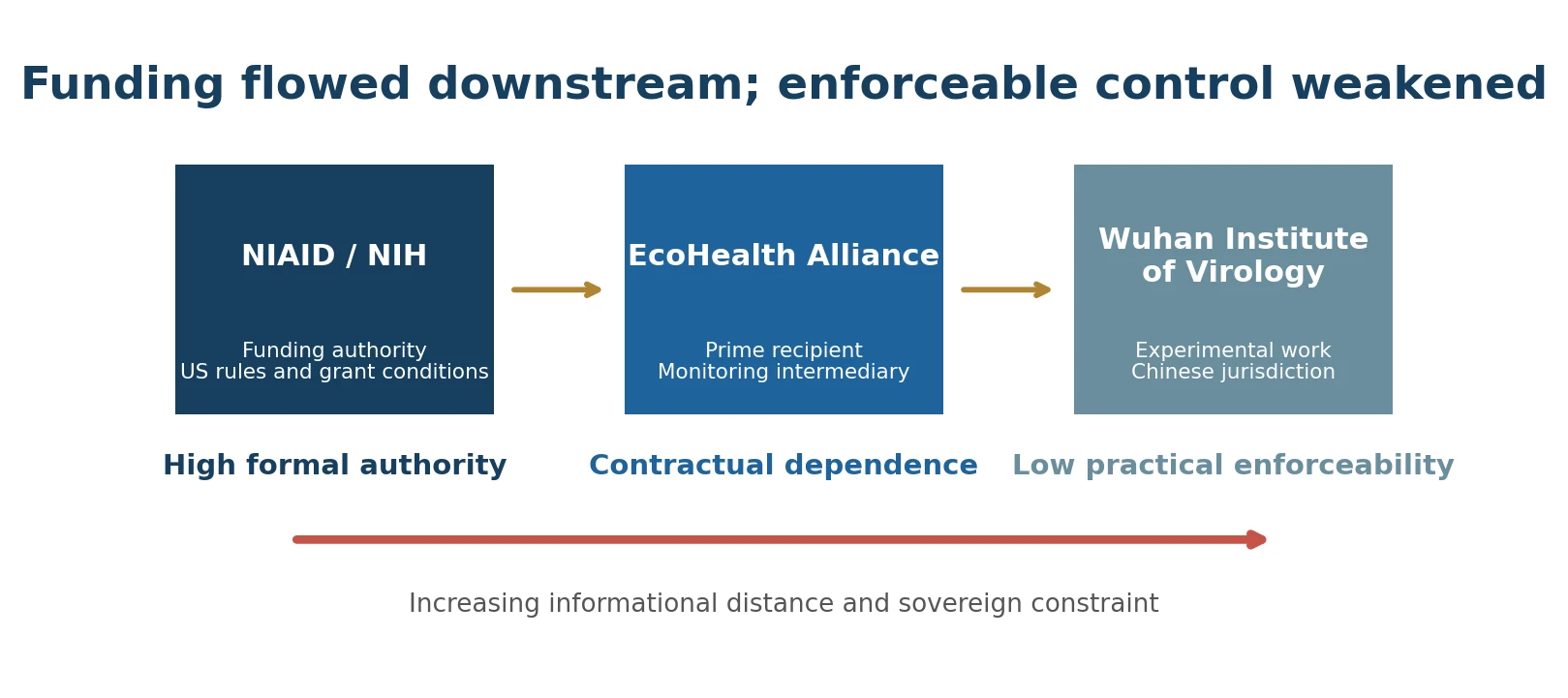
US-funded coronavirus research at the Wuhan Institute of Virology (WIV) did not simply move to China because of the pause: the relevant EcoHealth Alliance grant began in 2014 before the pause was announced. Yet the arrangement embodied the pause’s central weakness. NIAID funded an American intermediary, which subawarded work to a Chinese laboratory over which neither EcoHealth nor NIH possessed reliable enforcement power. The HHS Inspector General later found inadequate monitoring, a progress report almost two years late, failure to report experimental results that crossed a specified growth benchmark, and WIV’s eventual refusal to provide records. These findings do not establish COVID-19’s origin. They establish that official assurances about control exceeded the control actually exercised.
The post-COVID response revealed a second form of institutional failure. Officials and scientists whose programs, judgments and reputations were implicated also helped shape public discussion of the laboratory-origin possibility. Evidence surrounding the “Proximal Origin” paper, David Morens’s evasion of public-record requirements, and continuing secrecy over pathogen-risk reviews justifies skepticism about claims of disinterested scientific adjudication. The problem is larger than Fauci and should not be reduced to demands for one man’s punishment. It is a governance problem: a system that internalized the benefits of risky research, dispersed its potentially catastrophic costs, and allowed politically interested institutions to control disclosure.
CGHA recommends replacing semantic arguments about “gain of function” with experiment-specific disclosure; independent risk review outside funding agencies; enforceable conditions for foreign subawards; public reporting of approvals and mitigation measures; separation of intelligence requirements from civilian grant decisions; durable federal records; and a presumption against experiments whose worst plausible harm is global but whose proposed benefit is speculative.
1. What the new documents establish—and what they do not
The Daily Caller News Foundation published what it described as an undated eight-page CIA–NIAID interagency agreement on 28 August 2026. According to the document, the CIA’s Biological Technology Center initiated a collaboration with NIAID involving forensic comparative analysis of viruses. Existing civilian research would be used to complement intelligence research; CIA money would leverage work already under way; and the CIA would help NIAID acquire biological materials. Outputs would be sensitive rather than formally classified, but dissemination required CIA approval. The accompanying report by Emily Kopp connects the agreement to a broader post-anthrax convergence of intelligence and civilian biology.
This is meaningful evidence of institutional integration. “Cover” is a loaded but not wholly unreasonable description: unclassified civilian research could advance sensitive intelligence purposes without appearing as a conventional intelligence project. It also created an information asymmetry. Researchers, peer reviewers and the public might see a public-health project while only a small group knew the complete intelligence purpose or restrictions.
Four limits matter. First, the published copy is hosted by the reporting organization rather than an official government archive, and its chain of custody has not been independently established. Second, the document is undated, so it cannot yet be placed precisely within the biodefense chronology. Third, it names institutions and offices, not a personal operational decision by Fauci. As NIAID director, Fauci bears leadership responsibility for the institute’s strategic direction, but that is different from proof that he negotiated or managed this agreement. Fourth, the agreement is not evidence that SARS-CoV-2 was engineered, that the CIA funded WIV coronavirus experiments, or that COVID-19 resulted from this program.
The paper’s evidentiary status is therefore straightforward:
| Claim | Assessment |
|---|---|
| CIA and NIAID had a structured biological-research relationship | Directly supported by the disclosed agreement |
| Civilian NIAID research could complement sensitive CIA work | Directly supported |
| CIA retained influence over dissemination of sensitive results | Directly supported |
| Fauci personally directed the agreement | Not established by the disclosed document |
| The agreement concerned WIV or SARS-CoV-2 | Not established |
| The institutional relationship helps explain blurred accountability | Strong inference when combined with GAO, OIG and congressional evidence |
This distinction is not timidity. It is what permits the larger conclusion to survive scrutiny.
2. Why intelligence involvement initially made sense
The anthrax letters were mailed beginning on 18 September 2001, one week after the September 11 attacks. Five people died and 17 others were infected. The events demonstrated that a small quantity of biological material could produce national fear, close government buildings and overwhelm conventional investigative boundaries. Attribution required microbiology as well as traditional intelligence: strain identification, genomic comparison, production clues, laboratory provenance and knowledge of foreign capabilities.
The CIA’s interest in forensic microbiology was therefore legitimate. Biological weapons are harder to observe than nuclear programs. A centrifuge cascade, test detonation or missile site leaves signatures. A pathogen project can be hidden inside a university, pharmaceutical facility or ostensibly defensive laboratory. The intelligence community needed access to biological expertise and international scientific networks.
NIAID simultaneously possessed a defensible public-health mandate. Its official institutional history states that its biodefense and emerging-infectious-disease portfolio “vastly expanded” after the 2001 anthrax attacks. NIH grant notices from the period show programs for regional biodefense research centers, biodefense partnerships, diagnostics, vaccines, therapeutics, sequencing and high-containment capacity. The case for much of this work was strong.
The error was not that spies spoke to scientists. It was constructing a system in which intelligence needs, research ambitions, institutional growth and public-health authority reinforced one another without a comparably powerful mechanism for external restraint.
3. The biodefense boom outran oversight
Federal biodefense spending rose dramatically after 2001. A peer-reviewed retrospective in The Lancet Infectious Diseases00382-0) estimates that total US biodefense funding rose from approximately $700 million in 2001 to approximately $4 billion in 2002, with a later peak in 2005. By 2006, NIH alone was allocated about $1.8 billion for biodefense research and development, according to GAO testimony. NIAID’s FY2009 budget justification placed total biodefense and emerging-infectious-disease activities at roughly $1.7 billion.
Money produced useful capabilities, but also constituencies. Universities built laboratories; investigators built careers; agencies acquired missions; contractors and biotechnology companies gained customers. Threat identification generated funding, and funding generated capacity to identify and experimentally investigate further threats. This feedback loop does not imply bad faith. It does mean that institutional incentives favored expansion.
GAO’s 2009 report, “High-Containment Laboratories: National Strategy for Oversight Is Needed,” documented the mismatch. Within the CDC Division of Select Agents and Toxins program, the number of overseen entities rose from 150 in 2004 to 242 in 2008. BSL-3 laboratories rose from 415 to 1,362. Inspectors rose from 25 to only 28, while the nominal budget declined from $14.2 million to $12.1 million. GAO found no federal entity responsible for tracking all high-containment laboratories, assessing aggregate risk or determining how many facilities the country actually needed.
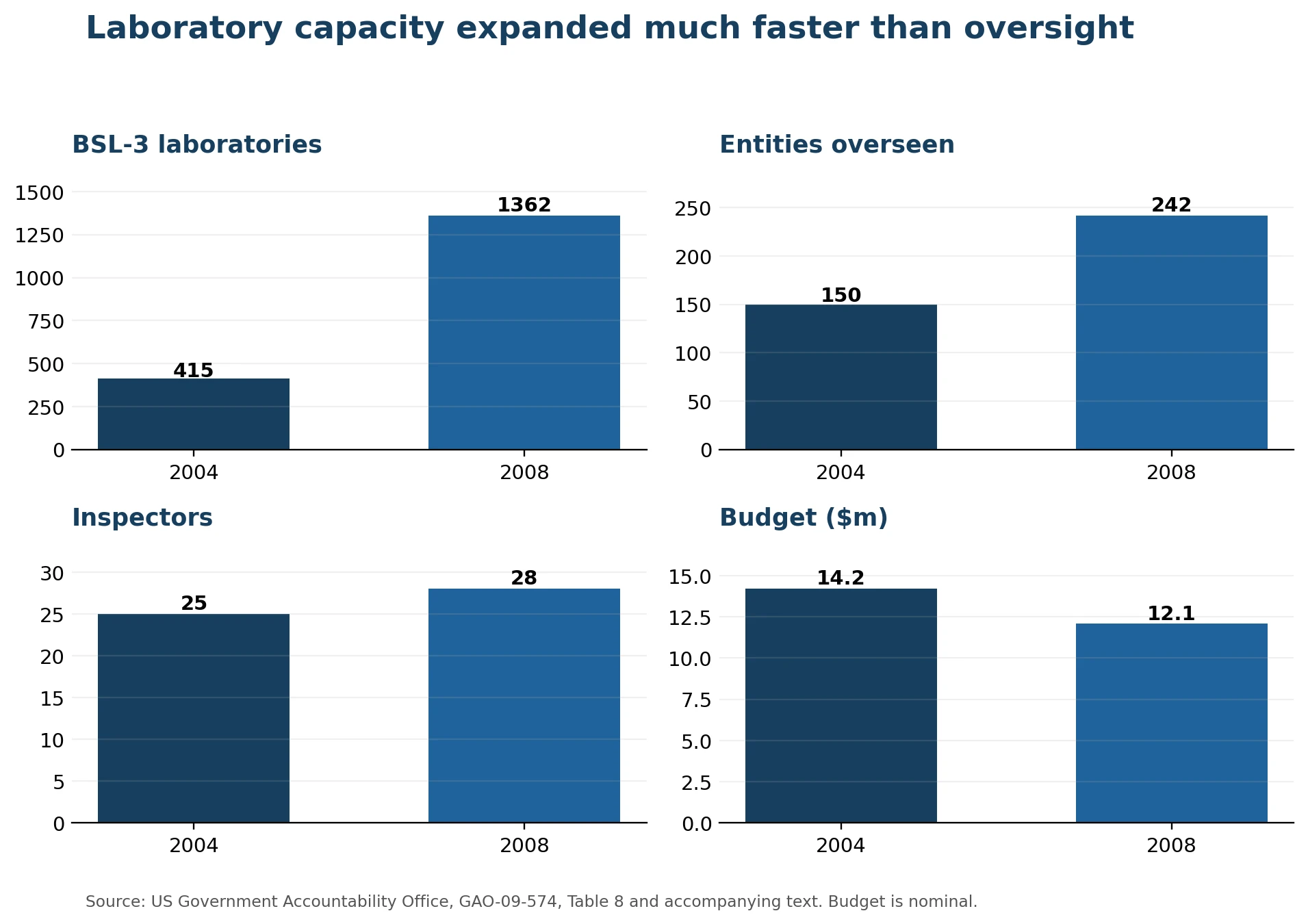
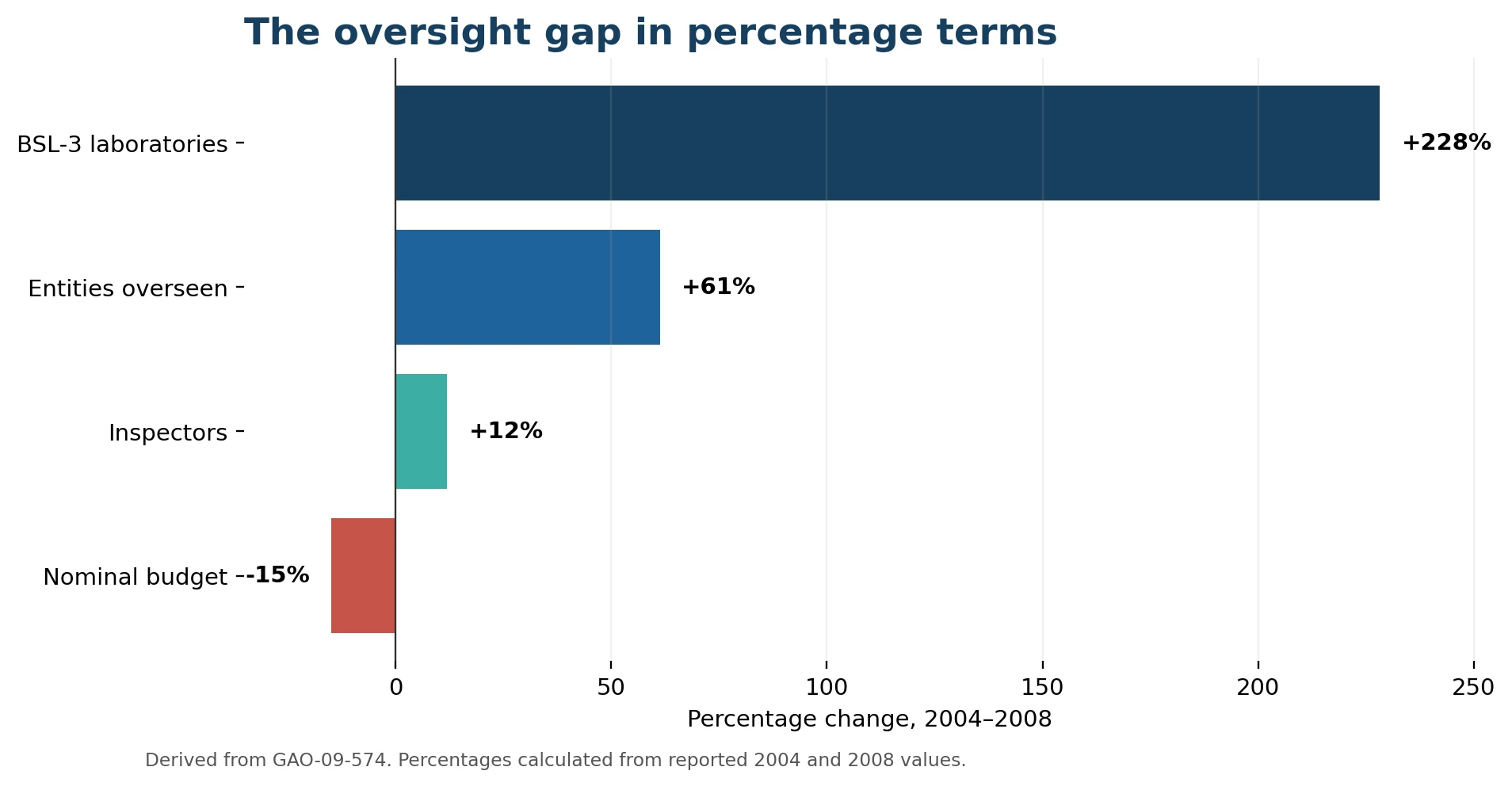
The imbalance is striking: laboratories increased by 228 percent, entities by 61 percent and inspectors by 12 percent, while the budget fell by 15 percent in nominal dollars. Those measures do not capture every laboratory or every oversight resource, but they demonstrate that rapid capacity expansion was not matched by supervision.
GAO returned to the problem in 2013. It found that the government still lacked a national assessment of laboratory need and consistent standards covering design, construction, operation and maintenance. The National Security Staff had rejected GAO’s recommendation for a single government-wide coordinating entity, saying that allocating resources that way was not in the national-security interest. Secrecy and fragmentation were not incidental defects; they were partly defended as features.
4. The 2014 warning—and the loophole problem
The United States did not need COVID-19 to learn that sophisticated laboratories make basic errors. In 2014, CDC personnel were potentially exposed to live anthrax after inadequate inactivation; viable smallpox vials were discovered improperly stored on an NIH campus; and an influenza sample was contaminated with the highly pathogenic H5N1 strain. Subsequent investigation found additional safety lapses. A 2015 GAO assessment described repeated breakdowns in compliance and inadequate oversight. DOD later discovered that incompletely inactivated anthrax had been shipped to 86 laboratories in 20 states, the District of Columbia and seven countries.
On 17 October 2014, the Obama administration announced a pause on new federal funding for research reasonably anticipated to enhance the pathogenicity or mammalian respiratory transmissibility of influenza, MERS or SARS viruses. Eighteen NIH projects were initially affected, though exemptions followed. The pause ended on 19 December 2017 when HHS introduced the Potential Pandemic Pathogen Care and Oversight (P3CO) framework. The NIH notice lifting the pause accurately describes both its scope and its limits.
The public debate often treats the pause as a binary switch: risky work was either prohibited or it was not. In practice, it was a definitional gate. The questions were prospective and contestable. Was increased pathogenicity “reasonably anticipated”? Was the starting virus already a potential pandemic pathogen? Did the experiment enhance transmissibility in the relevant mammalian system? Was the work characterization of naturally occurring viruses? Did it qualify for an exception?
When the funding agency, program officials and supported scientific community all have an interest in proceeding, a narrow definition can become an escape route. This is why Fauci’s repeated assertion that NIH did not fund “gain-of-function research” at WIV was formally defensible only under the operative regulatory definition. In his 2024 congressional interview, he explicitly distinguished that definition from the ordinary meaning of experiments that give a virus a new or enhanced function.
Semantic compliance is not the same as acceptable risk.
5. Wuhan: not an export after the pause, but a failure of controllability
NIAID awarded EcoHealth Alliance the grant “Understanding the Risk of Bat Coronavirus Emergence” with a project start date of 1 June 2014. EcoHealth subawarded part of the work to WIV. The chronology matters: the project began more than four months before the October funding pause and was not simply created in response to it. Claims that Fauci responded to the pause by “moving the research to China” overstate what the record presently proves. The more defensible criticism is that the pause’s narrow scope and discretionary classifications allowed closely related work to continue within a system whose foreign-subaward controls were demonstrably weak.
But the foreign-subaward structure made meaningful control weaker. NIAID supervised EcoHealth; EcoHealth supervised WIV; WIV operated within China’s political and security system. Each link increased informational distance and reduced enforceability.
The January 2023 HHS Office of Inspector General audit supplies the most reliable institutional findings. It did not determine whether the research caused COVID-19 or resolve the terminological dispute over gain of function. It found that:
- NIH identified potential risks but used its discretion not to refer the work for department-level ePPP review.
- NIH imposed a special condition requiring immediate notification if viral growth crossed a specified benchmark, but provided limited guidance.
- EcoHealth failed to provide the required immediate notification after an experiment produced results that NIH later concluded met the benchmark.
- EcoHealth’s Year 5 progress report was almost two years late, and NIH did not follow up promptly.
- EcoHealth could not obtain all requested records from WIV once the institute ceased cooperating.
- NIH and EcoHealth failed to monitor the awards and subawards effectively, producing missed opportunities to mitigate inherent risks.
These are not partisan conclusions. They come from HHS’s inspector general. The audit’s central lesson is that a paper condition is not a safeguard if the funder does not receive timely results, the intermediary cannot compel records and the foreign laboratory can terminate cooperation.
The official position was effectively: the work did not cross our regulatory line as we prospectively defined it; a reporting condition would alert us if results became concerning; and the foreign partners would supply the information required. Each assurance depended on information controlled by the grantee and subgrantee. When the condition failed, NIH learned late. When the crisis arrived, WIV and China controlled access.
6. COVID-19 transformed a scientific conflict into an institutional one
The origin of SARS-CoV-2 remains unresolved. The US intelligence community’s declassified 2021 assessment judged that the virus was not developed as a biological weapon and reported divided views on natural exposure versus a laboratory-associated incident. The 2023 ODNI report on potential links between WIV and the pandemic did not resolve the dispute. China’s refusal to provide complete records prevents confident closure.
It is essential not to leap from institutional conflicts to a claim that the laboratory origin has been proved. It is equally untenable to pretend that institutions with exposure were neutral umpires.
In early 2020, Fauci, NIH Director Francis Collins and leading virologists discussed features of the virus and the possibility of laboratory involvement. Several scientists initially expressed serious concern. The subsequent Nature Medicine correspondence, “The Proximal Origin of SARS-CoV-2,” became a powerful public instrument against the laboratory hypothesis. Later emails showed a more uncertain private discussion than the paper’s categorical public reception suggested. A 2023 House interim staff report argued that Fauci and Collins helped prompt, track and publicly deploy the paper. Because that is a majority staff interpretation rather than a judicial finding, its conclusions should be evaluated alongside the underlying communications and authors’ testimony. Still, the discrepancy between private uncertainty and public certainty is material.
David Morens’s conduct is less ambiguous. Emails released by the House showed Fauci’s senior scientific adviser discussing deletion of records, use of personal email to avoid Freedom of Information Act searches, and assistance to EcoHealth president Peter Daszak. The House memorandum is partisan in authorship, but many of its central facts are quotations from Morens’s own messages and were explored in public testimony. Whatever the ultimate legal conclusions, this was not a culture of fearless disclosure.
The newly disclosed CIA–NIAID agreement increases the importance of transparency because it demonstrates that the institutional relationships ran deeper than ordinary public-health grantmaking. It does not validate every allegation about intelligence manipulation. It strengthens the case for asking who had overlapping roles, what information was withheld as sensitive, which risk judgments were influenced by intelligence requirements, and whether those who helped build the system were allowed to define the public account of its performance.
7. The recurring governance failure
The central failure can be represented as a cycle:
- A genuine threat creates urgency and large budgets.
- Agencies recruit scientific expertise and expand research capacity.
- The scientific work creates useful knowledge but also new hazards and institutional dependencies.
- Oversight remains fragmented, technical and controlled by the funding system.
- Officials assume that classifications, grant conditions and professional norms provide control.
- A failure or crisis exposes that control as incomplete.
- Disclosure threatens programs, reputations, international relations and political authority.
- Communication management displaces open scientific inquiry.
The benefit–risk asymmetry is severe. A successful experiment can produce papers, grants, data, prestige and perhaps a useful platform. Those benefits accrue primarily to identifiable institutions. The worst plausible cost of an accident is dispersed globally. No university, agency or investigator can compensate the world for a pandemic. Ordinary liability, peer review and grant monitoring cannot discipline risks of that scale.
Classified or sensitive purposes add another asymmetry. Intelligence agencies may possess legitimate reasons not to disclose capabilities or sources. But secrecy prevents the wider scientific community and public from evaluating whether the promised benefits justify the risks. The CIA–NIAID arrangement therefore created a structural accountability deficit even if every participant acted lawfully and patriotically.
The most recent GAO work suggests that the problem persists. In January 2026, GAO reported that HHS generally had procedures to assess pathogen and experimental risk, but did not publicly share key information about risk reviews and mitigation. GAO noted that it had made 58 biosafety and biosecurity recommendations to HHS and other departments over the preceding decade; nine remained unimplemented as of December 2025. GAO-26-107348 recommended public disclosure of key risk-review information. HHS neither agreed nor disagreed.
8. What accountability should require
The answer is not to prohibit intelligence agencies from consulting biologists or to end all work on dangerous pathogens. It is to stop confusing expert confidence with control.
1. Regulate experiments, not labels. Public descriptions should identify the starting organism, modifications, experimental system, anticipated phenotypic changes, containment level and plausible failure modes. Whether officials attach the phrase “gain of function” should not determine oversight.
2. Move catastrophic-risk review outside the funding chain. A body institutionally separate from NIH, NIAID, DOD and intelligence sponsors should review experiments capable of creating or substantially enhancing pandemic hazards. Funders may submit evidence but should not adjudicate their own programs.
3. Impose a rebuttable presumption against globally asymmetric risk. When the worst plausible harm is worldwide but the benefit is a speculative contribution to surveillance or future countermeasures, the experiment should not proceed unless proponents demonstrate a unique, material benefit unavailable through safer methods.
4. Make foreign funding conditional on enforceable access. No high-risk subaward should proceed unless the US government has audit rights, prompt access to raw data and laboratory records, incident-reporting requirements, sample and sequence access where appropriate, and automatic suspension when access is denied. If sovereignty or security rules make these conditions impossible, the work is not controllable enough to fund.
5. Disclose risk decisions and exceptions. HHS should publish experiment-level summaries of approvals, exceptions, identified risks and mitigation measures, with narrowly tailored redactions. Aggregate counts do not permit accountability.
6. Separate intelligence tasking from civilian scientific judgment. Intelligence agencies may commission necessary defensive research, but its purpose, risk review and governance should be recorded. Civilian health agencies should not provide an unexamined legitimacy shield for sensitive projects.
7. Protect records and dissent. Communications about publicly funded research, origins investigations and risk decisions must be preserved. Using personal channels, deleting records or treating FOIA as an adversary should carry meaningful professional consequences. Scientists who raise safety or origin questions should not risk grants, publication or reputation merely for challenging the dominant institutional position.
8. Require retrospective evaluation. Programs should state measurable anticipated benefits before funding. Independent reviewers should later assess whether those benefits materialized, what hazards were created and whether safer approaches could have produced comparable knowledge.
Conclusion: the original sin was hubris
The post-anthrax biodefense expansion began with a legitimate fear. It produced valuable science and capabilities. The CIA was right to take biological threats seriously; NIAID was right to seek vaccines, treatments and better detection. A credible assessment should concede this plainly.
But defensible beginnings do not excuse an unaccountable system. The United States expanded high-containment research faster than oversight, allowed intelligence and civilian science to blur, relied on definitions policed by interested agencies, and funded sensitive work through foreign relationships it could not ultimately control. When COVID-19 made those choices politically consequential, too many officials acted as custodians of institutions and narratives rather than disinterested investigators.
The new CIA–NIAID document is not a smoking gun for the origin of COVID-19. It is evidence of the architecture that made honest investigation difficult: intertwined missions, concealed purposes, dispersed responsibility and institutional self-protection.
The lesson is not that government should never act against uncertain threats. It is that a government powerful enough to sponsor dangerous biological research must be accountable enough to admit what it sponsored, disclose how it judged the risks, and surrender control of the investigation when its own conduct is in question. On that test, the biodefense system failed.
About CGHA and attribution
The Center for Global Health Accountability publishes empirically grounded analysis of global-health institutions, incentives and policy trade-offs. Some CGHA contributors are named; others contribute without attribution because public association with challenges to established health institutions could threaten employment, promotion, research funding or professional standing. Anonymity protects contributors from disproportionate professional retaliation. It does not reduce CGHA’s responsibility for the accuracy, sourcing and arguments it publishes. Funders do not control CGHA’s research questions, methods, conclusions, wording or publication decisions.
Selected sources
- CIA–NIAID interagency agreement, undated
- Daily Caller News Foundation investigation, 28 August 2026
- GAO, High-Containment Laboratories: National Strategy for Oversight Is Needed, 2009
- GAO, Assessment of the Nation’s Need Is Missing, 2013
- GAO, Preliminary Observations on Federal Efforts to Address Weaknesses, 2015
- NIH notice announcing removal of the 2014 funding pause, 2017
- HHS OIG audit of NIH and EcoHealth Alliance, 2023
- NIH RePORTER, Understanding the Risk of Bat Coronavirus Emergence, project start 1 June 2014
- ODNI, Updated Assessment on COVID-19 Origins, 2021
- ODNI, Potential Links Between WIV and the Origin of COVID-19, 2023
- House Select Subcommittee, Proximal Origin interim staff report, 2023
- House Select Subcommittee memorandum on David Morens, 2024
- GAO, HHS Should Publicly Share More Information on How Risk Is Assessed and Mitigated, 2026