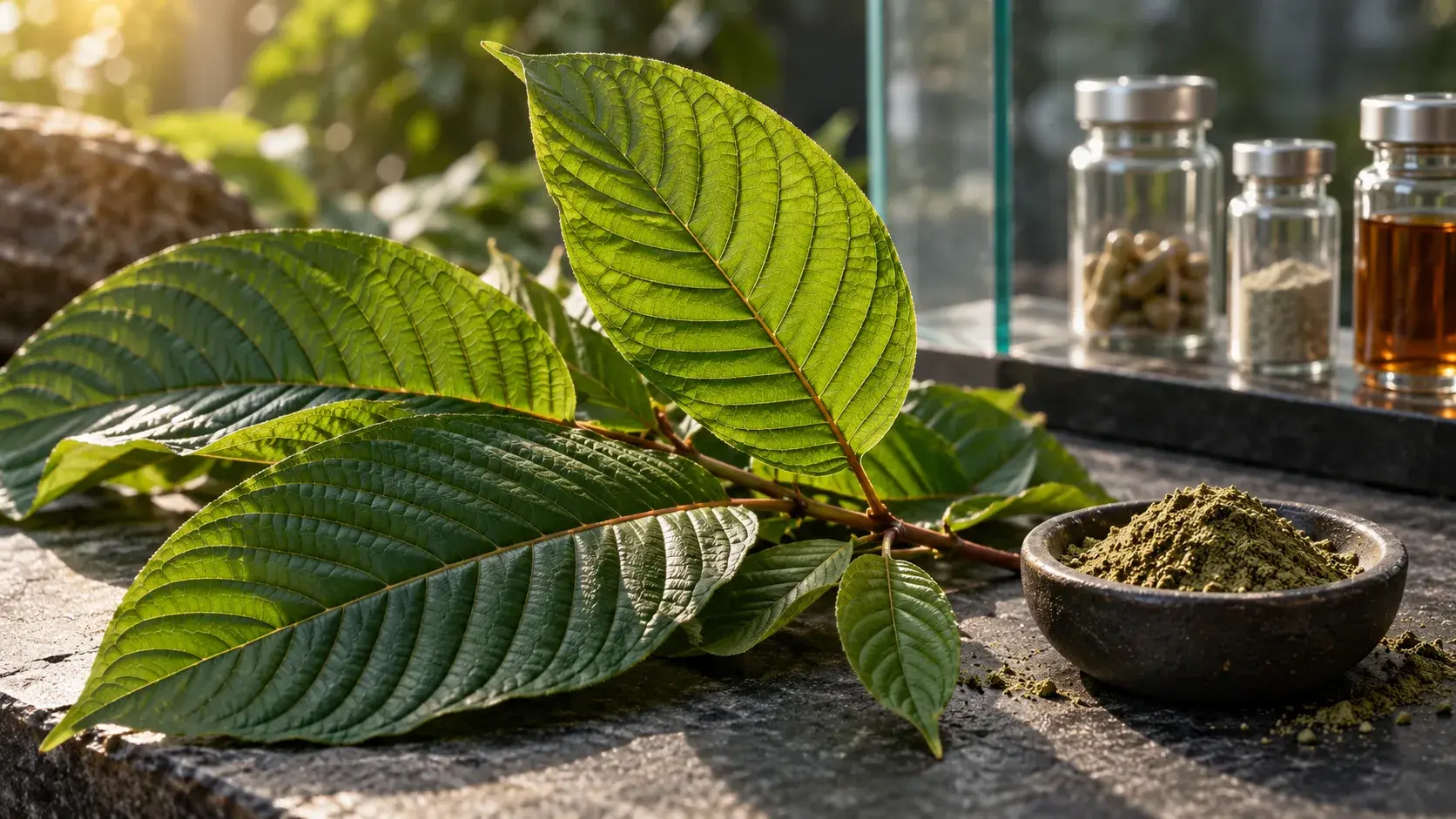
This paper forms part of the Politics of Acceptable Addiction inquiry, which asks why societies tolerate some recurring psychoactive habits, condemn others and often regulate the delivery system less carefully than the underlying drug. Kratom is a revealing next case because it begins as a plant containing naturally occurring alkaloids but now reaches consumers as products ranging from traditional leaf to engineered, opioid-active formulations. It therefore forces the same questions that arise in tobacco policy: whether law should classify a substance by its name and cultural reputation, or distinguish products by dose, formulation, delivery, comparative harm and the alternatives consumers will use instead.
Kratom now spans several markets that should not be governed as though they were one product. Traditional leaf, concentrated extracts, enhanced 7-hydroxymitragynine products and newer analogues differ sharply in manufacture, potency, dependence risk and likely patterns of substitution. The appropriate policy is regulated control with clear product boundaries. Blanket prohibition risks driving consumers toward illicit or more dangerous opioids, while treating industrially manufactured 7-OH as an ordinary botanical understates a genuine emerging risk.
Executive Summary
The deeper reason for examining kratom is not that it has suddenly become fashionable, nor that every dependence-producing substance requires a new prohibition. It is that kratom sits at the difficult edge of the acceptable-addiction spectrum. Caffeine is an alkaloid whose routine dependence is culturally normalized. Nicotine is another alkaloid whose risks are commonly confused with the much greater harms of burned tobacco. Kratom adds a third and more complicated case: the same botanical source can yield relatively mild traditional preparations, concentrated extracts and potent products acting at opioid receptors. The category name tells us far less than the chemistry, dose and product design.
The tobacco comparison is not a claim that kratom and nicotine are pharmacologically equivalent. It is a policy lesson. Just as sound tobacco policy must separate nicotine from combustion and distinguish cigarettes from lower-risk non-combustible products, sound kratom policy must separate leaf from enhanced 7-OH and newer analogues. Regulation that collapses unlike products can suppress safer substitutes, exaggerate some risks, understate others and create an illicit market without eliminating demand.
A September 2026 STAT report makes the issue newly topical. Addiction clinics told Theresa Gaffney that they were treating rapidly rising numbers of patients dependent on products sold as kratom, with some centers managing withdrawal as they would withdrawal from oxycodone, heroin or fentanyl. At Boulder Care, people reporting kratom-product use rose from 3 percent of new patients in September 2025 to 14 percent in August 2026. Two Massachusetts inpatient clinics reported moving from roughly one kratom-related admission a week to between 10 and 20 patients a week (Gaffney, 2026).
The reporting identifies a genuine warning signal, but its headline also illustrates the policy problem. “Kratom and 7-OH” are presented together even though most of the severe new cases appear to involve concentrated 7-OH or other high-potency products rather than traditional leaf. Treatment centers also observe a selected population: people who discontinue without clinical help never enter their statistics. The article is therefore evidence of an emerging high-potency-product problem, not a national incidence study and not proof that all kratom products carry equivalent risk.
Kratom has moved beyond its origins as a traditional Southeast Asian botanical. The American market now includes dried leaf and powder, mitragynine-standardized extracts, high-dose 7-hydroxymitragynine products and chemically modified analogues. These products share a botanical ancestry but do not share the same risk profile.
Traditional leaf can cause tolerance, dependence and withdrawal, particularly with frequent high-dose use. Its effects are nevertheless constrained by plant bulk, variable alkaloid content and slower oral consumption. Concentrated 7-OH is a more direct and potent mu-opioid-receptor product. Reports from treatment centers increasingly describe rapid tolerance and severe opioid-like withdrawal among heavy users. Newer compounds such as mitragynine pseudoindoxyl, MGM-15 and MGM-16 take the market further from traditional kratom and closer to an experimental synthetic-opioid trade.
No reliable human trial establishes that enhanced 7-OH is less addictive than oxycodone. Several animal experiments suggest that mitragynine has less reinforcing activity than classical opioids, but 7-OH substitutes for morphine in drug-discrimination tests and is self-administered by animals. Clinical experience now confirms that concentrated products can produce serious dependence. Claims of comparative safety must therefore distinguish leaf kratom from high-dose 7-OH and must not infer human addiction rates from receptor potency alone.
The United States has developed a fragmented legal boundary. Federal authorities have proposed Schedule I control for products exceeding specified 7-OH thresholds and for three related analogues, while leaving ordinary botanical kratom outside that action. States variously ban all kratom, ban or limit enhanced 7-OH, impose age and labeling rules, license sellers or leave the market largely unregulated. That variation already creates cross-border and online arbitrage.
A proportionate national model should preserve legal access to tested botanical kratom, impose tighter controls on enhanced 7-OH, require premarket review for novel analogues, and fund enforcement through licensing fees and moderate excise taxes. Taxation should reflect product risk without making compliant products uncompetitive against illicit sellers.
Why the STAT Report Matters
STAT published “Addiction clinics see rising cases of kratom and 7-OH withdrawal” on 21 September 2026. The article is valuable because national surveillance has lagged the product market. Clinicians are often the first to see a change in dependence severity, and several independent providers described the same pattern: consumers begin with products perceived as natural or benign, progress toward higher-potency formulations, develop tolerance and then seek medical help when they cannot stop.
The most striking numbers come from individual providers rather than a representative sample. Boulder Care reported the share of new patients mentioning kratom products rising from 3 percent to 14 percent in eleven months. Recovery Centers of America reported 10 to 20 weekly admissions involving kratom or 7-OH across two Massachusetts facilities, compared with no more than one a week previously. Clinicians described treating some withdrawal syndromes with buprenorphine and other methods used for opioid dependence (Gaffney, 2026).
Those observations deserve attention, but three limitations affect their interpretation. First, treatment centers disproportionately observe severe cases. Second, the underlying denominator is unknown: neither the number of users nor the amount consumed is measured. Third, the article repeatedly joins “kratom” and “7-OH,” even while acknowledging that most newer severe cases involve potent concentrated products. The category used in the headline is broader than the product driving much of the reported change.
That imprecision has practical consequences. If the public hears that kratom withdrawal now resembles fentanyl withdrawal, support may grow for banning traditional leaf. If consumers hear advocates insist that kratom is merely a mild botanical, they may assume that a 15 mg or 30 mg 7-OH tablet is similarly benign. Both conclusions flatten the risk spectrum. The STAT report should prompt rapid regulation of enhanced products and better surveillance, not an undifferentiated prohibition.
The central policy claim is therefore narrow but important. Kratom should remain a botanical category; enhanced 7-OH should not be allowed to borrow that category's reputation. The legal boundary should turn on measured composition, dose and manufacturing method, not on whether a seller prints the word kratom on the packet.
The Product Categories
The word kratom now conceals a product ladder. Policy should begin by naming each rung rather than regulating the plant name alone.
| Product | How it is made | Principal concern | Appropriate status |
|---|---|---|---|
| Leaf powder tea and capsules | Leaves are dried ground or brewed | Variable dose contamination and dependence with heavy use | Legal regulated botanical |
| Mitragynine extracts and enhanced leaf | Plant alkaloids are extracted concentrated or added back to leaf | Higher dose easier redosing and greater dependence risk | Legal with potency tiers testing and labeling |
| Commercial 7 OH | Usually manufactured by converting plant derived mitragynine although the molecule occurs naturally in trace amounts | Potent opioid effects rapid tolerance severe withdrawal and uncertain labeling | Restricted licensed product with strict dose limits or controlled medical channel |
| Mitragynine pseudoindoxyl | Powerful metabolite or rearrangement product manufactured for sale | High potency limited human evidence and analogue substitution | Premarket authorization required |
| MGM 15 and MGM 16 | Chemically modified 7 OH derivatives | Experimental pharmacology and almost no population safety evidence | Do not permit ordinary retail sale without review |
The distinction between natural and synthetic is not sufficient. Commercial 7-OH illustrates why. The molecule occurs naturally in kratom at trace levels, but commercial quantities are generally produced by chemically converting the much more abundant mitragynine. The resulting molecule is chemically identical to natural 7-OH. The material is best understood as a semisynthetic product whose risk comes from concentration, dose and delivery rather than from an ontological difference between natural and synthetic molecules (DEA, 2026a).
From Southeast Asian Leaf to American Retail
Indonesia, particularly West Kalimantan, supplies much of the botanical material entering the American trade. Farmers and leaf collectors sell dried material to local aggregators, who grind, blend and consolidate it for exporters. American importers then repackage the powder or process it into capsules, extracts, shots, gummies and tablets. Thailand and Malaysia retain important traditional-use and production histories, but Indonesia became the principal bulk exporter to the United States.
Indonesia introduced export controls in 2024 to improve legal certainty and product quality. Exported material must meet requirements concerning form, microbiological contamination, heavy metals and adulteration. The policy also restricts eligible exporters and attempts to move the trade away from poorly documented bulk shipments (Indonesian Ministry of Trade, 2024; Reuters, 2024).
The economics change as the product moves downstream. Leaf is bulky, relatively inexpensive and difficult to standardize. Extracts are easier to transport and brand and yield higher revenue per gram. Tablets containing measured or purportedly measured quantities of 7-OH permit still higher margins. Convenience and rapid repeat dosing are commercially valuable, but they can also increase tolerance and dependence.
Pharmacology and Dependence
Mitragynine is the principal alkaloid in kratom. It has complex pharmacology, including partial activity at the mu opioid receptor and activity at adrenergic and other systems. At lower doses, users may report stimulation, alertness and endurance. At higher doses, analgesic and sedative effects become more prominent. 7-OH is a more potent mu-opioid-receptor agonist. An agonist is a molecule that binds to a receptor and activates it, rather as a key both enters and turns a lock. Activation of the mu opioid receptor can produce analgesia, euphoria, sedation, tolerance and respiratory depression. A partial agonist activates the receptor but produces a lower maximum response than a full agonist under the same experimental system.
Potency is not identical to addictiveness. Addiction depends on dose, speed of onset, frequency, reinforcement, withdrawal, user vulnerability and the availability of substitutes. A compound can be potent but aversive at high doses; another can be less potent but highly reinforcing because it is delivered rapidly and repeatedly. Product design therefore matters as much as receptor binding.
Chemical Comparison
The molecular formulas help locate the kratom compounds within the wider alkaloid family, but formula alone cannot predict effect. Nicotine and caffeine are small alkaloids acting primarily outside the opioid system. Morphine, oxycodone and the kratom derivatives are larger oxygen-rich molecules, but their receptor activity depends on three-dimensional structure rather than simply the numbers of carbon, hydrogen, nitrogen and oxygen atoms.
| Compound | Molecular formula | Approximate molecular weight | Primary classification |
|---|---|---|---|
| Nicotine | C10H14N2 | 162.23 g/mol | Natural alkaloid and nicotinic receptor agonist |
| Caffeine | C8H10N4O2 | 194.19 g/mol | Natural purine alkaloid and adenosine receptor antagonist |
| Morphine | C17H19NO3 | 285.34 g/mol | Natural opiate alkaloid and mu opioid receptor agonist |
| Oxycodone | C18H21NO4 | 315.36 g/mol | Semisynthetic opioid derived from thebaine |
| Mitragynine | C23H30N2O4 | 398.50 g/mol | Natural kratom indole alkaloid with partial opioid activity |
| 7 OH | C23H30N2O5 | 414.50 g/mol | Natural trace alkaloid usually produced semisynthetically for commercial sale |
| Mitragynine pseudoindoxyl | C23H30N2O5 | 414.49 g/mol | Structural isomer and potent opioid agonist |
| MGM 15 | C23H32N2O5 | 416.51 g/mol | Semisynthetic dihydro derivative of 7 OH |
| MGM 16 | C23H31FN2O5 | 434.50 g/mol | Synthetic fluorinated derivative of MGM 15 |
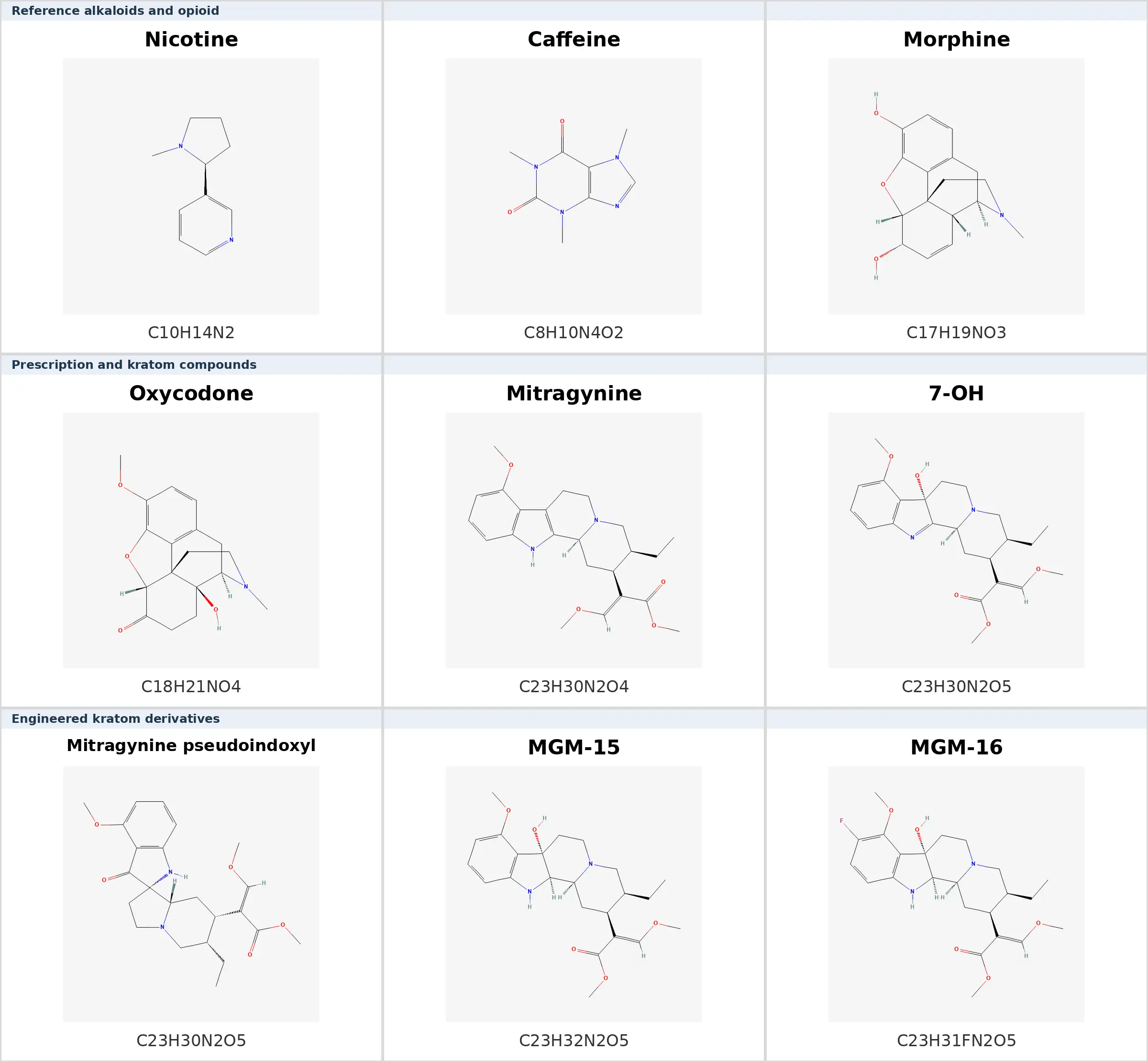
Several comparisons are revealing. Adding one oxygen atom converts the formula of mitragynine from C23H30N2O4 to the C23H30N2O5 formula of 7-OH. Mitragynine pseudoindoxyl has the same molecular formula as 7-OH but a different arrangement of atoms. It can therefore have different receptor potency despite containing exactly the same counts of each element. MGM-15 adds two hydrogen atoms through reduction, while MGM-16 replaces a hydrogen with fluorine on the MGM-15 scaffold. These small chemical changes can produce large pharmacological changes (PubChem, 2026; Matsumoto et al., 2014).
The comparison also clarifies the terminology. Caffeine and nicotine are alkaloids but are not opioids. Morphine is both an alkaloid and an opioid. Oxycodone is an opioid but is semisynthetic rather than a naturally occurring alkaloid. 7-OH begins as a naturally occurring alkaloid, yet nearly all high-dose commercial material depends on chemical conversion. Molecular ancestry does not determine the appropriate regulatory category.
Comparison with Oxycodone
The evidence does not support a numerical statement that 7-OH is a particular percentage less addictive than oxycodone. There has been no adequate human head-to-head trial of dependence, compulsive use or withdrawal under comparable dosing conditions. Oxycodone has decades of clinical and epidemiological evidence. Commercial high-dose 7-OH is comparatively new, inconsistently labeled and often used outside medical supervision. Absence of comparable evidence is not evidence of lower risk.
There are nevertheless important distinctions. Animal studies generally find that mitragynine has weaker reinforcing effects than morphine or heroin and in some tests is not readily self-administered. That finding is consistent with traditional leaf occupying a lower-risk position than conventional prescription opioids. Evidence for 7-OH is less reassuring. It substitutes for morphine in drug-discrimination experiments, animals will self-administer it in some models, and repeated exposure produces tolerance and physical dependence. One intracranial self-stimulation study did not find 7-OH rewarding and found high doses aversive, demonstrating that the preclinical literature is not uniform (Behnood-Rod et al., 2020).
Current clinical reports add a warning that laboratory studies could not provide. Addiction centers describe users of enhanced products developing rapid tolerance, dosing repeatedly throughout the day and experiencing sweating, agitation, anxiety, insomnia, gastrointestinal symptoms and powerful cravings on cessation. Some are treated with buprenorphine or methadone. These observations are selected from treatment populations and cannot establish prevalence, but they demonstrate that severe dependence is possible (Gaffney, 2026).
| Dimension | Traditional leaf | Enhanced 7 OH | Oxycodone |
|---|---|---|---|
| Human evidence | Longer history but weak surveillance and self selected studies | New market with case reports poison center data and treatment center reports | Extensive clinical prescribing misuse and mortality evidence |
| Reinforcement | Generally slower oral use and mixed alkaloid exposure | Concentrated convenient products can support frequent redosing | Formulation dependent and high when used rapidly or nonmedically |
| Dependence | Established especially with frequent high dose use | Established and sometimes severe | Well established |
| Overdose evidence | Lower apparent acute lethality but risk rises with co use and contamination | Respiratory depression and overdose concern with limited denominator data | Clear dose related respiratory depression and substantial mortality burden |
| Comparative conclusion | Probably lower risk than oxycodone for many users but not harmless | Too little human evidence to claim lower addictiveness | Known high dependence and misuse potential |
Signals of Harm and Their Limits
Poison-center reports involving kratom increased from 258 in 2015 to 3,434 in 2025. The sharp rise in 2025 coincided with the spread of high-potency and semisynthetic products. Across 2015 to 2025, 79 percent of 233 reported kratom-associated deaths involved multiple substances, most often other opioids. These figures establish a growing safety signal but cannot measure the incidence of harm per user or reliably separate leaf from enhanced products (Towers et al., 2026).
Commercial-product testing reinforces the need for regulation. Researchers have found products with 7-OH concentrations above label claims and chromatographic profiles inconsistent with traditional leaf. FDA warning letters documented tablets, strips and shots marketed with 15 mg and 30 mg quantities, while a December 2025 seizure removed approximately 73,000 units valued at about one million dollars (FDA, 2025a; FDA, 2025b).
The principal uncertainties are the number of users of each product class, their typical daily dose, the rate at which leaf users progress to concentrates, and the counterfactual drug that each user would consume if kratom were unavailable. Those gaps should temper both claims that kratom is causing a new opioid epidemic and claims that enhanced 7-OH is a reliably safe alternative to prescription opioids.
What the Evidence Can Establish
The evidence is strongest on three points. Traditional leaf and enhanced 7-OH are materially different products. Dependence and withdrawal can occur with both, but concentrated 7-OH can support faster repeat dosing and severe opioid-like withdrawal. Finally, mislabeled or mixed products make both clinical treatment and population surveillance less reliable.
The evidence is weaker on comparative rates. Poison-center reports count calls, not users; treatment-center reports select for people who need help; mortality reports frequently involve several substances; and product labels may not reveal what was consumed. These sources identify hazards and changes in the market, but they do not yield a defensible estimate of the probability that a leaf user, a 7-OH user or an oxycodone user will become addicted.
This distinction matters for policy. A warning signal can justify testing, labeling, age limits, surveillance and temporary restrictions while evidence develops. It does not automatically justify treating every product sharing a botanical origin as equally dangerous. Nor does uncertainty justify leaving concentrated opioid-active products in ordinary convenience-store channels.
The Legal Boundary
Federal law has historically occupied an awkward middle ground. Mitragynine and ordinary kratom have not generally been scheduled under the Controlled Substances Act, but FDA has not approved kratom as a drug and maintains that no legally marketed over-the-counter or prescription kratom drug exists. FDA has used import alerts, warning letters and seizure authority against adulterated products and unapproved medical claims (FDA, 2025c).
In July 2026 DEA announced its intention to place high-level 7-OH and three related substances in Schedule I. The proposed threshold covers botanical material containing more than 0.050 percent 7-OH by dry weight, and processed or synthetic articles containing more than 0.050 percent or more than 1 mg of 7-OH per article. It separately targets mitragynine pseudoindoxyl, MGM-15 and MGM-16. Ordinary botanical material below the threshold is excluded from this particular action (DEA, 2026a; DEA, 2026b).
The federal line is conceptually sound because it separates leaf from an enhanced opioid product, but the numbers require continuing review. A concentration rule alone can be evaded through small serving units, misleading package definitions or repeated consumption. A per-serving limit alone can be evaded through unrealistic serving instructions. Regulation should therefore use both concentration and absolute-dose limits, coupled with package limits and standardized laboratory methods.
Drawing a Boundary That Can Survive the Market
Every boundary creates incentives. If law controls only a named molecule, manufacturers can move to an analogue. If it controls only concentration, they can shrink the serving and encourage repeated use. If it controls only milligrams per serving, they can print an implausibly small serving on a multi-dose package. If it bans every chemically modified alkaloid, it may also block compounds that eventually prove medically useful. A durable rule must therefore combine several tests.
The first test is compositional: measured 7-OH concentration and absolute dose per unit and package. The second is process-based: deliberate conversion, enrichment or addition should move a product out of the ordinary botanical tier even when the resulting molecule also occurs naturally in trace amounts. The third is pharmacological: close analogues with comparable opioid-receptor activity should enter a premarket-review class rather than remain legal until individually scheduled. The fourth is functional: regulators should examine actual packaging and reasonably foreseeable consumption rather than the manufacturer's nominal serving.
This approach is stricter than botanical self-regulation but more discriminating than a plant-wide ban. It recognizes that a threshold is not a declaration that everything below it is safe. It is an administrable boundary, supported by testing and revised as human evidence improves.
The State Patchwork
State law is changing too quickly for a permanent static map. As of January 2026, the Legislative Analysis and Public Policy Association reported that 30 states and the District of Columbia regulated kratom or its components. Six states then treated mitragynine and 7-OH as controlled substances, effectively banning all kratom. Other jurisdictions scheduled only 7-OH, capped its concentration, prohibited synthetic derivatives, imposed age limits or required labels and licenses. Additional bans and reversals followed during 2026 (LAPPA, 2026; NCSL, 2026).
Three approaches illustrate the available choices. Oklahoma permits kratom but limits 7-OH to 1 percent of total alkaloids and requires quantitative labeling. Colorado restricts sales to adults aged 21 and older, bans synthetic alkaloids and caps 7-OH at 2 percent of total alkaloids. Rhode Island reversed its earlier blanket ban, established a regulated market for botanical kratom and prohibited 7-OH products. These regimes attempt to preserve lower-risk products while excluding or restricting enhanced ones (NCSL, 2026).
Illicit and Grey Trade
The illicit trade is not yet comparable in scale or violence to the fentanyl market, but several mechanisms are already visible.
Cross-border arbitrage arises when neighboring jurisdictions draw different lines. Consumers can buy in a permissive state and carry products into a prohibition state.
Online vendors can ship directly to consumers, obscure the origin of the product or fail to screen destinations and ages consistently.
Products can be described as botanical extracts, research materials or proprietary alkaloid blends even when they contain enhanced 7-OH or related compounds.
Mislabeled composition allows high-potency products to pass as ordinary kratom. It also makes poison surveillance unreliable because the package name does not identify the molecule consumed.
Novel analogues can replace a scheduled molecule faster than legislation can name each compound.
Recent enforcement provides concrete examples. California declared kratom an unsafe food additive, yet retailers continued selling powders, shots and high-potency products in 2026. Connecticut scheduled kratom alkaloids, but police subsequently found 7-OH and mitragynine pseudoindoxyl in retail products following a reported adverse reaction. FDA has also documented widespread online and smoke-shop marketing and has seized large inventories. These cases show the familiar limits of nominal prohibition when the supply chain remains intact and neighboring markets remain open (FDA, 2025a; NCSL, 2026).
Prohibition can also worsen product quality. Leaf is bulky and comparatively easy to inspect. High-value concentrates and analogues are easier to conceal and ship. If enforcement increases the cost of volume, suppliers have an incentive to move toward smaller, more potent products. This is the iron law of prohibition applied to kratom: enforcement against bulk can raise the commercial value of potency.
The likely substitutions matter. A ban may lead some occasional users to stop. It may lead others back to prescription opioids, illicit fentanyl, tianeptine or untested analogues. It may also encourage domestic chemical conversion of mitragynine rather than legal importation of tested products. Policy evaluation must measure these responses rather than counting only removed products or closed retailers.
The Potency Feedback Loop
Kratom offers an unusually clear test of the proposition that prohibition changes products as well as quantities. Traditional leaf is low in value relative to its bulk. Concentrated alkaloids are easier to conceal, ship and sell at a high margin. Enforcement that raises the cost of volume therefore changes the supplier's calculation even if it reduces total sales. The surviving market may become smaller but more potent.
Consumer information also deteriorates outside the regulated channel. A licensed botanical market can require batch tests, retain samples and identify importers. An illicit seller has reason to disguise potency, substitute compounds and avoid adverse-event reporting. The result is not simply the same drug sold unlawfully; it is a less observable market with a stronger incentive to innovate around the rule.
This is the same institutional problem seen with illicit nicotine products and other prohibited intoxicants. A legal line is unavoidable, but its consequences depend on where it is drawn and whether consumers retain a credible lower-risk product on the legal side. The objective should be to make movement down the potency ladder easy and movement up it progressively more difficult.
Taxation and Fees
Kratom is ordinarily subject to general state and local sales taxes where tangible consumer products are taxable. There is no general federal kratom excise tax comparable to federal tobacco or alcohol taxes. A growing number of states, however, impose or propose kratom-specific taxes and regulatory fees.
| Jurisdiction | Tax or fee approach | Status and policy implication |
|---|---|---|
| Mississippi | 25 percent of the manufacturer's list price in addition to other applicable taxes | A substantial upstream excise burden that can fund oversight but may widen the legal-illicit price gap |
| Rhode Island | 15 percent of wholesale cost from April 2026 | Part of the licensed market adopted after repeal of the blanket ban; separate retail sales tax may also apply |
| Nebraska | 10 percent retail excise tax from January 2027 | Paired with product registration, electronic records and directory enforcement |
| Utah | Processor retailer and product registration fees | Cost recovery through licensing and registration rather than a large consumer excise tax |
| Other state proposals | Rates and tax bases vary widely | Shows the danger of choosing a revenue instrument before establishing stable product classes |
Taxes can finance laboratories, retailer inspections, poison surveillance and treatment. They can also function as prohibition by price. A very high ad valorem tax penalizes inexpensive leaf and expensive enhanced products alike unless rates are differentiated. It also rewards unlicensed online sellers who evade both tax and testing.
A better model would combine modest risk-based excise taxes with licensing and per-product registration fees. Botanical leaf should face the lowest rate. Concentrated extracts could face a higher rate based on total alkaloid dose. If enhanced 7-OH remains in a legal restricted channel, it should face the highest rate and stronger tracking. Novel analogues should not become taxable consumer products merely because government can collect revenue from them; they require prior safety review.
A Framework for Regulated Control
Blanket prohibition is a poor default because the market includes users who may be substituting away from more dangerous opioids. Unregulated sale is also untenable because consumers cannot reliably distinguish leaf from concentrated 7-OH and have little assurance about dose or contaminants. Regulated control should preserve lower-risk substitution while placing increasing friction around increasingly opioid-like products.
Product Classes and Rules
| Tier | Products | Core controls |
|---|---|---|
| One | Leaf powder tea and conventional capsules | Age 21 testing for microbes metals and adulterants ingredient disclosure batch certificate and adverse event reporting |
| Two | Mitragynine extracts and enhanced leaf | All Tier One controls plus total alkaloid and mitragynine dose labels package limits and higher registration fees |
| Three | Enhanced 7 OH below any controlled substance boundary | Licensed specialist sale dose and package caps no youth oriented formats purchase limits interaction warnings and real time surveillance |
| Four | Novel analogues including MP MGM 15 and MGM 16 | No ordinary retail sale without premarket toxicology abuse liability and manufacturing review |
Testing and Labeling
Every product should carry a batch-specific certificate from an accredited independent laboratory. Labels should state total alkaloids, mitragynine and 7-OH per serving and per package; list other psychoactive ingredients; identify the manufacturer and importer; and warn against combining the product with alcohol, benzodiazepines, opioids or other central nervous system depressants. Regulators should define a realistic serving rather than accept a manufacturer’s nominal serving designed to evade limits.
Retail Controls
Retailers should be licensed and subject to compliance checks. Sales should be limited to adults aged 21 and older. Concentrated products should not use candy-like presentation, free samples or therapeutic claims unsupported by approved evidence. Ordinary food and beverage shelves are inappropriate for enhanced 7-OH because proximity to energy drinks reinforces the false impression that it is simply another stimulant supplement.
Tax and Enforcement Design
The legal market must remain competitive with illicit supply. Licensing fees should cover administration, and excise taxes should rise with alkaloid dose and product risk. Revenue should be dedicated to testing, retailer inspections, poison-center coding, treatment and repeated market sampling. Enforcement should focus first on undisclosed ingredients, sales to minors, excessive 7-OH, novel analogues and dangerous co-formulations rather than possession by dependent consumers.
Treatment and Surveillance
Consumers who are dependent should not be treated primarily as criminals. Clinicians need guidance that distinguishes kratom leaf withdrawal from concentrated 7-OH withdrawal and recognizes that buprenorphine or other opioid-use-disorder treatments may be appropriate in severe cases. Surveillance systems should record the actual product, dose, label, batch and co-used substances. The current generic kratom category prevents useful risk comparison.
The Place of Kratom in the Acceptable Addiction Framework
Kratom extends the comparison developed through caffeine and nicotine. Caffeine shows how a dependence-forming alkaloid becomes socially acceptable when its harms are modest and its uses align with productivity. Nicotine shows how the harms of one delivery system, burned tobacco, can stigmatize the underlying alkaloid even when lower-risk delivery systems become available. Kratom adds a third problem: product engineering can move a botanical along the risk spectrum while its inherited name remains unchanged.
The relevant unit is substance multiplied by product, route, dose, speed and context. Traditional kratom used instead of fentanyl may reduce harm. The same leaf used instead of coffee probably raises risk. Enhanced 7-OH used by an opioid-naive consumer can create a new dependence. A tightly controlled 7-OH product used instead of illicit fentanyl might nevertheless reduce overdose risk. Regulation must examine the actual counterfactual rather than assign one moral status to the plant.
This is why addiction alone cannot settle policy. Dependence matters, but so do poisoning, chronic disease, overdose, consumer function and substitution. Public health should seek to reduce serious harm rather than eliminate every recurring psychoactive habit. That objective requires honest product distinctions and legal routes for consumers to move down the risk ladder.
Conclusion
Kratom policy is being made during a rapid transition from leaf commerce to alkaloid engineering. Traditional botanical products, concentrated extracts, enhanced 7-OH and novel derivatives should not share one legal category. The evidence suggests that ordinary leaf usually presents less risk than conventional opioids, although dependence and contamination are real. The evidence does not yet justify claiming that commercial 7-OH is less addictive than oxycodone, and the rapid appearance of severe withdrawal cases counsels caution.
Government should draw and enforce a clear line around composition, manufacturing and dose while leaving tested lower-risk products available. Moderate taxation, licensing, independent testing, age restrictions, quantitative labels and focused controls on enhanced products offer a more credible approach than either blanket prohibition or the present convenience-store free-for-all. This is the broader lesson of acceptable addiction: law cannot abolish demand by refusing to distinguish among products. The measure of success should be fewer severe poisonings, fewer transitions to dangerous opioids and more movement down the risk ladder, not simply fewer packages labeled kratom.
Glossary
| Term | Meaning in this paper |
|---|---|
| Agonist | A molecule that binds to a receptor and activates it producing a biological response |
| Partial agonist | An agonist that produces less than the maximum possible receptor response even when it occupies the available receptors |
| Full agonist | An agonist capable of producing the maximum response available in the experimental system |
| Antagonist | A molecule that binds to a receptor without activating it and blocks or reduces activation by an agonist |
| Receptor | A cellular protein that recognizes particular molecules and initiates or changes biological signaling |
| Potency | The amount of a substance required to produce a specified effect Potency is not the same as overall danger or addictiveness |
| Efficacy | The maximum response a drug can produce after binding to its target |
| Alkaloid | A broad chemical category of naturally occurring nitrogen containing compounds including caffeine nicotine morphine and mitragynine |
| Opioid | A substance whose important effects arise through opioid receptors whether natural semisynthetic synthetic or produced by the body |
| Dependence | Physical adaptation that can produce withdrawal when use stops Dependence can occur without compulsive addiction |
| Addiction | Persistent or compulsive use despite harm involving behavior reinforcement and impaired control as well as pharmacology |
| Semisynthetic | A product made by chemically modifying a molecule originally obtained from a natural source |