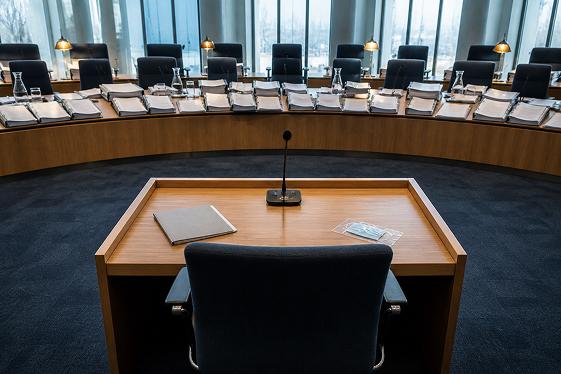
On Monday Sept 28th, Senator Ron Johnson [convened a roundtable](https://www.ronjohnson.senate.gov/2026/09/24/media-advisory-reminder-sen-johnson-to-lead-roundtable-discussion-covid-19-hospital-protocols-real-stories-from-real-people/) in the Senate’s Kennedy Caucus Room on COVID-19 hospital protocols. Patients, relatives, doctors, and nurses were invited to recount what happened inside hospitals. The event is a useful prompt, though their testimony and the underlying clinical records need independent examination before claims about particular treatments or deaths can be settled. The more durable question is why, six years after the outbreak, families still feel that the institutions entrusted with their lives have not heard them.
There is a familiar response to the loss of trust in science: lament it, blame misinformation, improve communication, and wait for confidence to recover. That response mistakes a breach of trust for a public relations problem. Even the celebrated breakthroughs were part of the problem because they were not always explained honestly. The rapid development of COVID vaccines was a scientific and industrial achievement. Government [helped finance development and procurement](https://www.gao.gov/assets/gao-21-207.pdf), industry made and sold the products, agencies assessed them, and officials urged or required people to take them. The closer these actors worked, the more essential it became to separate evidence from promotion. Instead, official spokespeople, journal editors, health agencies, and news organizations often claimed an authority they had not earned. They blurred uncertain evidence into settled guidance, treated disagreement as a moral failing, and rarely subjected their own decisions to the scrutiny they demanded of others.
The damage is measurable. [Pew Research Center found](https://www.pewresearch.org/science/2026/01/15/americans-confidence-in-scientists/) in October 2025 that 77 percent of Americans had at least a fair amount of confidence in scientists to act in the public interest, down from 87 percent in April 2020. The figure has been broadly flat since 2021. Confidence was 90 percent among Democrats and 65 percent among Republicans. [Only 61 percent](https://www.pewresearch.org/science/2026/01/15/americans-views-on-the-impact-of-science-on-society/) said science had a mostly positive effect on society, compared with 73 percent in 2019. Scientists still rank more highly than politicians and business leaders. The public has not uniformly abandoned science. But my own trust in every U.S. government science agency has gone. Many people who favored vaccination also came away dismayed by what officials said and did. A prestigious institutional name no longer gives me reason to defer to its claims.
The breakthrough and the bargain
The vaccine story explains why this distrust reaches beyond people who opposed vaccination. The [initial trials](https://www.fda.gov/media/144245/download) established strong protection against symptomatic disease in the conditions studied; they did not establish that a vaccinated person could never transmit the virus. CDC [recorded breakthrough infections](https://www.cdc.gov/mmwr/volumes/70/wr/mm7021e3.htm) by spring 2021 and [warned by July](https://archive.cdc.gov/www_cdc_gov/media/releases/2021/s0730-mmwr-covid-19.html) that vaccinated people infected with Delta could transmit it. Protection against infection [changed with variants and time](https://www.cdc.gov/mmwr/volumes/71/wr/mm7104e2.htm), while protection against severe disease remained a distinct benefit. Yet public arguments for mandates often collapsed those different claims into one promise of collective safety. For many who accepted the shots, the discovery that they could still become infected or transmit the virus did not negate the vaccines’ value. It did expose the cost of overstatement, especially once employment, education, and ordinary participation were made conditional on compliance.
This is the political economy of industrial-scale science. Federal funding and advance purchases, pharmaceutical revenue, emergency authorization, agency recommendations, and mandates created a tightly connected system. Collaboration can deliver a useful product quickly; Operation Warp Speed demonstrated that. It also gives each participant an incentive to defend the whole enterprise when a safety signal, a limitation of efficacy, or an inconvenient question arises. That is a structural concern, not proof that any particular scientist was bought. The remedy is to examine contracts, conflicts, data access, regulatory correspondence, and how risk-benefit judgments differed by age, health, and prior infection. People should have been told clearly what was known, what was conjecture, and what the state was asking them to sacrifice.
The moral pressure accompanying mandates compounded the scientific problem. People could endorse the protection offered to a vulnerable older person while opposing a blanket requirement imposed on a healthy younger employee or someone who had recovered from infection. Those are different judgments about benefits, risks, rights, and the authority of an employer or state. When officials treated reluctance as ignorance or malice, they pushed some of the pro-vaccine center away. The loss of trust did not require a belief that vaccines were worthless. It could begin with the simpler realization that the public had been given slogans where it needed distinctions.
In 2021, [CDC itself discussed myocarditis reports](https://www.cdc.gov/mmwr/volumes/70/wr/mm7027e2.htm), particularly among adolescent and young adult male recipients, while concluding that benefits outweighed risks under its assumptions at that time. A public agency should be able to explain the signal and its judgments without assuming that disclosure will destroy confidence. Suppressing a hard question, or sounding certain where subgroup estimates are contestable, is more likely to do lasting harm. Neither a passive adverse-event report nor a political anecdote by itself proves causation; both deserve a system willing to investigate and publish its reasoning.
How the origins argument became a trust test
Consider the origins debate. In February 2020, a [Lancet statement](https://www.thelancet.com/journals/lancet/article/PIIS0140-6736%2820%2930418-9/fulltext) condemned “conspiracy theories” suggesting a non-natural origin. In May 2021, [scientists writing in Science](https://www.science.org/doi/10.1126/science.abj0016) argued that both accidental laboratory release and zoonotic spillover remained viable and required investigation. In 2025, [the WHO’s own advisory process](https://www.who.int/news/item/27-06-2025-who-scientific-advisory-group-issues-report-on-origins-of-covid-19) said that both hypotheses must remain on the table because critical information was still unavailable. A particular origin has not been established. The institutional failure was the early conversion of an open scientific question into a test of loyalty. Journals published the arguments, but their prestige also lent premature closure to one side. Reporting often carried that closure to a much wider public.
This is why the journal and media record matters. Editorial decisions, conflicts of interest, communications with officials, corrections, and news framing should be examinable in full. Contact between an editor and a public official is not itself corruption; nor does a mistaken headline prove collusion. Yet a system that invokes transparency for everyone else cannot treat its own correspondence and decision making as beyond scrutiny. The right standard is disclosure of relevant records and a fair opportunity for the people involved to explain them.
There is a wider problem with the word “science” in public argument. It can mean a method that tests claims and welcomes correction. It can also mean a set of agencies, journals, funding bodies, contractors, and professional leaders. The first deserves vigorous defense; the second deserves audit. When institutional representatives tell the public to “trust science,” they often slide between the two. Criticism of an agency then sounds like an attack on reason itself. The COVID years made that rhetorical maneuver unusually consequential.
The news we choose, and the news chosen for us
The institutional failure unfolded in a fractured media market. Americans had already divided into sharply different news environments before COVID, years before today’s generative AI tools appeared. [Pew documented nearly inverse patterns of trust](https://www.pewresearch.org/journalism/2020/01/24/u-s-media-polarization-and-the-2020-election-a-nation-divided/) in news sources among Republicans and Democrats in 2020. People select accounts and outlets that feel credible to them; platforms then rank and recommend material in ways that can reinforce those choices. A person reading one feed and a neighbor reading another can encounter different facts, emphases, and omissions on the same day. The ensuing argument is often about whether an event happened at all before it reaches what the event means.
We should be precise about the evidence. A [large study of Facebook](https://www.nature.com/articles/s41586-023-06297-w) found substantial exposure to like-minded sources, but an experiment reducing such exposure during the 2020 election did not measurably change several attitudes over the study period. [Other feed experiments](https://www.science.org/doi/10.1126/science.abp9364) likewise caution against blaming an entire political culture on a single feed setting. The silos are real; the claim that an algorithm created all polarization is not established. Partisan identity, prior trust, social networks, and the choices of editors and users also matter.
COVID fit this architecture perfectly. In one information world, a challenged official claim could be treated as a necessary simplification in an emergency. In another, it became proof that no official claim deserved belief. Too many journalists approached questions through the prior question of which political camp would benefit from the answer. Too many alternative outlets rewarded certainty in the opposite direction. Both habits turn evidence into ammunition. Once confidence in national news also falls, the familiar suggestion to consult a reputable source loses much of its force. [Pew found in 2025](https://www.pewresearch.org/short-reads/2025/10/29/how-americans-trust-in-information-from-news-organizations-and-social-media-sites-has-changed-over-time/) that only 56 percent of Americans had at least some trust in information from national news organizations, down from 76 percent when it first asked in 2016.
This is why a COVID inquiry cannot consist of one party cross-examining the other on television. Each camp has to be able to see the underlying record, hear serious opposing witnesses, and watch claims corrected in public. A shared evidentiary process will not make citizens agree, but it could make disagreement more accountable.
“Was that AI?”
Generative artificial intelligence arrives in a culture already unsure whom to believe. It did not create the social media silos described above. Its separate effect is on the credibility of the material that circulates within and across them. AI can help researchers search literature, analyze data, translate, and develop useful tools. It can also produce persuasive prose, fabricated pictures and audio, invented citations, and plausible summaries that omit decisive context. [Pew found](https://www.pewresearch.org/short-reads/2025/04/28/americans-largely-foresee-ai-having-negative-effects-on-news-journalists/) that half of U.S. adults expected AI to have a negative effect on the news people receive, while only a tenth expected a positive effect. Those judgments are expectations, not measurements of actual damage, but they show the problem a news organization or agency now faces before it publishes a word.
The immediate question after seeing a striking clip or photograph is increasingly, “Was that AI?” That question can be healthy skepticism. It can also disable accountability. [Research on online discussion](https://journals.plos.org/plosone/article?id=10.1371/journal.pone.0291668) has found genuine media being incorrectly labeled as deepfakes. [Experimental political science research](https://www.cambridge.org/core/journals/american-political-science-review/article/liars-dividend-can-politicians-claim-misinformation-to-evade-accountability/687FEE54DBD7ED0C96D72B26606AA073) on the “liar’s dividend” shows how a public figure may benefit by falsely claiming an authentic scandal is fabricated. In other words, a false image can mislead people, and the existence of false images can give the subject of a real one a ready excuse. The mere assertion “AI” is no more evidence than the mere assertion “misinformation” was during COVID.
The AI danger debate belongs in this paper for another reason. Officials, scientists, companies, and commentators increasingly warn of grave future harms and ask the public to grant them authority over a fast-moving technology. Some dangers are serious. But the people demanding new powers or restrictions must explain their assumptions, disclose their interests, and tolerate disagreement. COVID taught many citizens to distrust an arrangement in which experts define an emergency, prescribe extraordinary measures, and later investigate themselves. A sweeping prediction about AI should face at least as much scrutiny as a sweeping claim about a virus.
There is no technological label that can restore trust by itself. [NIST reviews methods](https://www.nist.gov/publications/reducing-risks-posed-synthetic-content-overview-technical-approaches-digital-content) for authenticating and tracking digital content, watermarking, and detecting synthetic material. These can help establish provenance, especially when a newsroom preserves source files and a clear chain of custody. None can make an untrustworthy institution truthful. A genuine video can be framed deceptively; an accurately transcribed speech can omit its context; an AI-written report can cite real studies while selectively presenting their findings. Verification requires access to sources, a visible editorial process, correction of errors, and independent challenge.
What an accounting would require
The same discipline applies to Monday’s hospital accounts. Families deserve more than sympathetic listening, and clinicians deserve more than retrospective accusation. An independent review should obtain consented medical records, identify each hospital’s protocol and the dates it changed, compare decisions with the evidence available at that time, and give treating staff a chance to respond. Financial incentives, restrictions on family access, consent, transfers, ventilator decisions, and use or denial of particular drugs can then be assessed case by case. Some allegations may stand; others may not. Neither outcome should be preordained by the politics of the witness or the reviewer.
Congress has investigated parts of the pandemic, including a [House select subcommittee report in 2024](https://oversight.house.gov/report/after-action-review-of-the-covid-19-pandemic-the-lessons-learned-and-a-path-forward/). That report and later hearings have value, but a partisan report cannot substitute for a full, adversarial accounting across administrations and institutions. A serious inquiry would examine origins research and its funding; the development and revision of guidance; school closures and their costs; vaccine trial endpoints, changing effectiveness, safety signals, and adverse-event communication; the contractual relationships among agencies and manufacturers; the scientific and ethical case for mandates at each stage; treatment evidence; hospital practice; the handling of dissent; and the behavior of scientific journals and major newsrooms. It would publish documents where lawful, state what remains unknown, and permit witnesses with opposing interpretations to challenge one another.
Such a process would not require pretending that every dissenter was right. The question is how officials weighed evidence, expressed uncertainty, corrected error, and used power. A vaccine can confer substantial benefits and its development still expose failures in government, industry, and public communication. A treatment can prove ineffective while a family’s complaint about consent or humane care remains justified. These distinctions are essential if the inquiry is to find truth rather than manufacture another camp’s orthodoxy.
Some defenders of the establishment hope that confidence will rebound as memories fade. Pew’s plateau suggests that hope is misplaced. I do not expect to trust U.S. government science agencies again simply because different officials take charge or another campaign tells me to. A profession can produce valuable discoveries while its representative institutions lose credibility. The scientists who want the public to distinguish those two things must examine their own agencies and industry relationships with the same skepticism they apply to anyone else.
The practical response extends beyond Congress. Agencies should publish the evidence and uncertainty behind recommendations, including changes in their estimates. Journals should disclose conflicts, editorial chronology where it bears on a major public controversy, and substantive corrections. News organizations should link primary records and show how a claim was verified, especially when AI manipulation is alleged. Platforms should give users more control over recommendation and ranking, and researchers should be able to evaluate the effects without having to take a platform’s word for them. These measures will not make institutions infallible. They will make their work inspectable.
The next pandemic agreement, AI safety regime, or communications campaign will mean little to people who believe the last pandemic has never been honestly examined. The route to greater trust runs through records, admissions, independent challenge, and consequences where misconduct is established. It begins by treating the people who lost faith as citizens owed an account, rather than an audience waiting to be corrected.