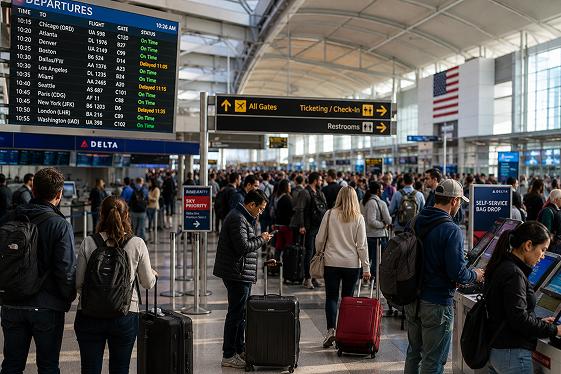
A long-haul ticket contains more than a fare. Government taxes, airport charges and airline fees can rival the underlying price, although they serve different purposes. Since April 2026, UK Air Passenger Duty alone has been £102 or £106 for long-haul economy passengers, depending on distance, and £244 or £253 in other cabins.
From Risk to Certainty
Human activity affects the climate. The harder questions concern the timing and scale of particular harms and the relative value of competing responses. Policy debate often compresses that uncertainty into a claim that reducing energy use is inherently justified, making any measure carrying a climate label easier to defend.
Aviation is visible, carbon-intensive and sometimes discretionary, so it is an obvious target. But the intuition that flying produces emissions and therefore should be discouraged does not tell policymakers which instrument will reduce those emissions most efficiently.
Aviation Taxes: Visibility Over Precision
Air Passenger Duty is substantial on long-haul and premium travel, yet the UK government describes it as a revenue measure and expects the 2026 rate change to have negligible environmental effect. The duty varies by passenger, cabin and distance band, not by aircraft efficiency, load factor, route, weather or fuel actually consumed. Two passengers can pay the same tax while generating materially different per-person emissions.
A carbon policy should reward verifiable reductions in emissions intensity. Fuel taxation remains constrained by international agreements and exemptions, while carbon pricing has limited geographic coverage. The result is a highly visible passenger charge only partly aligned with its supposed environmental objective.
A Global Mismatch
The global system is uneven. Europe layers passenger taxes and regional carbon pricing onto aviation while many growing markets prioritize connectivity and infrastructure. CORSIA, the main global market framework, is voluntary for states during its 2024–2026 first phase and covers only emissions above a baseline equal to 85 percent of 2019 levels, rather than pricing every tonne equally.
This produces visible taxation in some places, little comparable taxation elsewhere and an offset system of limited scope. Higher charges may suppress trips, but they may also reroute passengers through other hubs. Suppression, displacement and rerouting should not be counted as the same environmental result.
The Elasticity Problem
Travelers respond to price differently. Leisure passengers may change destinations or defer a trip, while family, business, cargo-linked and some long-haul journeys are less substitutable. Oil shocks and disrupted routes can also raise fares independently of climate policy, with taxes then layered on top.
Global traffic exceeded its 2019 level in 2024. That does not prove taxes have no effect, because the counterfactual is unknown. It does mean that avoided fuel and climate impact must be demonstrated rather than inferred from a higher ticket price. If much of the response is geographic redistribution, the environmental gain may be modest.
The Temptation to Govern at a Distance
The marginal cost is immediate for a self-paying traveler: a visit becomes dearer, a holiday shorter or a small-business trip harder to justify. Officials and executives whose necessary travel is reimbursed experience the same embedded duty differently. The insulation comes mainly from institutional budgets, not a universal personal tax exemption.
When decision-makers do not bear the full cost of a measure, incentives for restraint weaken. An attempt to price an externality can gradually become an attempt to shape behavior without a precise account of the emissions avoided.
The Politics of the Family Holiday
UK residents made an estimated 94.6 million visits abroad in 2024. Overseas travel is embedded in ordinary life, and a uniform increase does not affect every household equally. An affluent frequent flyer may absorb it; a working family may shorten or abandon the one trip it saved for all year.
Governments seeking durable climate policy must show that the charge reduces emissions, that less regressive options were considered and that those advocating restraint face comparable discipline. Dismissing distributional concern as ignorance invites a broader backlash against climate policy.
Offsets, Optics, and Unequal Restraint
Offsets can finance worthwhile projects, but integrity requires reductions or removals to be additional, uniquely counted, credibly measured and durable. Reviews have found those conditions difficult to establish consistently, including evidence of substantial over-crediting in some forest projects. Buying a credit is not, by itself, proof that a flight has been neutralized.
The credibility gap widens when institutions promote restraint while preserving reimbursed travel for themselves and answering its emissions with uncertain credits. High-level meetings may have legitimate purposes, but public acceptance depends on fairness as well as scientific evidence and economic efficiency.
When Science Becomes a Mandate
Aviation produced roughly 2 percent of global carbon dioxide emissions in 2022, with contrails and nitrogen oxides adding warming effects whose size is less certain. That supports serious policy. It does not make every passenger tax a precise emissions instrument.
A tax may raise revenue and reduce some demand. It should not be credited as exact climate policy when it neither prices a particular flight’s emissions nor rewards operational efficiency nor reports verified climate outcomes. Science identifies the risk; it does not dictate one preferred fiscal response.
A Question of Restraint
Good policy requires choosing an instrument suited to its stated objective. Aviation charges would be easier to defend if they tracked measured emissions, limited cross-border leakage, clearly separated revenue from behavior change and imposed comparable discipline on those designing and bearing them. The present system is highly visible, weakly targeted and unevenly felt.
The Real Cost of a Plane Ticket
A ticket records how policy is made: taxes, airport charges, carrier fees, emissions allowances and offset claims are collapsed into one political story although they work differently and should be evaluated separately. Conspicuous instruments can obscure whether a real operational or technological improvement occurred.
Bottom Line
Climate policy will be more durable when it prices the thing it means to change, rewards actual efficiency and applies its discipline to institutions as well as individuals. Until then, aviation taxation risks looking more like fiscal convenience than precise climate policy.