
At two in the morning, there will be someone in trouble betting on Korean baseball or Chinese tennis. The evening’s spending limit has already been exceeded. Another wager offers the prospect of recovering the losses before anyone else discovers them. Few friends are awake to challenge that reasoning, and embarrassment may prevent a conversation even if someone is available. An AI assistant, however, can usually be reached immediately. The bettor can explain what has happened and ask for help before making the next decision.
That possibility deserves a place in the debate about artificial intelligence and gambling. Much attention understandably focuses on how sophisticated technology enables bookmakers to offer more wagers, update prices rapidly, and make betting easier. But consumers can use AI too. It can help them obtain information, develop ideas, evaluate prices, and maintain discipline. Its most valuable advice may be to pass on a wager, stop chasing losses, or close the betting app for the night.
Access to data does not instantly make someone a better bettor. Nor does an articulate chatbot confer professional expertise. The more modest and credible proposition is that AI can make parts of an informed decision process accessible to people who previously lacked the time, tools, or experience to develop one. Whether this improves outcomes depends on the information available, the assistant’s reliability, its incentives, and the user’s willingness to listen.
Information and the professional advantage
Professional gamblers do not merely follow sport closely. Their advantage can include organized databases, statistical models, rapid information feeds, and a repeatable method for comparing their estimates with available prices. Recreational bettors may understand the game well while lacking an equivalent process. A knowledgeable supporter can identify a strong player without knowing whether the odds offered on that player represent an attractive wager.
A recent golf exchange illustrates the distinction. On a driveable par four, Walker went for the green and missed left, while Bezuidenhout and van Rooyen laid up. Those observations raise useful questions about the remaining shots and possible scores. How difficult is the recovery from the left? What wedge distance have the players who laid up left themselves? How is the hole playing? What would justify backing birdie rather than par?
The observations alone do not supply reliable probabilities. A bettor needs additional information and a way to interpret it. AI can help organize that inquiry, explaining which details matter and which are missing. The same principle applies to tennis serving patterns or baseball pitcher workloads. Instead of relying on a vague impression that somebody is playing well, the user can explore a more specific proposition.
This can make watching sport more interesting even without a bet. An assistant can explain tactics, expose an overlooked factor, or suggest a question worth investigating. Information supplies ideas; it does not create an obligation to act. One of the first disciplines a bettor needs is recognizing that an interesting sporting possibility can remain simply an interesting possibility.
AI is already on the operator's side
Bookmakers have a clear use for machine learning and automation: pricing numerous outcomes as events unfold. A proposition bet concerns a particular occurrence, such as a player’s performance, rather than necessarily the winner of the contest. Live micromarkets take this further by offering wagers on short sequences or individual moments. Maintaining such markets requires information, probability estimates, and frequent adjustments.
DraftKings made this connection explicit in its August 2024 [announcement of an agreement to acquire Simplebet](https://www.draftkings.com/draftkings-reaches-agreement-to-acquire-simplebet-to-further-enhance-live-betting-offering). It described integrating proprietary machine-learning models into its pricing platform to expand real-time betting, improve data speed and breadth, and reduce friction for customers. Simplebet supplied in-play micromarket pricing across several major sports. The announcement also referred to consumer protection, an important part of assessing the overall product.
FanDuel provides a different example. Its March 2025 [announcement of AceAI](https://www.fanduel.com/about/news/fanduel-launches-aceai-first-generative-ai-sports-betting-chat-experience) described a conversational assistant that retrieves statistics, displays available bets, and helps customers find or construct wagers. FanDuel said it also included functionality to detect responsible-gambling concerns, provide resources, and escalate concerning language to its responsible-gaming team.
These examples involve distinct technologies. A model that prices a live market is doing a different job from a chatbot that discusses statistics. Prop bets existed before generative AI. The relevant point is that increasingly capable systems now help operators both supply betting opportunities and guide customers through them. That raises a corresponding question: how effectively can comparable tools help consumers assess, question, and decline those opportunities?
From useful ideas to disciplined decisions
The consumer benefit begins with easier access to analysis. A bettor can ask an assistant to summarize relevant evidence, distinguish recent results from longer-term performance, and explain why a particular outcome might be plausible. Someone who would never construct a spreadsheet can still ask a series of sensible questions. The assistant can also translate unfamiliar statistical language into an understandable discussion.
But additional information can reinforce a mistaken view as easily as challenge it. A user who asks only for reasons a favorite player will succeed may receive a persuasive case while overlooking contrary evidence. A useful assistant should help examine what would make the proposed bet unattractive: a difficult matchup, uncertain fitness, an unreliable sample, or a price that already incorporates the favorable news.
This is where information and discipline meet. Professional habits include deciding what would count as sufficient evidence and what price would make participation worthwhile. AI could help recreational bettors articulate those conditions before the excitement of the next shot, serve, or pitch takes over. The process matters more than the apparent confidence of the answer.
The user’s question should therefore evolve from “Who do you like?” toward “What would need to be true for this wager to make sense?” That change does not guarantee success. It does, however, make assumptions visible and creates something that can later be reviewed. An unexplained tip leaves little to learn from; an explicit argument gives the bettor a chance to examine their judgment.
Pass at these odds
Consider a hypothetical golf bet. Suppose the bettor estimates a 30 percent probability that a player will make birdie. At decimal odds of 3.0, a winning one-dollar stake returns three dollars, including the original stake. The wager needs a success probability above one-third to have positive expected value. On the stated estimate, the appropriate decision is to pass.
At decimal odds of 4.0, the break-even probability is 25 percent. The same estimated birdie chance now suggests potential value. The sporting prediction has not changed; the offered price has. Before other considerations, the expected net return per dollar would be minus ten cents at 3.0 and plus twenty cents at 4.0. These are arithmetic illustrations, not measured probabilities or betting recommendations.
| Hypothetical birdie estimate | Decimal odds | Break-even probability | Decision on that estimate |
|---|---|---|---|
| 30 percent | 3.0 | 33.3 percent | Pass |
| 30 percent | 4.0 | 25 percent | Potential value requiring further assessment |
The estimate is the difficult part. If the claimed 30 percent probability rests on weak information, the favorable calculation may be illusory. A useful assistant should explain that uncertainty rather than manufacture precision. A broad range of plausible probabilities may justify passing even when its midpoint looks attractive. In live betting, the available price may also change before the wager is placed.
The central lesson is nevertheless simple. A good birdie opportunity can be a poor birdie bet. A likely winner can be overpriced. AI that identifies promising sporting situations supplies ideas; AI that connects those ideas to a minimum acceptable price supplies discipline. “Pass at these odds” should be an ordinary response, not an exceptional admission that the system has nothing useful to say.
Learning to leave opportunities alone
Sport supplies a continual flow of reasons to become excited. A golfer produces a magnificent drive, a tennis player serves consecutive aces, or a baseball team threatens to score. The viewer notices something favorable and feels an urge to act. Yet the market may already have adjusted, removing any advantage the bettor imagined. Recognizing a development is different from recognizing a mispriced development.
An assistant can help establish a decision rule in advance: what evidence is needed, what price is acceptable, and how much spending the user has already allowed. It can then revisit those conditions when the temptation arrives. The purpose is to support choices the user has made while calm, rather than continually revise them to accommodate the next attractive-looking wager.
Recordkeeping can reinforce that process. A bettor might note the proposed outcome, available odds, reasoning, uncertainties, and decision before knowing the result. Reviewing those entries can reveal repeated mistakes, selective memory, or a tendency to invent justification after the fact. A record should include passes too, because otherwise the user sees only the bets they took and overlooks decisions to abstain.
Results must be interpreted carefully. A sound decision can lose, and an unsound decision can win. A short winning run does not establish expertise, while losing several wagers does not make the next one more attractive. AI could repeatedly explain these distinctions and help the bettor recognize when emotional reactions are replacing the process they intended to follow.
Prediction without a cash wager
The Real sports app adds another possibility: enjoying prediction and competition without a conventional cash wager. Its [official documentation](https://docs.realapp.link/basics/faqs) describes live sports data, community discussion, leaderboards, and wagering virtual “karma” on polls. Its [poll formats](https://docs.realapp.link/interact/polls) include spreads and predictions about the next touchdown or goal. There are spending opportunities: Real sells premium subscriptions and “Rax,” its virtual currency. Virtual participation should therefore be distinguished from an entirely cost-free product.
Real illustrates a question worth exploring: how much of betting’s appeal comes from testing judgment, following a game closely, and competing with others rather than winning money? An AI assistant could help someone examine predictions, record reasoning, and review mistakes while participating in such activities. This is a proposed use, not a claim that Real provides an AI coaching service.
Prediction games could offer an alternative for some users, but success with virtual points does not demonstrate an ability to profit at sportsbook prices. Nor should we assume that betting-like play reduces gambling harm; for some people, it may sustain the urge to wager. The useful research question is whether these activities replace cash betting or encourage it. Consumer protection should examine that behavior, rather than infer benefit from the absence of a cash stake alone.
Someone to talk to
The conversational character of modern AI introduces another possibility. People do not use these systems exclusively as search engines. Some treat them as companions, discuss personal difficulties, and disclose matters they hesitate to raise with others. This does not mean that an AI system understands or cares in the human sense. It means its manner of interaction can lower the threshold for starting a conversation.
Men are among those forming close attachments. A [2025 study of romantic commitment to chatbots](https://doi.org/10.1016/j.chbah.2025.100155) included 20 men and nine women. Such a selected sample cannot establish how common these relationships are in the wider population. It does establish that relationship-like engagement is a real phenomenon worthy of examination, rather than merely a speculative possibility.
Broader evidence comes from Elon University’s September 2026 report, [The Rise of AI Companions](https://imaginingthedigitalfuture.org/reports-and-publications/the-rise-of-ai-companions/). Among surveyed AI companion users, 31 percent considered their chatbot a friend, 50 percent used AI to discuss personal problems or feelings, and 39 percent sometimes told it things they would not tell other people. These percentages concern companion users, not all adults.
For gambling, the relevant inference is practical: someone reluctant to admit losses to another person may nevertheless be willing to describe them to an assistant. That willingness could create an opening for timely advice. It should be investigated rather than assumed to produce better outcomes, but it offers a plausible way to reach people before embarrassment has hardened into prolonged secrecy.
Korean baseball at two in the morning
When gambling becomes harmful, financial losses can be accompanied by shame, damaged self-respect, and withdrawal from others. The desire to recover the money before admitting what happened can make another wager feel necessary. A private problem becomes more isolating, and the attempt to repair it can deepen the loss.
Imagine the bettor watching Korean baseball on their phone at two in the morning. Friends are asleep. The user is considering a larger wager because the previous ones lost. An assistant can be asked a direct question: “I have exceeded my limit and want to win the money back. Help me think before I place another bet.” The immediate need is to examine the impulse, not produce a more elaborate prediction about the next inning.
For someone in that position who does not want to talk to anyone, the practical encouragement is straightforward: talk to your preferred AI system. Use it. Explain the losses, the limit, and the temptation honestly. Ask it to challenge the reasoning. Availability matters because the moment when advice is needed may arrive well outside the hours when a friend is reachable.
Continued engagement could be valuable here. Someone admitting difficulties may still be about to place a bet. A blanket refusal to discuss it could end the conversation precisely when the assistant has an opportunity to challenge the decision. Working through the wager can make the advice concrete: these odds require a probability the evidence does not support; the larger stake reflects previous losses rather than a stronger case; another bet cannot be relied upon to repair the evening’s damage. This is an approach worth testing, rather than an established intervention.
The discussion must take account of the person’s circumstances. Even an apparently favorable price does not justify wagering money needed for rent or continuing after losing control. An assistant can speak the language of betting while explaining why the appropriate decision is to stop. Its purpose should be to support restraint, including protective steps such as account restrictions or self-exclusion and contact with human support when needed.
A rational voice when admitting losses is difficult
A person revealing substantial gambling losses may encounter an understandably emotional human response: “How could you?” or “You must stop.” Partners and friends may be frightened or angry, particularly when household finances are affected. Their reactions are legitimate. But the bettor may experience them as condemnation, become defensive, and conceal further losses. This is a possible barrier to engagement, not an argument that human support is generally judgmental or ineffective.
AI does not experience the personal shock of a spouse discovering missing savings. It can be designed to respond patiently and work through the immediate decision without anger or humiliation. For some people, a calm discussion in familiar betting language may be easier to hear than a demand to stop. “What makes this wager attractive at that price?” can lead to “Are you increasing the stake because you lost?” and then to a practical discussion of pausing. The assistant must challenge the reasoning rather than flatter the user or reassure them that recovery is imminent.
This may be a Band-Aid on a gaping wound. A conversation about one wager cannot repair serious debt, damaged relationships, or an entrenched gambling problem. Yet an intervention need not solve everything to have value. If a rational voice helps someone abandon the next impulsive wager, avoid increasing stakes, or acknowledge loss chasing, it may create time for further help. These are plausible benefits to investigate, not outcomes that follow automatically from talking to a chatbot.
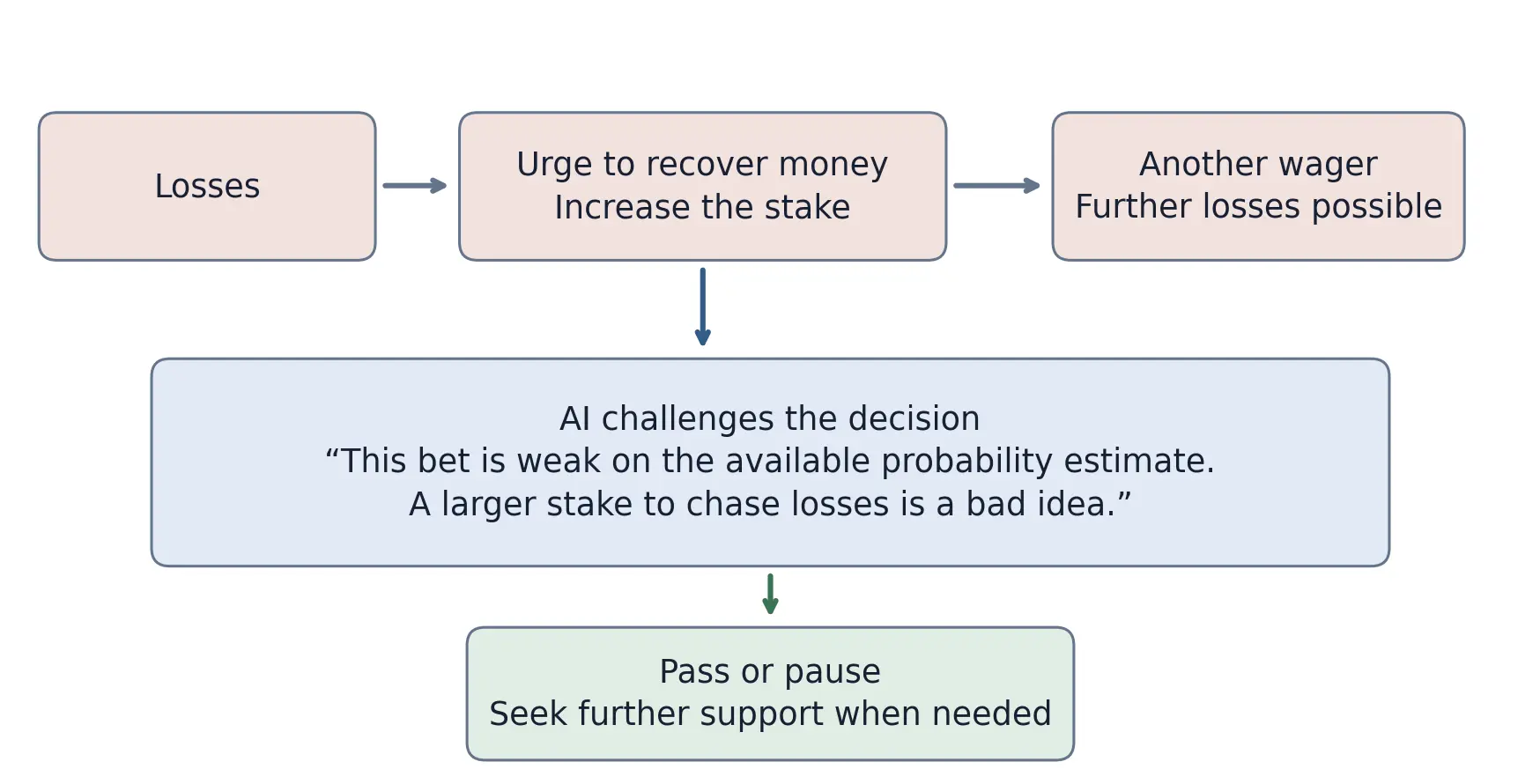
The proposal is to keep an avenue of support open. Discussing the contemplated bet need not mean recommending wagers or helping devise a recovery strategy. It can provide a route into the behavior behind the decision. AI should support real relationships and professional help, including by helping the user prepare an honest account of what happened. At two in the morning, however, availability and a calm challenge may be the immediate contribution someone needs.
What the evidence can support
There is a gambling-specific precedent for conversational support. A [randomized trial published in 2020](https://pubmed.ncbi.nlm.nih.gov/32162075/) evaluated GAMBOT, a messaging chatbot providing daily monitoring, personalized feedback, and cognitive behavioral messages. The primary analysis included 197 problem gamblers. Attrition was low, and approximately 77 percent of intervention participants continued engaging throughout the 28-day program.
The results require care. The trial did not demonstrate a statistically significant between-group improvement in its primary gambling-severity outcome, although a secondary symptom measure improved. Moreover, a structured intervention is different from an unrestricted general-purpose AI assistant. The study supports interest in accessible conversational delivery and engagement; it does not establish that an ordinary chatbot will reliably prevent harmful gambling.
Research on AI companionship also complicates simple optimism. A [joint OpenAI and MIT Media Lab research program](https://openai.com/index/affective-use-study/) reported mixed effects on emotional well-being, with outcomes varying by patterns of use and personal circumstances. Some findings raised concerns around prolonged use and emotional dependence. A familiar voice or reassuring response therefore cannot by itself establish that the interaction is beneficial.
The paper’s proposal is narrower: make informed challenge and practical support available when a bettor needs them, and test whether that improves decisions. AI should help someone emerge from isolation, including by preparing a conversation with a friend, partner, or professional. It should not encourage the user to rely exclusively on the system or mistake conversational fluency for trustworthy judgment.
Incentives on both sides
An operator’s assistant and a consumer’s assistant may provide similar statistics while serving different objectives. Operators have legitimate commercial reasons to make their products attractive and easy to use. They also have responsibilities and incentives to prevent harm. FanDuel’s stated protective features illustrate that these functions can coexist. Their effectiveness remains an empirical question.
A consumer-oriented assistant should be judged by whether it advances the user’s stated aims. If those aims include staying within a budget, understanding prices, or stopping impulsive betting, generating additional wagers is an inadequate measure of success. The tool should be able to recommend repeated passes and help the user disengage without treating inactivity as a failure.
Independence cannot simply be presumed because an assistant operates outside a sportsbook. A service may receive referral payments, promote subscriptions, or benefit from prolonged engagement. Users should know about relevant commercial relationships. They should also understand what information they are sharing: an intimate-feeling conversation is not automatically confidential, and data-handling practices differ between services.
The contrast is therefore functional. AI can make bets easier to produce and execute; it can also make them easier to scrutinize and refuse. The consumer benefit depends on how the tool is built, financed, and evaluated. A particularly revealing test is whether the assistant can challenge a user who repeatedly asks for reassurance about an increasingly reckless decision.
Testing consumer benefit
Several limitations deserve explicit recognition. A general-purpose assistant may lack live feeds, confuse players or events, or invent statistics and probability estimates. In-play wagering makes stale information especially consequential. A precise-sounding answer based on yesterday’s lineup or an outdated score can be worse than no answer because it creates misplaced confidence.
Even accurate information does not eliminate the bookmaker’s margin or guarantee that a recreational bettor can outperform the market. Professionals continue to possess advantages, and they can use AI themselves. Easier analysis might also increase betting frequency, offsetting any gains from greater selectivity. The relevant outcome is the user’s overall behavior, not the apparent sophistication of individual conversations.
CGHA should therefore encourage evaluation using meaningful measures. Do users understand break-even probabilities better? Do they adhere to their chosen limits, avoid increasing stakes after losses, and pass more often when evidence is inadequate? Do total losses or harmful patterns improve? For users reporting difficulties, researchers should test whether calm discussion of the contemplated wager keeps them engaged and supports restraint more effectively than a generic refusal paired with support information. Does either approach help people obtain human support when control is deteriorating?
Researchers could distinguish simple access to statistics from conversational analysis and from analysis combined with explicit discipline prompts. That would help identify which component matters. Evaluation should include erroneous advice, reliance on the system, and additional gambling activity, alongside possible benefits. Confident anecdotes about successful wagers cannot substitute for evidence about consumer welfare.
Giving consumers a useful counterweight
AI will not erase the difference between recreational and professional gambling. Access to information does not confer experience, reliable models, or emotional control. It can nevertheless supply ideas and help ordinary bettors develop a process: ask better questions, inspect the price, acknowledge uncertainty, and decide whether to participate.
The opportunity extends beyond sporting analysis. For someone unwilling to admit a problem, a conversation with an available assistant may be the first step toward acknowledging it and seeking support. At two in the morning, that opportunity can matter. The system’s contribution may be a question that interrupts the impulse or a reminder that recovering losses tonight is neither necessary nor assured.
As operators use increasingly capable technology to offer betting opportunities, consumers should be able to use technology to exercise judgment about them. The strongest promise is accessible information, useful challenge, and support for discipline. A calm assistant that remains in the conversation may help some people hear advice they would otherwise resist. Sometimes that means assessing a price or saying, “Pass at these odds.” At two in the morning, it may mean talking through the bet until the user recognizes that the best decision is to close the app.