Summary
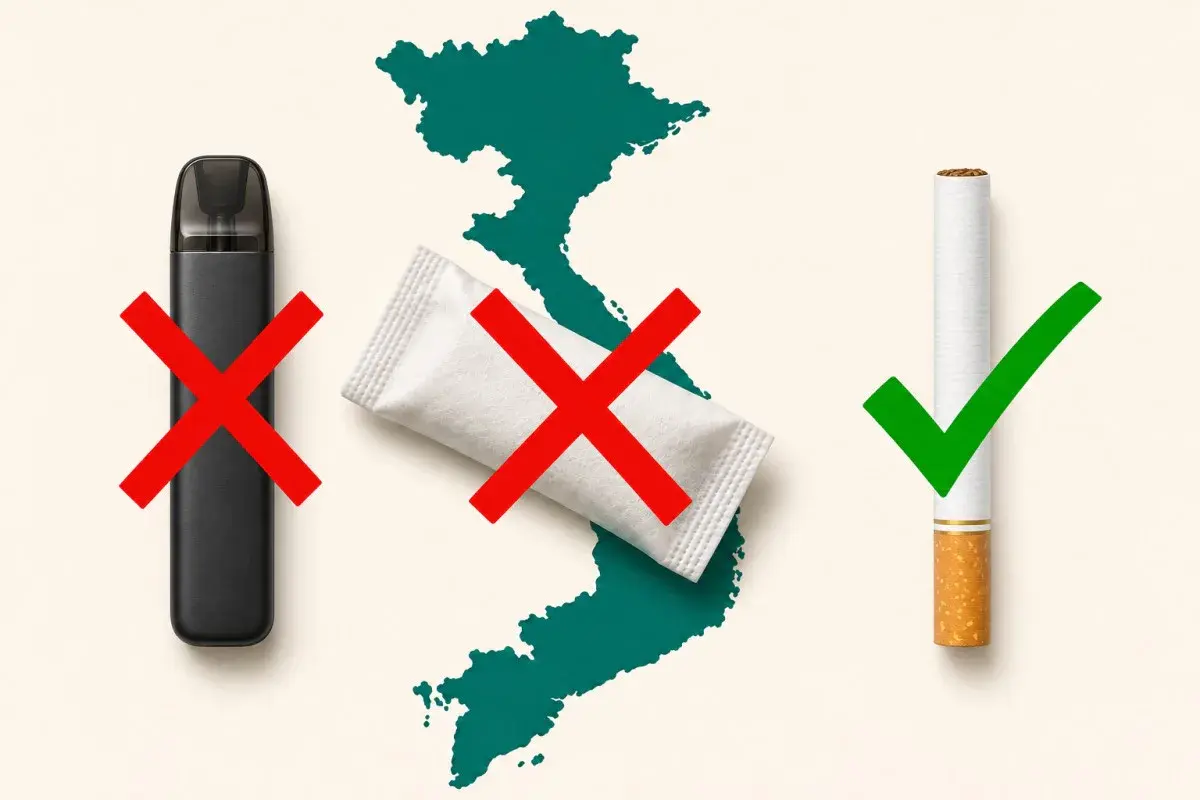
Vietnam has prohibited vapes and heated tobacco and has now enacted an explicit prohibition on nicotine pouches. Cigarettes remain legally available, subject to taxes and other controls. This paper compares the combined prohibitions with regulated adult access to all three alternatives, holding other tobacco policies constant. If regulated access produces additional sustained switching away from smoking by 5%, 10%, 20% or 50% of the smokers who would otherwise continue, a national burden model estimates approximately 23,900, 47,800, 95,600 or 238,900 fewer premature deaths over 2027–2046, respectively. These are conditional estimates of adult smoking mortality. The 50% case tests the scale of the effect at high substitution. Vietnam-specific uptake remains the principal empirical uncertainty.
From coffeehouses to nicotine prohibition
In The Politics of Acceptable Addiction, Roger Bate traces how authorities have treated stimulants as questions of public order and social legitimacy. In the 1630s, Ottoman Sultan Murad IV suppressed coffee, tobacco and alcohol. Istanbul’s coffeehouses were closed and smoking was prohibited. In England in 1675, Charles II tried to close coffeehouses, which had become places to exchange news and criticize the government. The two episodes show how easily a government can make a substance or its setting the target of a policy driven by a broader concern (Bate, 2026, chs. 3 and 5). Ottoman coffee and tobacco prohibitions · British Museum on coffeehouse culture
Vietnam’s decision is one of the more illogical examples in that history. The government has left the established, deadly product on the legal market while prohibiting three products that can take its place. Earlier rulers tried to suppress smoking itself. Vietnam is suppressing routes out of smoking while keeping cigarettes available. That is a particularly hard position to defend as public health policy when the country records roughly 85,000 deaths attributable to smoking in a single year.
The National Assembly adopted its vape and heated-tobacco ban in November 2024. The amendment passed on November 21, 2026 explicitly prohibits the sale and use of nicotine pouches and generally takes effect July 1, 2027. WHO Vietnam welcomed the earlier restrictions and publicly urged legislators in May 2026 to extend the comprehensive ban to nicotine pouches. This is a concrete example of the reach of international tobacco-control advocacy. WHO’s public argument emphasizes protecting young people from addiction. The case for prohibition also needs to reckon with how many adults would keep smoking when legal alternatives disappear. WHO’s public endorsement establishes its policy position. Attribution of the legislative outcome would require additional evidence. Vietnam’s amended tobacco law · Implementation timetable · WHO’s endorsement of the earlier bans · WHO’s call to include pouches
Methods
We compare the combined restrictions with a regulated market for vapes, nicotine pouches and heated tobacco for adults. Each scenario holds cigarette taxes, smoke-free rules and conventional cessation policy constant across the two regimes. Switching means a complete and sustained move away from smoked tobacco attributable to regulated access. The switching fraction is the difference between the two regimes after allowing conceptually for cessation and informal substitution that would happen under the bans. Each exclusive switch is counted once. Dual users contribute only after fully stopping smoking.
The annual benchmark is 84,586 deaths attributable to smoking in Vietnam in 2023, from the Global Burden of Disease study as published by Our World in Data. This series excludes secondhand-smoke deaths. The central calculation holds the benchmark flat and a sensitivity case lets the underlying death burden decline by 2% annually in both regimes. That alternative is illustrative. WHO has separately modeled declines in smoking from Vietnam’s tax reforms. Global Burden of Disease mortality data · WHO’s analysis of Vietnam’s tax reforms
| Input | Central assumption |
|---|---|
| Horizon | 20 calendar years, 2027–2046 |
| Net additional sustained switching | 5%, 10%, 20% or 50%, reached over ten years in equal annual increments |
| Mix among switchers | 50% vapes, 20% pouches, 30% heated tobacco |
| Residual excess mortality relative to continued smoking | 5% for vapes, 2% for pouches, 15% for heated tobacco |
| Weighted residual excess mortality | 7.4% |
| Time for half the eventual mortality reduction to accrue | Ten years from switching |
Product shares and mortality parameters are scenarios. The vape and pouch values follow the assumptions in Bate’s earlier comparative-risk analysis. The heated-tobacco value is an illustrative assumption. FDA has authorized reduced-exposure claims for specific IQOS products following complete switching. Those claims concern exposure to harmful chemicals and do not quantify mortality. FDA also recognized lower risks for specified outcomes for certain ZYN products. Cochrane finds that nicotine e-cigarettes improve cessation compared with nicotine replacement therapy. Direct evidence on pouches as a cessation tool remains limited. The gradual benefit is motivated by research showing that smoking-cessation benefits accrue over time and differ by disease. The ten-year half-time is a modeling choice. Comparative-risk model · Smoking cessation and mortality · Cochrane pouch review · Cochrane vaping review · FDA heated-tobacco findings · FDA pouch findings
For year t, the counterfactual smoking burden is D(t) = 84,586 × (1 − g)^(t − 1), where g is the assumed annual decline. Cohort j switches at midyear and represents s/10 of the benchmark risk pool, where s is the additional switching share. Using time since switching at year-end to approximate annual benefit, each switching cohort contributes D(t) × (s/10) × (1 − r) × [1 − 2^−((t − j + 0.5)/h)] to deaths averted in year t, where r is residual risk and h is the half-time. We sum over the switching cohorts present each year and then over 20 years. The constant-burden model assumes switchers carry the same average smoking-attributable risk as the pool they come from.
Results
| Additional sustained switching | Deaths averted by year 10 | Deaths averted by year 20 | 20-year total with 2% annual baseline decline* | 20-year sensitivity span |
|---|---|---|---|---|
| 5% | 4,400 | 23,900 | 18,200 | 10,900–38,100 |
| 10% | 8,800 | 47,800 | 36,500 | 21,900–76,300 |
| 20% | 17,600 | 95,600 | 73,000 | 43,700–152,500 |
| 50% | 44,000 | 238,900 | 182,400 | 109,300–381,400 |
The baseline-decline column reports cumulative deaths averted through year 20. The lower sensitivity case combines 25% residual risk, a 15-year half-time and a 2% annual baseline decline. The upper case uses 2% residual risk, a five-year half-time and a flat baseline. These are deliberately contrasting parameter sets. The span is neither a confidence interval nor a bound on the real-world policy effect. Estimates are rounded to the nearest 100.
At 10% substitution, keeping the same rollout and lag but allocating all switching to vapes gives about 49,000 deaths averted, all to pouches about 50,600 and all to heated tobacco about 43,900. These equal-uptake comparisons isolate the assumed risks. Each product could reach different smokers, and the evidence for cessation and long-term harm varies across products.
Interpretation
The model is an aggregate estimate of adult mortality foregone. It uses a historical death burden reflecting many years of accumulated exposure. It cannot trace individual smokers or account explicitly for Vietnam’s age structure, competing causes of death, changes in smoking intensity, differences in the profiles of switchers, or substitution between cigarettes and other smoked products. The linear 50% case especially depends on the assumption that late adopters carry a similar average risk to early adopters. Relapse and informal access affect the net switching input. The central cases count only durable switching.
A full evaluation would also estimate youth uptake, transitions from nicotine products to smoking or away from it, health effects among people who otherwise would have used no nicotine, and changes in secondhand smoke. As a simple break-even illustration, under the 5% central case the additional deaths caused by regulated access through omitted pathways would have to total roughly 24,000 over the same 20 years to erase the modeled adult benefit. That calculation gives a scale for the question. It supplies no estimate of youth harm.
The policy criticism is about proportionality. Age restrictions and product standards address risks to young people and product quality while preserving an option for adults who would otherwise smoke. A categorical ban takes that option off the legal market. Its defenders should compare those two policies and put numbers on both sides of the ledger.
Model code
def annual_deaths_averted(switching, residual_risk=0.074, half_time=10,
                          decline=0, rollout=10, years=20, burden=84_586):
    annual = []
    for year in range(1, years + 1):
        baseline = burden * (1 - decline) ** (year - 1)
        accumulated_benefit = sum(
            1 - 2 ** (-(year - cohort + 0.5) / half_time)
            for cohort in range(1, min(year, rollout) + 1)
        )
        annual.append(
            baseline * (switching / rollout) * (1 - residual_risk)
            * accumulated_benefit
        )
    return annual
for switching in (0.05, 0.10, 0.20, 0.50): central = annual_deaths_averted(switching) declining = annual_deaths_averted(switching, decline=0.02) lower = annual_deaths_averted(switching, 0.25, 15, 0.02) upper = annual_deaths_averted(switching, 0.02, 5) totals = [sum(central[:10]), sum(central), sum(declining), sum(lower), sum(upper)] print(f"{switching:.0%}", *(f"{round(total, -2):,.0f}" for total in totals)) ```